June 4, 2026
The energy storage landscape stands at a critical juncture where technological innovation intersects with geopolitical strategy. Multiple pathways emerge for transforming how nations store and deploy electrical power, each carrying distinct implications for supply chain independence, manufacturing sovereignty, and economic security. Understanding these interconnected scenarios requires examining not just the technical specifications of emerging solid-state batteries, but the broader strategic implications of energy storage transformation.
Understanding Solid-State Technology and Its Role in Energy Security
Next-Generation Battery Architecture Fundamentals
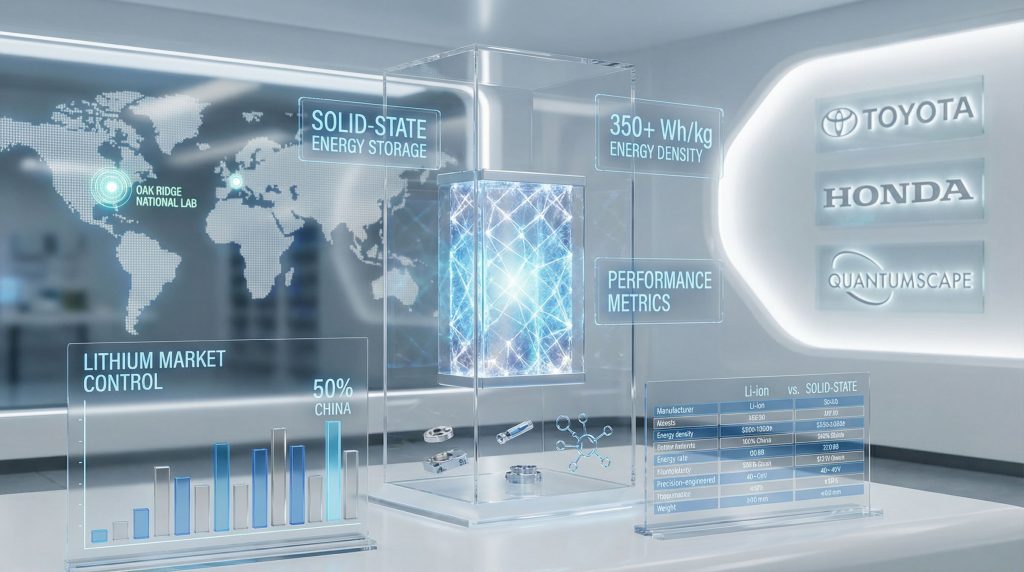
Solid-state batteries represent a fundamental departure from conventional lithium-ion designs through their use of solid electrolyte materials rather than liquid solutions. This architectural shift enables energy densities exceeding 350 Wh/kg, compared to current lithium-ion systems that typically achieve less than 300 Wh/kg. The elimination of liquid electrolytes removes the need for separator components, reducing overall battery weight and volume while enhancing safety profiles.
The global lithium-ion battery market reached $150 billion in 2025, representing a 20% year-over-year increase that underscores the massive scale of potential disruption. Current lithium-ion technology powers approximately 70% of all rechargeable devices globally, creating an enormous addressable market for superior alternatives.
Solid electrolyte systems create safer operational environments by eliminating flammable liquid components that pose fire hazards. Recent incidents, including a battery facility fire in Perth, Australia that triggered widespread HAZMAT warnings in April 2026, demonstrate the ongoing safety vulnerabilities of liquid electrolyte designs.
Strategic Implications Beyond Technical Performance
China's control of approximately 50% of the global lithium market creates strategic vulnerabilities for Western economies dependent on energy storage technology. This market concentration extends beyond raw materials into battery cell manufacturing, where Chinese companies have established what industry analysts describe as protective barriers against international competition.
The environmental costs of lithium extraction compound supply chain risks. Lithium mining requires intensive water consumption and poses ecological threats to extraction communities, particularly in South America's Atacama Desert region. Additionally, current lithium-ion batteries can store energy for maximum durations of approximately four hours, creating mismatches with grid-scale renewable integration requirements that demand 8-12 hour storage capabilities.
Furthermore, solid-state technology offers pathways toward supply chain diversification by enabling domestic manufacturing capabilities in the United States, Japan, and European markets. Alternative battery chemistries reduce dependence on Chinese-controlled lithium processing while potentially utilising domestically sourced materials.
When big ASX news breaks, our subscribers know first
Supply Chain Transformation Through Advanced Battery Chemistry
Current Market Concentration Vulnerabilities
China's decade-long strategic approach to battery market dominance has created what industry experts characterise as a protective barrier around production capabilities. This consolidation encompasses multiple critical points: raw lithium extraction and processing, battery cell manufacturing, electric vehicle component integration, and technology standards development.
The strategic orchestration of market capture demonstrates coordinated industrial policy rather than organic market evolution. Chinese manufacturers maintain cost advantages through vertical integration from raw materials to finished products, creating barriers to entry for Western competitors attempting to establish alternative supply chains.
However, market structure analysis reveals concentration risks extending beyond percentage market share. Single facility disruptions can trigger regional HAZMAT emergencies, indicating system fragility despite apparent market strength. The Perth battery facility incident exemplifies how concentrated manufacturing creates cascading vulnerability across supply networks.
Diversification Pathways Through Innovation
Oak Ridge National Laboratory's development of advanced polymer electrolytes addresses one of solid-state technology's primary technical barriers: restricted ion transport within solid materials. This innovation targets applications across electric vehicle batteries, fuel cells, and grid-scale energy storage systems, suggesting broad deployment potential across multiple market segments.
Nuclear battery technology represents an alternative diversification pathway entirely separate from lithium-dependent supply chains. NRD LLC's betavoltaic design using Nickel-63 offers continuous power generation for over a century without maintenance requirements, targeting applications where battery replacement proves impractical such as aerospace systems, remote monitoring equipment, and medical devices.
In addition, these diversification strategies reduce geopolitical concentration risks while enabling domestic sourcing potential, particularly for nuclear technologies where the United States maintains advanced research capabilities. The recent Chinese battery recycling breakthrough demonstrates how innovation continues reshaping the global battery metals landscape.
Technical Breakthroughs Accelerating Commercial Viability
Oak Ridge National Laboratory Polymer Innovation
The Department of Energy's Oak Ridge National Laboratory has engineered a polymer electrolyte specifically designed to overcome the restricted, sluggish transport of ions within solid electrolyte materials that has historically limited solid-state battery performance. This breakthrough addresses what researchers identify as one of the most significant technical hurdles preventing commercial deployment.
The polymer approach enables enhanced ion conductivity, directly facilitating faster charge and discharge cycles essential for electric vehicle applications. Unlike previous solid-state designs that suffered from poor ion mobility at room temperature, ORNL's innovation maintains performance across temperature ranges required for transportation and grid storage applications.
Multi-application design flexibility allows the same polymer electrolyte technology to function across three distinct market segments: transportation (electric vehicle batteries), specialised mobility (fuel cell systems), and grid infrastructure (utility-scale storage). This versatility accelerates potential market penetration by addressing multiple use cases simultaneously.
Nuclear Battery Technologies and Alternative Chemistries
Betavoltaic nuclear batteries utilising Nickel-63 isotope decay generate electrical power through radioactive processes rather than chemical reactions. This fundamental difference eliminates charging requirements while providing consistent power output for extended periods without degradation.
The sealed, solid-state architecture of nuclear batteries makes them suitable for applications where traditional battery replacement proves impossible or impractical. Aerospace systems, underwater monitoring equipment, satellite communications, and implantable medical devices represent primary target markets where century-long operational capacity provides significant advantages over conventional alternatives.
Nuclear battery technology sidesteps lithium supply chain dependencies entirely, utilising domestically available radioactive materials and established nuclear engineering capabilities. This independence from critical mineral supply chains controlled by geopolitical rivals offers strategic advantages for national security applications.
Comparative Technology Performance Analysis
| Technology Type | Energy Density | Safety Rating | Charging Speed | Commercial Timeline | Supply Chain Risk |
|---|---|---|---|---|---|
| Lithium-Ion | <300 Wh/kg | Moderate (fire risk) | Standard | Current | High (China-dependent) |
| Solid-State | 350+ Wh/kg | High (non-flammable) | Fast | 2027-2030 | Medium (diversifiable) |
| Nuclear Battery | Variable | Very High | N/A (continuous) | Specialised use | Low (domestic) |
Current lithium-ion technology demonstrates energy storage limitations of approximately four hours maximum duration, while renewable grid integration requires 8-12 hour storage capabilities for effective peak demand management and load balancing. Consequently, solid-state alternatives potentially extend storage duration while nuclear batteries provide continuous baseline power independent of charging infrastructure.
Corporate and National Development Leadership
Industrial Development Landscape
Major automotive manufacturers including Toyota and Honda target pre-2030 integration of solid-state battery technology into electric vehicle production lines. These timelines reflect accelerated development programs driven by competitive pressure and supply chain security concerns rather than purely technical considerations.
QuantumScape's QSE-5 prototype validation represents progress toward commercial-scale solid-state manufacturing, with performance metrics approaching target specifications for automotive applications. Western development strategies emphasise technological differentiation rather than cost competition, focusing on performance advantages that justify premium pricing during market introduction phases.
Investment flows increasingly redirect toward Western battery innovation hubs as governments prioritise supply chain independence over short-term cost optimisation. This shift reflects strategic recognition that battery technology constitutes critical infrastructure requiring domestic production capabilities.
National Innovation Strategies
United States Department of Energy research funding prioritises solid-state battery development through institutions like Oak Ridge National Laboratory, reflecting policy alignment between national security objectives and technological innovation. These investments target fundamental research barriers rather than incremental improvements to existing technologies.
European Union battery sovereignty initiatives emphasise reducing dependence on Asian supply chains through coordinated industrial policy and research funding. Japan's solid-state technology export potential leverages advanced materials science capabilities and automotive industry integration to capture global market opportunities.
Policy frameworks increasingly treat battery technology as strategic infrastructure comparable to semiconductor manufacturing, telecommunications networks, and energy production facilities. This classification justifies government intervention in research funding, manufacturing incentives, and trade protection measures.
Commercial Deployment Barriers and Solutions
Manufacturing Scale-Up Challenges
Laboratory-to-production transition difficulties represent the primary obstacle preventing solid-state battery commercialisation. Current manufacturing processes developed for liquid electrolyte systems require substantial modification for solid-state architectures, demanding new equipment, quality control procedures, and workforce training.
Cost competitiveness with established lithium-ion infrastructure presents immediate market penetration challenges. Existing battery manufacturing facilities represent billions in sunk capital costs, creating resistance to technology transitions that require facility replacement rather than upgrade pathways.
Quality control and yield optimisation requirements for solid-state manufacturing exceed current industry capabilities. Interface management between solid electrolyte layers and electrode materials demands precision manufacturing tolerances that increase production complexity and reduce initial yield rates.
Technical Performance Barriers
Room-temperature ionic conductivity limitations continue constraining solid-state battery performance despite recent advances. While polymer electrolyte innovations address ion transport restrictions, achieving conductivity levels matching liquid electrolyte systems requires further materials science breakthroughs.
Dendrite formation during charging cycles can compromise solid-state battery performance and longevity. These metallic growths that penetrate solid electrolyte materials create short circuits and capacity degradation over repeated charge-discharge cycles.
Heat management during high-speed charging operations presents engineering challenges for automotive applications. Solid-state batteries generate thermal loads that require cooling systems adding weight and complexity to vehicle designs, potentially offsetting energy density advantages.
Industrial Transformation Scenarios
Electric Vehicle Market Disruption Potential
Range anxiety elimination through higher energy density represents solid-state technology's primary value proposition for electric vehicle adoption. 350+ Wh/kg energy density enables vehicle ranges exceeding 500 miles per charge, addressing consumer concerns about charging infrastructure limitations.
Charging infrastructure adaptation strategies must account for faster charging capabilities enabled by solid-state technology. Current charging networks designed for lithium-ion charging speeds may require upgrades to support rapid charging protocols, creating coordination challenges between battery manufacturers and infrastructure providers.
Original equipment manufacturer adoption timelines reflect competitive positioning considerations as much as technical readiness. Early adopters gain marketing advantages and customer loyalty, while late entrants risk market share loss during technology transition periods.
Grid-Scale Energy Storage Applications
Renewable energy integration enhancement through improved energy storage duration addresses one of solar and wind power's fundamental limitations: intermittency management. Solid-state batteries potentially extend storage windows beyond the four-hour maximum of current lithium-ion systems.
Peak demand management and load balancing capabilities enable utility companies to optimise electricity distribution efficiency while reducing infrastructure investment requirements. Grid-scale solid-state deployment could defer expensive transmission line construction by providing distributed storage capacity.
Utility-scale deployment economics depend on achieving cost parity with alternative storage technologies including pumped hydro, compressed air, and emerging alternatives like gravity-based systems. Direct lithium extraction advances could support production of materials needed for these applications.
Specialised Applications and Market Niches
Smartphone and laptop battery life extensions through solid-state technology could drive consumer electronics adoption ahead of automotive applications. Higher energy density enables device miniaturisation or extended operating times, creating immediate market value for early deployment.
Medical device applications benefit from solid-state safety profiles and extended operational duration. Implantable devices, patient monitoring systems, and surgical equipment represent high-value markets where battery reliability justifies premium pricing.
Aerospace and defence applications prioritise safety and performance over cost considerations, creating ideal early adoption markets for solid-state technology. Satellite systems, unmanned aerial vehicles, and military equipment demand battery solutions that exceed civilian application requirements.
The next major ASX story will hit our subscribers first
Investment Landscape and Strategic Considerations
Market Timing and Competitive Positioning
Early-stage technology investment considerations must balance potential returns against development risks and timeline uncertainties. Solid-state battery companies require substantial capital for research, manufacturing infrastructure, and market development before generating revenue.
Patent landscape analysis reveals concentrated intellectual property ownership among established technology companies and research institutions. New market entrants face licensing costs and potential patent disputes that affect competitive positioning and profit margins.
Partnership strategies between research institutions and industry enable shared development costs while accelerating commercialisation timelines. Collaborative arrangements distribute technical and financial risks while providing access to specialised expertise and manufacturing capabilities.
Supply Chain Reconfiguration Benefits
Raw material sourcing diversification reduces geopolitical concentration risks while potentially lowering input costs through competitive supplier markets. Solid-state technologies utilising alternative materials create opportunities for domestic or allied nation sourcing strategies.
Manufacturing location strategic importance reflects both cost considerations and security requirements. Domestic battery production capabilities enhance supply chain resilience while creating employment opportunities in advanced manufacturing sectors.
Workforce development requirements include specialised technical training for solid-state manufacturing processes, materials handling, and quality control procedures. Educational institutions must adapt curricula to support emerging battery technology employment demands.
Geopolitical Implications and Market Disruption Scenarios
Western Technology Leadership Pathway Analysis
Successful market disruption of Chinese battery dominance requires achieving cost-competitive production while maintaining performance advantages. Western manufacturers must overcome scale disadvantages through automation, process innovation, and strategic material sourcing arrangements.
Timeline projections for achieving manufacturing competitiveness suggest 2027-2030 as critical periods for solid-state market penetration. Early commercial deployment success determines whether Western companies establish market positions before Chinese competitors develop competing technologies.
Policy support mechanisms including research funding, manufacturing incentives, and trade protection measures influence competitive dynamics. Government intervention through procurement preferences, tariffs, and export controls affects market access and profitability for different technology suppliers.
Chinese Strategic Response Considerations
Accelerated solid-state development programs within Chinese companies and research institutions suggest recognition of competitive threats from Western innovation. Chinese investment in alternative battery chemistries parallels Western development efforts, creating multiple technology competition pathways.
Market flooding tactics utilising current lithium-ion cost advantages could delay solid-state adoption by maintaining price pressure on premium battery technologies. Strategic pricing below production costs aims to prevent market share loss during technology transition periods.
Strategic material access control through export restrictions or preferential pricing for domestic customers represents potential Chinese response strategies. Critical mineral supply chain leverage affects Western battery technology competitiveness regardless of technical performance advantages.
Long-term Energy Security Framework
Energy security enhancement for Western economies through battery technology independence parallels semiconductor manufacturing sovereignty initiatives. Strategic industries requiring domestic production capabilities expand beyond traditional defence applications to include civilian infrastructure.
Technology transfer restrictions and export controls increasingly apply to battery technology, manufacturing equipment, and critical materials. These measures aim to prevent technology leakage while maintaining competitive advantages in strategic sectors.
International cooperation frameworks for battery innovation enable allied nations to share development costs and manufacturing capacity while excluding strategic competitors. The development of a battery-grade lithium refinery highlights how critical minerals & energy security concerns drive international collaboration.
Future Technology Trajectories and Market Transformation
2030 Market Evolution Projections
Solid-state battery market share estimates suggest 15-25% penetration in premium applications by 2030, with broader adoption dependent on achieving cost parity with lithium-ion alternatives. Market segmentation occurs based on performance requirements and price sensitivity across different applications.
Lithium-ion technology obsolescence timeline varies by market segment, with consumer electronics potentially transitioning earlier than grid storage applications. Automotive adoption depends on achieving manufacturing scale sufficient to support vehicle production volumes.
Hybrid deployment strategies during transition periods utilise solid-state batteries for premium applications while maintaining lithium-ion systems for cost-sensitive markets. This approach enables manufacturing scale-up while serving different customer requirements simultaneously.
Beyond Current Technology Horizons
Quantum battery research developments explore energy storage mechanisms based on quantum mechanical principles rather than chemical reactions. These theoretical approaches could eventually surpass both conventional and solid-state battery performance limitations.
Biological and organic battery alternatives utilise naturally occurring materials and processes for energy storage applications. Sustainable and biodegradable battery systems address environmental concerns while potentially reducing critical mineral dependencies.
Fusion-powered energy concepts integrate advanced nuclear technology with energy storage systems for applications requiring enormous power density and duration. These theoretical systems target aerospace, industrial, and infrastructure applications beyond current battery capabilities.
Strategic Navigation Framework
Stakeholder-Specific Recommendations
Investment Strategy Considerations:
- Portfolio diversification across multiple battery technology pathways reduces concentration risk while capturing upside potential from successful innovations
- Early-stage venture capital investments target breakthrough technologies with disruptive potential rather than incremental improvements
- Infrastructure investments in manufacturing capabilities and supply chain development create long-term competitive advantages
Government Policy Priorities:
- Research funding allocation balances fundamental science with applied engineering to accelerate commercialisation timelines
- Supply chain security initiatives prioritise critical material access and domestic manufacturing capabilities
- International cooperation agreements enable shared development costs while excluding strategic competitors
Corporate Adoption Strategies:
- Technology evaluation frameworks assess performance requirements against cost considerations and supply chain reliability
- Partnership arrangements with battery technology developers provide access to innovation while sharing development risks
- Manufacturing transition planning accounts for facility conversion costs and workforce retraining requirements
Critical Success Factors for Market Transformation
Manufacturing cost reduction achievements must reach competitive parity with established lithium-ion production while maintaining performance advantages. Automation, process optimisation, and scale economics determine commercial viability timelines for solid-state technologies.
Safety certification and regulatory approval processes require demonstrating performance under diverse operating conditions and failure modes. Regulatory frameworks must evolve to accommodate new battery technologies while maintaining safety standards appropriate for different applications.
Consumer acceptance and market education efforts address performance expectations and charging behaviour changes required for solid-state adoption. For instance, understanding how solid-state batteries work helps consumers appreciate their advantages over traditional solid-state battery designs.
Disclaimer: This analysis involves forecasts and assumptions about emerging technologies that may not materialise as projected. Battery technology development timelines, market adoption rates, and geopolitical factors contain inherent uncertainties that could significantly affect actual outcomes. Investment decisions should consider multiple scenarios and consult additional sources before making commitments.
Ready to capitalise on the next battery metals breakthrough?
Discovery Alert's proprietary Discovery IQ model delivers real-time alerts on significant battery metals discoveries, instantly empowering subscribers to identify actionable opportunities ahead of the broader market. Understand why major mineral discoveries can lead to substantial returns by exploring Discovery Alert's dedicated discoveries page, showcasing historic examples of exceptional outcomes, and begin your 14-day free trial today to position yourself ahead of the market.