June 22, 2026
Why Europe's Clean Energy Gap Is Harder to Fill Than It Looks
The mathematics of European decarbonisation have always contained an uncomfortable reality. Domestic renewable capacity, while growing at record speed, cannot fully substitute for the concentrated, high-temperature industrial energy that fossil fuels have historically delivered. Steelmaking, cement production, chemical synthesis, and long-haul freight all require energy forms that intermittent wind and solar cannot directly provide at scale. Green hydrogen has emerged as the most credible answer to this structural problem, and Sonatrach green hydrogen exports from North Africa, with its proximity to European markets and exceptional solar irradiance, have become one of the most watched potential supply strategies in the world.
Algeria sits at the centre of this conversation. As Europe's third-largest natural gas supplier after Russia and Norway, the country has spent decades building pipeline infrastructure, bilateral energy relationships, and operational supply trust with European counterparties. Now, through its state-owned energy company Sonatrach, Algeria is pursuing a methodical strategy to convert that legacy position into a green hydrogen export franchise. The partnership framework being assembled is sophisticated. The commercial economics, however, remain deeply challenging.
When big ASX news breaks, our subscribers know first
Sonatrach's European Hydrogen Strategy: Building the Architecture
A Multi-Partner Approach Taking Shape Across the Continent
Sonatrach's approach to European green hydrogen market entry has not followed a single bilateral pathway. Instead, the company has pursued simultaneous relationships across multiple European markets, creating a hub-and-spoke partnership structure that preserves strategic flexibility while building institutional familiarity with European counterparties.
The most recent addition to this framework arrived on June 17, 2026, when Sonatrach formalised a memorandum of understanding with German gas distribution company VNG AG at its Algiers headquarters. The agreement focuses on exploring cooperation in green hydrogen production and methane emissions reduction. Critically, it extends a relationship that dates to December 2022, when both companies signed an initial cooperation agreement with similar objectives. Nearly four years of dialogue have produced a deepening of intent, though no specific project announcement or investment commitment has accompanied either agreement.
This pattern is consistent across Sonatrach's broader partnership portfolio:
- An October 2024 multi-party agreement signed during an industrial exhibition in Oran sought to evaluate the feasibility of producing green hydrogen in Algeria for export to Germany, Italy, and Austria through a shared energy corridor
- A separate bilateral agreement with Spain's CEPSA targets a green hydrogen production project in Algeria incorporating electrolysis infrastructure, renewable power supply, and potential derivative production including green ammonia and green methanol
- A September 2025 strategic review confirmed that Sonatrach was simultaneously cultivating hydrogen partnerships with Gulf Cooperation Council states, creating an alternative export pathway independent of European demand timelines
The accumulation of MoUs without final investment decision progression is not necessarily a sign of weakness. It mirrors precisely the early market positioning tactics used by LNG exporters in the 1990s, who established extensive bilateral relationship networks before committing capital to specific infrastructure, allowing them to select the most commercially viable pathways once demand signals crystallised.
The SoutH2 Corridor: Mapping the Proposed Infrastructure Backbone
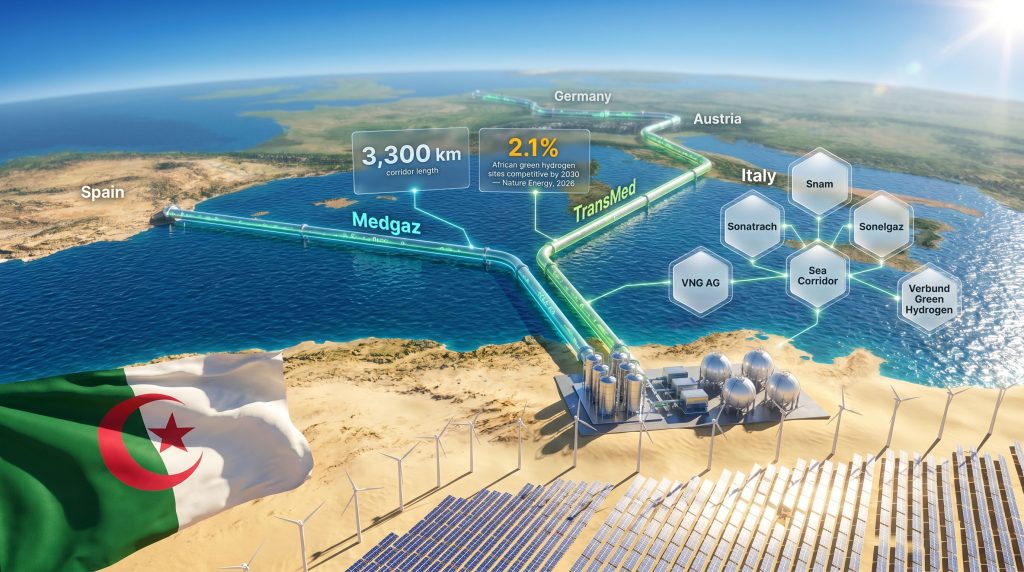
The physical delivery mechanism underpinning much of this partnership activity is the SoutH2 Corridor, a proposed pipeline network spanning approximately 3,300 kilometres designed to transport hydrogen from North African production facilities to Central European industrial markets. The corridor's primary destination markets are Italy, Austria, and Germany.
The European Commission has formally designated SoutH2 Corridor-related projects as Projects of Common Interest (PCI), a classification that unlocks streamlined permitting processes across EU member states and signals European institutional endorsement. Furthermore, this designation can improve project bankability by reducing regulatory risk premiums for potential financiers.
The consortium of entities engaged in the corridor framework reflects the multi-stakeholder complexity of transnational hydrogen infrastructure:
| Partner Entity | Country | Role in Corridor |
|---|---|---|
| Sonatrach | Algeria | Upstream hydrogen production |
| Sonelgaz | Algeria | Renewable electricity generation |
| Snam | Italy | Pipeline infrastructure and transit |
| VNG AG | Germany | Gas distribution and offtake |
| Sea Corridor | Italy | Corridor coordination and logistics |
| Verbund Green Hydrogen | Austria | Green hydrogen integration |
It is important to note that PCI status does not guarantee funding, remove commercial viability requirements, or constitute project-specific government support. Each entity in the consortium must independently satisfy its own investment criteria before any final investment decision can be reached.
The Economics of Sonatrach Green Hydrogen: What the Numbers Actually Show
The 2.1% Competitiveness Finding and What It Means for Algeria
The most significant data point to emerge from recent research on African green hydrogen economics comes from a peer-reviewed study published in Nature Energy in June 2026. Researchers from the Technical University of Munich, the University of Oxford, and ETH Zurich conducted the most comprehensive geographic and economic assessment of African green hydrogen production to date, analysing more than 10,000 locations across 31 countries.
Their central conclusion was stark: only 2.1% of assessed production sites could achieve economic competitiveness by 2030, even under optimistic assumptions that included European government price guarantees and committed offtake arrangements. However, understanding energy transition mining dynamics suggests that early-mover positioning can still yield long-term advantages even when near-term economics are challenging.
The research identified two primary cost barriers:
- Electrolyzer capital costs remain substantially higher than the levels required to produce hydrogen at prices competitive with grey hydrogen alternatives, particularly without carbon pricing mechanisms
- Transport and export infrastructure investment adds a significant cost burden on top of production economics, including compression, pipeline conversion or construction, and cross-border delivery logistics
The sector-wide development picture reinforces this assessment:
| Metric | Status as of Mid-2026 |
|---|---|
| Green hydrogen projects identified across 31 African countries | 34 |
| Projects having reached Final Investment Decision (FID) | 2 |
| Pilot projects in active operation | 1 |
| Production sites assessed for 2030 competitiveness | 10,000+ |
| Sites meeting competitiveness threshold | ~2.1% |
Key data point: According to the June 2026 Nature Energy study by researchers from the Technical University of Munich, Oxford, and ETH Zurich, only 2.1% of more than 10,000 assessed African production sites could achieve economic competitiveness by 2030, even with European price guarantees in place.
Why Ammonia Changes the Export Economics
One factor that partially mitigates the transportation cost challenge is the use of ammonia as a hydrogen carrier. Compressed gaseous hydrogen presents significant logistical difficulties: its low volumetric energy density requires either very high-pressure compression or cryogenic liquefaction for cost-effective long-distance transport. Ammonia, by contrast, can be stored and shipped at relatively modest pressures using established infrastructure.
Sonatrach's discussions with CEPSA around green ammonia production are therefore not peripheral to the hydrogen export strategy. They represent a commercially pragmatic adaptation that could meaningfully reduce the per-unit export cost compared to pure hydrogen transport. Green methanol presents a similar advantage as an intermediate carrier, particularly for maritime transport applications. In addition, the decarbonisation benefits of adopting ammonia as an energy vector extend well beyond hydrogen logistics alone.
This distinction is less visible in headline partnership announcements but represents one of the more technically significant elements of the developing Algerian green hydrogen export framework.
Infrastructure Realities: What Pipeline Conversion Actually Involves
Hydrogen Embrittlement and the Limits of Repurposing
Algeria's existing pipeline assets, the Medgaz corridor connecting to Spain and the TransMed corridor linking to Italy, represent a genuine competitive advantage over greenfield hydrogen exporters. However, this advantage is conditional rather than absolute.
Both pipelines were engineered for natural gas transport. Hydrogen's molecular properties create specific technical challenges for steel pipeline infrastructure:
- Hydrogen embrittlement causes steel to become brittle over time when exposed to hydrogen at high pressures, potentially compromising pipeline integrity
- Lower volumetric energy density means that transporting an equivalent amount of energy requires either higher flow volumes or pressure increases beyond original design specifications
- Seal and valve compatibility must be independently assessed, as components optimised for methane may not perform reliably with hydrogen
A near-term transitional pathway that avoids full conversion costs is hydrogen blending, introducing hydrogen into natural gas streams at low concentrations, typically 5% to 20% by volume. This approach is technically feasible with limited infrastructure modification and allows early-stage hydrogen volumes to reach European markets while full conversion economics are assessed. However, blending limits the total hydrogen volume that can be delivered and requires careful management of downstream appliance compatibility in European distribution networks.
Water Availability: The Hidden Constraint in Saharan Electrolysis
Algeria's solar irradiance levels across the Saharan interior rank among the highest globally, providing strong theoretical support for large-scale renewable energy solutions in hydrogen production. What receives considerably less attention in partnership announcements is the water requirement for electrolysis.
Producing one kilogram of green hydrogen through electrolysis requires approximately nine litres of purified water. At the scale required for commercial export volumes, this creates a material resource constraint in arid production regions. Solutions include seawater desalination integrated into production facilities, but desalination itself requires energy input, adding to both cost and infrastructure complexity.
Sonelgaz's role as the renewable electricity generation partner within the SoutH2 framework means the Algerian state electricity utility will need to simultaneously scale renewable capacity, manage grid integration, and coordinate with desalination infrastructure providers. Each of these functions introduces potential bottlenecks that are not captured in MoU-level partnership announcements.
Regulatory Certification: The EU Standards Challenge
RFNBO Compliance and What It Demands of Algerian Producers
European import frameworks for green hydrogen impose strict certification requirements under the EU's Delegated Acts on Renewable Fuels of Non-Biological Origin (RFNBOs). To qualify as green hydrogen under European taxonomy definitions, Algerian producers must demonstrate:
- Additionality: the renewable electricity used in electrolysis must come from new generation capacity, not from diverting existing grid supply
- Temporal correlation: renewable electricity generation and electrolysis must be temporally matched, typically on an hourly basis
- Geographic proximity: the renewable generation source must be located in the same bidding zone or a geographically connected zone as the electrolysis facility
These requirements add administrative complexity and potential cost to Algerian production operations. Certification infrastructure, independent auditing, and real-time monitoring systems must all be developed and validated before Algerian hydrogen can enter European markets under green taxonomy classifications. The early-stage development phase carries the highest compliance cost burden relative to production volume. Notably, EU-backed green hydrogen frameworks emerging in other African nations offer instructive parallels for how certification pathways can be structured.
Competitive Positioning: How Algeria Compares to Other Export Regions
| Export Region | Key Advantage | Key Constraint | European Market Proximity |
|---|---|---|---|
| Algeria | Existing pipelines, established EU relationships | High production costs, conversion requirements | High, direct pipeline access |
| Morocco | Advanced renewable sector | Limited export pipeline infrastructure | Moderate |
| Gulf States | Capital availability, advanced projects | Long shipping distance | Low, shipping-dependent |
| Australia | Exceptional solar and wind resources | Extreme distance, Asia-Pacific focus | Very Low |
| Chile | High-quality Patagonian wind | Remote location, nascent infrastructure | Very Low |
Algeria's pipeline connectivity represents a structural advantage that no competing exporter can replicate without decades of new construction. The combination of direct pipeline access and established commercial relationships with European utilities creates a differentiated market position. Furthermore, as green transition materials demand accelerates across Europe, the pressure to secure reliable supply chains will only intensify. The constraint is economic, not geographic.
The next major ASX story will hit our subscribers first
Three Scenarios for Algeria's Green Hydrogen Position by 2035
Scenario 1: Accelerated Corridor Deployment
European carbon pricing reaches levels that make North African green hydrogen cost-competitive by 2030-2031. Electrolyzer costs decline faster than consensus forecasts. Initial Algerian electrolysis capacity of 200-500 MW is commissioned by 2029, with first commercial exports to Italy by 2031. Probability: Low to moderate, contingent on sustained European policy commitment and manufacturing scale-up.
Scenario 2: Incremental Blending Strategy (Base Case)
Hydrogen blending into existing Medgaz and TransMed gas streams begins at 5-10% concentration by 2028-2030. Full pipeline conversion is deferred beyond 2035. Sonatrach maintains its natural gas supplier role while progressively building green hydrogen production capacity alongside declining electrolyzer costs. Probability: Moderate to high, representing the most commercially conservative and realistic pathway.
Scenario 3: Stalled Development
Electrolyzer cost reductions fail to materialise at projected rates. European industrial demand shifts toward direct electrification rather than hydrogen. Sonatrach's MoU portfolio produces no FID by 2030, and Algeria's first-mover advantage erodes as competing exporters advance. Probability: Moderate, particularly if European policy momentum on hydrogen imports weakens.
Frequently Asked Questions
What pipelines could carry Sonatrach green hydrogen to Europe?
The two primary corridors under consideration are the Medgaz pipeline connecting Algeria to Spain and the TransMed pipeline linking Algeria to Italy. Both were built for natural gas transport and would require technical assessment and potential modification before commercial hydrogen volumes could be transported.
Has any Algerian green hydrogen reached European markets?
As of mid-2026, no commercial green hydrogen exports from Algeria to Europe have commenced. The sector remains in the feasibility study and MoU phase, with only two of 34 identified African green hydrogen projects having reached a final investment decision.
What is the VNG AG agreement and how does it differ from the SoutH2 MoU?
The Sonatrach and VNG AG bilateral MoU focuses on exploring cooperation in green hydrogen and methane emissions reduction between the two companies specifically. The SoutH2 Corridor MoU involves a larger six-entity consortium focused on integrated pipeline infrastructure linking Algeria to Central Europe. VNG AG participates in both frameworks.
Why are African green hydrogen production costs higher than projected?
The June 2026 Nature Energy study found that electrolyzer capital costs and transport infrastructure investment requirements substantially exceed earlier modelling assumptions. These two combined cost factors make the vast majority of African sites economically uncompetitive without material policy support mechanisms. The Sonatrach-CEPSA cooperation framework is one example of how structured bilateral agreements attempt to address these cost dynamics through shared infrastructure commitments.
The Strategic Verdict: Framework in Place, Economics Unresolved
Sonatrach's Sonatrach green hydrogen strategy has assembled precisely the right architecture. The right partnerships span the right markets. The existing pipeline corridors offer a genuine head start. The PCI designation for the SoutH2 Corridor provides regulatory momentum. The CEPSA discussions on green ammonia reflect technically sound thinking about export format economics.
What the current framework cannot manufacture is the economic environment required to convert these strategic assets into bankable projects. Electrolyzer costs must continue declining toward competitive production thresholds. European carbon pricing must create durable price signals that reward low-carbon hydrogen imports. RFNBO certification infrastructure must be developed and validated. Water and grid integration constraints must be solved at scale in arid production environments.
The window of opportunity is real but not indefinite. Algeria's pipeline infrastructure and established European energy relationships represent a time-sensitive competitive advantage. Each year that passes without FID progression narrows the gap between Algeria's head start and the positions of competing exporters developing alternative supply models. The MoU phase has lasted long enough to establish credibility. The next phase requires capital commitments that MoUs alone cannot deliver.
This article is intended for informational purposes only and does not constitute financial or investment advice. Forward-looking statements, scenario projections, and economic assessments involve inherent uncertainty and should not be relied upon as predictions of future outcomes.
Want to Stay Ahead of the Next Major Resource Discovery?
While Europe's green hydrogen supply chain slowly takes shape, significant mineral discoveries on the ASX are happening right now — and Discovery Alert's proprietary Discovery IQ model delivers real-time alerts the moment they're announced, turning complex data across 30+ commodities into clear, actionable opportunities. Explore historic discoveries and their returns, then start your 14-day free trial at Discovery Alert to ensure you're positioned before the broader market catches on.