
July 24, 2026
The Hidden Choke Point Shaping South Africa's Coal Export Fortunes
Bulk commodity export systems rarely fail at the point most observers expect. Ports sit idle not because they lack cranes or berths, but because rail networks upstream cannot fill them. This counterintuitive dynamic sits at the heart of the South Africa coal exports rise Transnet Richards Bay Coal Terminal story in 2026, where RBCT operates well below its design ceiling not due to any deficiency in port infrastructure, but because of the decades-long underperformance of the single rail artery connecting inland mines to the KwaZulu-Natal coast.
Understanding this distinction transforms how investors, commodity analysts, and mining sector observers should read the current export recovery. The question is not whether RBCT can handle more coal. It clearly can. The question is whether Transnet Freight Rail can consistently deliver enough coal to justify optimism about a sustained volume inflection, and the mid-2026 data points are the most constructive seen in years.
When big ASX news breaks, our subscribers know first
South Africa Coal Exports Rise: Reading the Volume Trajectory Correctly
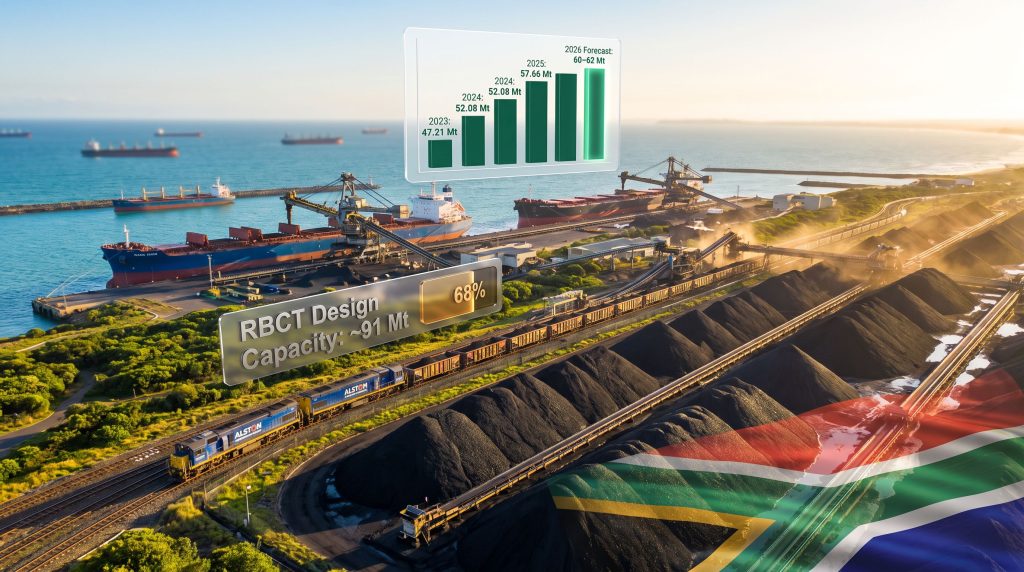
The multi-year export volume chart for the Richards Bay Coal Terminal tells a story of compounding failures followed by incremental, hard-won recovery. The 2023 trough of 47.21 million tonnes represented the nadir of a deterioration driven by locomotive shortages, cable theft along the rail corridor, rolling stock unavailability, and unplanned infrastructure failures that cascaded through the scheduling system.
Each year since has seen measurable improvement, however the recovery has been sequential rather than structural in the sense that no single transformative intervention occurred. Instead, a series of operational improvements have stacked on top of each other to produce a compound upward trajectory. Furthermore, the South Africa mining decline of prior years makes this progress all the more notable.
| Year | RBCT Export Volume | Year-on-Year Change |
|---|---|---|
| 2023 | 47.21 Mt | Multi-year low |
| 2024 | 52.08 Mt | +10.3% |
| 2025 | 57.66 Mt | +10.7% |
| 2026 Base Forecast | 60 Mt | +4.1% (projected) |
| 2026 Optimistic Scenario | ~62 Mt | +7.6% (projected) |
| RBCT Design Capacity | ~91 Mt | Significant headroom remains |
Note: 2025 export volumes are referenced in the source as 56.5 Mt in one instance and 57.66 Mt in the outline figures. The 56.5 Mt figure is sourced directly from RBCT CEO Alan Waller's remarks at the Coal and Energy Transition Day conference in Johannesburg on July 22, 2026, as reported by MiningMX. Figures may reflect rounding or differing measurement periods.
The scale of unused capacity deserves emphasis. Even under the most optimistic 2026 scenario of 62 Mt, the terminal would operate at roughly 68% of its ~91 Mtpa design throughput. That gap of approximately 29 million tonnes represents not wasted infrastructure, but latent volume optionality entirely contingent on rail supply chain performance.
What the Transnet Richards Bay Rail Line Actually Measures
The Terminal as a Passive Recipient
RBCT's operational role is frequently mischaracterised. The terminal does not control its own throughput in any meaningful upstream sense. It receives coal delivered by Transnet Freight Rail, stockpiles it, and loads it onto vessels. Its stacker-reclaimers, conveyors, and ship loaders are sized for volumes the rail network has not supplied in years.
This makes RBCT what analysts sometimes describe as a demand-ready facility with a supply-constrained input chain. The terminal has consistently demonstrated willingness and capacity to export more coal than it receives. The operational ceiling has always been set at Transnet's railhead, not at the port gate. Indeed, understanding these coal supply challenges is essential for any accurate assessment of South Africa's export potential.
This framing matters because it reorients any discussion of export growth away from port investment and toward rail reform as the decisive policy and capital allocation question for South Africa's coal export competitiveness.
Annualised Railage Rate as the Key Metric
One of the more technically instructive data points from mid-2026 is the annualised railage rate that Transnet achieved in the four weeks immediately preceding a scheduled 12-day maintenance shutdown of the Richards Bay line. During that window, Transnet demonstrated a 64 million tonne annualised delivery rate to the terminal.
This figure matters for two reasons. First, it demonstrates that the rail network is now physically capable of sustaining volumes consistent with the terminal's full-year forecast, having previously struggled to approach such rates consistently. Second, it makes the post-maintenance performance a critical leading indicator for second-half 2026 volumes. If Transnet returns from the shutdown at or near that rate, the 60 Mt base case is essentially secured and the 62 Mt optimistic scenario becomes genuinely achievable.
Three Operational Pillars Behind the Rail Recovery
1. The Alstom Locomotive Programme: Completing the Fleet
The full deployment of 102 new Alstom locomotives on the Richards Bay coal line marks the completion of a rolling stock programme that had been in progress for several years. Prior to full deployment, locomotive availability was a persistent scheduling constraint. Train services were cancelled or curtailed not because track capacity was exhausted, but because serviceable locomotives were unavailable to haul loaded sets.
The completion of this programme is a concrete, measurable input rather than a policy aspiration. Its effect is visible in the railage rate data: consistent locomotive availability supports consistent train frequencies, which in turn support consistent coal delivery to RBCT. According to reporting from Reuters, these rail improvements have been a central driver of the export volume gains observed across recent periods.
2. Line Security: From Active Disruption to Managed Risk
Cable theft and infrastructure sabotage on the coal rail corridor had been contributing materially to train cancellations in prior years. The security situation has reportedly returned to conditions last observed in 2020, with a meaningful decline in incident frequency.
The qualitative distinction here is operationally significant. According to remarks by RBCT CEO Alan Waller at the Coal and Energy Transition Day conference in Johannesburg in July 2026, as reported by MiningMX, the line is now experiencing security incidents without those incidents causing service cancellations. This shift from incidents-causing-cancellations to incidents-being-absorbed represents a threshold change in operational resilience, not merely an incremental improvement.
3. Maintenance Discipline and Planned Shutdowns
The 12-day maintenance shutdown of the Richards Bay line currently underway at the time of writing is a planned operational event. Its existence and timing reflect a degree of maintenance scheduling discipline that was absent during the worst years of Transnet's performance decline, when deferred maintenance and unplanned failures compounded each other.
Planned shutdowns allow vessel scheduling to adjust in advance, reducing demurrage costs and cargo disruption. The return-to-operations performance post-shutdown will be the most closely watched indicator of whether the rail recovery has genuine structural depth or remains fragile.
The June Derailment: What a Single Incident Revealed About Systemic Resilience
A derailment on the coal line during June 2026 reduced first-half export volumes by an estimated 700,000 tonnes. Despite this setback, RBCT reported exports of just over 30 Mt through the end of June, broadly consistent with the 60 Mt full-year trajectory.
| Recovery Scenario | Throughput Impact | Indicative Full-Year Volume |
|---|---|---|
| Slow recovery (historical pattern) | Extended deficit, scheduling cascade | Below 58 Mt |
| Moderate recovery | Partial catch-up, some permanent loss | ~59 to 60 Mt |
| Rapid recovery (2026 observed) | Near-immediate return to rate | 60 to 62 Mt achievable |
The speed of Transnet's return to pre-derailment railage rates following the June incident was described by RBCT's CEO, as reported by MiningMX, as among the most efficient recovery performances observed in recent years. Historically, disruptions on this corridor produced prolonged throughput deficits because the rail operation lacked the scheduling buffers and locomotive availability to absorb shocks and resume normal tempo quickly.
The 2026 experience suggests that the operational improvements now embedded in the system have meaningfully improved its resilience. This is not a data point that appears in annual throughput figures, but it carries significant forward-looking implications for how the network will handle future disruptions.
Asian Demand, Pricing Stability, and the Absence of a Crisis Premium
Where South African Coal Actually Goes
Asian markets absorbed approximately 84.5% of RBCT coal exports in 2024, with India functioning as the dominant destination. This concentration makes South African thermal coal volumes and pricing heavily sensitive to Indian power sector procurement cycles, monsoon-related demand variation, and domestic Indian coal production growth.
The remaining export share is distributed across European, Middle Eastern, and African buyers, each responding to distinct demand drivers. European buyers, in particular, have structurally adjusted their procurement behaviour following the extreme price volatility of 2022. In addition, resource export bottlenecks elsewhere in the global supply chain have indirectly supported demand for South African material.
The $103 Per Tonne Reality
Benchmark thermal coal export prices are currently tracking at approximately $103 per tonne. This compares to the extraordinary crisis-era peak of approximately $400 per tonne briefly reached during 2022 following the Ukrainian conflict and the associated disruption to European energy supply chains. For further context on the broader coal price outlook, current conditions reflect a stabilised but still commercially viable market environment.
The current pricing environment supports producer margins without reflecting any demand-driven crisis premium. Stock levels at RBCT have remained stable, with no evidence of the drawdown patterns that would signal accelerated Asian buying or supply tightness.
The absence of a price shock following Persian Gulf developments in mid-2026 reflects how fundamentally European energy buyers have restructured their coal procurement posture since 2022. The lesson from that period appears to have translated into more hedged, less spot-market-dependent purchasing strategies, which in turn dampens the price spike transmission mechanism that once made geopolitical events in energy corridors immediately visible in seaborne coal benchmark prices.
This structural shift in buyer behaviour creates a more stable, predictable pricing environment for South African exporters. For producers, $103/t is a workable margin environment. It is not a windfall, but it is sufficient to support operational investment and production planning with reasonable confidence.
The next major ASX story will hit our subscribers first
The Capacity Gap: Structuring the Upside Case Correctly
| Metric | Value |
|---|---|
| RBCT Design Capacity | ~91 Mt per annum |
| 2025 Actual Exports | ~56.5 to 57.66 Mt |
| 2026 Base Forecast | 60 Mt |
| 2026 Optimistic Scenario | ~62 Mt |
| Utilisation Rate (Base Case) | ~66% |
| Utilisation Rate (Optimistic) | ~68% |
| Remaining Unused Capacity | ~29 to 31 Mt |
Reaching 80 Mt or beyond, which would represent a genuinely transformative volume recovery, would require:
- Sustained annualised railage rates above 70 Mtpa over multiple consecutive quarters
- Further expansion of locomotive availability and fleet reliability beyond current levels
- Continued security stabilisation and a reduction in vandalism-related disruptions
- Reduced frequency of both planned and unplanned maintenance shutdowns
- Multi-year capital commitment to rail infrastructure that extends well beyond the rolling stock programme already completed
Each of these is a necessary but not individually sufficient condition. The interdependency between them means that progress on one front can be partially offset by deterioration on another, which is precisely what characterised the 2018 to 2023 decline period.
Key Risks and Upside Catalysts for H2 2026
Downside Risks
- Post-maintenance railage rates falling short of the pre-shutdown 64 Mtpa annualised level, breaking the momentum built through the first half of the year
- Additional unplanned derailments or track failures introducing volume deficits that cannot be recovered within the calendar year
- Softening Indian power sector demand, particularly if domestic coal production in India accelerates faster than anticipated
- Security conditions on the rail corridor deteriorating from current stabilised levels back toward cancellation-causing incidents
Upside Catalysts
- Transnet sustaining the 64 Mtpa annualised delivery rate through the second half, making the 62 Mt optimistic scenario the likely outcome rather than the ceiling
- Continued improvements in locomotive scheduling and preventive maintenance reducing unplanned availability losses
- Asian thermal coal demand remaining firm or strengthening through the northern hemisphere winter procurement cycle
- No further unplanned infrastructure disruptions on the Richards Bay coal corridor in the remaining months of 2026
What the RBCT Recovery Signals for South African Mining Infrastructure Investors
For equity investors with exposure to South African coal producers operating on the Richards Bay corridor, the South Africa coal exports rise Transnet Richards Bay Coal Terminal trajectory in 2026 offers a genuinely improved operational backdrop compared to the 2021 to 2023 period. The combination of completed locomotive deployment, stabilised security conditions, and demonstrated rapid incident recovery creates a more predictable production and logistics planning environment.
The volume gap between the optimistic 2026 scenario and RBCT's design capacity represents latent upside optionality that is entirely rail-dependent. Investors should treat this not as a near-term catalyst but as a multi-year structural opportunity contingent on Transnet sustaining and extending the operational discipline demonstrated in mid-2026.
The broader implication extends beyond coal. The RBCT recovery model, where incremental rail improvements translate into measurable export volume gains, is directly applicable to other South African bulk commodity corridors including manganese and iron ore. Consequently, the relationship between commodity prices and miners operating on these corridors makes Transnet's performance a systemic variable for the country's commodity export competitiveness, not a sector-specific coal problem.
This article contains forward-looking analysis based on publicly available operational data and industry commentary. Export volume projections are estimates subject to change based on rail performance, market conditions, and operational developments. This content does not constitute financial or investment advice. Readers should conduct independent due diligence before making any investment decisions.
Want to Capitalise on the Next Major Resource Discovery Before the Market Moves?
Discovery Alert's proprietary Discovery IQ model scans ASX announcements in real time, instantly identifying high-potential mineral discoveries across 30+ commodities — turning complex data into clear, actionable opportunities for both short-term traders and long-term investors. Explore how historic discoveries have generated exceptional returns on Discovery Alert's dedicated discoveries page, then begin your 14-day free trial to position yourself ahead of the broader market.