July 24, 2026
The Supply Chain Logic That Moves Oil Markets Before Crises Hit
Long before a tanker route is physically disrupted, traders begin repricing risk. The most revealing signal in global oil markets is rarely the headline itself but rather the procurement behaviour that precedes it. When refiners start buying crude weeks ahead of schedule, paying tighter premiums for grades they would ordinarily source at the last moment, the market is communicating something that no official statement has yet confirmed: supply anxiety has crossed a threshold.
That is precisely the dynamic unfolding across China's crude import market in mid-2026. China buying Russian ESPO crude amid Middle East risks is not a story about opportunistic arbitrage. It is a story about structural vulnerability, geographic hedging, and the behavioural economics of energy security when multiple risk layers converge simultaneously.
When big ASX news breaks, our subscribers know first
What ESPO Crude Actually Is and Why Chinese Refiners Value It
ESPO, which stands for East Siberia-Pacific Ocean, is a pipeline and export system that carries crude from Russia's interior fields to the Kozmino terminal on its Pacific coast. The grade itself is classified as light and sweet, meaning it has relatively low sulphur content and favourable API gravity. For Chinese refiners, these characteristics are commercially significant because they translate directly into higher diesel yields per barrel processed.
Diesel remains the dominant refined product driving refinery economics across China's industrial base. Unlike many Middle Eastern grades that skew toward heavier, more sulphurous profiles requiring additional hydrocracking investment, ESPO slots efficiently into existing Chinese refinery configurations without significant upgrading costs.
The table below illustrates why ESPO competes so effectively against comparable grades:
| Attribute | ESPO Crude | Typical Middle Eastern Blend |
|---|---|---|
| Sulphur Content | Low (sweet) | Medium to High (sour) |
| API Gravity | Light | Medium to Heavy |
| Diesel Yield | High | Moderate |
| Shipping Distance to China | ~1 week from Kozmino | 2-3+ weeks from Persian Gulf |
| Price vs. ICE Brent (mid-2026) | ~$1/bbl discount | Varies by grade |
| Sanctions Exposure | Moderate | Low (most grades) |
Beyond refinery economics, the logistics profile is equally compelling. Kozmino sits roughly one week's sailing time from major Chinese import terminals. That proximity has historically meant Chinese buyers had little incentive to secure ESPO cargoes far in advance, since fresh supply was always close at hand. The fact that this behavioural norm has now broken down is itself a significant market signal.
The Price Compression Signal: Reading ESPO's Narrowing Discount to Brent
Commodity price relationships tell stories that verbal commentary often obscures. The evolution of ESPO's pricing against ICE Brent across a two-week window in late July 2026 is one of the clearest demand-pressure signals visible in the current crude oil market in recent memory.
Consider the trajectory:
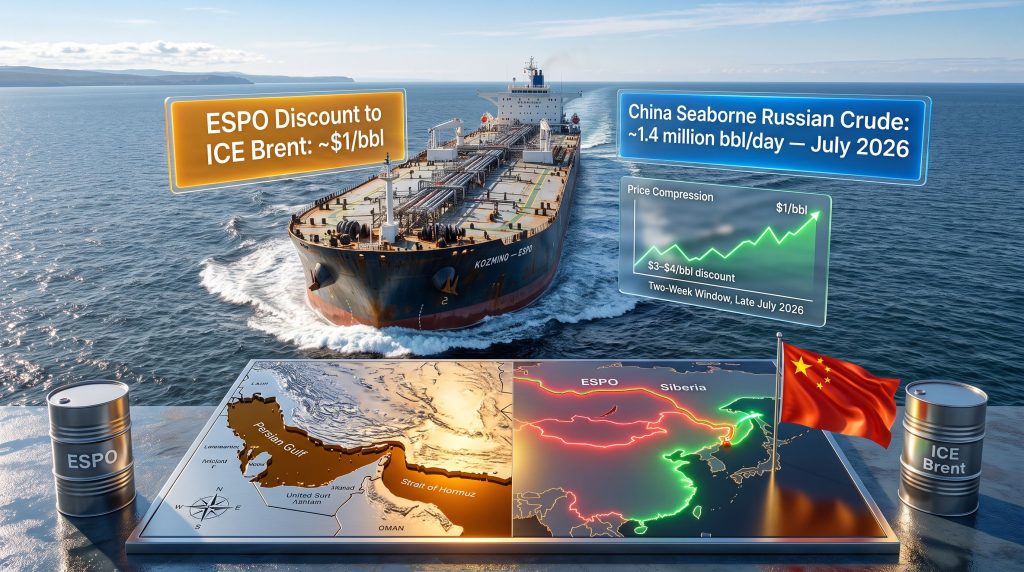
- Two weeks prior to late July 2026: ESPO traded at a $3 to $4 per barrel discount to ICE Brent
- By late July 2026: That discount had compressed to approximately $1 per barrel
- Implied demand impulse: A narrowing of $2 to $3 per barrel within a fortnight, driven entirely by buy-side acceleration rather than any supply-side constraint at Kozmino
This kind of discount compression is not routine. Under normal market conditions, a one-week transit grade with ample Siberian production behind it should not see its price premium surge unless buyers are competing urgently for finite loading slots. The fact that all August-loading cargoes from Kozmino were fully absorbed by late July, with multiple September shipments also already traded, confirms that the price signal is an authentic reflection of demand intensity.
Cargo sell-through velocity is one of the least-discussed but most reliable indicators of genuine supply anxiety in crude markets. When buyers advance their procurement windows by weeks for a grade that typically requires no forward planning, the implied fear premium embedded in that behaviour is real, even if it does not show up cleanly in any single price series.
Normal ESPO trading involves minimal forward purchasing precisely because the short transit time removes most of the incentive. The current pattern, where September cargoes are changing hands in late July, represents a structural departure from that baseline.
How Middle East Instability Is Reshaping Chinese Crude Procurement
The Strait of Hormuz remains the most consequential maritime chokepoint in global energy. Approximately 20 to 21 million barrels of crude and petroleum products transit through it daily, representing roughly one-fifth of global oil consumption. Furthermore, any credible threat to Persian Gulf shipping routes does not need to materialise into physical disruption to alter refiner behaviour. The anticipation alone is sufficient to trigger procurement adjustments.
Is China's Middle Eastern Supply Concentration a Vulnerability?
China's import mix has historically skewed heavily toward Middle Eastern grades. Saudi Arabia, Iraq, the UAE, and Kuwait collectively represent a substantial portion of China's crude intake. This concentration creates a geographic exposure problem: a single regional disruption could simultaneously affect multiple supply relationships.
The Red Sea shipping crisis that emerged in late 2023 and extended into 2024 illustrated how quickly alternative routing requirements can inflate delivered costs and extend transit times. Persian Gulf crudes already face 2 to 3+ week voyages to Chinese ports under normal conditions. Any routing deviation or insurance-related constraint extends that further, creating both cost and availability problems for refiners operating on lean inventory models.
These broader geopolitical trade tensions have, consequently, forced Chinese refiners to reassess the resilience of their traditional supply chains. China's state-owned and independent refiners have responded differently to this risk environment:
- Independent Chinese refiners (commonly called teapot refineries, concentrated in Shandong province) have moved most aggressively to lock in ESPO cargoes, driven partly by their greater flexibility and appetite for discounted Russian barrels
- State-owned entities have historically exercised more caution around Russian crude due to sanctions compliance considerations following Western restrictions on major Russian energy producers
- However, tighter Middle East conditions and the immediate economics of supply security have drawn even more conservative buyers back toward Russian barrels at current price levels
The involvement of Unipec, the trading arm of Sinopec and one of the world's largest crude traders, confirms that major state-linked entities are participating actively, not merely watching from the sidelines. According to market intelligence from Vortexa, Chinese oil majors led by Unipec have been central to the acceleration of ESPO buying since July 2026, with Middle East disruption serving as the catalyst for extended forward purchasing.
Russia's Pacific Export Volume: What the Numbers Reveal
Tracking data from Kpler, a commodity shipping intelligence platform, provides quantifiable context for the scale of this procurement shift:
| Period | Estimated Chinese Seaborne Imports of Russian Crude |
|---|---|
| March 2026 | Monthly high watermark at the time (disruption onset reference) |
| July 2026 (mid-month tracking) | ~1.4 million barrels per day |
| July 2026 trajectory | On track for highest monthly volume since March 2026 |
March 2026 functions as the baseline reference point because it coincided with the initial phase of Middle East conflict disruption that first triggered meaningful reorientation in Chinese crude sourcing. The fact that July 2026 volumes are tracking toward or beyond that prior high suggests the current buying wave is not a brief tactical response but a sustained volume commitment.
The Kozmino terminal itself deserves attention as a strategic infrastructure node. As Russia's primary Pacific crude export facility, its throughput capacity and cargo scheduling constraints represent a physical ceiling on how much ESPO can be delivered into Asia regardless of demand. This makes early cargo capture even more competitively meaningful when Chinese buyers are all seeking the same loading windows simultaneously.
The US Legislative Variable: Policy Risk as a Procurement Accelerant
Overlaid on the geopolitical supply risk is a distinct but reinforcing policy risk. In addition, the evolving Russian oil sanctions landscape and proposed US legislation targeting major purchasers of Russian energy have introduced a forward-looking cost uncertainty that adds urgency to near-term buying decisions.
How Does the Tariff Threat Accelerate Buying Behaviour?
The mechanism here operates through rational forward-looking behaviour:
- If tariffs on Russian crude purchases are enacted, the cost of future acquisition rises
- Volumes purchased before implementation avoid that cost increment
- Therefore, the optimal strategy for a Chinese refiner facing this uncertainty is to maximise near-term volume within the current cost structure
- This creates a self-reinforcing buying impulse that compounds the geopolitical supply anxiety already driving procurement
It is important to note that these are proposed legislative measures, not enacted policy. The procurement urgency they generate is based on risk probability assessments by market participants, not confirmed regulatory outcomes. Investors and market observers should distinguish between policy risk priced into current behaviour and actual policy implementation.
The interaction between geopolitical supply risk and potential tariff risk creates a rare dual-incentive structure where both the push factor (Middle East disruption threat) and the pull factor (lower cost availability window) are pointing toward the same action: buy Russian crude now, in volume, ahead of schedule. The broader US-China oil price impact of these legislative proposals continues to reverberate across Asian procurement markets.
The next major ASX story will hit our subscribers first
The Secondary Market Effect: What Displaced Middle Eastern Crude Tells Us
One of the more analytically interesting dimensions of this procurement shift is the downstream behaviour it generates. Some Chinese processors acquiring ESPO are reselling limited volumes of Middle Eastern grades, including UAE Upper Zakum, into the secondary market.
This behaviour warrants careful interpretation:
- It is not simply supplementation, where ESPO adds to existing Middle Eastern intake
- It reflects active displacement, where ESPO is substituting for Middle Eastern volumes in refinery run plans
- The resale of Upper Zakum into the secondary market at a quick-profit spread indicates refiners are treating ESPO as the preferred base grade and monetising displaced barrels rather than running them
For Middle Eastern exporters, this pattern carries a longer-term market share implication. If Chinese refiners build operational familiarity and procurement infrastructure around ESPO at scale, the structural reorientation could persist beyond the current disruption episode. Supply relationships in crude markets are partially path-dependent: once logistics, financing, and refinery configurations are optimised for a particular grade, switching costs create inertia.
Scenario Analysis: Three Trajectories for China's Crude Sourcing in H2 2026
Scenario 1: Middle East De-escalation and Demand Normalisation
If regional tensions ease materially, the risk premium embedded in current ESPO procurement behaviour dissipates. The discount to Brent would likely widen back toward the $3 to $4 per barrel range, September and October buying would revert to standard short-lead windows, and Middle Eastern grades would reclaim volume in Chinese import slates. This scenario treats current behaviour as cyclical rather than structural.
Scenario 2: Sustained Disruption and Deepening ESPO Dependency
If Middle East supply risks persist or intensify through H2 2026, ESPO's discount narrows further or reaches parity with Brent. Chinese refiners extend forward purchasing into Q4, Kozmino throughput tests its effective export ceiling, and the Russia-China crude corridor consolidates as a primary supply artery. The trade war oil markets dynamic further complicates price discovery across Asian benchmarks in this scenario.
Scenario 3: US Sanctions Enacted Mid-Cycle
If proposed tariff legislation advances toward implementation within a defined timeline, Chinese buyers front-load maximum feasible ESPO volumes ahead of the effective date. This produces a short-term price spike followed by a structural reconfiguration as buyers reassess total cost of procurement under the new tariff framework. Alternative crude sources, potentially including Iranian barrels through informal channels, may see accelerated engagement.
Disclaimer: The above scenarios represent analytical frameworks based on current market conditions and publicly available information. They are not investment advice and should not be treated as predictive statements about future market outcomes.
What This Means for Global Oil Market Architecture
China buying Russian ESPO crude amid Middle East risks is more than a procurement story. It is, however, evidence of a broader structural evolution in how the world's largest crude importer manages supply chain risk in an environment of persistent geopolitical fragmentation.
The narrowing of the ESPO discount to Brent is a price mechanism reflecting that evolution in real time. When a grade that naturally trades at a significant discount due to sanctions exposure and political risk closes that gap rapidly, it means the competitive alternatives are being perceived as more risky, not less. That inversion of the usual risk hierarchy is the defining market insight of this episode.
For OPEC+ producers, a sustained Chinese pivot toward Pacific crude sources creates meaningful pressure on their pricing assumptions about Asian demand. Gulf exporters have long treated China as their most important growth market. If ESPO and potentially other non-Gulf sources progressively capture incremental Chinese volume during disruption periods, the recovery of that market share in calmer times becomes less certain with each successive pivot.
The Kozmino-to-China corridor, once a complementary supply route, is demonstrating characteristics of a strategic energy artery whose throughput scales inversely with Persian Gulf stability. That relationship is unlikely to be temporary.
Frequently Asked Questions
What is ESPO crude and why does it matter to Chinese refiners?
ESPO is a light, low-sulphur crude grade exported from Russia's Kozmino terminal on the Pacific coast. Its approximately one-week transit time to Chinese ports, competitive discount to global benchmarks, and high diesel yield make it a strategically efficient supply option, particularly when Middle Eastern supply routes face uncertainty.
Why is China buying ESPO earlier than usual in 2026?
Escalating geopolitical risk across the Middle East, particularly threats to Persian Gulf and Red Sea shipping corridors, has prompted Chinese refiners to secure crude supply ahead of their standard procurement timelines. Both August and September loading cargoes were absorbed weeks ahead of schedule by late July 2026, according to Kpler tracking data.
How much Russian crude is China importing in July 2026?
Kpler data indicated China was on track to import approximately 1.4 million barrels per day of Russian crude via seaborne routes in July 2026, potentially the highest monthly volume since March 2026.
What has happened to ESPO's price relative to Brent?
ESPO's discount to ICE Brent compressed from approximately $3 to $4 per barrel to around $1 per barrel within a two-week window in mid-2026, driven by accelerated Chinese buying demand rather than any supply-side change at Kozmino.
Could US policy measures affect China's Russian crude purchasing?
Proposed US legislation targeting major purchasers of Russian energy, including China, could impose tariffs that increase future procurement costs. This policy risk is considered a contributing factor to the urgency of near-term ESPO buying, though no such measures have been enacted as of the time of reporting.
Want to Know Which Commodity Discoveries Are Generating Significant Returns Right Now?
Discovery Alert's proprietary Discovery IQ model scans ASX announcements in real time, instantly identifying high-potential mineral discoveries across 30+ commodities — from energy to base metals — and translating complex data into actionable investment insights. Explore historic discoveries and their exceptional market returns, then begin your 14-day free trial to position yourself ahead of the broader market.