July 24, 2026
Why Forecast Ranges for the Global Aluminium Extrusion Market Span Billions of Dollars
Understanding an industry through its headline numbers alone is one of the most reliable ways to misread it. The global aluminium extrusion market is a textbook case: published forecasts for the same market, projecting to the same endpoint of 2032, diverge by tens of billions of dollars depending on who is doing the measuring. Before examining what the global aluminium extrusion market forecast to 2032 actually reveals, it is worth understanding why the numbers look so different across research sources — because the methodology behind a forecast is often more instructive than the figure itself.
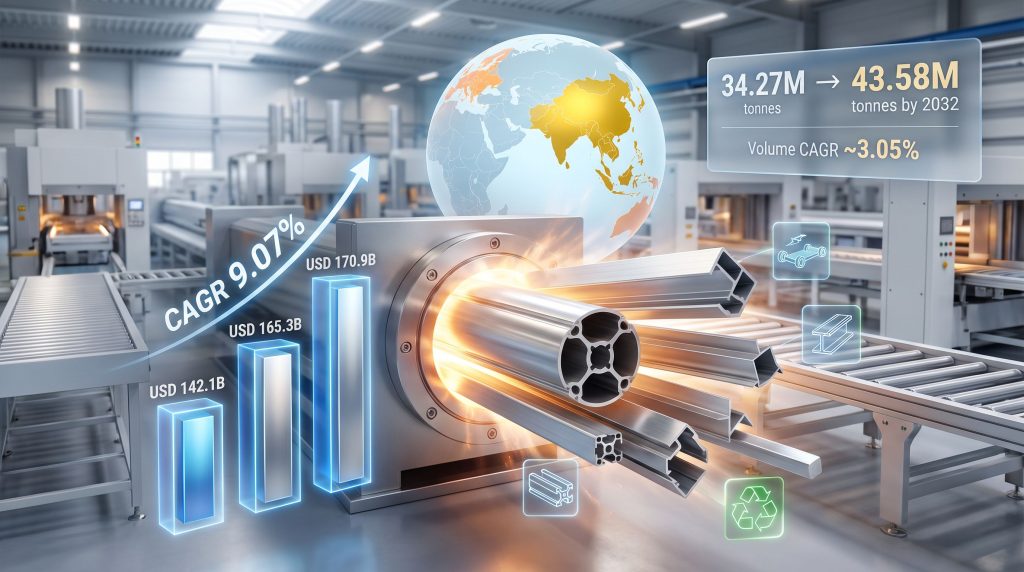
Some research firms measure only the extruded profile at the point of production. Others extend their boundary to include downstream fabrication, anodising, powder coating, and assembly. Some track physical volume in tonnes, while others track USD value — a figure that fluctuates every time the London Metal Exchange aluminium price moves. Add in differences in base year selection, regional scope, and macroeconomic modelling assumptions, and it becomes clear why estimates for 2032 range from approximately USD 142 billion to over USD 170 billion.
The practical implication for procurement teams, capacity investors, and supply chain strategists is significant: the forecast number matters less than the framework behind it.
When big ASX news breaks, our subscribers know first
What the Global Aluminium Extrusion Market Is Actually Worth
Cutting through the methodological noise, the global aluminium extrusion market was valued at approximately USD 100 to 105 billion in 2024, advancing to roughly USD 110 billion in 2025, and is on a trajectory to cross USD 118 billion in 2026. By 2032, credible estimates place the market between USD 150 billion and USD 175 billion, representing a compound annual growth rate in the range of 6 to 8 percent per year.
The table below maps the range of published estimates to give a clearer picture of where consensus sits and where it fractures:
| Forecast Scenario | 2032 Market Value | CAGR | Base Year |
|---|---|---|---|
| Conservative Estimate | ~USD 142.1 billion | 6.1% | 2022 |
| Mid-Range Estimate A | ~USD 162.8 billion | 8.0% | 2023 |
| Mid-Range Estimate B | ~USD 165.3 billion | 8.88% | 2024 |
| Optimistic Estimate | ~USD 170.9 billion | 9.07% | 2024 |
| Consensus Reference Point | ~USD 150–175 billion | 6–8% | 2025 |
The divergence between value and volume growth trajectories is itself a revealing signal. In physical terms, global extrusion demand is projected to grow from approximately 34.27 million tonnes in 2024 to around 43.58 million tonnes by 2032 — a volume CAGR of roughly 3.05 percent. Value grows considerably faster than volume because the product mix is shifting structurally toward higher-margin, precision-engineered profiles, particularly for electric vehicle platforms and advanced building systems, which command meaningful price premiums over standard commodity shapes.
According to aluminium extrusion market analysis from IMARC Group, this structural shift toward value-added profiles is one of the defining characteristics separating the current growth cycle from previous expansions in the sector.
"This divergence between value and volume growth is one of the most strategically underappreciated dynamics in the extrusion sector. It signals a market undergoing qualitative transformation, not merely quantitative expansion."
How the Market Breaks Down: Segmentation Across Four Dimensions
Product Form: Solid Profiles Lead, Hollow Profiles Grow Faster
Solid profiles represent more than 50 percent of total extrusion market volume. Their dominance reflects structural demand from the construction sector, where angles, bars, channels, and standard structural sections are produced in high throughput at relatively low technical complexity. These are the simplest and most cost-efficient shapes to manufacture, making them the backbone of commodity extrusion capacity globally.
Hollow profiles, by contrast, are the faster-growing value segment. Applications in EV battery enclosure systems, thermal management components, and complex aerospace assemblies require multi-void cross-sections that demand significantly higher die engineering, press capability, and metallurgical control. The premium commanded by these profiles relative to commodity solid shapes is substantial and is widening as EV adoption accelerates.
Alloy Grade: Where Technical Differentiation Determines Margin
Alloy-level segmentation is frequently omitted from generic market summaries, yet it is precisely the data layer most critical to procurement decisions, capacity investment planning, and supply chain risk assessment. The four principal alloy families each occupy distinct technical and commercial territory:
| Alloy Series | Key Characteristics | Primary Application | Growth Trajectory |
|---|---|---|---|
| 1xxx (near-pure Al) | Maximum electrical conductivity | Busbars, conductors, electrical infrastructure | Fastest-growing grade |
| 6xxx (Al-Mg-Si) | Balanced strength, corrosion resistance, extrudability | Windows, doors, curtain walls, structural profiles | Dominant by volume |
| 5xxx (Al-Mg) | High corrosion resistance, weldability | Marine, offshore, transport | Niche, stable |
| 7xxx (Al-Zn) | Highest strength-to-weight ratio | Aerospace, defence, high-performance automotive | Niche, premium |
The 6xxx series functions as the workhorse of the global extrusion industry. Its combination of mechanical strength, corrosion resistance, and processing efficiency — a property the industry terms extrudability — makes it the default choice across the construction and general industrial segments. The 1xxx series, meanwhile, is recording the fastest growth rate of any alloy category, driven by expanding electrical infrastructure demand where conductivity is the defining performance requirement.
Surface Finish: Three Tiers Serving Distinct Markets
- Mill-finished: The as-extruded baseline product, holding the largest share by volume. It serves cost-sensitive construction and industrial applications where surface appearance is secondary to dimensional accuracy and structural performance.
- Anodised: The electrochemical oxide layer created through anodising delivers simultaneous corrosion protection and decorative appeal. It is the standard finish for architectural profiles, consumer-facing products, and applications where long-term surface integrity is specified.
- Powder-coated: A polymer coating applied electrostatically and cured under heat. It is the dominant finish for exterior facade systems, outdoor infrastructure, and any application where weather resistance and colour specification are procurement requirements.
End-Use Industry: Construction Leads, Automotive Accelerates
| End-Use Sector | Market Position | Key Application Drivers |
|---|---|---|
| Construction and Infrastructure | Largest consumer by volume | Window frames, door systems, curtain walls, structural glazing, solar mounting structures |
| Automotive and Transport | Fastest-growing demand segment | EV battery enclosures, crash management systems, chassis components, space-frame assemblies |
| Electrical and Electronics | Significant and expanding | Heat sinks, busbars, LED housings, power distribution components |
| Machinery and Industrial Equipment | Stable, technically demanding | Automation frames, linear rails, precision structural components |
| Consumer Durables | Emerging growth area | Furniture, appliances, sporting goods, lifestyle products |
Regional Dynamics: Where Capacity Sits and Where Demand Is Growing
Asia Pacific: Structural Dominance, Not Just Scale
Asia Pacific accounts for approximately 74 percent of global aluminium extrusion market share, a concentration built over decades through industrial policy alignment, access to competitively priced energy, and vertically integrated supply chains connecting bauxite mining through to finished profile production. China functions as the single largest producer and consumer by a margin that dwarfs every other nation, spanning everything from commodity construction profiles to advanced automotive-grade hollow sections.
India, Japan, South Korea, and Vietnam constitute the secondary growth tier within the region. Each is expanding extrusion capacity in response to domestic infrastructure investment cycles and export-oriented manufacturing growth. India, in particular, is attracting significant capacity investment as domestic construction activity intensifies and the country's automotive sector modernises.
North America: Infrastructure Spending and EV Manufacturing Create a Structural Demand Uplift
North America is emerging as one of the fastest-growing regional markets in value terms. Federal infrastructure investment programmes, the reshoring of manufacturing capacity across multiple industrial sectors, and accelerating EV platform launches are collectively reshaping the regional demand profile. Furthermore, the impact of US aluminium tariffs on the Midwest Premium through late 2025 and into 2026 has materially reshaped import economics, providing strong incentives for domestic capacity investment.
Europe: Green Premium Meets Energy Cost Headwinds
European demand presents a more complex picture. The volume base is mature, but the product mix is shifting structurally toward low-carbon, certified-green extrusions as net-zero construction commitments and automotive decarbonisation targets reshape procurement specifications. The EU's Carbon Border Adjustment Mechanism (CBAM) is creating a measurable competitive advantage for European producers operating on recycled billet and renewable energy.
High energy costs represent the structural constraint on European capacity expansion. Production cost premiums of 20 to 30 percent relative to lower-cost manufacturing regions are compressing margins and accelerating the shift toward secondary aluminium inputs as both a cost management and carbon compliance strategy. This dynamic mirrors broader challenges facing low-carbon aluminium operations globally as producers navigate the energy transition.
Middle East and Africa: The Fastest-Growing Regional Opportunity
Gulf-based producers benefit from competitively priced energy and secure access to primary aluminium billet from regional smelters, positioning the Middle East as a structurally advantaged extrusion manufacturing base. The Middle East and Africa region is projected to record the fastest regional growth rate through 2032, driven by domestic construction demand expansion and growing export-oriented extrusion capacity targeting European and Asian markets.
The Four Structural Forces Driving Growth to 2032
Force 1: EV Lightweighting Redefines What Aluminium Extrusion Is Worth
Every kilogram eliminated from an electric vehicle's structure directly extends its driving range, making mass reduction a non-negotiable engineering priority at the platform design level. Aluminium extrusions are displacing steel across battery enclosure systems, crash management structures, and space-frame assemblies. Comprehensive aluminium adoption in these systems has demonstrated a range extension potential of up to 15 percent — a figure that resonates powerfully with both EV manufacturers and consumers.
This is not a cyclical demand driver. The EV transition represents a permanent structural shift in the composition of automotive demand for extruded aluminium. As battery energy density continues to improve over time, the engineering value of each kilogram saved increases further, reinforcing rather than diminishing the strategic case for aluminium substitution.
Force 2: Net-Zero Construction and Solar Infrastructure Create a Multi-Year Demand Floor
Net-zero construction commitments across major economies are mandating higher-performance building envelopes, driving demand for thermally broken aluminium window systems, advanced curtain wall profiles, and building-integrated photovoltaic (BIPV) mounting structures. Solar energy infrastructure — particularly utility-scale ground-mount and rooftop systems — represents a rapidly scaling, volume-intensive demand source that is still in relatively early stages of its growth trajectory.
Infrastructure investment programmes across Asia and North America are providing a sustained multi-year demand floor beneath the construction segment. Consequently, this insulates overall market volume from short-term cyclical softness in private construction activity.
Force 3: Recycled Aluminium and Carbon Compliance Become Market Access Requirements
Secondary aluminium production requires approximately 95 percent less energy than primary smelting from bauxite. This is not merely a sustainability credential — it is a cost and carbon advantage of transformational magnitude that is becoming a competitive necessity as regulatory frameworks mature. The dynamics of green metals pricing across the broader metals sector further illustrate how carbon compliance is reshaping procurement thresholds.
The EU's CBAM framework is progressively pricing the embedded carbon content of imported aluminium products, creating a structural market bifurcation between low-carbon and high-carbon supply chains. Producers investing in recycled billet supply, green energy procurement, and third-party carbon certification are building durable advantages that will compound through the 2030s.
Force 4: Advanced Manufacturing Technology Raises the Competitive Floor
Multi-hole die technology, high-tonnage precision extrusion presses, and AI-integrated quality control systems are enabling manufacturers to produce increasingly complex hollow and multi-void profiles at commercially viable throughput rates. Automation investment is reducing labour cost dependency and improving dimensional consistency — both critical requirements for automotive and aerospace qualification programmes where dimensional tolerances are specified in fractions of a millimetre.
These manufacturing advances are raising the technical floor of what constitutes a competitive extrusion operation. Sub-scale regional producers operating older press technology are finding it progressively harder to win technically demanding contracts, accelerating industry consolidation toward larger, better-capitalised operators.
The Cost Economics of Aluminium Extrusion: What Determines Who Wins
Billet Cost: The Dominant Variable in the Operating Cost Structure
Aluminium billet — priced against the LME aluminium benchmark plus applicable regional delivery premiums — typically represents 70 to 80 percent of an extruder's total operating cost. This concentration of cost in a single input creates structural vulnerability to LME price volatility and regional premium movements.
Extruders with long-term billet supply agreements or integrated upstream positions carry a structural margin advantage over spot-dependent operators. This becomes most visible precisely when market conditions are most volatile, as demonstrated by the sharp upward movement in the US Midwest Premium through late 2025 and into 2026.
Energy Intensity: The Geographic Competitiveness Determinant
The extrusion process — encompassing billet preheating, press operation, quenching, and post-extrusion heat treatment — consumes approximately 1,000 to 1,500 kWh per tonne of finished product. This energy intensity means that electricity tariff differentials between regions translate directly into production cost gaps of 20 to 30 percent.
The logical consequence of this dynamic is already visible in capacity investment flows: new extrusion press capacity is gravitating toward Asia and the Gulf, where energy costs are structurally lower, while European capacity faces ongoing pressure to either decarbonise or consolidate through merger and acquisition activity.
The next major ASX story will hit our subscribers first
Competitive Landscape: The Companies Shaping the Market to 2032
| Company | Strategic Position | Competitive Differentiation |
|---|---|---|
| Norsk Hydro | Global integrated producer | Low-carbon extrusion, automotive-grade profiles, European leadership |
| Constellium | Automotive and aerospace specialist | High-value hollow profiles, crash management systems, advanced alloys |
| Hindalco / Novelis | Asia-Pacific and global recycled aluminium | Recycled content leadership, integrated billet supply |
| China Zhongwang | Largest extruder by volume | Scale, cost efficiency, domestic Chinese market dominance |
| Arconic | North American industrial and aerospace | Precision profiles, aerospace qualification |
| Kaiser Aluminum | North American specialty | High-strength alloys, aerospace and automotive applications |
| Gulf Extrusion / BALEXCO / ALUPCO | Middle East regional leaders | Energy cost advantage, export-oriented capacity |
The two defining competitive themes structuring the industry heading toward 2032 are consolidation and decarbonisation. Among the leading aluminium producers, capacity acquisition is accelerating as producers seek scale advantages in billet procurement, press utilisation, and geographic coverage. Simultaneously, verified low-carbon footprint extrusions are transitioning from a marketing differentiator to a procurement qualification threshold in European and North American markets.
For instance, the Alcoa aluminium strategy illustrates how major integrated producers are repositioning their upstream and downstream assets to align with the emerging low-carbon demand premium. According to comprehensive forecasting data from Precedence Research, the global aluminium extrusion market forecast to 2032 strongly favours producers who can combine technical capability with credible decarbonisation credentials.
Frequently Asked Questions on the Global Aluminium Extrusion Market to 2032
How big is the aluminium extrusion market in 2025?
The market is estimated at approximately USD 110 billion in 2025, with published estimates across research sources ranging from USD 105 billion to USD 119 billion, reflecting differing market boundary definitions and base year selections.
What will the aluminium extrusion market be worth by 2032?
Most credible forecasts place the 2032 market value between approximately USD 142 billion and USD 171 billion. The most frequently cited reference range is USD 150 to 175 billion, representing a CAGR of 6 to 8 percent from a 2025 base.
What is the projected volume of global aluminium extrusion demand by 2032?
In physical terms, global aluminium extrusion demand is projected to reach approximately 43.58 million tonnes by 2032, up from around 34.27 million tonnes in 2024, representing a volume CAGR of approximately 3.05 percent.
Which alloy series is the fastest-growing in extrusion?
The 1xxx series (near-pure aluminium) is the fastest-growing alloy grade by demand growth rate, driven by expanding electrical infrastructure applications — particularly busbars, conductors, and power distribution components — where electrical conductivity is the primary performance requirement.
Why is the electric vehicle sector such a powerful demand driver?
EV manufacturers face a fundamental engineering constraint: vehicle mass directly limits driving range. Aluminium extrusions are used in battery enclosure systems, crash management structures, and space-frame assemblies. Comprehensive aluminium substitution for steel in these systems can extend EV driving range by up to 15 percent, making lightweighting a non-negotiable design priority.
How does energy pricing affect competitive positioning in extrusion?
Extrusion consumes approximately 1,000 to 1,500 kWh per tonne of finished product. Regions with high electricity tariffs face production cost premiums of 20 to 30 percent relative to lower-cost manufacturing locations. This differential is progressively shifting new capacity investment toward Asia and the Gulf and is accelerating the decarbonisation transition in European operations.
Strategic Implications for Market Participants
For Procurement and Supply Chain Teams
- Secure long-term billet supply agreements or establish supplier relationships with recycled-content producers to reduce exposure to LME price volatility and regional premium spikes.
- Prioritise suppliers with CBAM-compliant, low-carbon certified supply chains for any product destined for European markets, where carbon import costs are becoming a material procurement factor.
- Develop alloy-level sourcing strategies that align with application requirements: 6xxx series for mainstream structural applications, 1xxx series for electrical infrastructure, 7xxx series for high-performance engineering.
- Map supplier energy sources as part of supply chain due diligence, since the carbon intensity of extrusion operations will increasingly determine market access eligibility in regulated markets.
For Capacity Investors and Producers
- Prioritise geographic locations with competitive energy tariffs and access to recycled billet supply when evaluating new press capacity investment.
- Invest in multi-hole die capability and precision press technology to access the faster-growing, higher-margin hollow profile segment serving EV and aerospace customers.
- Develop verified low-carbon product offerings with third-party certification as a prerequisite for competing in European and premium North American demand segments through the late 2020s and into the 2030s.
- Monitor Midwest Premium and LME price dynamics closely when modelling North American operations, as tariff-driven premium movements have demonstrated the capacity to materially reshape regional trade economics within a short timeframe.
Disclaimer: This article contains forward-looking statements, market forecasts, and analytical projections sourced from publicly available industry research. Forecast figures represent estimates based on modelling assumptions that may not reflect actual outcomes. This content is intended for informational purposes only and does not constitute financial, investment, or procurement advice. Readers should conduct independent due diligence before making any business or investment decisions.
Want to Invest in the Commodities Powering the Aluminium Megatrend?
The structural forces reshaping global aluminium demand — from EV lightweighting to green infrastructure buildout — are creating significant opportunities across ASX-listed resources companies, and Discovery Alert's proprietary Discovery IQ model delivers real-time alerts the moment a significant mineral discovery hits the ASX, turning complex data across 30-plus commodities into clear, actionable insights. Explore Discovery Alert's dedicated discoveries page to understand how major mineral discoveries have historically generated exceptional returns, and begin your 14-day free trial today to position yourself ahead of the broader market.