
July 24, 2026
The Hidden Architecture of Aluminium Pricing: What Price Benchmarks Really Reveal
Commodity markets are rarely moved by single events. More often, price signals accumulate across multiple data points, contract tenors, and inventory metrics until a coherent picture of market sentiment emerges. When the LME aluminium cash price falls below $3,200 per tonne, it is not simply a number crossing a threshold. It is a convergence of macroeconomic forces, physical supply dynamics, and forward-looking market positioning that carries implications far beyond the trading floor.
Understanding what the LME aluminium cash price below $3,200 per tonne actually means — and why it matters to industries ranging from automotive manufacturing to renewable energy infrastructure — requires unpacking a pricing architecture that most market participants only partially understand. Furthermore, the aluminium tariffs impact on cross-border flows adds another dimension of complexity to an already pressured pricing environment.
When big ASX news breaks, our subscribers know first
The LME as the Global Arbiter of Aluminium Value
Why the Cash Price Functions as a Real-Time Pulse Check
The London Metal Exchange has operated as the world's primary venue for base metal price discovery since 1877, and aluminium has been traded on the exchange since 1978. The cash price, also called the spot price, represents the cost of aluminium for immediate delivery and settlement typically within two business days.
Unlike equity markets, where price reflects discounted future earnings, the LME cash price reflects the current physical value of metal in warranted warehouses. It is the price a buyer would pay today to receive physical aluminium tomorrow, making it the most sensitive real-time indicator of market conditions.
The three-month price, by contrast, is the most liquid contract on the LME and serves as the primary hedging instrument for producers and consumers. Long-dated forward prices such as the December 2027 contract provide insight into longer-term market expectations and producer hedging strategies.
What $3,200 Per Tonne Represents as a Psychological Marker
Round numbers carry disproportionate weight in commodity markets. The $3,200 per tonne level for LME aluminium functions as both a technical reference point and a psychological threshold. Producers with higher cost structures, particularly those operating in regions with elevated energy prices, watch this level closely because it determines whether smelting operations remain economically viable.
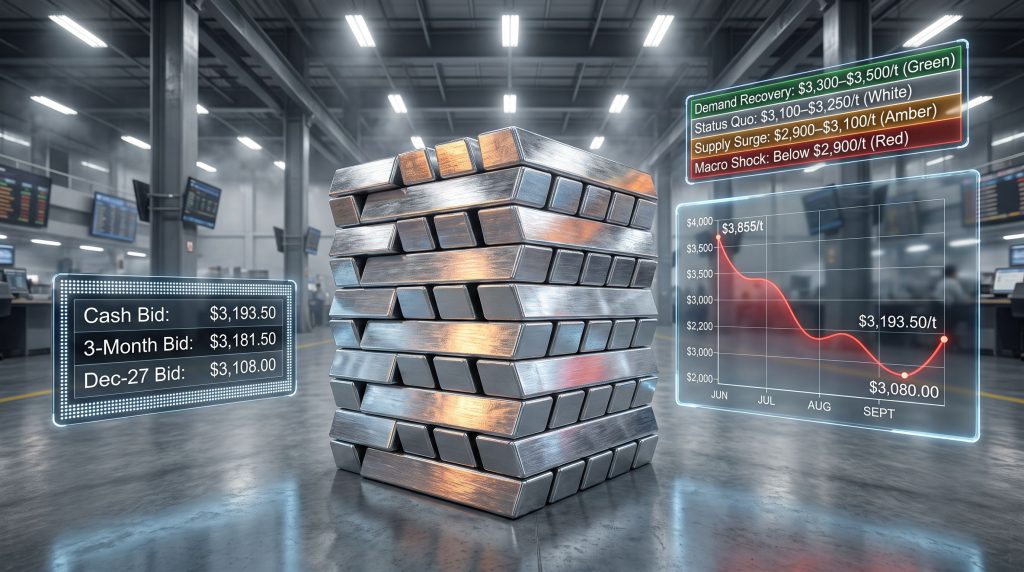
When the cash bid price moved from $3,204 per tonne on July 22 to $3,193.50 per tonne on July 23, 2026, falling 0.33% in a single session, it did not simply reflect a modest intraday decline. It marked the continuation of a correction that had been compressing margins across the value chain for nearly two months.
A Full Snapshot of LME Aluminium Pricing Across All Contract Tenors
Session-by-Session Data: July 22 to July 23, 2026
The July 23 session produced a broad-based decline that spanned every tradeable contract on the LME aluminium curve:
| Contract Type | July 22 Price | July 23 Price | Change (%) |
|---|---|---|---|
| Cash Bid | $3,204.00/t | $3,193.50/t | -0.33% |
| Cash Offer | $3,205.00/t | $3,194.00/t | -0.34% |
| 3-Month Bid | $3,183.00/t | $3,181.50/t | -0.05% |
| 3-Month Offer | $3,185.00/t | $3,182.00/t | -0.09% |
| Dec-27 Bid | $3,117.00/t | $3,108.00/t | -0.29% |
| Dec-27 Offer | $3,122.00/t | $3,113.00/t | -0.29% |
| 3M Asian Ref. Price | $3,192.50/t | $3,188.00/t | -0.14% |
What a Simultaneous Decline Across All Tenors Signals
When only spot prices fall while forward prices hold steady, the market is typically sending a signal about short-term oversupply. When the entire forward curve declines in unison, the interpretation is more bearish. It suggests that sellers are not simply offloading prompt metal but are also reducing their long-term price expectations.
The December 2027 bid falling to $3,108 per tonne is particularly noteworthy. Contracts priced nearly 18 months into the future are reflecting a market consensus that does not anticipate a swift structural recovery. Producers considering capital allocation decisions or smelter expansions would read this signal cautiously.
The 3-month Asian Reference Price closing at $3,188 per tonne is also significant for Asia-Pacific trade flows. This price governs a substantial volume of physical aluminium contracts settled in the region, and its compression toward the cash price level indicates reduced backwardation in the nearby term. In addition, the aluminum and alumina markets have faced their own structural headwinds that continue to influence sentiment across the curve.
Contextualising the Scale of the Correction: Nearly $700 Per Tonne in Eight Weeks
Tracing the Price Trajectory from Peak to Present
The current pricing environment looks markedly different from where aluminium traded in late May and early June 2026. The price trajectory over this period reveals the full magnitude of the correction:
| Date | LME Cash Settlement Price (USD/t) |
|---|---|
| 2 June 2026 | $3,855.00 |
| 18 June 2026 | $3,402.00 |
| 3 July 2026 | $3,080.00 |
| 6 July 2026 | $3,105.00 |
| 7 July 2026 | $3,119.00 |
| 8 July 2026 | $3,141.00 |
| 22 July 2026 | $3,204.00 |
| 23 July 2026 | $3,193.50 |
The peak-to-trough decline from approximately $3,855 per tonne in early June to $3,080 per tonne on July 3 represents a correction of roughly $775 per tonne, or just over 20%, in less than five weeks. The subsequent partial recovery toward $3,200 has stalled, raising the question of whether the market found genuine support or simply experienced a technical bounce off an oversold condition.
Is the Partial Recovery Sustainable?
The recovery from $3,080 back toward $3,200 looked constructive on the surface, but the resumption of declines on July 23 suggests the rebound lacked fundamental reinforcement. Technical analysts monitoring the aluminium chart would note that the market has yet to reclaim the $3,250 level convincingly, leaving the broader downtrend intact.
A price that recovers without a corresponding improvement in demand indicators, inventory drawdowns, or currency tailwinds is generally considered a technical bounce rather than a trend reversal. The distinction matters enormously for hedging decisions.
The Structural Drivers Pressing Aluminium Lower
Demand Deterioration Across Key End-Use Sectors
Aluminium is one of the most widely used industrial metals, consumed across automotive manufacturing, construction, aerospace, packaging, and increasingly, renewable energy infrastructure. When multiple downstream sectors experience simultaneous slowdowns, the aggregate impact on aluminium demand can be swift and pronounced.
The automotive sector, a leading consumer of aluminium for lightweighting applications, has faced production headwinds in 2026 from softening consumer demand and inventory management challenges among original equipment manufacturers. Construction activity in major economies has similarly moderated in response to elevated borrowing costs.
Chinese Production as a Supply Counterweight
China accounts for approximately 55-60% of global primary aluminium production, and its smelting capacity decisions fundamentally shape global supply dynamics. When Chinese output remains elevated or expands during a period of demand softness elsewhere, the result is a structural surplus that anchors prices. Consequently, China's industrial demand outlook remains a critical variable for any credible aluminium price forecast.
Unlike Western smelters, which typically respond to price signals by curtailing output, Chinese producers often continue operating due to strategic considerations, long-term power contracts, and state-linked business structures. This asymmetry between price-responsive Western supply and relatively inelastic Chinese supply creates extended price compression episodes.
Currency Dynamics and USD Correlation
Aluminium is priced in US dollars on the LME. A stronger US dollar environment mechanically reduces the purchasing power of buyers operating in other currencies, suppressing demand at the margin and placing downward pressure on USD-denominated prices. The Federal Reserve's policy trajectory therefore carries indirect but material influence over aluminium pricing.
Key Structural Pressures at a Glance
- Downstream demand weakness across automotive, construction, and general industrial sectors
- Elevated Chinese primary aluminium output maintaining supply pressure in export markets
- A stronger US dollar compressing commodity purchasing power across non-USD economies
- Trade policy uncertainty affecting cross-border aluminium flows and adding cost friction to supply chains
- Slower-than-expected restocking from fabricators who accumulated inventory during 2025
Decoding the Inventory Data: What LME Warehouse Stocks Reveal
The Warrant System Explained
LME warehouse stocks are tracked through a warrant system that distinguishes between live warrants (metal available for delivery) and cancelled warrants (metal that has been earmarked for physical withdrawal from the warehouse). The distinction is critical for understanding near-term supply dynamics.
When cancelled warrants rise, it typically signals that buyers are taking physical delivery, which reduces the available exchange stock and can tighten the spot market. When cancelled warrants fall, as occurred on July 23, it may indicate that previously flagged withdrawals have been completed or that withdrawal intentions were reversed.
| Metric | July 22 | July 23 | Change |
|---|---|---|---|
| Opening Stocks | 278,275 t | 276,775 t | -0.54% |
| Live Warrants | 245,900 t | 245,900 t | Unchanged |
| Cancelled Warrants | 30,875 t | 29,275 t | -5.18% |
Reading the July 23 Inventory Movement
The 1,500 tonne reduction in opening stocks represents a 0.54% decline in a single session. While this may appear modest in percentage terms, at the scale of LME registered warehouses, single-session drawdowns of this magnitude accumulate meaningfully over weeks. Sustained inventory declines, if driven by genuine physical demand rather than logistical repositioning, can create price floor support.
The 5.18% fall in cancelled warrants from 30,875 tonnes to 29,275 tonnes adds a layer of nuance. Fewer cancelled warrants means less metal is currently flagged for imminent physical withdrawal. This could suggest that some physical buyers who previously indicated they would take delivery have paused or reversed that intention, which is a moderately bearish signal for nearby physical demand.
The next major ASX story will hit our subscribers first
Alumina Pricing Stability: A Signal From Upstream
The Bauxite-to-Aluminium Cost Chain
Primary aluminium production follows a sequential cost chain: bauxite is mined, refined into alumina (aluminium oxide), and then smelted into primary aluminium metal using electrolytic reduction. Each stage in this chain carries its own pricing dynamics, and understanding the spread between alumina and aluminium prices provides insight into smelter profitability.
The LME Alumina Platts price holding unchanged at $337.16 per tonne on July 23 is a meaningful data point. While aluminium prices have fallen sharply from June peaks, alumina costs have not declined in parallel. This compression in the spread between input costs and output prices squeezes smelter margins and may eventually trigger production curtailments if sustained.
Historically, when aluminium prices fall sharply while alumina costs remain anchored, higher-cost smelters face the most acute pressure. Curtailments at marginal producers can then act as a self-correcting supply mechanism that eventually supports a price recovery. Furthermore, green metals pricing trends suggest that decarbonisation premiums may provide an additional floor for responsibly produced aluminium in coming years.
Recovery Scenarios and the Road Ahead for Aluminium Prices
What Would Need to Change for Prices to Recover Above $3,200?
A durable recovery above the $3,200 threshold would likely require one or more of the following catalysts:
- Accelerated restocking from downstream fabricators who have been operating on lean inventories
- Confirmed demand recovery from electric vehicle and renewable energy infrastructure build-out, both of which are structurally long aluminium
- Smelter curtailments in high-cost regions responding to margin compression from current price levels
- US dollar softening, which would mechanically support USD-denominated commodity prices
- A shift in Federal Reserve rate expectations toward accommodation, reducing the cost burden on industrial borrowers
Scenario Analysis for Q3 2026
| Scenario | Primary Driver | Price Outlook (Q3 2026) |
|---|---|---|
| Demand Recovery | EV and renewable sector restocking | $3,300-$3,500/t |
| Status Quo | Flat demand, stable supply | $3,100-$3,250/t |
| Supply Surge | Chinese output expansion continues | $2,900-$3,100/t |
| Macro Shock | Global recession signals intensify | Below $2,900/t |
Disclaimer: Scenario projections are analytical tools intended to map possible outcomes, not predictions of actual market movements. Commodity markets are subject to unpredictable geopolitical, macroeconomic, and operational variables that can cause outcomes to diverge significantly from any modelled scenario.
Downstream Industry Implications: Who Feels the Pressure First?
Automotive and Aerospace Hedging Under Price Uncertainty
Large industrial consumers of aluminium typically hedge their metal exposure through LME forward contracts, locking in prices months or years ahead. During periods of sharp price declines, companies that over-hedged at higher prices face mark-to-market losses on their hedge books even as their physical procurement costs fall. This dynamic creates financial complexity for procurement and treasury teams.
Packaging and Construction: Cost Pass-Through Dynamics
Aluminium-intensive sectors such as beverage can manufacturing and architectural products have different cost pass-through mechanisms. Packaging contracts are often structured with aluminium price escalators that reset periodically, meaning the price signal takes time to flow through to consumer-facing products. However, the aluminium market leaders with diversified downstream exposure tend to absorb these transitions more effectively than smaller, single-market operators.
Secondary Producers Gain Relative Advantage
Aluminium recyclers and secondary smelters, which process scrap rather than primary metal, operate with structurally lower energy requirements, typically consuming around 5% of the energy needed to produce primary aluminium. When primary prices fall, secondary producers face less competitive pressure from low-cost primary material, and their scrap procurement advantages become more pronounced. Tracking aluminium price movements over time helps secondary producers time their scrap purchases more strategically.
Frequently Asked Questions
What does it mean when the LME aluminium cash price falls below $3,200 per tonne?
It signals that immediate physical aluminium is being transacted at a price that many higher-cost producers find economically stressful. It also indicates that near-term demand expectations have moderated or that supply is exceeding current consumption needs.
How quickly can LME aluminium prices recover from a significant correction?
Historical corrections of 15-20% magnitude have taken anywhere from six weeks to several months to recover, depending on the underlying supply-demand rebalancing. Recoveries driven by genuine demand improvement tend to be more durable than those driven purely by speculative buying.
What is the difference between the LME cash price and the three-month aluminium price?
The cash price reflects the cost of aluminium for immediate delivery within two business days. The three-month price is the most actively traded contract and is used as the primary benchmark for hedging and physical contract pricing. The spread between the two, known as the contango or backwardation, signals whether near-term supply is tight or abundant.
Why do cancelled warrants matter to aluminium price forecasting?
Cancelled warrants indicate metal that buyers intend to withdraw from LME warehouses. Rising cancelled warrants signal physical demand absorption, which can support spot prices. Falling cancelled warrants, as seen on July 23, suggest reduced near-term withdrawal activity.
How does alumina pricing relate to the LME aluminium cash price?
Alumina is the primary raw material input for primary aluminium smelting. Its price stability at $337.16 per tonne, even as aluminium prices have declined, compresses smelter margins and raises the prospect of production curtailments, which could eventually reduce supply and support a price recovery.
What industries are most affected when aluminium prices drop sharply?
Primary aluminium producers and higher-cost smelters face the most immediate margin pressure. Downstream fabricators benefit from lower input costs, though pass-through timing varies by contract structure. Aluminium recyclers and traders with uncovered long positions in physical inventory also face valuation challenges.
Key Takeaways
- The LME aluminium cash price falling to $3,193.50 per tonne on July 23, 2026 extended a correction that began when prices peaked near $3,855 per tonne in early June, representing a decline of approximately $660 per tonne from peak to the most recent close
- Broad-based declines across all contract tenors on July 23 indicate systemic bearish sentiment rather than isolated spot-market noise, with December 2027 forward prices also retreating to below $3,115 per tonne
- LME warehouse stocks fell 0.54% in a single session while cancelled warrants dropped 5.18%, presenting a mixed signal: some physical drawdown is occurring, but near-term withdrawal intentions have moderated
- Alumina pricing stability at $337.16 per tonne highlights a cost-price squeeze for primary smelters that, if prolonged, could generate supply curtailments capable of supporting a price floor
- The forward curve pricing December 2027 contracts below $3,115 per tonne reflects market consensus that a swift structural recovery is not the base case, making near-term price developments critical to watch for all participants across the aluminium value chain
Want to Stay Ahead of the Next Major Mineral Discovery Before the Market Moves?
While aluminium price dynamics unfold across global commodity markets, Discovery Alert's proprietary Discovery IQ model scans ASX announcements in real time, delivering instant alerts on significant mineral discoveries — including those in the metals shaping the energy transition — so investors can act before the broader market catches on. Explore historic discovery returns to understand the scale of opportunity, and begin a 14-day free trial today to position yourself ahead of the next major find.