August 14, 2026
The Mineral Beneath the Map: Why Raw Material Geography Is Rewriting Global Power
For most of the twentieth century, oil defined the strategic calculus of great powers. Pipelines, tanker routes, and refinery capacity shaped alliances, triggered conflicts, and determined which nations held leverage over industrial economies. Today, a parallel dynamic is unfolding across a far more diverse portfolio of materials. Cobalt, lithium, copper, platinum group metals, and rare earth elements have quietly become the oil of the digital and electrified age, and the geography of their occurrence is concentrated in ways that create systemic vulnerabilities for the United States. The Trump Africa critical minerals investment program represents Washington's most consequential response to these vulnerabilities in decades.
That vulnerability has pushed Washington toward one of its most consequential pivots in African engagement in decades: a $500 million initiative designed to use commercial diplomacy and private capital as instruments of supply chain security rather than traditional foreign aid as a tool of development.
When big ASX news breaks, our subscribers know first
Understanding the Supply Chain Exposure Behind the Trump Africa Critical Minerals Investment Program
The strategic logic underpinning this initiative begins with a straightforward but uncomfortable set of facts. The United States depends on foreign sources for the majority of its most critical industrial minerals. Across categories including cobalt, manganese, graphite, and several rare earth elements, import reliance exceeds 90% in some cases, according to data from the U.S. Geological Survey.
What makes this dependency particularly acute is not merely the geography of ore deposits, but the geography of processing. China has built dominant positions not just in mining, but across the midstream and downstream stages of critical mineral supply chains, including crushing, chemical processing, and refining into battery-grade or industrial-grade materials. This means that even ore extracted outside China frequently passes through Chinese processing infrastructure before it becomes usable by U.S. manufacturers.
Furthermore, China's rare earth strategy has demonstrated how control over processing stages can be weaponised as a geopolitical tool, creating leverage that extends well beyond conventional trade relationships.
The distinction between mining and processing is one of the most underappreciated dynamics in critical minerals analysis. A country can produce ore while remaining almost entirely dependent on a rival nation's processing infrastructure to convert that ore into a usable industrial input. Supply chain sovereignty requires control at multiple stages, not just extraction.
This structural reality is what has driven bipartisan concern across multiple U.S. administrations and ultimately produced the architecture now being deployed through the Trump Africa critical minerals investment program.
Africa's Mineral Endowment: A Quantified Picture
Sub-Saharan Africa's mineral endowment is not simply large — it is irreplaceable within any realistic short-to-medium term supply diversification strategy. No alternative sourcing geography exists that could substitute for African production in several critical categories without decade-scale development timelines and capital commitments measured in the hundreds of billions. The critical minerals demand surge projected through 2030 makes this reality increasingly urgent for policymakers.
| Mineral | Primary African Country | Strategic Significance |
|---|---|---|
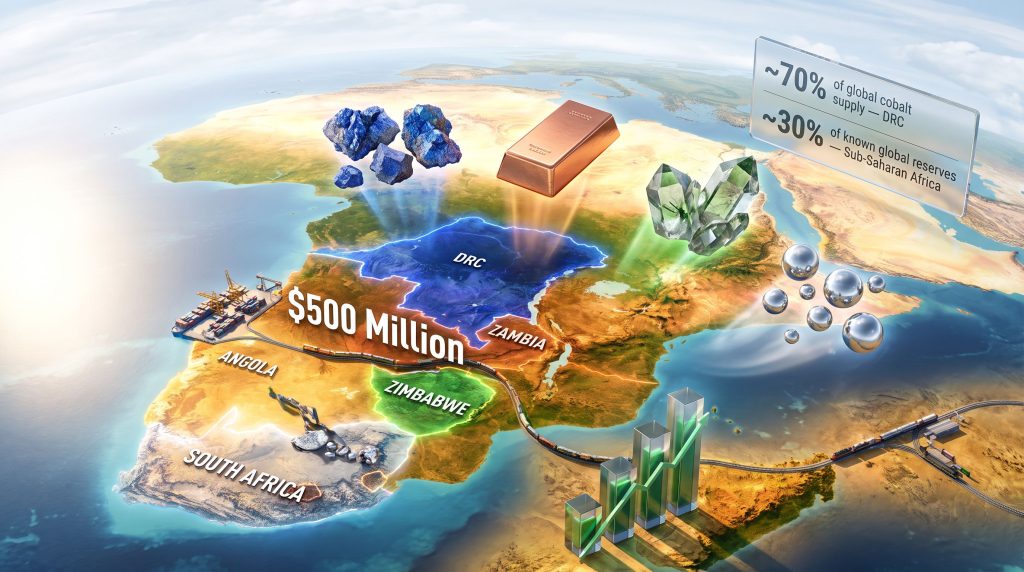
| Cobalt | Democratic Republic of Congo (~70% of global supply) | Essential for lithium-ion battery cathodes used in EVs and defence electronics |
| Platinum Group Metals | South Africa (dominant global producer) | Critical for hydrogen fuel cells, catalytic converters, and advanced industrial processes |
| Copper | Zambia (top-tier global producer) | Foundational for electrification infrastructure, EV motors, and grid systems |
| Lithium | Zimbabwe (fastest-growing African producer) | Core battery anode and cathode chemistry input for all major battery architectures |
| Critical Minerals (combined) | Sub-Saharan Africa broadly | Estimated ~30% of known global reserves across all critical mineral categories |
One dimension that receives less mainstream attention is the quality dimension of African mineral deposits. The DRC's cobalt, for instance, is not simply abundant; much of it occurs as a byproduct of copper mining, meaning its extraction economics are tied to copper price cycles in ways that create periodic supply volatility.
This geological co-occurrence dynamic matters significantly to supply chain planners because it means cobalt supply cannot be easily isolated or ramped independently of copper market conditions. Similarly, Zimbabwe's lithium deposits include hard-rock pegmatite sources, which typically yield higher-grade spodumene concentrate compared to brine-based sources. This geological characteristic matters for downstream processing economics, as higher-grade feedstocks require less energy and chemical input to refine to battery-grade lithium carbonate or lithium hydroxide.
Program Architecture: What the $500 Million Actually Buys
The U.S.-Africa Strategic Investment Program, administered by the State Department's Bureau of African Affairs, is structured to operate as an enabling layer rather than a direct capital deployment vehicle. Its design reflects a theory of change: that the primary obstacle to U.S.-aligned investment in African mineral sectors is not a shortage of private capital but a shortage of the conditions that make private capital willing to commit.
Program Structure at a Glance:
- Total program value: $500 million
- Administering body: U.S. Department of State, Bureau of African Affairs
- Grant mechanism: Up to 10 cooperative agreements or individual grants
- Award range per grant: $5 million to $50 million
- Geographic scope: Sub-Saharan Africa
- Dual focus: Critical mineral supply chains and Commercial Diplomacy Acceleration
Pillar One: Six Operational Targets Within the Mineral Supply Chain
The mineral supply chain pillar addresses six distinct intervention points, each targeting a different bottleneck in the pathway from geological resource to commercially deliverable mineral product:
-
Geological mapping and resource characterisation — Many African mineral-rich regions remain geologically underexplored at the resolution required for bankable feasibility studies. Improving subsurface data reduces exploration risk and accelerates project development timelines for private investors.
-
Regulatory streamlining — Permitting and licensing timelines across multiple African jurisdictions remain among the longest globally. Compression of these timelines directly reduces the cost of capital for project developers.
-
In-country processing and refining expansion — This is one of the most commercially and politically sensitive areas. African governments have increasingly demanded value addition within their borders rather than export of unprocessed ore. This pillar seeks to build processing capacity that satisfies both investor return requirements and host-country development objectives.
-
Technical workforce development — Operating and maintaining modern mining and processing facilities requires specialised skills in metallurgy, plant engineering, and environmental management that are in short supply across much of sub-Saharan Africa.
-
Transaction advisory services — Many commercially viable African mining projects stall not because capital is unavailable but because the deal-structuring, legal, and financial expertise required to reach financial close is absent on the ground. Advisory support directly addresses this bottleneck.
-
Alternative processing node development — Reducing the concentration of processing capacity within Chinese-controlled networks by building viable processing infrastructure in Africa and other U.S.-aligned geographies is a long-term strategic objective embedded within this pillar.
Pillar Two: Commercial Diplomacy Acceleration
The second pillar extends the programme's scope beyond the mining sector, targeting investment environment reforms across energy, telecommunications, emerging technologies, and artificial intelligence. This reflects Washington's broader thesis that mineral supply chain security cannot be achieved in isolation from the broader investment climate of African partner nations. Indeed, the energy security risks associated with concentrated supply chains have made this holistic approach increasingly necessary.
The Larger Architecture: Placing $500 Million in Strategic Context
A critical error in media coverage of this initiative has been treating the $500 million grant programme as the totality of Washington's African mineral strategy. It is more accurately understood as the diplomatic and regulatory scaffolding upon which a far larger capital structure is being built.
| Programme or Initiative | Approximate Value | Primary Function |
|---|---|---|
| U.S.-Africa Strategic Investment Program | $500 million | Grants for supply chain development and regulatory reform |
| Lobito Corridor (rail and port infrastructure) | $500M+ (broader commitments ~$5 billion) | Strategic mineral export corridor linking DRC/Zambia copper belts to Angola's Atlantic coast |
| Project Vault (U.S. strategic mineral reserve) | ~$12 billion (including $10B EXIM Bank loan) | Domestic strategic reserve to buffer U.S. manufacturers from supply disruption events |
| DFC Critical Minerals Portfolio | Ongoing | U.S. International Development Finance Corporation equity and debt investments in African mining |
| Phalaborwa Rare Earths Project | $50 million U.S. equity investment | Country-specific rare earths development execution in South Africa |
The $500 million grant programme is best understood as the diplomatic infrastructure layer of a tiered strategy. It creates the regulatory, geological, and transactional conditions that justify and de-risk the far larger capital deployments flowing through the DFC, EXIM Bank, and private sector channels.
The Lobito Corridor: Infrastructure as Geopolitical Strategy
The Lobito Corridor deserves particular attention because it illustrates a dimension of mineral strategy that goes beyond extraction: logistical control. China has invested heavily in African port and rail infrastructure over two decades, creating export routes that direct mineral shipments through Chinese-influenced logistics networks.
The Lobito Corridor, connecting the copper belts of the DRC and Zambia to Angola's Atlantic port of Lobito, represents a direct effort to create a commercially viable alternative. Mineral shipment volumes transiting the Lobito Corridor are identified in the programme's framework as a key performance indicator, signalling that Washington views logistical infrastructure as inseparable from supply chain security.
The U.S.-China Competition: What Two Decades of Asymmetric Investment Created
Understanding the competitive challenge facing Washington requires understanding the depth of China's structural position across African mineral supply chains. Chinese state-backed entities began acquiring mining stakes, building processing facilities, and financing African infrastructure in the early 2000s, operating under a strategic patience that U.S. private capital, with its quarterly reporting cycles and return-on-investment timelines, has historically found difficult to match.
The resulting asymmetry is significant:
- Chinese entities hold long-term offtake agreements across DRC cobalt and Zambian copper that lock in material flows for years or decades ahead.
- Chinese-built processing infrastructure in several African countries creates dependencies that are difficult to displace even when alternative investors are available.
- Chinese financing models, which frequently bundle mineral access with infrastructure development and sometimes sovereign debt instruments, offer host governments packages that U.S. commercial capital alone cannot easily replicate.
However, the US-Congo minerals partnership represents one of the more concrete efforts to shift this balance, offering an alternative framework that African governments can weigh against Chinese financing arrangements.
Zimbabwe's lithium sector illustrates the urgency of this dynamic. With the country reporting a fresh $300 million in new investor interest, some of which is believed to originate from Chinese-linked sources, the window for U.S.-aligned capital to establish a competitive foothold is narrowing. The Trump Africa critical minerals investment program is, in part, a race against that closing window.
The next major ASX story will hit our subscribers first
Geopolitical Friction: The Contradictions Washington Must Resolve
The initiative's design contains an internal tension that analysts have highlighted as potentially its most significant long-term risk. Washington is simultaneously pursuing commercial partnership with African nations while deploying trade policy instruments — including tariffs and foreign aid reductions — that have created diplomatic friction with several of the same governments it seeks as mineral partners.
African nations are increasingly sophisticated actors in mineral access negotiations. Several governments, including those of the DRC and Zimbabwe, have enacted or signalled policies requiring local beneficiation, meaning the processing of raw ore within national borders rather than export of unrefined material. These policies reflect legitimate development aspirations but can complicate investor return calculations, particularly in the early stages of project development.
Washington's approach faces a fundamental test of coherence: it seeks mineral partnerships framed around mutual commercial benefit while simultaneously applying economic pressure through trade policy that signals a transactional rather than a partnership-oriented relationship. The resolution of that contradiction will be more determinative of this programme's long-term success than the scale of its grant awards.
Consequently, the defence critical materials dimension of this competition adds further urgency, as allied nations including Australia are independently developing strategies to reduce exposure to similar supply chain vulnerabilities.
Measuring What Success Actually Looks Like
The programme departs from traditional development assistance frameworks by defining success through commercial, rather than humanitarian, metrics. This represents a meaningful methodological shift in how Washington evaluates Africa engagement outcomes.
The five measurable dimensions of success:
- Number of U.S. and U.S.-aligned companies entering African critical mineral sectors for the first time
- Total dollar value of investments and mineral offtake agreements secured by those companies
- Quality and transparency improvements in partner-country regulatory frameworks for mining
- Revenue increases accruing to African governments from better-governed, more transparent mining operations
- Volume of mineral shipments transiting the Lobito Corridor as a proxy for logistical infrastructure utilisation
This metrics framework reveals the programme's underlying theory: that the most durable form of supply chain security is not grant-funded projects but commercially viable, privately operated supply chains that generate sufficient returns to sustain themselves beyond the period of U.S. government support.
The Aid-to-Investment Transition: A Structural Comparison
| Dimension | Traditional Aid Model | New Investment-Led Model |
|---|---|---|
| Primary instrument | Development assistance grants | Private capital and commercial partnerships |
| U.S. government role | Donor and programme implementer | Market enabler and deal facilitator |
| African government role | Aid recipient | Commercial partner with sovereign agency |
| Primary success metric | Humanitarian and development outcomes | Investment volumes and offtake agreements |
| Strategic objective | Development stability | Supply chain security and market access |
| Response to Chinese competition | Indirect at best | Explicit and operationally direct |
Secretary of State Marco Rubio articulated the philosophical underpinning of this shift in the programme's policy documentation, stating that the administration's approach would centre trade over aid, opportunity over dependency, and investment over assistance. This framing reflects a substantive restructuring of U.S.-Africa engagement doctrine, not merely a change in funding mechanisms.
Country-Level Dynamics: Where the Strategic Bets Are Being Placed
Democratic Republic of Congo
The DRC occupies a position of irreplaceable strategic importance, supplying approximately 70% of global cobalt production. U.S. strategy in the DRC is focused on creating entry points for aligned investors into a mining sector where Chinese entities have established extensive equity positions. The Lobito Corridor is the most visible expression of U.S. engagement, providing an export infrastructure alternative to existing routes.
Zambia
As one of the world's premier copper-producing nations, Zambia is a central node in the Lobito Corridor's commercial logic. U.S. investment interest is concentrated on copper extraction and processing capacity expansion, with the DFC identified as a vehicle for equity and debt participation in viable projects.
South Africa
South Africa's dominance in platinum group metals — which are critical for hydrogen fuel cell technology, industrial catalysis, and advanced electronics — has attracted direct U.S. equity investment. The $50 million U.S. equity stake in the Phalaborwa rare earths project represents one of the most concrete examples of country-specific deal execution within the broader strategy.
Zimbabwe
Zimbabwe's hard-rock pegmatite lithium deposits are attracting intense international attention. The country's lithium resource base is characterised by spodumene-bearing pegmatites that can yield high-grade concentrate, a geological quality advantage in the global lithium supply chain. With $300 million in fresh investor capital reported, the competition for Zimbabwe's lithium sector is already well advanced.
Angola
Angola's strategic role in this architecture is primarily logistical. The port of Lobito serves as the Atlantic terminus of the entire Lobito Corridor investment, making Angola's continued partnership with U.S. commercial diplomacy objectives essential to the infrastructure investment's functionality.
What to Watch: Near-Term Indicators of Programme Traction
For investors and analysts tracking the Trump Africa critical minerals investment program's real-world impact, the following developments over the next 12 to 24 months will be the most revealing signal set:
- Grant award announcements from the Bureau of African Affairs identifying the first funded project cohort and the organisations receiving cooperative agreements
- Lobito Corridor construction milestone completions and initial mineral shipment data through the Angola terminal
- DFC deal announcements specifically in DRC, Zambia, and Zimbabwe, which would indicate the enabling layer of the grant programme is translating into larger capital commitments
- African government responses to regulatory reform requests embedded in commercial diplomacy engagement, particularly around permitting timeline compression and local processing requirements
- The competitive response of Chinese state-backed entities to U.S. entry attempts, which may include accelerated offtake agreement renewals or infrastructure investment announcements designed to foreclose U.S.-aligned access
The programme's ultimate measure of success will not be the number of grants awarded or diplomatic agreements signed. It will be whether commercially self-sustaining, U.S.-aligned mineral supply chains are delivering consistent material flows to American manufacturers within a five-to-ten year horizon. That gap between diplomatic intent and operational supply chain reality remains the defining challenge Washington has yet to fully resolve.
Disclaimer: This article is intended for informational purposes only and does not constitute financial, investment, or legal advice. Forecasts, projections, and assessments of programme outcomes involve inherent uncertainty and should not be relied upon as guarantees of future results. Readers should conduct their own due diligence before making investment decisions based on information contained herein.
Want to Stay Ahead of the Next Major Mineral Discovery Driving These Supply Chain Shifts?
As critical minerals reshape global power dynamics and investment capital floods into African and ASX-listed exploration plays, Discovery Alert's proprietary Discovery IQ model delivers real-time alerts on significant ASX mineral discoveries — instantly translating complex geological and commodity data into actionable investment insights for both short-term traders and long-term investors. Explore historic discovery returns that demonstrate just how transformative early-mover positioning can be, and begin your 14-day free trial today to secure a market-leading edge before the broader market catches on.