July 24, 2026
The Geography of Risk: How Gulf Oil Exporters Are Rebuilding the World's Energy Architecture
For decades, energy strategists have described the Strait of Hormuz as the single most consequential 23 miles of water on the planet. Roughly 20% of global oil supply has historically flowed through this narrow corridor, hemmed in on one side by the Arabian Peninsula and on the other by Iranian territory. When regional conflict intensifies, that geographic reality stops being an abstract vulnerability and starts becoming an operational emergency. The current pressure cycle across the Middle East has done exactly that, converting years of theoretical planning around Gulf pipeline projects to bypass the Strait of Hormuz into urgent, capital-backed construction programmes with defined timelines and measurable throughput targets.
What makes this infrastructure wave genuinely different from previous bypass discussions is the simultaneity of it. Saudi Arabia, the UAE, and Iraq are all advancing major overland and coastal corridor projects at the same time, driven by the same strategic imperative: reducing existential dependence on a maritime chokepoint that sits along an adversarial state's coastline. The downstream consequence of this convergence extends far beyond the Gulf itself, reshaping trade dynamics along Africa's Red Sea rim in ways that are only beginning to be understood.
When big ASX news breaks, our subscribers know first
Why Hormuz Cannot Simply Be Replaced
Understanding the scale of what these pipeline projects are attempting requires first appreciating why the Strait of Hormuz is so structurally difficult to replicate. The navigable shipping lane through the strait measures roughly 33 kilometres wide, but the usable corridor for very large crude carriers (VLCCs) is considerably narrower. Iran's physical proximity to those shipping lanes creates what defence analysts describe as an asymmetric threat environment: relatively low-cost interdiction tools, including mines, drones, and fast-attack vessels, can exert disproportionate disruption pressure on a corridor handling millions of barrels per day.
The historical roots of bypass thinking trace directly to the Iran-Iraq War of the 1980s, when the threat of Hormuz closure first catalysed serious overland infrastructure investment. Saudi Arabia's East-West Pipeline was a direct product of that era, and it remains operational today. The lesson from that period, now being applied at much larger scale, is that no single pipeline can replicate Hormuz's total throughput capacity. The only viable approach is a networked set of corridors that collectively absorb a meaningful share of Gulf export volumes.
Furthermore, crude oil geopolitical risks continue to amplify the urgency behind these infrastructure decisions, pushing producers to accelerate timelines that might otherwise stretch across a decade or more.
Before the current regional conflict, approximately 15 to 20 million barrels of Persian Gulf oil passed through the Strait of Hormuz every day. Even partial disruption of that flow carries immediate and severe consequences for global oil prices, supply chains, and energy-importing economies far removed from the conflict zone itself.
A Country-by-Country Breakdown of the Seven Major Projects
Saudi Arabia: The East-West Pipeline and Its Limitations
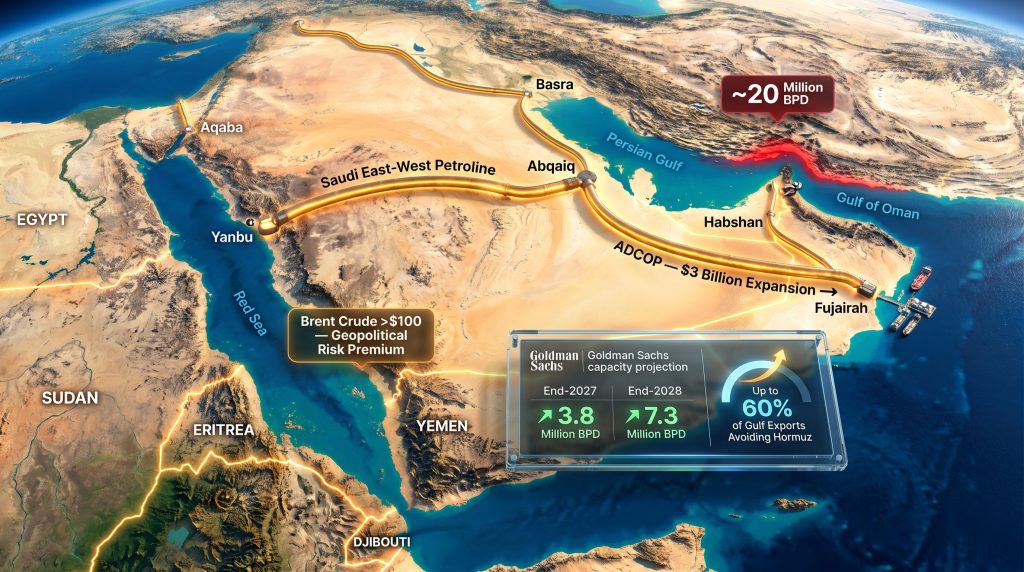
Saudi Arabia's Petroline, the East-West Pipeline, runs from the eastern production fields through the Abqaiq processing hub and terminates at the Yanbu export terminal on the Red Sea coast. Built in the 1980s specifically to provide Hormuz bypass capability, the pipeline has experienced a significant increase in strategic relevance as current regional tensions have escalated.
Yanbu's position on the Red Sea gives Saudi Arabia direct access to shipping lanes serving both European and Asian buyers, though the economics differ depending on destination. Expansion considerations for both the pipeline and the Yanbu terminal infrastructure are reportedly under evaluation. However, the project's vulnerability was starkly illustrated when Houthi drone strikes targeted the East-West Pipeline itself, demonstrating that overland bypass routes carry their own threat exposure.
This creates what analysts describe as a strategic paradox: the Red Sea corridor that Hormuz bypass infrastructure is designed to feed is simultaneously subject to interdiction from Yemen-based forces with Iranian backing, meaning Gulf producers are effectively managing two distinct geopolitical risk layers rather than eliminating one.
UAE: A $3 Billion Bet on Fujairah
The UAE's infrastructure commitment is among the most concrete and time-bound of the current bypass programmes. The Abu Dhabi Crude Oil Pipeline (ADCOP), linking production assets at Habshan to the Fujairah terminal on the Gulf of Oman, is already operational as a Hormuz bypass route. The current expansion programme, valued at approximately $3 billion, is reported to be roughly 50% complete as of mid-2026, with targeted delivery around mid-2027.
The strategic significance of Fujairah lies in its geography. Unlike Red Sea terminals, Fujairah sits on the Gulf of Oman, entirely outside the Strait of Hormuz's threat envelope and beyond the reach of Houthi anti-shipping operations. Upon completion, the expansion is projected to add more than 1 million barrels per day of additional bypass capacity, making it the most operationally significant near-term addition to the Gulf's export infrastructure.
The UAE is also reported to be developing a new port and container terminal on the Arabian Sea, extending bypass logic beyond crude oil to general cargo flows. The potential integration of this infrastructure with the India-Middle East-Europe Economic Corridor (IMEC) suggests the UAE is pursuing a broader vision of Fujairah as a regional energy and logistics hub rather than simply a pipeline terminus.
Iraq: The Most Ambitious and Most Uncertain Corridor
Iraq's bypass strategy is simultaneously the most expansive in scope and the most exposed to geopolitical delay. The primary concept involves linking southern Iraqi production at Basra northward through Haditha toward Turkish and Syrian Mediterranean terminals, with potential throughput capacity of up to 2 million barrels per day if fully realised. However, most segments remain in advanced planning and bilateral negotiation rather than active construction.
Turkish transit politics and Syrian reconstruction timelines introduce significant uncertainty. Both countries represent essential waypoints for the Mediterranean route, and neither relationship is without friction. The viability of this corridor depends as much on diplomatic continuity as on engineering capacity.
A secondary Iraqi option involves a proposed pipeline to Jordan's Aqaba port on the northern Red Sea. This route would give Iraq direct Red Sea access without crossing Saudi or Emirati territory, integrating Iraqi exports into the broader Red Sea corridor taking shape across the region. Financing discussions and bilateral negotiations with Jordan and international development partners are ongoing. In addition, OPEC's market influence over production allocation decisions will play a significant role in determining how quickly these Iraqi corridors move from negotiation to construction.
The Capacity Build-Out: What Goldman Sachs Projects
The most comprehensive quantitative framework for the combined bypass programme comes from Goldman Sachs, whose projections provide a useful statistical anchor for assessing the infrastructure transition's scale.
| Metric | End-2027 Estimate | End-2028 Estimate |
|---|---|---|
| Combined bypass capacity added | 3.8 million bpd | 7.3 million bpd |
| Pre-conflict Gulf export baseline | ~23 million bpd | ~23 million bpd |
| Share of exports potentially avoiding Hormuz | ~30-35% | Up to 60% |
| Current Hormuz daily throughput (pre-conflict) | ~20 million bpd | ~20 million bpd |
Critical context: Even at the 2028 upper-bound projection of 7.3 million barrels per day in combined bypass capacity, a substantial volume of Gulf crude will remain structurally dependent on Hormuz passage. These projects reduce chokepoint exposure; they do not eliminate it.
The residual 40% of exports still transiting Hormuz at the 2028 projection ceiling represents a persistent systemic risk that global oil markets will continue pricing in. Energy markets price tail risk, not average outcomes, which means the Hormuz geopolitical risk premium embedded in Brent crude above $100 per barrel will not fully deflate even as bypass infrastructure scales substantially. Strategic petroleum reserve releases from major importing economies serve as a complementary risk management tool during this transition period, but they cannot substitute for structural capacity additions.
Africa's Red Sea Coastline: From Transit Geography to Strategic Asset
The downstream consequence of the Gulf's infrastructure pivot is a meaningful elevation in the strategic importance of the Red Sea's African coastline. Nations bordering the waterway, particularly Egypt, Sudan, Eritrea, and Djibouti, are positioned along what is rapidly becoming a tier-one global energy corridor.
Their positions differ considerably in terms of existing infrastructure and proximity to commercial opportunity:
- Egypt holds a dual-role advantage, combining Red Sea coastline access with Suez Canal transit revenues. Increased energy corridor traffic through the Red Sea compounds Egypt's existing strategic value as a transit nation, though the Suez Canal's inability to accommodate VLCCs limits how much redirected crude can flow northward toward European markets.
- Djibouti operates established port infrastructure at a chokepoint position at the southern entrance to the Red Sea, with meaningful potential as a bunkering and logistics hub serving expanded energy flows.
- Sudan and Eritrea have less-developed coastlines but represent longer-term infrastructure investment opportunities as energy corridor development follows the commercial traffic.
The Suez Canal constraint deserves particular emphasis. Because VLCCs, the dominant vessel class for long-haul crude shipments, cannot physically transit the canal, oil destined for Asian markets via Red Sea terminals may require routing around the Cape of Good Hope. This adds significant voyage distance and freight cost, consequently influencing the economics of Red Sea export terminals and shaping which buyers can efficiently access Gulf crude through bypass routes.
The Dual-Risk Problem: Houthi Activity in the Alternative Corridor
One of the less-discussed but critically important dimensions of the bypass infrastructure story is that the Red Sea corridor carries its own independent security risk profile. Houthi forces operating from Yemen have conducted sustained anti-shipping operations across the Red Sea, including documented strikes on Saudi oil tankers, and have demonstrated the capability to target pipeline infrastructure directly.
| Risk Factor | Strait of Hormuz | Red Sea Corridor |
|---|---|---|
| Primary threat actor | Iranian naval and IRGC forces | Houthi rebel forces (Yemen) |
| Proxy relationship | Direct state control | Iranian-backed non-state actor |
| Historical disruption record | Multiple mining and tanker incidents | Ongoing anti-shipping campaign from 2023 |
| Infrastructure vulnerability | Shipping lanes | Pipelines and tanker routes |
| Diplomatic resolution pathway | Iran nuclear negotiations | Yemen peace process |
The Iran-Houthi strategic relationship effectively extends Tehran's disruptive reach beyond Hormuz into the Red Sea, meaning Gulf producers are not simply trading one risk for another with a lower probability. They are managing two overlapping threat vectors simultaneously, each with different actors, different escalation dynamics, and different diplomatic resolution pathways. The broader dynamics of trade and geopolitics affecting energy infrastructure investment further complicate how quickly these corridors can be made commercially viable.
The commercial impact of Houthi activity has been material and measurable. The first Nigerian LNG shipment to cross the Red Sea in four months, reported in mid-2026, illustrated how sustained Houthi operations had suppressed regular commercial traffic through the very corridor that bypass infrastructure is intended to strengthen.
The next major ASX story will hit our subscribers first
Three Scenarios for Gulf Export Architecture Through 2028
Scenario 1: Accelerated Completion Reaches 60% Bypass by 2028
This outcome requires sustained capital deployment across all three major producing nations, stable construction environments in Iraq and the UAE, and a meaningful reduction in Houthi activity in the Red Sea. Under these conditions, the Hormuz risk premium embedded in Brent crude pricing would compress, African coastal economies would begin receiving infrastructure spillover investment, and the geopolitical leverage Iran derives from Hormuz proximity would structurally diminish.
Scenario 2: Partial Build-Out Plateaus at 30-40% Bypass Capacity
The more probable near-term outcome involves Iraqi route delays driven by transit-country political complications, combined with Houthi activity continuing to suppress Red Sea terminal utilisation. Brent crude volatility would remain elevated, Hormuz dependency would persist for the majority of Gulf exports, and the uplift for African Red Sea economies would be limited to Egypt and Djibouti in the near term.
Scenario 3: Strategic Stagnation Below 20% Bypass Capacity
A scenario in which escalation in Yemen renders Red Sea terminals commercially unviable, financing gaps impede Iraqi infrastructure, or diplomatic breakdown interrupts transit-country relationships would leave Hormuz as the dominant chokepoint with intensified oil price volatility as the consequence. This scenario would likely accelerate interest in non-Gulf supply sources and compress timelines for energy transition investment, as importing nations would face urgent incentives to reduce oil dependency rather than simply diversify supply routes.
Frequently Asked Questions
Will These Pipelines Fully Replace the Strait of Hormuz?
No. Even at maximum projected capacity by end-2028, the Goldman Sachs figures suggest bypass infrastructure would cover approximately 60% of pre-conflict Gulf export volumes at the upper bound. Hormuz will remain the structurally dominant export corridor through at least the end of the current decade.
Which African Nations Benefit Most Directly from Increased Red Sea Energy Traffic?
Egypt and Djibouti are best positioned in the near term due to existing infrastructure. Sudan and Eritrea represent longer-cycle opportunities dependent on sustained infrastructure investment following initial corridor development.
What Are the Primary Risks to These Projects?
The main risk factors include:
- Continued Houthi anti-shipping and anti-infrastructure operations in the Red Sea
- Transit-country geopolitical instability, particularly across Iraq's northern export corridors
- Financing constraints for large-scale cross-border infrastructure in politically complex terrain
- Technical construction challenges in conflict-adjacent areas
- Diplomatic friction with transit nations, especially Turkey and Jordan
What Is the Transportation Cost Impact of Red Sea Routing for Asian Buyers?
The inability of VLCCs to transit the Suez Canal means Asian buyers accessing Gulf crude via Red Sea terminals may face Cape of Good Hope routing costs, adding substantial voyage time and freight expense compared to direct Hormuz transit. This cost differential will influence long-term supply contract structures between Gulf producers and Asian refiners. For further insight into how these routing decisions affect broader energy market dynamics, the International Energy Agency publishes regular analysis on global oil trade flow shifts.
The Long-Term Structural Shift
The infrastructure transition currently underway across the Gulf represents the most consequential reorganisation of global oil export architecture since the original pipeline construction era of the 1970s and 1980s. The move from single-chokepoint dependency toward a distributed network of overland and coastal export corridors is rebalancing geopolitical leverage away from Iran's geographic position and toward the transit-country relationships that underpin each bypass route.
For Africa's Red Sea rim, the implications extend beyond immediate commercial opportunity. Port capacity expansion, pipeline terminal development, and bunkering infrastructure investment represent a structural economic opportunity that could reposition countries like Egypt and Djibouti as permanent fixtures in the global energy supply chain rather than incidental geography. The U.S. Energy Information Administration tracks evolving chokepoint throughput data that underscores just how critical these alternative corridors are becoming to global supply resilience.
The open question is whether African coastal nations can mobilise the institutional frameworks, multilateral financing relationships, and infrastructure development capacity required to capture value from this transition actively, rather than simply serving as the geography through which redirected oil happens to flow. The window for positioning around Gulf pipeline projects to bypass the Strait of Hormuz is open, but the construction timelines suggest it will not remain open indefinitely.
This article contains forward-looking projections, including capacity estimates sourced from Goldman Sachs research, that are subject to material change based on geopolitical developments, construction timelines, and financing conditions. Nothing in this article constitutes investment advice. Readers should conduct independent research before making any financial decisions.
For additional context on how Hormuz disruptions are affecting African central bank policy and regional trade flows, further reporting is available from Business Insider Africa at africa.businessinsider.com.
Want to Stay Ahead of the Next Major Resource Discovery Reshaping Global Markets?
As geopolitical pressures accelerate the redrawing of global energy infrastructure, the ripple effects on commodity markets and mineral exploration are significant — Discovery Alert's proprietary Discovery IQ model instantly identifies significant ASX mineral discoveries across more than 30 commodities, delivering real-time alerts that turn complex market shifts into actionable investment opportunities. Explore how historic mineral discoveries have generated substantial returns and begin your 14-day free trial today to position yourself ahead of the broader market.