July 24, 2026
The Battery Metal That One Country Controls — and How That Power Is Being Weaponised
Commodity markets rarely pivot on the decisions of a single government. Crude oil has OPEC. Rare earths have China. And cobalt, the metal underpinning the energy storage systems powering the global electric vehicle transition, has the Democratic Republic of Congo. Understanding how Kinshasa is now actively deploying that concentration of supply as a policy instrument — and what it means for battery manufacturers, automakers, and investors worldwide — requires stepping back from the immediate price action and examining the structural mechanics at play.
The DRC cobalt export quotas and global cobalt deficit story is not simply about a country restricting exports to lift prices. It is a more complex and consequential question of whether a resource-rich nation can convert short-term supply leverage into durable industrial development before the very technology driving cobalt demand evolves beyond it.
When big ASX news breaks, our subscribers know first
From Glut to Gap: How the Cobalt Market Reached This Inflection Point
For several years preceding 2025, the cobalt market laboured under the weight of chronic oversupply. A combination of aggressive capacity expansion in the DRC, growing byproduct output from copper operations, and rising Indonesian nickel production — which yields cobalt as a secondary product — pushed global inventories well above demand. Prices collapsed accordingly, falling to a range of roughly $15,000 to $20,000 per metric ton at their lowest point in 2024 and early 2025, a level that made many operations economically marginal.
That prolonged period of oversupply created the conditions for the policy intervention that followed. With domestic mining revenues under severe pressure, Kinshasa concluded that market forces alone would not restore price equilibrium within a reasonable timeframe. The response was deliberate and sequenced: a temporary export ban in early 2025, followed by the introduction of a structured quota framework from October 2025 onward. The DRC cobalt export ban has since become one of the most consequential supply management decisions in recent commodity market history.
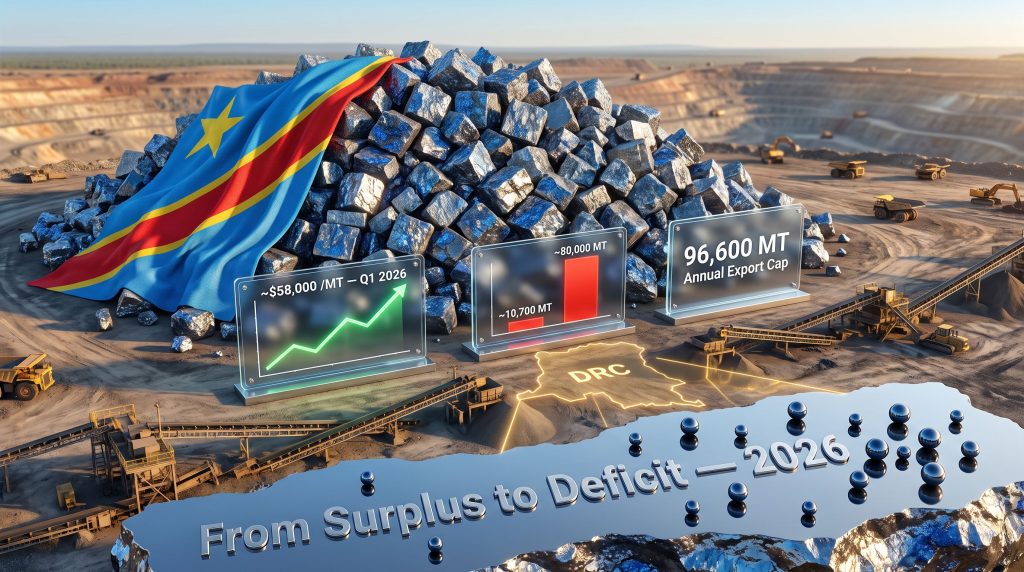
The results were rapid. According to the International Energy Agency's Global Minerals Outlook 2026, cobalt prices reached approximately $58,000 per metric ton in the first quarter of 2026, representing more than a tripling from their prior-year lows. That price recovery validated the core premise of the DRC's supply management strategy, even as it introduced new uncertainties for downstream buyers. For a deeper cobalt export suspension analysis, the sequencing of these policy decisions reveals a calculated and deliberate approach.
Cobalt Price Trajectory: Key Reference Points
| Period | Approximate Price (USD/MT) | Market Condition |
|---|---|---|
| Pre-restriction lows (2024 to early 2025) | ~$15,000 to $20,000 | Deep oversupply |
| Q1 2026 | ~$58,000 | Post-ban, quota-driven tightening |
| Outlook (2026 to 2027) | Elevated / supported | Deficit conditions expected |
How the DRC's Export Quota Architecture Actually Functions
The mechanics of the DRC cobalt export quota system are more sophisticated than a simple volume cap. The framework divides the total annual allocation into two distinct pools, each administered through separate channels.
The base company quota of 87,000 metric tons is distributed among individual mining operators based on their documented production history and shipping records. This data-driven allocation methodology is significant: it signals a deliberate shift toward active, evidence-based supply management rather than a blunt blanket restriction. Companies with stronger production track records receive larger allocations, creating competitive incentives within the framework.
The remaining 9,600 metric tons are held as a strategic reserve quota managed directly by ARECOMS, the Congolese state minerals authority. This reserved tranche gives the government discretionary control over a meaningful volume of supply, independent of private sector decisions.
DRC Export Quota Framework: 2026 to 2027
| Quota Component | Volume (Metric Tons) | Administered By |
|---|---|---|
| Base company quota | 87,000 | Mining operators |
| Strategic reserve quota | 9,600 | ARECOMS (state regulator) |
| Total annual cap | 96,600 | Combined |
| Transitional 2025 allocation (Oct–Dec) | 18,125 | ARECOMS |
The 2025 production and export data illuminates just how dramatically supply has been compressed. The DRC produced approximately 100,015 metric tons of cobalt in 2025 but exported only 44,333 metric tons, meaning that more than half of total domestic output was withheld from global markets during that period. The 2026 quota ceiling of 96,600 tons, while nominally higher than 2025 exports, still represents roughly half of the country's 2024 production volume, which exceeded 200,000 metric tons.
DRC Production Versus Export: The Supply Withdrawal in Numbers
| Year | DRC Cobalt Production (MT) | DRC Cobalt Exports (MT) | Withheld Volume (MT) |
|---|---|---|---|
| 2024 | ~200,000+ | Not restricted | Minimal |
| 2025 | 100,015 | 44,333 | ~55,682 |
| 2026 (cap) | N/A | 96,600 (max) | Policy-dependent |
The Deficit Scenarios: A Range With Enormous Consequences
Multiple independent forecasting bodies have converged on a shared directional assessment: the global cobalt market is entering a period of structural tightness. However, the magnitude of the projected deficit varies significantly depending on how strictly the DRC enforces its export quota regime. Furthermore, the cobalt price impacts flowing from these enforcement decisions are already being felt across battery supply chains worldwide.
The Cobalt Institute's June 2026 analysis presents two boundary scenarios. Under a full global mine supply scenario that excludes DRC-specific restrictions, the projected shortfall is approximately 16,000 metric tons, representing roughly 5% of total global demand. That is a meaningful deficit by commodity market standards, but manageable for well-capitalised buyers.
The picture changes dramatically under quota-constrained conditions. If the DRC enforces its export ceiling strictly and accumulated stockpiles are not released to global markets, the Cobalt Institute estimates the deficit could reach approximately 80,000 metric tons, equivalent to roughly 27% of total global demand. That is not a tightening — it is a structural supply crisis.
Fastmarkets, in its baseline 2026 projection, estimates a shortfall of approximately 10,700 metric tons against projected global demand of 292,300 metric tons. According to S&P Global's assessment, a deficit outlook has been separately confirmed, though without specifying a precise volume.
Deficit Scenario Comparison: 2026 Projections
| Forecast Scenario | Projected Deficit (MT) | % of Global Demand | Source |
|---|---|---|---|
| Full mine supply, no DRC restriction | ~16,000 | ~5% | Cobalt Institute |
| DRC quota-constrained supply | ~80,000 | ~27% | Cobalt Institute |
| Fastmarkets baseline (2026) | ~10,700 | ~3.7% | Fastmarkets |
| S&P Global outlook | Deficit confirmed | Not specified | S&P Global |
Several factors could, however, moderate the pace and depth of the supply squeeze:
- Drawdown of accumulated stockpiles held at Congolese mine sites
- Administrative delays or inconsistencies in quota enforcement
- Growth in non-DRC cobalt output, particularly from Indonesia and the Philippines
- Accelerating adoption of cobalt-reduced or cobalt-free battery chemistries by EV manufacturers
ARECOMS and the Strategic Reserve: A New Layer of Market Risk
Perhaps the least-understood dimension of the DRC's supply management framework is the role of the strategic reserve managed by ARECOMS. This mechanism extends the Congolese state's reach beyond simply capping total export volumes. ARECOMS holds the authority to deduct volumes from individual mining companies' export quota allocations, purchase excess material stockpiled at production sites, and determine the precise timing and conditions under which accumulated inventories are returned to global markets.
In practical terms, this creates a form of sovereign supply optionality. Kinshasa can, in principle, absorb excess domestic production into state-controlled inventory during periods of low prices, and release those volumes strategically when market conditions improve. The IEA's Global Minerals Outlook 2026 noted that this mechanism introduces a meaningful degree of discretionary intervention risk for downstream buyers, who must now factor in state-level inventory decisions alongside traditional supply and demand dynamics.
"This mechanism allows the state to withhold or release volumes depending on price movements. As a result, downstream buyers will need to factor in discretionary interventions by ARECOMS, which could increase medium-term price uncertainty." — IEA, Global Minerals Outlook 2026
For procurement managers at battery manufacturers, automakers, and electronics companies, this represents a qualitatively new form of supply chain risk. Traditional cobalt supply models were built around mine production forecasts, processing capacities, and logistics. The ARECOMS variable introduces a geopolitical and policy dimension that is far harder to model or hedge against.
Why Cobalt Is a Copper Byproduct — and Why That Changes Everything
A critical structural feature of the DRC cobalt market that is frequently underappreciated outside specialist circles is that cobalt is almost never the primary target of mining operations in the region. It is predominantly extracted as a byproduct of copper production. The great copper-cobalt belt running through Katanga Province contains some of the world's highest-grade copper deposits, and cobalt emerges from the same ore bodies at ratios that vary considerably by deposit type and mineralogy.
This byproduct relationship creates a fundamental tension in the current policy environment. When Kinshasa restricts cobalt exports, it does not thereby reduce cobalt production in any straightforward sense. Copper miners continue to process ore, and cobalt continues to be produced. The restriction instead creates an accumulation of cobalt inventory within the DRC, which is precisely what the ARECOMS strategic reserve mechanism is designed to manage.
Major operators including Glencore have indicated they intend to prioritise copper over cobalt at certain assets under the current restriction regime. This is a rational economic response: copper prices remain commercially attractive, the DRC places no equivalent restriction on copper exports, and companies can continue to generate revenue while cobalt inventory builds on-site pending future quota allocations. If restrictions are eventually relaxed, those accumulated stockpiles could re-enter global markets relatively quickly, potentially moderating any price appreciation.
The next major ASX story will hit our subscribers first
Battery Chemistry Evolution: The Clock Running Against Cobalt
The DRC's current leverage over global cobalt supply exists within a time-limited window. Battery technology is evolving in directions that structurally reduce — and in some applications eliminate — cobalt demand per unit of energy storage capacity. Consequently, understanding shifts in global cobalt production becomes increasingly important as manufacturers weigh their long-term sourcing strategies.
Lithium iron phosphate chemistry uses zero cobalt and has gained significant market share in mass-market electric vehicles and stationary grid storage applications. Chinese manufacturers, led by CATL, have championed LFP technology to the point where it now accounts for a substantial and growing share of global battery production. Higher nickel NMC formulations such as NMC 811, while still containing cobalt, have materially reduced cobalt intensity compared to earlier NMC variants.
Battery Chemistry Cobalt Intensity Comparison
| Battery Chemistry | Cobalt Content | Primary Application | Market Trend |
|---|---|---|---|
| NMC 811 | Low-medium | Premium EVs, energy storage | Dominant in high-range EVs |
| NMC 532 / 622 | Medium | Mid-range EVs | Declining share |
| LFP (LiFePO₄) | Zero | Mass-market EVs, grid storage | Rapidly expanding |
| Solid-state (emerging) | Variable | Next-gen EVs | Pre-commercial |
Crucially, certain end markets remain structurally dependent on cobalt regardless of EV battery chemistry shifts:
- Aerospace and defence applications requiring high energy density and thermal stability
- Consumer electronics including smartphones, laptops, and wearables
- High-performance grid-scale energy storage systems
- Specialty industrial and chemical applications
In addition, advances in the battery recycling breakthrough space could, over time, introduce recovered cobalt as a meaningful alternative feedstock, further complicating the long-term supply picture. The near-term demand outlook therefore remains robust, but the trajectory beyond 2028 to 2030 carries genuine uncertainty. The strategic imperative for Kinshasa is clear: the window for converting supply concentration into industrial development is real but not unlimited.
The Downstream Integration Imperative
Raw material export dominance has historically generated far less economic value for producing nations than processing and refining those materials closer to where final products are manufactured. The DRC is acutely aware of this dynamic. Local cobalt processing has begun to emerge as a strategic pathway under discussion, with Entreprise Générale du Cobalt exploring models through which the country can capture greater value-added revenue beyond mine-gate sales.
The challenge is significant. Building refining and processing capacity requires capital investment, skilled workforce development, reliable energy infrastructure, and commercially viable logistics networks. These are substantial barriers in any frontier market context. However, the current period of supply tightness and elevated prices creates a revenue environment that could fund such investments if directed accordingly.
The stakeholders monitoring DRC cobalt export quotas and global cobalt deficit dynamics most closely span the entire battery supply chain:
- Battery manufacturers such as CATL, which processes large volumes of Congolese cobalt through Chinese refining operations
- Automakers dependent on cobalt-containing NMC chemistries for high-performance EV platforms
- Mining operators with existing DRC production assets navigating quota allocations and stockpile management
- Governments in the US, EU, Japan, and South Korea pursuing critical mineral supply chain diversification strategies
Disclaimer: This article contains forward-looking statements and projections sourced from third-party forecasting organisations including the IEA, Cobalt Institute, Fastmarkets, and S&P Global. These projections reflect analytical assessments at a point in time and are subject to material revision. Nothing in this article constitutes financial or investment advice. Commodity markets are inherently volatile, and outcomes may differ materially from any forecasts referenced.
Frequently Asked Questions: DRC Cobalt Export Quotas and the Global Deficit
What is the DRC's cobalt export quota for 2026?
The DRC has established a total annual export ceiling of 96,600 metric tons for both 2026 and 2027. This total combines an 87,000-ton base allocation distributed among mining companies and a 9,600-ton tranche held as a strategic reserve managed directly by ARECOMS.
How does the quota compare to the DRC's actual production capacity?
In 2025, the DRC produced approximately 100,015 metric tons of cobalt but exported only 44,333 metric tons, meaning more than half of domestic output was withheld. The 2026 quota of 96,600 tons represents roughly half of the country's 2024 production volume of over 200,000 metric tons.
What happens if the DRC relaxes its export quota?
A relaxation would likely trigger a rapid increase in export volumes from operators that have accumulated stockpiles during the restriction period. This could moderate or reverse recent price gains depending on the speed and scale of the release. ARECOMS's discretionary authority over strategic reserve inventories means any relaxation would be managed, rather than automatic.
Is cobalt demand expected to grow despite the rise of cobalt-free batteries?
Near-term demand remains solid, underpinned by premium electric vehicles, consumer electronics, aerospace applications, and energy storage systems. Longer-term demand faces headwinds from the rapid expansion of LFP chemistry in mass-market EVs. The key question for market participants is how quickly that chemistry shift accelerates and whether it outpaces demand growth from other end markets.
What is ARECOMS and what authority does it hold?
ARECOMS is the Congolese state authority responsible for managing the critical minerals strategic reserve established in 2026. It has the power to deduct volumes from company export quotas, acquire excess stockpiles from production sites, and control the timing and conditions of inventory releases to global markets, giving it substantial discretionary influence over near-term cobalt supply availability.
Want to Know When the Next Major Mineral Discovery Hits the ASX?
Discovery Alert's proprietary Discovery IQ model delivers real-time alerts on significant ASX mineral discoveries — cutting through complex commodity data to surface actionable opportunities the moment they emerge, whether you're tracking battery metals like cobalt or broader critical minerals plays. Start your 14-day free trial today and explore historic examples of major discovery returns that demonstrate just how consequential being early to a discovery can be.