
June 12, 2026
When the Grid Comes Back On, the Real Battle Is Just Beginning
Resource-rich nations have confronted a recurring dilemma throughout the history of industrial development: how much of the value embedded in their mineral endowment is actually retained within their borders? For most commodity producers, the answer has historically been disappointing. Ore leaves. Processing happens elsewhere. The margin accrues offshore. South Africa's relationship with chrome is a textbook illustration of this pattern, and the South Africa ferrochrome electricity discount approved through the Negotiated Pricing Agreement (NPA) framework is either the beginning of a reversal or simply a more affordable version of the same trajectory.
The stakes are not trivial. Chrome is not a niche industrial mineral. It is the foundational input in ferrochrome, which is in turn the primary alloying agent in stainless steel production. Global stainless steel demand has expanded structurally over recent decades, underpinned by construction, automotive, consumer goods, and medical equipment applications. South Africa sits atop more than 72% of the world's chrome reserves, yet its contribution to global ferrochrome output has contracted sharply while raw ore exports to offshore processors have climbed.
When big ASX news breaks, our subscribers know first
The Electricity Arithmetic That Determines Smelter Survival
Why Energy Intensity Makes Ferrochrome Unlike Almost Any Other Metal
To understand the South Africa ferrochrome electricity discount, you first need to appreciate what makes ferrochrome smelting so structurally exposed to power pricing decisions. The production process involves submerged arc furnaces operating at extreme temperatures, drawing enormous quantities of electricity over sustained periods to reduce chrome ore into the metallic form used in alloy production.
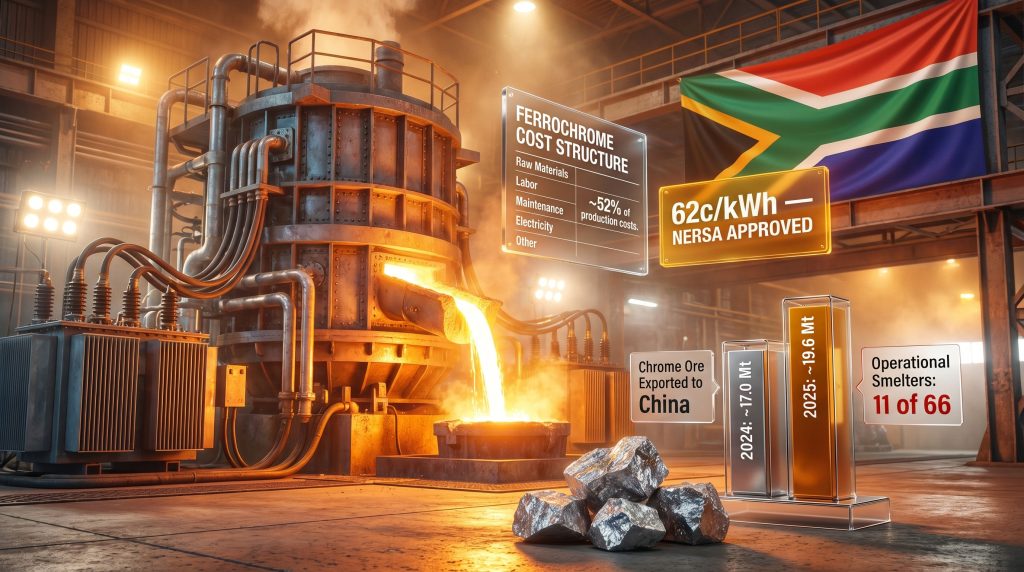
Electricity accounts for approximately 52% of total ferrochrome production costs, according to figures presented at a public regulatory hearing. This is an extraordinary cost concentration in a single input variable. By comparison, labour typically accounts for a fraction of this share, and logistics costs, while meaningful, remain secondary. When a single input determines the majority of your operating cost and that input is priced by regulatory decision rather than by competitive market forces, the viability of your entire operation is effectively a policy question.
This creates a binary threshold effect in smelter economics. When electricity tariffs sit below the viability threshold, smelters operate, employ workers, process ore, and generate export revenue. When tariffs push above that threshold, the commercially rational response is to idle capacity or shut permanently. The marginal cost difference between a viable and an unviable smelter is not gradual; it is often a cliff edge.
South Africa's Chrome Position Versus Its Processing Reality
The divergence between South Africa's resource endowment and its processing output tells a story that no single data point can fully convey. The table below captures the scale of the gap.
| Indicator | Figure |
|---|---|
| South Africa's share of global chrome reserves | More than 72% |
| Global ferrochrome production (2025) | ~15.9 million tonnes |
| South Africa's ferrochrome output (2025) | ~1.6 million tonnes |
| Chrome ore exported to China (2025) | ~19.6 million tonnes |
| Chrome ore exported to China (2024) | ~17.0 million tonnes |
| Operational smelters remaining (of 66 total) | 11 |
Source: Merafe Resources 2025 operating context and publicly reported figures.
The year-on-year increase in raw chrome ore exports to China, rising from 17.0 Mt in 2024 to 19.6 Mt in 2025, represents a ~15% growth rate in unprocessed material leaving South Africa. This is not simply a trade statistic. It is a signal that as domestic smelting capacity contracts, the processing stage migrates to importing nations, predominantly China, which then captures the ferrochrome manufacturing margin. Furthermore, China steel demand trends directly influence the price signals that determine whether South African smelters can compete for that processing work.
Every tonne of chrome ore exported without domestic processing represents a foregone manufacturing margin, a foregone employment contribution, and a foregone unit of higher-value export revenue. The ore is the same. The difference is where the economic value from transforming it is created.
What the 62c/kWh NPA Deal Actually Means
Structure, Scope, and Regulatory Architecture
The South Africa ferrochrome electricity discount centres on a rate of 62 South African cents per kilowatt hour (62c/kWh), approved by NERSA for two producers: Samancor Chrome and the Glencore-Merafe Chrome Venture. This arrangement operates under an amended Negotiated Pricing Agreement framework, which is a mechanism within Eskom's commercial architecture that permits differentiated tariff arrangements for large industrial customers under defined regulatory conditions.
The NPA requires NERSA approval and is not an informal arrangement; it is a structured regulatory instrument with defined eligibility and oversight requirements. Eskom confirmed the discounted rate was agreed in April 2026, with NERSA subsequently confirming the 62c/kWh price for the named ferrochrome producers.
Eskom's position at the NERSA regulatory hearing was that the arrangement would help it remain financially stable without requiring broader tariff increases for other customer categories, additional borrowing, or further recourse to other forms of financial support. In addition, the South Africa ferroalloys sector more broadly stands to benefit if this pricing precedent encourages wider industrial cost competitiveness.
| Tariff Metric | Previous Rate | Discounted Rate | Approximate Reduction |
|---|---|---|---|
| Electricity cost per kWh | ~87c/kWh | 62c/kWh | ~29% nominal reduction |
| Discount relative to prior rate | ~35-36% | ||
| Combined annual demand retained | ~12.8 TWh | Significant load anchor |
Eskom's Commercial Logic: Demand Retention, Not Charity
A critical and widely misunderstood dimension of the NPA framework is that Eskom's support for the discount was rooted in grid economics rather than industrial charity. The argument presented to NERSA was straightforward but counterintuitive to those unfamiliar with utility economics.
If ferrochrome smelters close permanently, Eskom loses approximately 12.8 terawatt hours (TWh) of annual electricity demand. Generating infrastructure built to serve that demand does not disappear; it continues to incur fixed costs. Those costs must then be recovered across a smaller customer base, which mathematically creates upward pressure on tariffs for every remaining customer category, including households and small businesses.
The paradox of the electricity discount is that allowing large industrial customers to pay less may ultimately protect smaller customers from paying more. The alternative, losing that demand entirely, concentrates fixed cost recovery onto a shrinking pool of ratepayers.
From a utility economics standpoint, retaining a large-volume customer at a discounted rate can be more financially rational than losing that customer entirely, provided the discounted rate still exceeds the marginal cost of supply. This is the commercial foundation Eskom built its NERSA case on.
Grid Stability Was Necessary But Not Sufficient
The Load-Shedding Recovery and Its Limits
South Africa's electricity system has undergone a meaningful stabilisation over the past year. Eskom reported on 16 May 2026 that the country had completed 365 consecutive days without load-shedding, the first full-year uninterrupted supply milestone since September 2018. This represents genuine progress in grid reliability after years of scheduled power cuts that disrupted industrial operations, eroded investor confidence, and imposed measurable costs on GDP performance.
However, the ferrochrome sector illustrates with particular clarity why supply reliability and tariff affordability are two distinct problems requiring separate solutions. A smelter needs electricity that is both available and affordable. Eliminating load-shedding addresses the first condition. The NPA discount addresses the second. Neither is sufficient on its own.
This distinction between availability and affordability is analytically important for any investor or policymaker assessing South Africa's industrial recovery trajectory. The grid stabilisation story improved sentiment and reduced operational uncertainty. But for energy-intensive industries like ferrochrome, the cost structure remained uncompetitive at standard industrial tariff rates even after supply improved. Stable power got the lights back on. Affordable power determines whether the factories remain viable.
Employment, Regional Economics, and the Multiplier Effect
Direct Jobs at Stake
The employment dimension of the South Africa ferrochrome electricity discount extends well beyond headline smelter employment figures. The Glencore-Merafe Chrome Venture cancelled planned retrenchments affecting up to 1,500 workers following confirmation of the electricity cost relief. Across the broader sector, the discount is estimated to help protect approximately 3,500 direct jobs at a time when only 11 of South Africa's 66 ferrochrome smelters remain operational.
That figure, 11 operational smelters from an original fleet of 66, deserves particular attention. It represents an industry that has already undergone severe structural contraction. The smelters that have closed did not close overnight; they closed progressively as sustained cost pressure, electricity unreliability, and weak ferrochrome prices combined to make continued operation commercially irrational. What remains is a residual industrial base operating at the margins of viability.
Chrome-Dependent Communities Across the Bushveld Belt
Ferrochrome production in South Africa is geographically concentrated across the Bushveld Igneous Complex, with significant smelting activity in provinces including North West and Limpopo. The Bushveld Complex is geologically unique, accounting for the overwhelming majority of South Africa's chromite reserves and hosting layered intrusions of exceptional scale and ore grade consistency.
This geological concentration means that smelter closures are not distributed across a diversified economic landscape; they hit specific communities hard. The economic exposure in chrome-dependent areas extends across multiple layers:
- Contractor and specialised maintenance service providers tied to smelter operations
- Transport and freight operators moving chrome ore from mine to smelter and finished ferrochrome to export ports
- Local retail and household spending supported by smelter wages and contractor income
- Municipal revenue bases reliant on industrial ratepayer contributions from smelting operations
In chrome-producing provinces, the closure of a single large smelter creates cascading economic disruption across supply chains, transport networks, and community spending patterns, making industrial electricity pricing a de facto regional development instrument whether policymakers intend it that way or not.
The Policy Debate: Legitimate Instrument or Selective Advantage?
Arguments For and Against the NPA Framework
The 62c/kWh arrangement has attracted scrutiny from multiple directions, and that scrutiny is not unreasonable. Any framework that provides differentiated pricing to specific named producers within a regulated utility environment raises legitimate questions about transparency, equity, and precedent.
Arguments supporting the discount:
- Prevents permanent destruction of industrial capacity built over decades that cannot be quickly rebuilt
- Retains Eskom revenue and demand that would otherwise be permanently lost
- Protects downstream employment and regional economic stability in chrome-dependent communities
- Enables South Africa to export value-added ferrochrome rather than bulk raw chrome ore
Arguments requiring scrutiny or caution:
- Households and smaller businesses operating at standard tariffs may perceive the arrangement as creating an unequal burden
- Transparency around eligibility criteria and the process by which specific producers were designated requires ongoing regulatory clarity
- If the pricing model is miscalibrated, the financial shortfall could shift to other ratepayer categories
- Precedent risk is real: other energy-intensive industries facing cost pressure may seek comparable NPA arrangements, and NERSA will need a coherent framework for evaluating such applications
Three Scenarios for the Policy's Outcome
| Scenario | Conditions Required | Likely Outcome |
|---|---|---|
| Industrial recovery | Smelters stabilise; idle capacity restarts; ferrochrome exports increase | Export revenue grows, ZAR supported, JSE mining shares re-rate upward, employment expands |
| Status quo preservation | Existing 11 smelters sustained but no capacity additions | Raw ore exports continue rising; limited domestic value-add multiplier; sector flatlines |
| Policy failure | Tariff model miscalculated; Eskom revenue shortfall; broader increases follow | Household tariff pressure rises; political contestation intensifies; NPA model loses credibility |
The next major ASX story will hit our subscribers first
Investment Implications for Mining Equities and the Rand
What Fund Managers and Sector Investors Are Watching
The ferrochrome tariff arrangement introduces a set of interrelated variables that investors with exposure to JSE mining equities, the South African rand (ZAR), or chrome-linked export sectors need to track carefully. The discount improves the cost side of the operational equation for named producers, but demand-side and macro-level risks remain independent of domestic tariff arrangements. Consequently, a broader metals and mining analysis is essential context for evaluating these risks in their entirety.
A senior market analyst at EBC Financial Group noted that South Africa has stabilised its power supply but that supply stability is no longer the defining variable for energy-intensive industries. The more consequential test is whether electricity can be priced at levels that make domestic manufacturing competitive, with ferrochrome as the clearest demonstration case of whether South Africa profits from its own minerals or cedes the manufacturing margin to offshore processors.
Key monitoring indicators for investors include:
- Whether additional smelters reopen or further closures occur following the tariff confirmation
- NERSA's position on extending or modifying the NPA framework beyond the initial approval period
- China's chrome ore import trajectory from South Africa and Chinese domestic ferrochrome production trends
- Eskom's financial performance and any flow-on effects to the broader industrial tariff structure
- Ferrochrome spot pricing and stainless steel demand trends as demand-side inputs to producer margins
Disclaimer: This article contains forward-looking analysis and scenario projections that involve assumptions about policy outcomes, commodity prices, and macroeconomic conditions. These projections are not guarantees of future performance. Investors should conduct independent due diligence before making investment decisions based on any analysis contained herein.
The Deeper Question: Processing Nation or Perpetual Ore Exporter?
Where the Value-Add Gap Actually Sits
The intellectual core of this debate is not about electricity at all. It is about where in a commodity value chain a nation chooses, or is forced by cost structures, to participate. Chrome ore is a bulk commodity. Ferrochrome is a processed industrial input with measurably higher export value per tonne. The energy, capital, and technical expertise required to bridge that gap exist within South Africa. The commercial conditions to deploy them profitably have not consistently existed, primarily because of electricity costs.
The fact that South Africa exported approximately 19.6 Mt of chrome ore to China in 2025 while producing only ~1.6 Mt of ferrochrome domestically against a global production base of ~15.9 Mt captures the value-add gap in quantitative terms. The ore is leaving. The processing is happening in China. The ferrochrome margin is accruing to Chinese producers. Furthermore, the global steel outlook and green steel pricing dynamics will increasingly determine whether South Africa's ferrochrome can find premium markets as decarbonisation reshapes downstream demand.
Whether the NPA discount can durably shift this equation depends on factors that extend beyond the tariff itself:
- Tariff sustainability: Whether 62c/kWh can be maintained or extended without creating distortions in Eskom's broader revenue model
- Reinvestment decisions: Whether producers use the cost relief to rehabilitate and potentially expand capacity or merely extend the life of marginal existing operations
- Regulatory consistency: Whether NERSA and broader energy policy signals a long-term commitment to competitive industrial electricity pricing rather than episodic interventions
- Value chain integration: Whether domestic chrome ore beneficiation expands meaningfully or raw ore export growth continues to outpace ferrochrome output
The mineral endowment is fixed. The policy choices are not. South Africa has the ore, a recovering grid, and now a structured tariff mechanism designed to keep its smelters running. Whether that combination translates into an actual industrial recovery, rather than simply a more affordable version of the same structural decline, is the test the next several years will answer.
Frequently Asked Questions: South Africa Ferrochrome Electricity Discount
What is the South Africa ferrochrome electricity discount rate?
NERSA approved a discounted rate of 62 South African cents per kilowatt hour (62c/kWh) for Samancor Chrome and the Glencore-Merafe Chrome Venture, representing a reduction of approximately 35-36% from the previous rate of around 87c/kWh.
Why does electricity matter so much for ferrochrome production?
Electricity accounts for approximately 52% of ferrochrome production costs, making it the dominant variable in smelter economics. No other cost input comes close to this share, which means tariff changes have an immediate and outsized impact on whether smelting is commercially viable.
How many ferrochrome smelters are still operating in South Africa?
As of the most recent available data, only 11 of South Africa's original 66 ferrochrome smelters remain operational, reflecting years of cost pressure, load-shedding disruption, and unfavourable ferrochrome pricing conditions.
What is the Negotiated Pricing Agreement (NPA) framework?
The NPA is a mechanism within Eskom's commercial framework allowing the utility to offer differentiated tariffs to large industrial customers under specific regulatory conditions. It requires NERSA approval and is designed to retain high-volume electricity consumers whose departure would negatively affect grid economics and Eskom's overall financial position.
Does the electricity discount affect all South African industries?
The current arrangement specifically names Samancor Chrome and the Glencore-Merafe Chrome Venture. However, whether other energy-intensive industries could seek comparable arrangements under the NPA framework remains an open regulatory question that NERSA would need to address through defined eligibility criteria.
Want To Track The Next Major Mineral Discovery Before The Market Does?
Discovery Alert's proprietary Discovery IQ model delivers real-time alerts on significant ASX mineral discoveries, transforming complex mineral data into actionable insights for both short-term traders and long-term investors — explore historic discoveries and their returns to understand what's possible, then start your 14-day free trial at Discovery Alert to position yourself ahead of the broader market.