
June 12, 2026
The Hidden Fragility of Critical Mineral Infrastructure in a Warming World
Global nickel supply chains have long been analysed through the lens of grade, cost curves, and geopolitical risk. What receives far less attention is the physical vulnerability of the processing infrastructure that converts laterite ore into battery-ready metal. High-pressure acid leach facilities are among the most technically complex and environmentally sensitive industrial structures in the mining sector, and they are disproportionately concentrated in tropical regions where extreme weather events are intensifying.
When a major HPAL operation goes offline, the ripple effects extend well beyond a single quarterly production report. Furthermore, as battery raw materials markets continue to tighten, these vulnerabilities carry increasing financial and strategic weight.
The story of Ambatovy resumes nickel production after cyclone disruption is not simply a recovery milestone. It is a case study in supply chain fragility, ownership transitions under pressure, and the structural risks that battery supply chain managers are only beginning to price properly.
When big ASX news breaks, our subscribers know first
Understanding What Cyclone Gezani Actually Disrupted
More Than a Weather Pause
When Cyclone Gezani forced a halt at Madagascar's east coast earlier this year, Ambatovy's processing facility in the port city of Toamasina sustained material damage that went well beyond surface-level disruption. The suspension was not a precautionary decision made out of an abundance of caution. The plant required a comprehensive structural, safety, and environmental integrity assessment before any restart could be authorised.
This distinction matters enormously to anyone trying to understand the real operational risks at laterite nickel operations. At a conventional open-cut mine, a cyclone might damage haul roads, flood pit benches, or disrupt logistics. Recommissioning is measured in days to weeks. At an HPAL facility like Ambatovy's, the processing circuit operates under extreme conditions:
- Temperatures exceeding 250 degrees Celsius inside pressure oxidation vessels
- Highly concentrated sulphuric acid streams flowing through interconnected circuits
- Pressure vessels that require certified inspection before any restart
- Downstream cobalt and nickel refining trains that cannot be restarted until upstream systems are verified
Any structural compromise to these systems does not just halt production. It creates genuine containment risk for acid streams and process residues. This is why Ambatovy's recovery timeline was measured in months rather than weeks, and why the phased restart approach taken by management reflects sound risk governance rather than operational conservatism.
The Toamasina Processing Plant: What Was at Stake
Ambatovy's operations are split between a mining area near Moramanga in Madagascar's highlands and the processing plant in Toamasina on the coast. The slurry pipeline connecting the two is itself a significant piece of infrastructure. It was the coastal processing plant, not the mine site, that sustained the most critical damage from Gezani, which is precisely why the recovery timeline was extended.
The processing circuit relies on multiple acid plants to generate the sulphuric acid used in the HPAL leaching process. Without functioning acid plants, the entire downstream production chain — including the precipitation, solvent extraction, and electrowinning circuits that produce finished nickel and cobalt briquettes — cannot operate.
Production Targets and What the Numbers Actually Mean
June 2026 Restart Metrics at a Glance
| Commodity | June 2026 Target | 2025 Annual Production | Implied Monthly Average |
|---|---|---|---|
| Nickel | ~2,500 metric tons | ~29,000 metric tons | ~2,417 metric tons |
| Cobalt | ~250 metric tons | ~2,700 metric tons | ~225 metric tons |
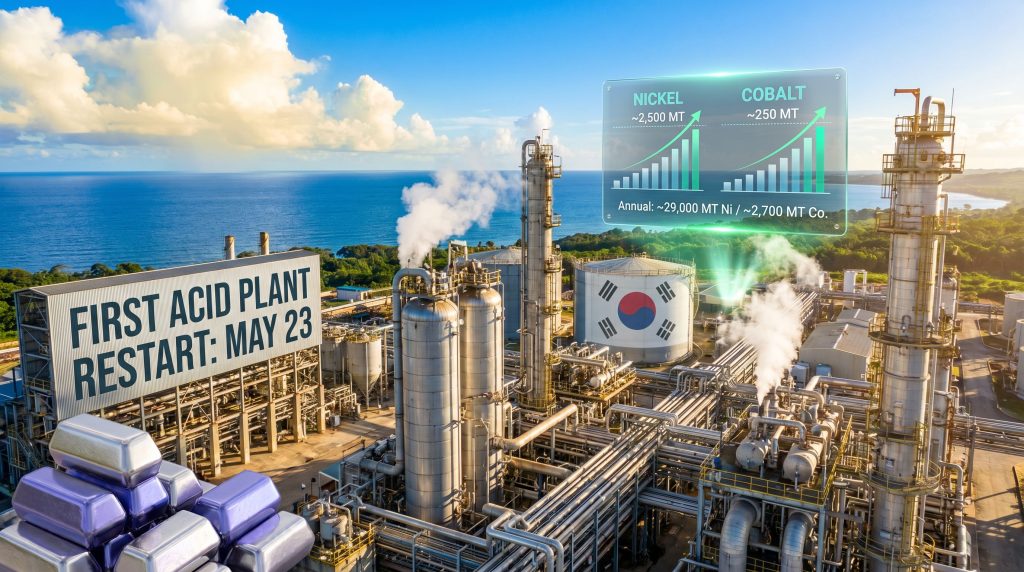
The first acid plant came back online on May 23, with the second acid plant targeted for recommissioning by the end of June. The June production targets represent a partial-capacity ramp-up, not a full return to normalised throughput. However, the nickel target of 2,500 metric tons is notably close to the implied monthly average of approximately 2,417 metric tons, suggesting the operation aims to approach pre-disruption run rates relatively quickly once both acid plants are operating.
This is a more aggressive recovery trajectory than many comparable HPAL incidents have achieved. It signals that the physical damage, while serious, did not compromise the core pressure vessel integrity of the primary leach circuit, which would have required significantly longer recommissioning timelines.
Reading Between the Production Numbers
The cobalt output target of 250 metric tons for June aligns proportionally with the operation's historical nickel-to-cobalt ratio. Ambatovy's ore body delivers a relatively consistent cobalt-to-nickel ratio through the processing circuit, which means cobalt production tracks closely with nickel throughput. A restoration of nickel volumes toward normalised levels therefore implies a concurrent restoration of cobalt supply, which carries its own significance given Ambatovy's role as a non-DRC cobalt source.
In addition, as the cobalt mining industry faces ongoing supply pressures globally, Ambatovy's recovery is particularly timely for battery manufacturers seeking reliable alternatives to DRC-sourced material.
Battery supply chain managers sourcing cobalt outside the Democratic Republic of Congo have limited alternatives at scale. Ambatovy's cobalt production, approximately 2,700 metric tons annually, represents a meaningful contribution to the non-DRC supply pool that feeds South Korean and Japanese battery cell manufacturers.
Ownership Dynamics and the Capital Structure Behind the Recovery
A Shareholder Transition Executed During an Active Crisis
The ownership context surrounding Ambatovy's rebuild is one of the most underappreciated dimensions of this story. KOMIR, the Korea Mine Rehabilitation and Mineral Resources Corporation, is the operation's current majority shareholder. Sumitomo Corporation of Japan divested its 54% stake to a consortium of investors in May, completing a significant ownership transition at the same moment the facility was being rebuilt following cyclone damage.
Critically, both KOMIR and Sumitomo contributed funding to the post-cyclone rebuild, even as the ownership transfer was being executed. This is not a trivial operational detail. It strongly implies that Sumitomo's exit agreement included transition-period capital obligations, rather than a clean break from financial responsibility at the moment of sale. For investors monitoring large-scale critical mineral asset transfers, this type of structured transition commitment is a significant governance signal.
Why KOMIR's Anchor Role Is Strategically Significant
State-backed ownership structures at critical mineral operations behave differently from purely commercial ownership during stress events. A commercial operator facing a major cyclone-related shutdown and concurrent ownership transition might deprioritise capital deployment pending a clearer ownership resolution. KOMIR's willingness to fund the rebuild reflects South Korea's broader strategic interest in securing reliable upstream supply of nickel and cobalt for its battery manufacturing ecosystem.
South Korea's battery cell manufacturers, including major global suppliers, depend on a consistent flow of high-purity nickel and cobalt intermediates. Ambatovy produces nickel and cobalt briquettes that are well-suited to battery-grade refining pathways, making it a strategically valuable upstream asset from Seoul's perspective. State-backed capital resilience during a crisis is one of the less-discussed advantages of sovereign-aligned ownership in critical mineral supply chains.
Ambatovy's Role in the Global Nickel and Cobalt Supply Architecture
Where Ambatovy Sits in the Non-Indonesian Supply Chain
The global nickel market has undergone a structural shift over the past five years, with Indonesian nickel production expanding dramatically and increasingly dominating battery-grade nickel supply. This concentration has created what supply chain strategists describe as a single-country dependency risk, prompting downstream battery manufacturers and their customers to seek diversification.
Ambatovy resumes nickel production after cyclone disruption at a particularly significant moment, given that it produces approximately 29,000 metric tons of nickel annually as one of the most significant non-Indonesian, non-sulphide nickel operations globally. Its relevance to supply chain diversification strategies is considerable:
- It produces battery-suitable nickel briquettes through a proven hydrometallurgical pathway
- It operates outside Indonesia, the Philippines, and New Caledonia, the three most cyclone- and geopolitically-exposed laterite jurisdictions
- Its cobalt co-production provides a non-DRC alternative at meaningful scale
- KOMIR's ownership aligns it with South Korean battery supply chain interests
The HPAL Technology Context: Why These Operations Are Irreplaceable and Vulnerable
HPAL technology is the only commercially proven pathway for processing laterite nickel ores, which account for the vast majority of the world's known nickel resources. However, HPAL plants are extraordinarily expensive to build, technically demanding to operate, and, as Ambatovy's cyclone experience illustrates, highly sensitive to physical damage.
The global fleet of operating HPAL facilities is small. Each one represents decades of investment and irreplaceable processing capacity that cannot be quickly replicated or substituted. Consequently, when one goes offline, even temporarily, the effect on battery-grade nickel availability is disproportionate to the facility's physical footprint.
Supply Chain Implications Across Different Time Horizons
A Framework for Assessing the Market Impact
| Impact Horizon | Nature of the Effect | Key Market Consideration |
|---|---|---|
| Immediate (0 to 3 months) | Spot supply reduction from a ~29,000 t/year producer | Tightening of battery-grade nickel briquette availability |
| Medium-term (3 to 6 months) | Cobalt supply disruption from a non-DRC source | Additional pressure on battery-grade cobalt procurement |
| Structural (6 to 12 months) | Investor reassessment of climate risk at tropical laterite operations | Rising premium for climate-resilient upstream assets |
The medium-term cobalt dimension is frequently overlooked in coverage focused on nickel. Cobalt supply outside the DRC is structurally thin, and any disruption to a meaningful non-DRC producer tightens an already constrained market for battery manufacturers seeking supply chain compliance with responsible sourcing frameworks.
Climate Risk as a Structural Investment Factor
Ambatovy's disruption sits within a broader pattern that commodity analysts and ESG-focused investors are increasingly tracking. Madagascar, Indonesia, the Philippines, Papua New Guinea, and New Caledonia — all of which host major nickel laterite operations — lie within tropical storm belts or are exposed to intensifying extreme weather patterns.
Furthermore, as critical minerals demand grows alongside the global energy transition, the strategic cost of unplanned outages at these facilities increases proportionally.
As physical climate risk models become more sophisticated, the probability-weighted cost of cyclone-related outages at tropical HPAL operations is increasingly being incorporated into asset-level discount rates and insurance pricing.
This is a relatively new analytical development. Historically, weather-related disruptions at mining operations were treated as episodic, insurable events. The accumulating evidence of increasing tropical cyclone intensity is shifting this framing toward treating climate exposure as a structural operational risk factor, particularly for surface-exposed processing infrastructure.
The next major ASX story will hit our subscribers first
How a Post-Cyclone Restart Is Actually Managed: Step-by-Step
The Recommissioning Sequence at an HPAL Facility
Understanding why HPAL restarts take months requires appreciating the sequential dependencies built into the recommissioning process. Each stage must be completed and certified before the next can begin:
- Operational suspension upon cyclone approach, with all processing circuits brought to a controlled shutdown state
- Structural damage assessment by civil and process engineers, covering pressure vessels, piping, civil foundations, and containment systems
- Environmental integrity verification covering tailings storage, acid containment berms, and drainage systems
- Safety system certification confirming that all pressure relief, emergency shutdown, and chemical containment systems are functional
- Auxiliary systems restart including utilities, instrumentation, and control systems before any primary circuits are energised
- Sequential acid plant recommissioning, starting with one plant to validate performance before committing to the second
- Controlled production ramp-up, increasing feed rates incrementally toward normalised throughput
- Full capacity restoration once all circuits have demonstrated stable performance across multiple operating cycles
Ambatovy resumes nickel production after cyclone through precisely this framework, with the first acid plant online on May 23 and the second targeted for end of June. The gap between the two acid plant restarts is not a sign of difficulty. It is standard risk-managed recommissioning protocol that prevents compounding problems across both plants simultaneously. For historical context, Sumitomo's post-cyclone restart following earlier disruptions followed comparable timelines, underscoring that this phased approach is well-established practice at Ambatovy.
Key Takeaways for Investors and Supply Chain Strategists
The Ambatovy cyclone recovery offers several durable analytical insights for market participants evaluating critical mineral exposure. In addition, those monitoring the nickel market recovery more broadly will find Ambatovy's restart trajectory a useful benchmark for assessing HPAL resilience.
- Climate resilience is a financial variable, not merely an ESG consideration. HPAL facilities in tropical jurisdictions carry quantifiable cyclone-related downtime risk that should be reflected in asset valuations and procurement contracts.
- State-backed ownership provides capital resilience during crisis periods that purely commercial structures may not match. KOMIR's role in funding the rebuild prevented what could have been a significantly extended outage.
- Structured ownership transitions at operating assets require carefully negotiated transition obligations, as demonstrated by Sumitomo's continued capital contribution despite completing its divestment.
- Non-Indonesian, non-DRC critical mineral production carries a strategic premium that is growing as battery supply chains seek geographic diversification.
- Phased restart transparency from operational leadership is a positive governance signal for investors assessing management quality at complex hydrometallurgical operations.
For critical mineral investors and battery supply chain managers, Ambatovy's experience makes a compelling case for incorporating cyclone resilience engineering, redundant acid plant capacity, and transition-period capital obligations into the due diligence frameworks applied to tropical laterite operations.
This article is intended for informational purposes only and does not constitute financial or investment advice. Forecasts, production targets, and market projections referenced herein are subject to change and carry inherent uncertainty. Readers should conduct independent due diligence before making investment decisions related to any commodities or mining sector assets discussed.
Want to Stay Ahead of the Next Major Critical Mineral Discovery?
Discovery Alert's proprietary Discovery IQ model delivers real-time alerts on significant ASX mineral discoveries, instantly translating complex mineral data into actionable investment insights — so subscribers can identify opportunities before the broader market reacts. Explore Discovery Alert's discoveries page to see how historic mineral discoveries have generated substantial returns, and begin a 14-day free trial to secure a genuine market-leading edge in critical minerals investing.