
May 19, 2026
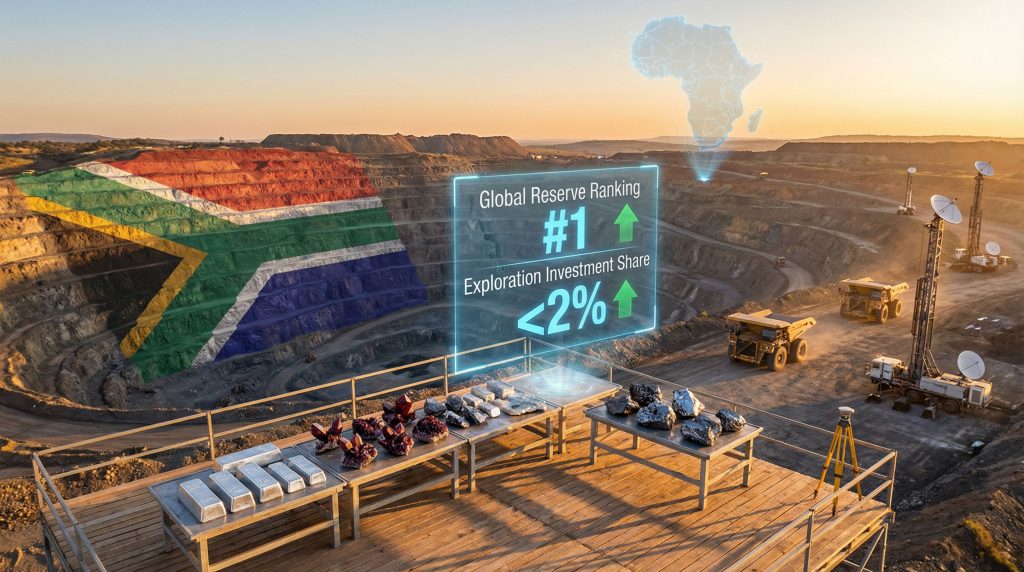
The global transition toward renewable energy technologies and electric vehicle adoption has fundamentally altered mineral demand patterns, creating unprecedented opportunities for resource-rich jurisdictions capable of mobilising patient capital toward exploration activities. Furthermore, exploration in South Africa mining industry presents compelling investment cases when evaluated through critical minerals strategy frameworks. Modern battery manufacturing requires specific mineral compositions that traditional mining operations may not have prioritised, necessitating renewed geological assessment programs across historically productive mining districts.
African mineral endowments present compelling investment cases when evaluated through critical mineral value chain frameworks, yet capital deployment remains concentrated in established mining jurisdictions with proven regulatory frameworks and infrastructure networks. This geographical concentration of exploration investment reflects risk-adjusted return calculations that factor regulatory uncertainty, infrastructure deficits, and tenure security challenges into project evaluation metrics.
Structural Barriers Constraining Exploration Capital Allocation
Administrative Processing Inefficiencies
South African exploration licensing suffers from systematic processing delays that extend project timelines beyond investor tolerance thresholds. The country's mining cadastral system implementation has experienced significant delays, creating information asymmetries around tenure boundaries and claim verification procedures. Companies often benefit from streamlined permitting insights when navigating these complex administrative processes.
Industry analysis indicates that licensing bottlenecks create cascading delays throughout exploration project development phases. When administrative approvals extend beyond 18-24 months, exploration companies often redirect capital toward jurisdictions with streamlined approval mechanisms, reducing South Africa's competitive positioning within global exploration investment flows.
Key Administrative Challenges:
- Extended licensing approval timelines
- Fragmented inter-departmental coordination
- Limited cadastral system functionality
- Inconsistent policy implementation across provinces
Geoscientific Infrastructure Deficiencies
Pre-competitive geological data availability represents a critical factor in exploration investment decisions, as comprehensive geoscientific databases reduce early-stage risk assessment costs. South Africa's geological mapping coverage operates below international benchmarks established by leading mining jurisdictions such as Canada and Australia.
Modern exploration programs leverage sophisticated data integration techniques, combining satellite imagery analysis, geophysical surveys, and machine learning algorithms to identify prospective targets. However, these technological capabilities require foundational geological datasets that may be incomplete or outdated across significant portions of South African mining districts.
Geoscientific Data Gaps:
- Limited high-resolution geological mapping
- Incomplete geochemical survey coverage
- Fragmented geophysical database integration
- Insufficient metallurgical testing protocols for battery-grade minerals
When big ASX news breaks, our subscribers know first
Policy Framework Development for Exploration Acceleration
Tenure Security Enhancement Mechanisms
The Mineral Resources Development Bill represents a significant opportunity to establish internationally competitive tenure security frameworks that align with long-term capital deployment requirements. Mining project development cycles typically span 13-15 years from initial exploration to production commencement, followed by operational periods extending 30-40 years.
Security of tenure provisions must account for these extended timelines while incorporating performance-based mechanisms that prevent speculative land banking. Leading mining jurisdictions implement "use it or lose it" provisions that encourage active exploration while maintaining investor confidence through clear renewal procedures and dispute resolution mechanisms.
Blended Finance Innovation Models
The Junior Mining Exploration Fund demonstrates how public-private partnership structures can mobilise patient capital for high-risk exploration activities. This R1 billion initiative combines R400 million in government funding with R600 million from multinational mining company Anglo American, administered through the Industrial Development Corporation.
Fund Structure Analysis:
| Component | Amount | Source | Role |
|---|---|---|---|
| Public Funding | R400 million | Department of Mineral Resources | De-risking early-stage exploration |
| Private Capital | R600 million | Anglo American | Commercial expertise and industry networks |
| Total Capitalisation | R1 billion | Blended Structure | Risk-sharing across capital providers |
Blended finance mechanisms enable exploration projects to access funding at developmental stages where pure commercial capital considers risk-return profiles insufficiently attractive. The Industrial Development Corporation's administrative role leverages existing institutional capacity for due diligence, monitoring, and performance evaluation. Moreover, understanding various capital raising methods can provide additional funding pathways for exploration companies.
Critical Mineral Value Chain Integration Strategies
Battery Component Manufacturing Opportunities
South Africa's manganese reserves position the country strategically within lithium-ion battery manufacturing value chains, provided exploration programs target specific grade specifications required for battery-grade materials. Traditional manganese mining operations focused on steel production applications may require metallurgical process modifications to meet battery industry specifications.
Advanced exploration programs must incorporate sophisticated metallurgical testing during early-stage evaluation phases, as battery manufacturing requires precise mineral purity levels and chemical compositions. This necessitates integration between geological assessment, metallurgical engineering, and market specification analysis throughout exploration workflows. Additionally, African platinum investment opportunities complement the broader critical minerals portfolio.
Regional Value Chain Coordination
Critical mineral value chains operate most efficiently through regional integration frameworks rather than isolated national strategies. African mineral endowments span multiple jurisdictions, suggesting that exploration success depends partly on coordinated regional approaches to infrastructure development, regulatory harmonisation, and market access facilitation.
Continental mineral corridors enable economies of scale in transportation infrastructure, processing facilities, and skilled workforce development. Individual country strategies may suboptimise regional value chain efficiency if they duplicate infrastructure investments or create regulatory barriers to cross-border mineral processing and trade.
Regional Integration Benefits:
- Shared infrastructure development costs
- Coordinated regulatory frameworks
- Integrated transportation networks
- Collective bargaining power in global markets
Technology Integration in Modern Exploration Programs
Advanced Target Identification Systems
Contemporary exploration leverages artificial intelligence and machine learning algorithms to process satellite imagery, geophysical data, and historical exploration records for improved target identification accuracy. These technologies can partially compensate for historical geological data gaps while reducing exploration costs per successful discovery.
Digital transformation within exploration workflows includes automated drilling systems, real-time data analytics, and predictive modelling capabilities that compress discovery timelines and improve success rates. Furthermore, AI in drilling operations demonstrates how technology implementation requires substantial upfront capital investment and specialised technical expertise.
Industry 4.0 Implementation
Exploration companies increasingly integrate Internet of Things sensors, automated sampling systems, and cloud-based data management platforms to optimise field operations efficiency. These technological capabilities enable real-time decision-making during drilling programmes and reduce operational costs through automated data collection and analysis.
Technology Integration Components:
- Satellite-based target identification
- Automated drilling and sampling systems
- Real-time geochemical analysis
- Machine learning pattern recognition
- Cloud-based data management platforms
Investment Capital Structure Optimisation
Risk-Adjusted Return Requirements
Exploration activities exhibit inherently high failure rates, with successful discoveries representing small percentages of total exploration programmes. This risk profile requires specialised investment capital willing to accept significant loss probabilities in exchange for substantial upside potential from successful discoveries.
Exploration in South Africa mining industry requires diversified funding sources including pension funds with long-term investment horizons, development finance institutions with patient capital mandates, and international mining finance specialists with sector expertise. Traditional commercial banking facilities prove inadequate for exploration financing due to risk-return mismatches and collateral limitations.
Performance-Based Incentive Alignment
Successful exploration funding models incorporate performance-based incentive structures that align investor interests with exploration company objectives. These mechanisms include staged funding releases tied to exploration milestones, equity participation arrangements, and royalty structures that provide ongoing returns from successful discoveries.
Investment Structure Options:
- Staged milestone-based funding
- Equity participation agreements
- Royalty and streaming arrangements
- Joint venture partnerships
- Development finance institution participation
Global Competition for Exploration Investment
Jurisdictional Competitiveness Analysis
Mining investment decisions evaluate multiple factors simultaneously: geological prospectivity, regulatory certainty, infrastructure quality, and skilled workforce availability. According to Mining Weekly's analysis, South Africa must address deficiencies across all dimensions to improve its global ranking as an exploration destination.
Competitive jurisdictions combine stable political environments with efficient regulatory processes, reliable infrastructure networks, and established mining service industries. Canada, Australia, and Chile maintain leading positions through consistent policy implementation, transparent approval processes, and world-class geological databases.
Competitiveness Factors:
| Factor | Weight | South Africa Position | Required Improvements |
|---|---|---|---|
| Geological Potential | High | Excellent | Maintain advantages |
| Regulatory Certainty | High | Below Average | Policy consistency |
| Infrastructure Quality | Medium | Mixed | Power supply reliability |
| Workforce Skills | Medium | Good | Technical training programmes |
Infrastructure Development Coordination
Exploration success correlates strongly with reliable electricity supply, transportation networks, and telecommunications infrastructure quality. Coordinated infrastructure development creates positive spillover effects benefiting multiple exploration projects simultaneously while reducing individual project infrastructure costs.
Strategic infrastructure investment programmes should prioritise mining districts with high geological potential, creating exploration-friendly environments that attract international investment capital. This approach requires coordination between multiple government departments and agencies to align infrastructure development with mineral resource development strategies.
The next major ASX story will hit our subscribers first
Economic Development Through Exploration Activity
Employment Generation Analysis
Exploration activities generate immediate employment opportunities in geological services, drilling operations, surveying, and environmental consulting. These positions often occur in rural areas where alternative economic opportunities remain limited, creating direct community development benefits.
The employment multiplier effects from exploration extend beyond direct hiring to include accommodation services, transportation, catering, and equipment supply. A single major exploration programme can support hundreds of direct and indirect positions throughout multi-year exploration cycles.
Employment Categories:
- Geological and geophysical specialists
- Drilling crew and equipment operators
- Environmental and community liaison professionals
- Laboratory and analytical services
- Support services (accommodation, transportation, catering)
Technical Expertise Development
Successful exploration programmes build local technical expertise through skills transfer, training programmes, and research partnerships with universities. This knowledge accumulation creates long-term competitive advantages by establishing centres of excellence for mineral exploration across Africa.
Technical expertise development includes geological survey techniques, geochemical analysis methods, drilling technologies, and project management capabilities. These skills remain valuable throughout mining value chains and support broader industrial development objectives beyond individual exploration projects.
Strategic Implementation Framework
Exploration in South Africa mining industry renaissance requires coordinated policy implementation across regulatory reform, infrastructure investment, and capital market development. The country's exceptional geological endowment provides fundamental competitive advantages, but systematic execution will determine whether mineral wealth translates into sustained economic growth.
The 13-15 year timeline from exploration to production means current policy decisions will determine South Africa's mining sector competitiveness through 2040. This temporal dimension creates urgency for comprehensive exploration sector reform that addresses regulatory barriers, infrastructure constraints, and investment capital access simultaneously.
Recent analysis from Business Day highlights how decades-old mines emphasise the need for new discoveries. Consequently, exploration in South Africa mining industry presents critical opportunities for economic transformation.
Implementation Priorities:
- Expedited cadastral system deployment
- Streamlined licensing approval processes
- Blended finance programme expansion
- Regional cooperation framework development
- Infrastructure investment coordination
- Technical expertise development programmes
The intersection of critical mineral demand growth, technology advancement, and policy reform creates unprecedented opportunities for African mining jurisdictions willing to implement comprehensive exploration sector strategies. Success requires sustained commitment to regulatory certainty, infrastructure development, and investment capital mobilisation across multiple government levels and private sector participants.
Investors and industry professionals interested in African mining sector developments can monitor regulatory updates and project announcements through specialised mining publications that track legislative changes and exploration activity across the continent.
Looking to Capitalise on South Africa's Mining Renaissance?
Discovery Alert's proprietary Discovery IQ model delivers instant notifications on significant ASX mineral discoveries, helping investors identify actionable opportunities before the broader market recognises their potential. Given the strong parallels between African critical mineral opportunities and ASX-listed exploration companies targeting similar commodities, subscribers gain crucial insights into emerging discovery trends that could signal broader sector momentum. Start your 14-day free trial today to position yourself ahead of the market as the global critical minerals transformation unfolds.