June 6, 2026
Global supply chain dynamics in critical minerals face unprecedented transformation as nations reassess dependencies built over decades. While traditional economic theory suggests market efficiency through specialisation, recent geopolitical tensions reveal vulnerabilities when essential resources become concentrated in single-source suppliers. This paradigm shift has prompted manufacturing powerhouses to develop comprehensive South Korea critical minerals strategy balancing economic pragmatism with strategic autonomy.
Advanced economies with significant semiconductor and battery manufacturing exposure now recognise that supply chain resilience requires active government intervention beyond market mechanisms. The intersection of national security and economic competitiveness has created new frameworks where diplomatic engagement and diversification strategies operate simultaneously across multiple channels.
Critical Minerals as Economic Leverage: Understanding Systemic Vulnerabilities
South Korea critical minerals strategy emerges from a fundamental recognition of concentrated risk exposure across its most valuable industries. The nation's $1.8 trillion economy depends heavily on uninterrupted flows of specialised materials for semiconductor production, electric vehicle battery manufacturing, and advanced petrochemical processes.
Supply chain analysis reveals multiple chokepoints where disruptions cascade through interconnected manufacturing systems. Semiconductor production requires simultaneous access to rare earth elements, lithium compounds, and specialised industrial metals. Any single material shortage can halt entire production lines worth billions in output.
Furthermore, the October 2025 expansion of Chinese export controls specifically targeting semiconductor users demonstrated how regulatory mechanisms can create immediate supply pressures. These controls introduced additional scrutiny layers for companies like Samsung Electronics and LG Energy Solution, whose global operations depend on predictable material flows.
Import Dependency Risk Assessment
Current dependency levels across critical material categories reveal the scope of vulnerability:
- Rare Earth Elements: 98% import reliant, primarily from Chinese sources
- Battery Materials (lithium, cobalt, nickel): 95% import dependent
- Industrial Metals: 85% reliance on foreign suppliers
- Current Strategic Reserves: 54-day supply buffer across designated materials
Manufacturing sector exposure concentrates in three key areas where supply disruptions create immediate operational impacts. Semiconductor fabrication facilities cannot substitute materials without extensive retooling and quality certification processes. However, recent developments in Chinese battery recycling breakthrough technology offer potential alternatives for some supply constraints.
Battery manufacturing requires precise chemical compositions that limit supplier flexibility. Petrochemical refining depends on catalyst materials with specific purity standards. The timeline vulnerability analysis shows that most supply disruptions require 60-90 days minimum for alternative sourcing activation.
This gap between current 54-day reserves and operational requirements drives the strategic expansion to 100-day buffer capacity. Additionally, the ongoing lithium supply-demand imbalance demonstrates the volatile nature of critical mineral markets.
When big ASX news breaks, our subscribers know first
Strategic Mineral Classification: The 17-Element Framework
South Korea's designation of 17 critical minerals reflects a systematic approach to national security resource planning. This classification system prioritises materials based on dual-use applications spanning defence, advanced manufacturing, and clean energy infrastructure.
The strategic framework operates through three distinct tiers, each requiring different intervention approaches and timeline priorities. Moreover, considerations around critical minerals energy security influence these classifications significantly.
Primary Tier: Battery Manufacturing Essentials
Lithium, cobalt, and nickel constitute the foundation of South Korea's electric vehicle and energy storage ambitions. These materials support both LG Energy Solution's global battery production and the domestic EV manufacturing ecosystem including Hyundai and Kia operations.
Current market dynamics show extreme price volatility across battery materials. Lithium carbonate prices fluctuated between $15,000-$80,000 per ton during 2022-2024, demonstrating how supply constraints translate directly into cost pressures for manufacturers.
Cobalt sourcing faces additional complexity due to geographic concentration in the Democratic Republic of Congo, where political instability and ethical mining concerns create ongoing supply risks. Alternative cobalt sources in Australia and Canada offer higher security but at premium costs.
Secondary Tier: Rare Earth Dependencies
Rare earth elements enable permanent magnet production, phosphor manufacturing, and semiconductor fabrication processes. China's dominance in rare earth processing creates bottleneck vulnerabilities even when raw materials originate from other countries.
The technical complexity of rare earth separation and purification requires specialised facilities with significant capital investment and environmental compliance frameworks. Building domestic processing capacity involves multi-year development timelines and substantial technological learning curves.
Processing bottlenecks occur at multiple stages:
- Mining extraction: Geographic concentration in few countries
- Initial separation: Chemical processing requiring specialised expertise
- Refinement to specification: Achieving purity standards for specific applications
- Alloy production: Final processing for end-use applications
Critical Minerals Supply Risk Matrix
| Mineral Category | Import Dependency | Primary Sources | Supply Risk Level | Substitution Difficulty |
|---|---|---|---|---|
| Lithium | 95%+ | Chile, Australia, China | Critical | Low |
| Cobalt | 98%+ | DRC, Australia | Critical | Medium |
| Nickel | 92%+ | Indonesia, Philippines | High | Medium |
| Rare Earths (Light) | 99%+ | China | Critical | Very High |
| Rare Earths (Heavy) | 99%+ | China | Critical | Very High |
| Graphite | 94%+ | China | High | Medium |
| Manganese | 89%+ | South Africa, Australia | Medium | Low |
Investment Architecture: The 250 Billion Won Framework
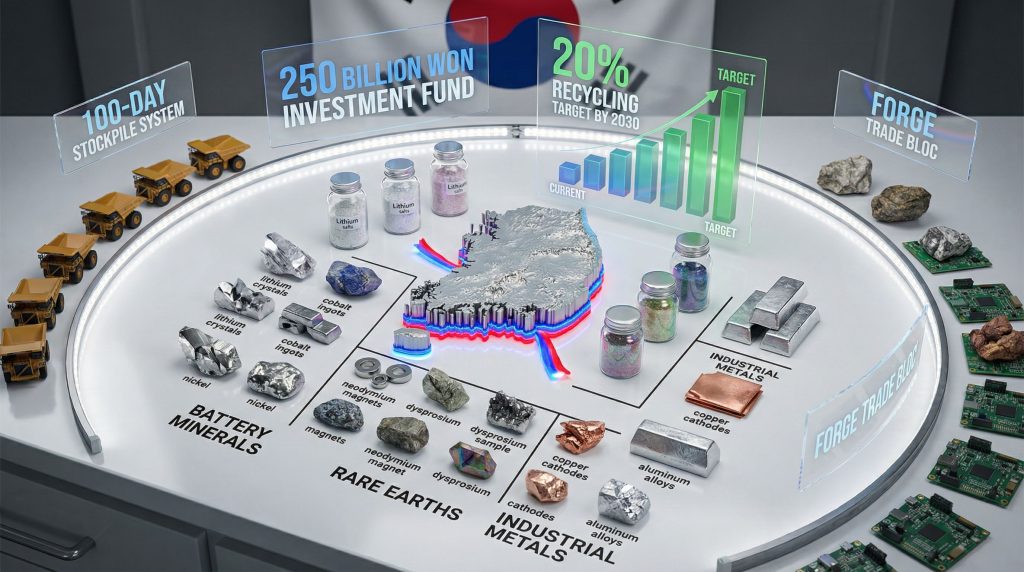
The 250 billion won (approximately $172.35 million USD) investment fund represents a state-backed venture capital approach to supply chain diversification. This financial structure enables Korean companies to participate in overseas resource projects that exceed traditional private sector risk tolerance.
In addition, lessons learned from Australian lithium innovations inform South Korea's investment allocation strategies across different geographical regions.
Geographic Allocation Strategy
The investment framework distributes capital across three strategic regions, each offering distinct advantages for supply chain diversification:
African Operations (40% allocation – 100 billion won)
- Copper and cobalt mining partnerships in Democratic Republic of Congo and Zambia
- First-loss capital provision for Korean companies in politically volatile regions
- Joint venture structures with established international mining operators
Southeast Asian Projects (35% allocation – 87.5 billion won)
- Rare earth processing facilities in Vietnam and Laos
- Proximity advantages to Chinese raw material sources while reducing direct dependency
- Lower labour costs and established regional processing infrastructure
Domestic Recycling Infrastructure (25% allocation – 62.5 billion won)
- Battery material recovery facility construction
- Electronic waste processing capacity expansion
- Urban mining technology development for rare earth extraction
Public-Private Risk Sharing Mechanisms
The investment structure operates through multiple risk mitigation approaches designed to encourage private sector participation in high-risk overseas projects:
- Equity Co-investment: Government takes minority stakes alongside private Korean companies
- First-Loss Protection: State fund absorbs initial losses up to predetermined thresholds
- Political Risk Insurance: Coverage for expropriation, currency controls, and regulatory changes
- Technical Assistance: Government-provided geological and engineering expertise
Expected return thresholds vary by project category, with recycling investments targeting 8-12% internal rates of return over 10-year periods. Meanwhile, overseas mining partnerships require 15-20% returns to justify political and operational risks.
Dual-Track Diplomacy: Balancing Alliance Commitments with Economic Realities
South Korea's approach to critical minerals diplomacy demonstrates sophisticated strategic balancing between US alliance commitments and Chinese economic interdependence. This dual-track strategy enables Seoul to maintain access to Chinese materials while participating in US-led supply chain initiatives.
Consequently, this approach mirrors broader international trends, as evidenced by the development of the European CRM facility which similarly seeks to balance multiple partnership arrangements.
FORGE Leadership and Strategic Positioning
As chair of the Forum on Resource Geostrategic Engagement (FORGE) through June 2026, South Korea occupies a unique position bridging different approaches to supply chain security. FORGE represents Washington's response to Chinese export controls, creating alternative sourcing networks among allied nations.
The chairmanship role provides South Korea with significant influence over FORGE priority-setting and resource allocation. This leadership position enables Seoul to shape alliance approaches toward supply chain diversification while maintaining flexibility for bilateral arrangements.
Korean Foreign Minister Cho Hyun emphasised coordination enhancement with FORGE partners while simultaneously announcing expanded cooperation channels with Chinese authorities. This dual approach contrasts with more confrontational US strategies that treat Chinese supply control as inherently adversarial.
Furthermore, the Minerals Security Partnership under South Korean leadership demonstrates how middle powers can leverage international frameworks for national strategic objectives.
China Cooperation Mechanisms
The establishment of hotline and joint committee frameworks with Chinese authorities represents pragmatic recognition that immediate supply needs require cooperative rather than confrontational approaches.
These mechanisms include several operational components:
- Expedited Import Procedures: Streamlined customs and regulatory approval processes
- Quality Assurance Protocols: Joint certification systems for material specifications
- Supply Chain Communication: Real-time information sharing on availability and logistics
- Dispute Resolution: Formal channels for addressing trade disagreements
The cooperative framework acknowledges that administrative friction, rather than absolute scarcity, causes many supply disruptions. Chinese authorities maintain capacity to expedite approvals when diplomatic relationships support such cooperation.
Multi-Partner Diversification Network
Beyond US and Chinese relationships, South Korea has developed partnerships across multiple countries, each offering specific advantages for supply chain diversification:
United States Partnership
- Technology transfer agreements for domestic mineral separation capabilities
- Joint research programs on recycling and processing technologies
- Access to US Geological Survey data and expertise
Australian Collaboration
- Mining joint ventures in established lithium and rare earth projects
- Exploration rights for Korean companies in proven mineral regions
- Governance protections under OECD standards and rule-of-law frameworks
Vietnam and Laos Operations
- Rare earth processing facilities serving regional supply chains
- Geographic advantages reducing transportation costs from source regions
- Lower operational costs while maintaining quality standards
Recycling Revolution: Building Circular Economy Infrastructure
The 20% recycling target by 2030 represents a fundamental shift from linear consumption to circular resource management. This transformation requires significant infrastructure investment and technological capability development across multiple material categories.
Current State and Target Analysis
Existing recycling rates reveal the nascent state of South Korea's circular economy for critical minerals:
| Material Category | Current Recycling Rate | 2030 Target | Required Investment | Technical Complexity |
|---|---|---|---|---|
| Battery Materials | <2% | 25% | 45 billion won | High |
| Electronic Components | 5% | 20% | 30 billion won | Very High |
| Industrial Catalysts | 8% | 15% | 20 billion won | Medium |
| Total Investment | N/A | N/A | 95 billion won | N/A |
The dramatic gap between current and target recycling rates reflects both technological challenges and economic barriers. Battery material recycling requires sophisticated hydrometallurgical and pyrometallurgical processing to achieve specification-grade outputs suitable for new battery production.
Technical Processing Requirements
Advanced recycling for critical minerals involves multiple processing stages, each requiring specialised equipment and expertise:
Battery Material Recovery
- Discharge and dismantling of used lithium-ion batteries
- Shredding and separation of component materials
- Chemical leaching to extract lithium, cobalt, and nickel compounds
- Purification to battery-grade specifications
Electronic Component Processing
- Circuit board disassembly and component separation
- Magnetic separation for rare earth permanent magnets
- Acid leaching for rare earth extraction from phosphors and magnets
- Solvent extraction for individual rare earth element separation
Urban Mining Techniques
- Identification and collection of end-of-life products containing critical minerals
- Concentration and pre-processing to increase material density
- Application of metallurgical techniques adapted from primary mining
- Quality control to ensure recycled materials meet industrial specifications
Economic Incentives and Regulatory Framework
The transition to circular economy requires regulatory reforms converting waste classification to resource status for critical minerals. This reclassification enables:
- Tax incentives for companies investing in recycling infrastructure
- Simplified permitting for recycling facility construction
- Extended producer responsibility requirements for electronics and battery manufacturers
- Import duty exemptions for recycling equipment and technology
Economic modelling indicates that recycling operations achieve profitability when material prices exceed specific thresholds. Lithium recycling becomes cost-competitive at $20,000+ per ton prices, while cobalt recycling achieves margins at $35,000+ per ton.
Korea Mining Corporation: Institutional Revival for Resource Security
The reactivation of Korea Mining Corporation represents institutional consolidation of scattered overseas mining interests under unified strategic direction. This revival addresses the need for coordinated resource acquisition across multiple countries and material categories.
However, this approach requires careful consideration of international best practices, particularly those outlined in IEA strategies for securing reliable critical minerals supply.
Restructured Operations Framework
The revitalised corporation operates through multiple business lines designed to maximise resource access while managing political and operational risks:
Direct Equity Participation
- Minority stakes in established mining operations
- Development-stage project financing for Korean companies
- Technical expertise provision for complex extraction projects
Joint Venture Partnerships
- Risk-sharing arrangements with international mining companies
- Technology transfer agreements for advanced extraction methods
- Operational management support for Korean companies in unfamiliar jurisdictions
Geographic Expansion Priorities
The corporation's expansion strategy targets three distinct regions based on mineral availability and strategic considerations:
African Copper and Cobalt Operations
- Partnership opportunities in Democratic Republic of Congo mining sector
- Risk mitigation through diversified project portfolios
- Community development programmes to ensure operational continuity
Latin American Lithium Projects
- Brine operation participation in Chile's Atacama Desert region
- Hard rock lithium exploration in Argentina and Brazil
- Processing facility development for value-added production
Southeast Asian Rare Earth Processing
- Processing facility construction in Vietnam and Malaysia
- Integration with existing rare earth supply chains
- Technology development for environmentally sustainable processing
ESG Compliance and Risk Management
Overseas mining operations require comprehensive environmental, social, and governance frameworks to ensure sustainable development and community acceptance:
- Environmental Impact Assessment: Comprehensive evaluation of water, air, and soil impacts
- Community Engagement Standards: Local consultation and benefit-sharing agreements
- Governance Frameworks: Transparent reporting and anti-corruption measures
- Rehabilitation Planning: Mine closure and environmental restoration protocols
The next major ASX story will hit our subscribers first
Strategic Reserve Enhancement: 100-Day Supply Security
The expansion from current 54-day to 100-day strategic reserves represents a doubling of crisis response capacity. This enhancement acknowledges that supply disruptions rarely resolve within 8-12 weeks, necessitating extended buffer capacity for critical manufacturing sectors.
Distributed Storage Infrastructure
Strategic reserve expansion requires geographically distributed storage facilities across major industrial regions to ensure rapid deployment during supply crises:
Industrial Zone Integration
- Storage facilities co-located with major manufacturing complexes
- Specialised handling equipment for different material types
- Quality preservation systems for long-term storage
Transportation Network Optimisation
- Multiple access routes to prevent single-point-of-failure scenarios
- Integration with existing logistics infrastructure
- Emergency deployment protocols for crisis situations
Eight-Day Emergency Response Framework
The rapid response mechanism operates through early warning systems and pre-positioned alternative sourcing arrangements:
Early Warning Indicators
- Real-time monitoring of supplier production levels
- Geopolitical risk assessment and scenario planning
- Market price volatility analysis as supply shortage predictor
Alternative Sourcing Activation
- Pre-negotiated emergency supply contracts with multiple suppliers
- Expedited customs and regulatory approval procedures
- Industry coordination protocols for priority allocation during shortages
Monitoring and Analysis Infrastructure
- Predictive analytics for demand forecasting across industrial sectors
- International market intelligence gathering from multiple sources
- Supply chain tracking systems providing real-time visibility
Global Implications: Reshaping Critical Minerals Geopolitics
South Korea critical minerals strategy signals broader shifts in global supply chain architecture. This strategy influences both regional cooperation patterns and international competition dynamics in technology supply chains.
Asia-Pacific Trade Flow Transformation
Successful diversification by South Korea reduces Chinese market dominance while creating new intra-regional cooperation opportunities. Vietnam and Laos benefit from processing facility development, while Australia gains access to Korean investment in mining projects.
These shifts create multiplier effects across the region:
- Reduced Concentration Risk: Multiple processing locations decrease single-source dependencies
- Technology Transfer: Korean expertise spreads to partner countries
- Infrastructure Development: Investment creates dual-use facilities serving multiple countries
Innovation and Technology Spillovers
Investment in domestic separation and recycling capabilities generates technological capabilities with broader applications:
Advanced Processing Technologies
- Solvent extraction improvements applicable to multiple mineral types
- Automation systems reducing labour requirements for complex processing
- Environmental protection technologies for sustainable operations
Digital Supply Chain Management
- Real-time tracking systems applicable across multiple industries
- Predictive analytics for supply chain optimisation
- Blockchain applications for supply chain transparency and verification
Future Scenarios and Strategic Implications
The success of South Korea's dual-track approach may influence other nations facing similar supply chain vulnerabilities. Key metrics for evaluating success include:
2030 Independence Targets Feasibility
- 50% reduction in import dependency across designated minerals
- Cost-competitiveness of domestic recycling operations
- Successful operation of overseas mining partnerships
Regional Leadership Development
- FORGE chairmanship leverage for broader Asian cooperation frameworks
- Technology sharing agreements with allied nations
- Standard-setting influence in sustainable mining practices
Risk Mitigation Effectiveness
- Resilience testing during supply chain stress events
- Economic cost justification for diversification investments
- Environmental and social sustainability of overseas operations
South Korea critical minerals strategy represents a sophisticated approach to managing resource security in an era of increased geopolitical competition. By combining diplomatic engagement with strategic investment and technological development, Seoul demonstrates how medium-sized economies can enhance resilience while maintaining essential economic relationships. The success of this approach will influence similar strategies across Asia-Pacific and beyond, potentially reshaping global critical minerals supply chains for the next decade.
Investment Disclaimer: This analysis is for informational purposes only and does not constitute investment advice. Critical minerals markets involve significant volatility and geopolitical risks. Readers should conduct their own research and consult qualified advisors before making investment decisions related to mining companies, critical minerals funds, or related securities.
Looking to Invest in Critical Minerals Discoveries on the ASX?
Discovery Alert's proprietary Discovery IQ model delivers instant notifications when significant ASX mineral discoveries are announced, helping investors capitalise on market-moving opportunities before they become widely recognised. With geopolitical tensions reshaping supply chains and nations scrambling to secure strategic mineral reserves, stay ahead of critical minerals discoveries that could benefit from this unprecedented demand shift.