July 24, 2026
The Supply Chain Paradox at the Heart of East Asia's Industrial Powerhouse
There is a fundamental tension embedded in South Korea's economic identity. The country has built one of the world's most sophisticated industrial bases, anchoring global supply chains in semiconductors, electric vehicle batteries, and advanced electronics manufacturing. Yet the raw materials underpinning this entire edifice are sourced almost entirely from abroad. This is not a minor operational detail. It is a structural vulnerability that, if left unaddressed, could undermine decades of industrial development during the very period when demand for these materials is accelerating fastest.
Understanding the South Korea critical minerals strategy requires starting not with policy announcements, but with the underlying physics of the problem. Unlike energy dependency, which can theoretically be addressed through domestic renewable buildout, critical mineral dependency cannot be resolved through substitution at the national level. These materials require specific geological formations that South Korea simply does not possess in commercially meaningful quantities.
When big ASX news breaks, our subscribers know first
Why South Korea's Mineral Dependency Is Uniquely High-Stakes
South Korea imports more than 95% of its critical minerals, with net import reliance across the full basket of strategic materials approaching total dependency. The country holds negligible commercially viable reserves of lithium, cobalt, nickel, rare earths, gallium, or germanium. This is not unusual for a small, densely populated nation. What is unusual is the specific industrial profile that depends on these materials.
South Korea is simultaneously one of the world's largest producers of semiconductor chips and EV battery cells. Samsung SDI and LG Energy Solution rank among the top global battery manufacturers by capacity, supplying major automotive groups across North America, Europe, and Asia. Samsung Electronics and SK Hynix dominate critical segments of the global memory chip market. Both industries are extraordinarily mineral-intensive. Furthermore, the South Korea battery expansion ambitions of these firms place ever-greater pressure on an already strained supply base.
| Dimension | South Korea | Japan | European Union | United States |
|---|---|---|---|---|
| Critical mineral import reliance | >95% | ~90% | ~80-90% | ~50-70% |
| Domestic mining capacity | Negligible | Minimal | Moderate (select minerals) | Moderate to significant |
| Strategic stockpile depth | Expanding (8-day rapid response) | 60-day target | Variable by member state | National Defense Stockpile |
| Recycling share of critical minerals | ~2% (target: >20% by 2030) | ~15-20% | ~12-15% | ~5-10% |
| Multilateral coordination role | MSP Chair (July 2024), FORGE Chair | MSP founding member | EU CRM Act framework | MSP lead architect |
The downstream exposure is severe across multiple mineral categories. Battery production draws approximately 70% of key input materials from external sources, with significant concentration in Chinese-processed intermediates for cathode active materials and electrolyte precursors. Semiconductor fabrication relies on externally processed specialty metals including gallium and germanium, both of which became flashpoints following China's 2023 export control regime. Rare earth elements, essential for the permanent magnets in EV motors and the precision components of defence electronics, are refined almost exclusively in China despite being mined across multiple jurisdictions.
Critical Insight: The distinction between mining and processing is frequently overlooked in policy discussions. South Korea's vulnerability is not simply about where minerals are extracted, but about where they are transformed into usable industrial inputs. China's rare earth restrictions, for example, persist even for materials mined in Australia, the United States, and Myanmar. This processing chokehold is harder to displace than mining concentration because it requires specialised chemical infrastructure, technical expertise, and environmental permitting that takes years to develop elsewhere.
The 33 + 10 Framework: How Seoul Classifies Strategic Priority
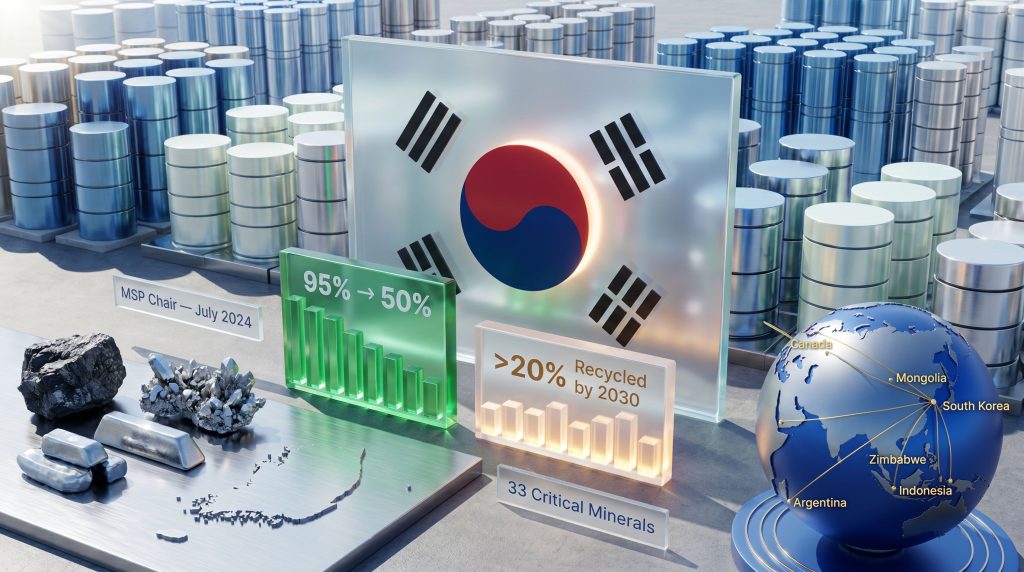
South Korea has developed a tiered classification system for managing supply security across different mineral categories. The government has formally designated 33 critical minerals requiring active supply security measures, with 10 strategic minerals elevated to the highest priority tier based on their centrality to EV battery production and advanced manufacturing.
The tier-one group likely encompasses lithium, cobalt, nickel, manganese, graphite, neodymium, dysprosium, gallium, germanium, and tungsten. These are materials where supply concentration risk is most acute and where disruption would cause the fastest and most severe impact on Korea's industrial output. The tiered structure matters because it enables differentiated policy responses:
- Tier one materials trigger emergency stockpiling protocols and priority diplomatic engagement
- Tier two materials are addressed through geographic diversification of sourcing and bilateral agreements
- Tier three materials are subject to substitution research and materials science investment to reduce long-term reliance
This is a more sophisticated framework than simple criticality lists used by many peer economies, because it acknowledges that not all supply risks are equal and that policy resources should be calibrated accordingly.
The 2030 Quantitative Targets: Ambitious by Design
South Korea has committed to reducing overall critical mineral import dependency from its current baseline exceeding 95% down to 50% by 2030. This headline target encompasses several interconnected sub-objectives that must progress simultaneously to be achievable.
Key 2030 targets at a glance:
- Reduce overall critical mineral import dependency from >95% to 50%
- Increase recycled material content in the critical mineral supply mix from approximately 2% to over 20%
- Expand strategic stockpile capacity, underpinned by an eight-day rapid-response distribution system
- Achieve meaningful upstream equity participation in overseas mining and processing projects across multiple jurisdictions
The 50% target is calibrated for concentration risk reduction rather than self-sufficiency. This framing is deliberately pragmatic. Full self-sufficiency is geologically impossible for South Korea and economically irrational as a policy goal. The achievable ambition is to ensure that no single supplier, processing nation, or trade route can impose a systemic supply shock on Korean industry.
What makes the target ambitious is the lead time problem. Mining projects typically require seven to fifteen years from discovery to sustained production. Agreements signed in 2024 and 2025 may not yield material supply volumes until the mid-2030s or beyond. The 2030 timeline therefore depends heavily on accelerating investment in projects that already have resource definition rather than greenfield exploration, and on scaling recycling infrastructure at an unprecedented pace.
Building the Partnership Network: Tiers, Targets, and Tensions
South Korea's diplomatic minerals engagement spans four distinct geographic tiers, each performing a different strategic function within the overall supply architecture. In addition, the broader surge in critical minerals demand driven by the global energy transition is making this partnership network ever more critical to secure.
Tier 1: Allied Economy Partners
These relationships focus on risk reduction, co-financing structures, and governance alignment:
- Canada has emerged as the dominant alternative supplier for germanium following China's 2023 export controls, and Seoul has deepened cooperation to include joint stockpiling arrangements across multiple mineral categories
- United States engagement operates through the Minerals Security Partnership framework, which South Korea chaired from July 2024, and the associated Minerals Security Partnership Finance Network (MSPFN) that connects Korean firms to Western-backed capital for upstream projects
- European Union cooperation has deepened across supply chain resilience and economic security, with alignment around the principles of the EU Critical Raw Materials Act
- United Kingdom dialogue concentrates on innovation frameworks and governance standards for metals market transparency
Tier 2: Frontier Resource Jurisdictions
- Mongolia hosts significant heavy rare earth reserves critical for permanent magnets used in EV motors and wind turbines, making it a priority for strategic dialogue
- Zimbabwe, Africa's largest lithium producer, represents a key upstream investment target as lithium demand from Korean battery manufacturers continues to grow
- Broader Africa engagement has been formalised through the Korea-Africa Foreign Ministers' meeting framework, systematically targeting resource-rich jurisdictions across multiple mineral categories
Tier 3: Processing and Midstream Partners
- Indonesia hosts Korean investment in nickel and cobalt processing facilities directly tied to battery cell production, embedding Korea into the EV supply chain at the midstream level where value is created and where Chinese dominance has historically been strongest
- Argentina is the site of POSCO's most advanced upstream integration, with full ownership of lithium extraction projects combined with on-site processing infrastructure creating a vertically integrated upstream-to-midstream chain
Tier 4: Managed China Engagement
Seoul is explicitly not pursuing full decoupling from Chinese mineral supply. Instead, dedicated communication channels and joint committees have been established to maintain reliable access to Chinese rare earth supply, particularly for materials where alternative processing capacity will not be commercially viable within the 2030 timeframe. This reflects a deliberate de-risking posture rather than substitution, consistent with approaches adopted across allied economies.
Industry Warning: According to consultancy Plusmining, more than 50 bilateral critical minerals agreements have been signed globally over the past 18 months. More than half remain non-binding, representing diplomatic intent rather than operational supply security. The gap between agreement signing and financed, operational project execution is the central challenge for all resource-dependent economies pursuing diversification strategies.
The Multilateral Dimension: Seoul as Rule-Shaper
South Korea's assumption of the Minerals Security Partnership (MSP) chairmanship from July 2024 represents a significant elevation in its role within allied minerals governance. The MSP connects government agencies, export credit institutions, and development finance bodies to co-finance large-scale mining and processing projects in strategically aligned jurisdictions. For Korean companies, the MSPFN provides access to Western-backed financing that reduces the capital risk historically constraining Korean upstream participation. The CSIS analysis of the MSP under South Korean leadership offers further context on how this chairmanship is reshaping the architecture of allied mineral governance.
Seoul also currently chairs the Forum on Resource Geo-strategic Engagement (FORGE), a US-led multilateral initiative focused on building diversified and resilient critical mineral supply chains. Holding leadership positions in both frameworks simultaneously positions South Korea as a rule-shaper in the emerging geopolitical architecture for mineral governance, not merely a rule-taker responding to decisions made in Washington or Brussels.
| Framework | South Korea's Role | Primary Function |
|---|---|---|
| Minerals Security Partnership (MSP) | Chair from July 2024 | Co-financing and supply diversification |
| FORGE | Current Chair | Geopolitical supply chain resilience |
| Korea-Africa Foreign Ministers' Forum | Host and Convener | Upstream access diplomacy |
| EU-Korea Supply Chain Cooperation | Bilateral partner | Governance and resilience alignment |
This multilateral positioning matters for reasons beyond prestige. Countries that help design the institutional rules for mineral co-financing, governance standards, and trade frameworks gain structural advantages in accessing the most strategically desirable project opportunities. Korea's early and active multilateral engagement reduces the risk of being crowded out of key upstream assets as competition among resource-dependent economies intensifies.
The next major ASX story will hit our subscribers first
From Agreements to Assets: Where Korean Companies Are Executing
The gap between policy and reality in critical minerals is most visible at the corporate investment level. South Korea's most compelling case study is POSCO's full ownership of lithium projects in Argentina, where extraction is paired with on-site processing infrastructure to create genuine vertical integration. This structure eliminates midstream dependency, creates direct cost visibility for downstream battery customers, and positions POSCO to supply Samsung SDI and LG Energy Solution with material that bypasses Chinese processing channels entirely.
The Indonesian nickel and cobalt investments follow a similar logic. Korean industrial firms have committed capital to processing facilities that are structurally linked to battery cell production, embedding Korean industrial interests at the midstream stage where processing margins and strategic control are concentrated. Indonesia holds some of the world's largest nickel laterite reserves, and Korean investment through this corridor creates a long-term structural position in the dominant global nickel supply chain.
How Did Korea Respond to the Gallium and Germanium Shock?
The gallium and germanium experience provides a useful stress test of Korea's diversification reflexes. Following China's imposition of export controls on both materials in 2023, Korea's import composition shifted rapidly, with Canada emerging as the dominant germanium supplier within a relatively short timeframe. This demonstrated that supply redirection is possible under crisis conditions.
It also demonstrated the limits: alternative sources often carry higher cost structures and longer logistics chains, and the underlying markets for both materials remain highly concentrated and volatile despite the diversification achieved.
The lesson is that reactive diversification works, but proactive upstream equity investment is more durable, more cost-predictable, and more strategically controllable. Korea's corporate-level investments in Argentina and Indonesia represent this proactive model in practice. Technologies such as direct lithium extraction may further accelerate these upstream timelines as they mature commercially.
Domestic Pillars: Stockpiling, Recycling, and Public Finance
South Korea's resilience strategy rests on three domestic pillars that complement its international partnership activity.
Strategic Stockpiling
Strategic stockpiling is being expanded with an eight-day rapid-response distribution system calibrated to maintain industrial continuity through acute supply disruptions while alternative sourcing is activated. The eight-day window is a minimum operational buffer, not a long-term solution, and stockpile targets are designed to cover the fastest-response minerals where alternative sourcing can be redirected within days or weeks.
Scaling the Recycling Ambition
Recycling represents the most ambitious domestic pillar. Moving the recycled content share in Korea's critical mineral supply from approximately 2% to more than 20% by 2030 requires:
- Sufficient end-of-life battery feedstock volumes, which are currently limited by the relative youth of Korea's EV fleet
- Investment in hydrometallurgical processing capacity for recovering lithium, cobalt, and nickel from spent cells
- Regulatory frameworks governing battery collection, sorting, and material traceability
- Economically viable recycling unit economics, which improve as feedstock volumes grow and primary mineral prices remain elevated
The recycling ramp will accelerate naturally through the late 2020s as first-generation EV batteries reach end-of-life in meaningful volumes. The policy challenge is building the infrastructure ahead of feedstock availability rather than reactively.
Public Finance Mechanisms
Public financing mechanisms supporting private-sector overseas mineral investment include development loans for qualifying upstream projects, export credit insurance for investments in higher-risk jurisdictions, and tax incentives for companies building strategic mineral supply chains. This toolkit mirrors approaches used by Japan through JOGMEC and the United States through the Development Finance Corporation, calibrated to Korea's specific industrial base requirements.
Execution Risks and the Road to 2030
South Korea's critical minerals strategy is architecturally sophisticated. However, the execution risks are real and deserve clear-eyed assessment.
Key barriers to translating agreements into operational projects include:
- Host country political and regulatory risk in frontier jurisdictions across Africa, Central Asia, and Latin America, where governance uncertainty can delay or derail project timelines
- Financing gaps for large-scale mining infrastructure that often exceed what bilateral agreements alone can facilitate without coordinated multilateral co-financing
- Project lead times of seven to fifteen years from resource definition to sustained commercial production, meaning today's agreements yield supply volumes in the mid-2030s at the earliest for most greenfield projects
- Processing bottlenecks that persist even where raw material access is secured, because refining and conversion capacity requires separate capital commitments and technical infrastructure
The China variable adds another layer of complexity. Seoul's de-risking posture requires continuous recalibration as Beijing's export control regime evolves. Any escalation targeting rare earth supply chains specifically could stress Korea's supply buffers significantly, given that alternative rare earth processing capacity outside China remains limited and expensive.
Speculative Perspective: Some analysts within the minerals intelligence community suggest that the real competitive advantage in the 2030s will not belong to countries with the most bilateral agreements, but to those that successfully develop domestic or allied-nation processing and refining capacity. On this view, Korea's deepest strategic priority should be investing in midstream chemical processing capacity within allied jurisdictions, rather than continuing to accumulate upstream mining equity stakes that still depend on Chinese refineries to convert ore into usable industrial inputs. This remains a minority view, but it reflects a genuine structural insight about where the supply chain is most exposed.
What South Korea's Model Means for the Broader Industry
The South Korea critical minerals strategy is distinctive precisely because it is supply-chain-centred rather than resource-centred. With no meaningful domestic mineral endowment, Korea is forced into a more sophisticated multi-layered approach that must simultaneously progress across diplomatic partnerships, corporate equity investment, multilateral co-financing, emergency stockpiling, and domestic recycling. No single lever is sufficient.
This model is arguably more transferable to other resource-poor industrial economies — including Taiwan, Singapore, and Germany — than strategies that rely on domestic extraction as a primary hedge. Indeed, Austrade's analysis of Korean critical minerals opportunities underscores how this demand-driven model creates concrete openings for resource-rich partners willing to align on governance and processing standards. The degree to which Korea successfully converts its current diplomatic momentum into financed, operational, and producing projects will ultimately determine whether the 2030 targets are achievable in substance rather than just on paper.
This article is intended for informational purposes only and does not constitute financial or investment advice. Forward-looking statements and projections regarding supply chain targets, project timelines, and policy outcomes are subject to material uncertainty. Readers should conduct independent analysis before making any investment or procurement decisions based on information contained herein.
Want to Track the ASX Discoveries Fuelling the Critical Minerals Supply Chain?
As South Korea's industrial giants race to secure lithium, cobalt, nickel, and rare earths, the real opportunities often emerge at the moment of discovery — and Discovery Alert's proprietary Discovery IQ model delivers real-time alerts the instant significant ASX mineral discoveries are announced, turning complex geological data into actionable insights for investors at every level. Explore historic discovery returns on Discovery Alert's dedicated discoveries page and start your 14-day free trial to position yourself ahead of the market.