June 5, 2026
Understanding South Korea's Multi-Phase Energy Transformation Strategy
Advanced economies worldwide are grappling with the complex challenge of simultaneous decarbonization and energy security maintenance, but few nations have embarked on as ambitious a multi-sector transformation as South Korea. The nation's comprehensive approach to the South Korea energy transition involves coordinated restructuring across nuclear expansion, renewable deployment, and industrial process transformation by 2038.
This integrated strategy represents a departure from sequential energy transitions observed in other developed markets, where renewable deployment typically precedes fossil fuel retirement. Instead, South Korean policymakers have adopted a concurrent approach that balances immediate energy security needs with long-term decarbonization objectives through carefully managed capacity additions and retirements.
The government's 2026 budget allocations reflect this balanced strategy, with renewable energy funding receiving a 98.6% increase to ₩648 billion ($440 million), while selective reductions in hydrogen vehicle deployment funding demonstrate prioritization of infrastructure development over consumer adoption incentives. The renewable funding surge targets both solar installations and offshore wind development, with capacity targets of 10.5 GW offshore wind by 2030, expanding to 25 GW by 2035.
South Korea's energy transformation timeline differs significantly from European models, with nuclear capacity playing a central role rather than serving as a transitional technology. The strategy maintains nuclear power contribution at 32.4% of the generation mix by 2030, while simultaneously targeting renewable electricity generation between 21.6-32.95% of total capacity by the same deadline.
The transmission infrastructure component represents one of the most capital-intensive aspects of the transformation, with grid transmission capacity expansion targeting 25,587 circuit-kilometers by 2038, representing a 1.72x multiplier of current levels. This substantial infrastructure investment indicates recognition that distributed renewable generation requires correspondent grid modernization to maintain system reliability.
Furthermore, the importance of critical minerals in energy transition cannot be overstated in South Korea's comprehensive approach. The International Energy Agency's Korea 2025 report highlights the nation's strategic positioning within global energy markets during this transformation period.
When big ASX news breaks, our subscribers know first
What Makes South Korea's Nuclear-Hydrogen Integration Unique in Global Markets?
South Korea's approach to clean hydrogen production diverges fundamentally from global hydrogen development strategies currently predominant in European and North American markets. While most international hydrogen projects focus on green hydrogen production using renewable electricity or blue hydrogen utilizing fossil fuels with carbon capture technologies, South Korea has pioneered a nuclear-powered hydrogen production methodology designated as "pink hydrogen."
Revolutionary Pink Hydrogen Production Framework
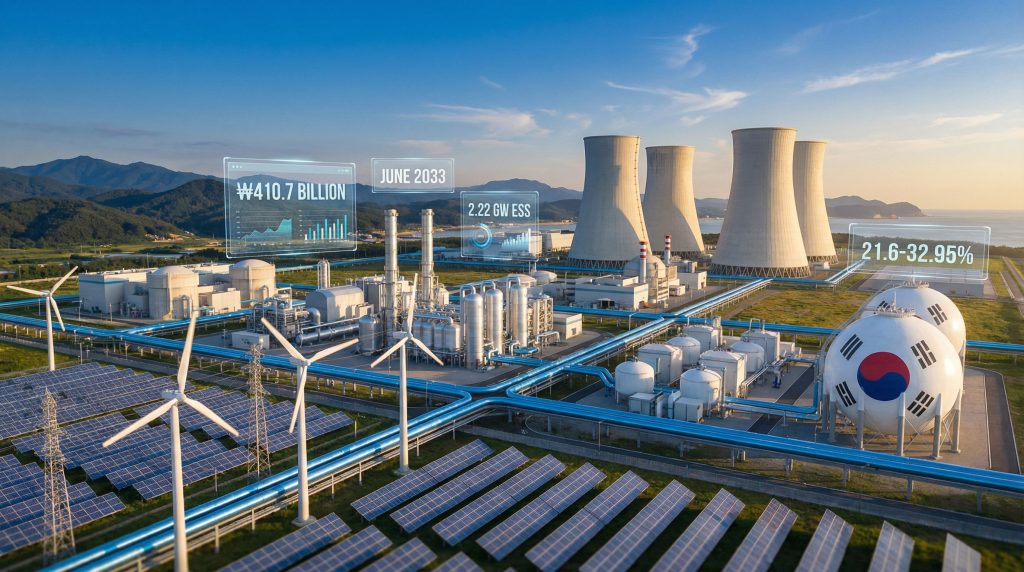
The Uljin Nuclear Hydrogen National Industrial Complex represents the flagship project of this innovative approach, with total project investment reaching ₩410.7 billion (approximately $300+ million USD). The facility targets completion by June 2033, following a comprehensive development timeline that includes approval applications submitted in 2026 and construction launch scheduled for March 2028.
The project's unique technical configuration involves energy integration from 10 nuclear reactors providing surplus baseload capacity for industrial-scale hydrogen electrolysis. This approach exploits nuclear power's characteristic high capacity factors, typically operating at 85-90% utilization rates, to ensure consistent hydrogen production economics without the output variability associated with renewable-powered electrolysis systems.
| Development Phase | Timeline | Key Milestone |
|---|---|---|
| Approval Process | 2026 | Application submissions completed |
| Construction Launch | March 2028 | Ground-breaking ceremony |
| Commercial Operations | June 2033 | Full-scale hydrogen production |
The nuclear-hydrogen integration strategy reflects recognition that hydrogen production requires substantial and consistent electricity input, with electrolysis processes operating most economically under steady baseload conditions. Traditional renewable-based hydrogen production faces challenges from intermittency, requiring either oversized renewable capacity or battery storage systems to maintain consistent output, both of which increase production costs significantly.
Hydrogen Infrastructure Investment Rebalancing
Government budget adjustments reveal strategic priority shifts within the hydrogen economy development. The 2026 hydrogen vehicle deployment budget received a 20% reduction to ₩576.2 billion, while hydrogen refueling infrastructure expansion maintains aggressive targets for 660+ stations by 2030. This rebalancing suggests recognition that industrial hydrogen applications represent more immediate commercial viability than consumer mobility applications.
South Korea exceeded its refueling station deployment targets in 2025, providing infrastructure foundation for eventual hydrogen vehicle commercialization when cost competitiveness improves. The maintained infrastructure investment combined with reduced vehicle subsidies indicates confidence in eventual demand growth while acknowledging current economic challenges in hydrogen vehicle adoption.
However, the hydrogen sector faces challenges from international joint venture restructuring. Plug Power's exit from its partnership with SK Plug Hyverse reflects broader market pressures affecting hydrogen technology companies, particularly those focused on mobility applications where commercialization timelines have extended beyond initial projections.
How Are Coal Phase-Out Policies Creating Market Disruptions?
The paradoxical relationship between South Korea's aggressive coal retirement policies and actual coal market behavior reveals fundamental tensions in energy transition implementation. Despite government commitments to complete coal phase-out by 2040 and the successful retirement of the Taean 1 coal-fired unit on December 31, 2025, coal import data indicates strengthening rather than weakening market participation.
Contradictory Coal Import Trends Amid Decarbonization
November 2025 data showed 4.1% year-over-year growth in coal imports, primarily driven by increased Russian supply arrangements. This trend contradicts expectations of declining coal demand as renewable capacity expands and nuclear units commence operation. The import growth occurred simultaneously with six consecutive weeks of declining high-CV coal prices, suggesting either strategic inventory building or continued operational requirements for coal-fired generation despite policy directives.
Korea Southern Power Company's procurement strategy exemplifies this apparent contradiction, with active seeking of up to 1.95 million tonnes of thermal coal for delivery through 2030. This procurement timeline extends well into the renewable energy expansion phase, indicating that coal plants retain operational roles beyond immediate grid balancing requirements.
The coal market dynamics reflect complex operational realities:
• Price-driven purchasing behavior: Declining coal prices create economic incentives for utility procurement despite policy pressure for demand reduction
• Grid stability requirements: Coal plants provide firm capacity and flexibility services essential for renewable integration management
• Nuclear capacity delays: While Saeul reactor 3 received operational clearance for August commercial launch, broader nuclear expansion timelines create interim coal dependency
• Flexible operation constraints: Coal plants operate under restricted flexibility mandates that limit rapid ramping capability, affecting overall system efficiency
Power Generation Mix Optimization Challenges
The energy transition creates operational complexities between different generation sources that policy frameworks must accommodate. LNG imports rebounded in December 2025, yet gas-fired power generation output remained subdued due to flexible coal plant operational restrictions and nuclear capacity delays. This disconnect between fuel availability and generation output indicates systematic operational constraints rather than fuel supply limitations.
Coal-fired generation actually increased in October 2025 despite government curbing policies, suggesting that grid operators prioritized system reliability over immediate decarbonization objectives when renewable output or nuclear availability proved insufficient for demand requirements. The maximum coal generation threshold of 19.7% by 2030 may represent minimum flexible capacity requirements rather than maximum allowable generation, indicating that some coal capacity retention serves essential grid stability functions.
In addition, the relationship between energy markets and geopolitical tensions affects oil market rally factors globally. The Russian supply relationship introduces geopolitical considerations into energy security planning. Increased Russian coal imports provide competitive pricing but potentially create supply chain vulnerabilities if international sanctions or trade disputes affect availability. This dynamic exemplifies the tension between immediate economic optimization and long-term energy security diversification objectives.
What Role Does Energy Storage Play in Grid Modernization?
Energy storage system deployment represents a critical enabler for South Korea's renewable energy integration targets, with the government establishing ambitious capacity targets of 2.22 GW ESS capacity by 2029. This storage deployment directly supports the renewable energy expansion objectives while providing grid services necessary for maintaining system reliability as variable generation sources increase their contribution to the energy mix.
Battery Storage System Expansion Strategy
The ESS expansion strategy emphasizes domestic manufacturing capability through LG Energy Solution's strategic pivot toward domestic lithium iron phosphate (LFP) battery production. This technology selection indicates prioritization of safety, calendar lifespan, and cost efficiency over energy density optimization, reflecting utility-scale applications that prioritize reliability and economics over space constraints.
LFP chemistry offers several operational advantages for grid-scale applications:
• Enhanced safety profiles: Lower thermal runaway risk compared to nickel-rich chemistries
• Extended calendar lifespan: Superior cycle life performance for frequent charge-discharge applications
• Cost efficiency: Lower material costs and reduced dependency on cobalt and nickel price volatility
• Temperature stability: Better performance retention under varying environmental conditions
The domestic production strategy addresses supply chain security concerns while building industrial capacity in strategic battery technologies. Consequently, battery metals investment strategies become increasingly relevant. LG Energy Solution's pivot reflects broader industrial policy objectives that prioritize technology sovereignty alongside immediate storage deployment needs.
Grid Infrastructure Investment Framework
The storage deployment operates within a comprehensive grid modernization program that includes substantial transmission and substation capacity expansion. The 2026 grid upgrade budget allocation of ₩214.3 billion ($145 million USD) supports infrastructure development necessary for distributed generation integration and bidirectional power flow management.
Grid Infrastructure Expansion Targets:
| Infrastructure Type | 2038 Target | Current Capacity Multiplier |
|---|---|---|
| Transmission Lines | 25,587 C-km | 1.72x |
| Substation Capacity | 187,560 MVA | 1.52x |
| Energy Storage | 2.22 GW (by 2029) | New capacity addition |
The proposed "West Coast energy expressway" high-voltage direct current development suggests recognition that offshore wind development along coastal regions requires dedicated transmission corridors to transport energy to inland consumption centers. This infrastructure represents essential complementary investment to renewable generation capacity expansion.
Traditional distribution grids operated with unidirectional power flow from centralized generation to distributed consumption. Integration of distributed renewable sources, combined with battery storage systems, requires substations capable of managing bidirectional power flow and voltage regulation under variable generation conditions. The 1.52x substation capacity expansion indicates substantial infrastructure requirements for accommodating these operational changes.
How Are Industrial Sectors Adapting to Sustainability Mandates?
South Korea's industrial sector transformation encompasses both immediate operational adjustments and long-term capacity restructuring across petrochemicals, metals processing, and manufacturing. These adaptations reflect regulatory pressure, economic incentives, and strategic positioning for future market conditions under sustained decarbonization policies.
Petrochemical Industry Rationalization Strategy
The petrochemical sector faces significant capacity restructuring pressures, with industry proposals targeting 2.7-3.7 million tonnes per year of cracker capacity reduction. However, implementation delays extending beyond 2027 indicate complex economic considerations affecting rationalization timing and scope.
Concurrent with capacity reduction discussions, operational restarts demonstrate selective facility utilization based on margin conditions. GS Caltex's paraxylene unit restart represents 550,000 tonnes annual capacity returning to service on January 15, 2026, driven by favorable PX-naphtha margin conditions. This operational flexibility indicates that petrochemical capacity retirement depends significantly on economic viability rather than solely regulatory pressure.
Notable Operational Developments:
• SK Energy RFCC unit restart: Ulsan facility operational, driving gasoline export surge in January 2026
• PX-naphtha margin strength: Supporting economic viability of paraxylene production restart
• Cracker capacity rationalization: Delayed implementation beyond 2027 despite 2.7-3.7 Mt/yr reduction proposals
• Export market optimization: Gasoline export increases following refinery complex restarts
The petrochemical industry's response to sustainability mandates involves selective capacity utilization rather than immediate wholesale retirement, suggesting economic optimization within environmental constraints. This approach maintains operational flexibility while assessment of long-term demand patterns and regulatory frameworks continues.
Circular Economy Implementation Requirements
New regulatory frameworks mandate specific recycled content requirements for major manufacturers, with beverage companies producing 5,000+ tonnes annually required to incorporate minimum 10% recycled PET content. This mandate creates immediate demand for recycled materials, potentially increasing rPET consumption by 17,500 tonnes annually across affected manufacturers.
The recycled PET requirement represents a concrete example of circular economy policy implementation that creates quantifiable market demand for recycled materials. Unlike voluntary sustainability commitments, mandatory content requirements provide demand certainty that supports investment in recycling infrastructure and collection systems.
Korea Zinc's partnership with Alta Resource Technologies addresses critical material recycling for energy transition technologies through rare earth element recovery from end-of-life magnets. The project targets 100 tonnes per year capacity by 2027, addressing supply chain security for materials essential to wind turbine and electric motor manufacturing.
The rare earth recycling initiative represents recognition that energy transition technologies require strategic material supply chain development beyond renewable generation capacity installation.
This recycling capacity development addresses potential supply constraints for neodymium, dysprosium, and other rare earth elements essential to permanent magnet production for wind turbines and electric vehicle motors. The 100 tonnes annual capacity, while modest relative to global rare earth production, establishes domestic recycling capability that reduces import dependency for critical materials.
What Are the Critical Success Factors for Renewable Energy Scaling?
South Korea's renewable energy scaling faces both technical infrastructure constraints and policy framework evolution under new administrative leadership. The integration of variable renewable sources with existing grid infrastructure requires coordinated investment across generation, transmission, and storage systems to maintain system reliability while achieving capacity targets.
Policy Framework Evolution and Political Dynamics
Administrative transitions affect renewable energy development priorities and implementation strategies. Current policy frameworks emphasize offshore wind and solar expansion as primary deployment sectors, with renewable energy funding receiving substantial budget increases to support accelerated capacity additions.
The renewable energy scaling strategy faces implementation challenges identified as 15-year delays compared to global benchmarks, suggesting systematic bottlenecks in project development, grid integration, or regulatory approval processes. These delays affect the timeline for achieving the 100 GW renewable capacity target by 2030 and may require policy framework adjustments or accelerated infrastructure investment to maintain schedule adherence.
Key Renewable Energy Financial Commitments:
• 2026 renewable funding: ₩648 billion ($440 million) representing 98.6% year-over-year increase
• Primary deployment focus: Solar installations and offshore wind development
• RE100 industrial complex development: Fully renewable-powered manufacturing facilities
• Grid integration investment: Coordinated transmission and distribution system upgrades
The development of RE100 industrial complexes indicates strategic targeting of large-scale industrial energy consumers for renewable energy deployment. These facilities provide demand aggregation that supports utility-scale renewable project economics while demonstrating commercial viability of renewable-powered industrial operations.
Grid Integration Bottleneck Resolution
Renewable energy integration requires substantial grid infrastructure development to accommodate distributed generation sources and variable output characteristics. The transmission capacity expansion targeting 25,587 circuit-kilometers by 2038 represents recognition that renewable generation sites (particularly offshore wind) often locate distant from major consumption centers.
The "West Coast energy expressway" high-voltage direct current development facilitates energy transmission from western coastal offshore wind development zones to inland industrial and residential consumption centers. HVDC technology provides efficient long-distance transmission with reduced line losses compared to alternating current systems, particularly beneficial for offshore wind integration.
Grid modernization challenges include:
• Bidirectional power flow management: Traditional grids designed for unidirectional flow require substantial upgrades
• Voltage regulation: Variable renewable generation requires dynamic voltage control capabilities
• Frequency stability: Storage systems and flexible generation required for grid frequency maintenance
• Transmission bottlenecks: Offshore wind and remote solar require new transmission corridors
The energy storage deployment target of 2.22 GW by 2029 provides grid services essential for renewable integration, including frequency regulation, voltage support, and energy time-shifting to align generation with consumption patterns. Battery storage systems enable renewable energy utilization during periods when generation exceeds immediate demand, effectively increasing the system capacity factor for variable renewable sources.
The next major ASX story will hit our subscribers first
How Do Trade Dynamics Impact Energy Transition Financing?
International trade relationships significantly influence South Korea's energy transition through both direct material supply chains and indirect effects from trade disputes affecting industrial sector costs. These dynamics create additional complexity in transition planning and financing strategies.
Trade Investigation Implications for Infrastructure Costs
US anti-dumping and countervailing duty investigations on South Korean hot-rolled coil imports affect infrastructure development costs for renewable energy projects. The investigations cover 335,040 tonnes annually of steel imports, representing significant volume for infrastructure-intensive renewable projects that require substantial steel input for wind turbine towers, transmission lines, and substation equipment.
Steel cost increases from trade restrictions create upstream pressure on renewable project economics, potentially affecting the pace of capacity expansion or requiring additional government subsidies to maintain project viability. The UK's consideration of removing South Korean plate over 2.5 meters wide from anti-dumping investigations provides some relief, though the overall trade environment remains challenging for steel-intensive energy infrastructure.
Strategic Material Supply Chain Development
Critical material supply chain security represents a strategic consideration for energy transition sustainability. Korea Zinc's rare earth element recycling partnership addresses supply chain vulnerability for materials essential to renewable energy technologies, particularly permanent magnets used in wind turbine generators and electric vehicle motors.
The 100 tonnes per year rare earth recycling capacity by 2027 establishes domestic supply capability for materials traditionally imported from concentrated global supply sources. While this capacity represents a modest contribution to total rare earth requirements, it provides supply chain diversification and technical capability development in strategic material processing.
Strategic Material Supply Chain Initiatives:
• Rare earth recycling: 100 t/yr capacity from end-of-life magnet recovery by 2027
• Battery material localization: LG Energy Solution domestic LFP production pivot
• Steel supply chain: Managing trade dispute impacts on infrastructure costs
• Critical mineral diversification: Reducing dependency on concentrated global suppliers
The emphasis on domestic material supply capability reflects recognition that energy transition success depends not only on generation capacity installation but also on secure supply chains for essential materials and components. Supply chain vulnerabilities could constrain transition progress even with adequate financing and policy support.
What Investment Opportunities Emerge from South Korea's Energy Transition?
The comprehensive scope of South Korea's energy transformation creates substantial investment opportunities across infrastructure development, industrial modernization, and supporting service sectors. These opportunities span both domestic capacity building and international market participation through technology export and project development.
Maritime Infrastructure and LNG Transportation Growth
South Korea's shipbuilding sector benefits from growing global demand for LNG transportation capacity and clean energy infrastructure support vessels. However, US natural gas forecasts significantly influence these market dynamics. Recent major shipbuilding contracts reflect this market expansion:
• Hyundai Samho Heavy Industries: Four LNG carrier orders secured for international delivery
• Samsung Heavy Industries: Two additional LNG carrier contracts awarded
• Maritime infrastructure development: Supporting energy import diversification strategies
The LNG carrier construction represents both immediate revenue opportunities for shipbuilding companies and strategic positioning for South Korea's role in global LNG trade expansion. As countries worldwide increase natural gas imports for coal displacement, LNG shipping capacity becomes increasingly valuable, with South Korean shipyards maintaining technological leadership in specialized vessel construction.
Technology Development and Joint Venture Evolution
Market consolidation and partnership restructuring create opportunities for strategic repositioning within energy technology sectors. Plug Power's exit from the SK Plug Hyverse joint venture, while representing challenges for hydrogen mobility development, also creates opportunities for alternative technology partnerships or domestic capability development.
The selective nature of international partnerships indicates that successful technology transfer and joint venture arrangements require alignment between commercial viability timelines and market development expectations. Companies with realistic commercialization timelines and proven technology performance may find enhanced partnership opportunities as market participants become more selective.
Investment opportunities include:
• Energy storage system integration: 2.22 GW capacity deployment by 2029 requiring substantial capital investment
• Transmission infrastructure development: Grid modernization across 25,587 C-km expansion
• Nuclear-hydrogen technology development: Pink hydrogen production methodology with potential export applications
• Recycling and circular economy infrastructure: Growing demand for recycled material processing capacity
Additionally, uranium market strategies become increasingly relevant given South Korea's nuclear capacity expansion plans and potential pink hydrogen applications.
Future Outlook: Achieving 2030-2038 Decarbonization Targets
South Korea's energy transition success depends on coordinated execution across multiple technology pathways and policy frameworks. The integration of nuclear baseload capacity, renewable energy scaling, energy storage deployment, and industrial sector transformation represents one of the world's most comprehensive decarbonization strategies.
The 2030 performance indicators provide measurable targets for transition progress assessment:
• Renewable electricity generation: 21.6-32.95% of total capacity
• Nuclear power contribution: 32.4% of generation mix
• Coal generation reduction: 19.7% maximum threshold
• Energy storage deployment: 2.22 GW ESS capacity milestone
However, implementation challenges require sustained policy coordination and substantial capital investment. The identified 15-year delay relative to global benchmarks indicates that achieving these targets may require accelerated regulatory processes, enhanced project financing mechanisms, or technology deployment strategies that address current bottlenecks.
The nuclear-hydrogen integration approach positions South Korea as a potential technology leader in clean hydrogen production methodologies. If pink hydrogen production achieves commercial success, this technology could become exportable to other countries with substantial nuclear capacity seeking hydrogen economy development pathways.
Furthermore, the Institute for Energy Economics and Financial Analysis provides comprehensive analysis of the South Korea energy transition challenges and opportunities ahead.
Investment decisions should consider the inherent uncertainties in energy transition timelines, regulatory evolution, and technology commercialization success rates. Past performance of energy transition projects does not guarantee future results, and policy changes may affect project economics and implementation schedules.
Market participants interested in South Korea energy transition opportunities should monitor policy implementation progress, infrastructure development timelines, and technology commercialization milestones to assess investment timing and sector positioning strategies. The comprehensive nature of South Korea's approach creates opportunities across multiple sectors while requiring careful evaluation of execution risks and market development timelines.
Interested in Tracking Energy Transition Investment Opportunities?
Discovery Alert's proprietary Discovery IQ model delivers real-time alerts on significant critical mineral discoveries essential for renewable energy infrastructure, empowering investors to identify actionable opportunities in battery metals and rare earth discoveries before broader market recognition. Begin your 14-day free trial today to position yourself ahead of the energy transition investment curve with immediate notifications on ASX mineral discoveries that could benefit from South Korea's expanding demand for critical materials.