May 20, 2026
When Industrial Policy Becomes a Lifeline: Understanding South Korea's Steel Crossroads
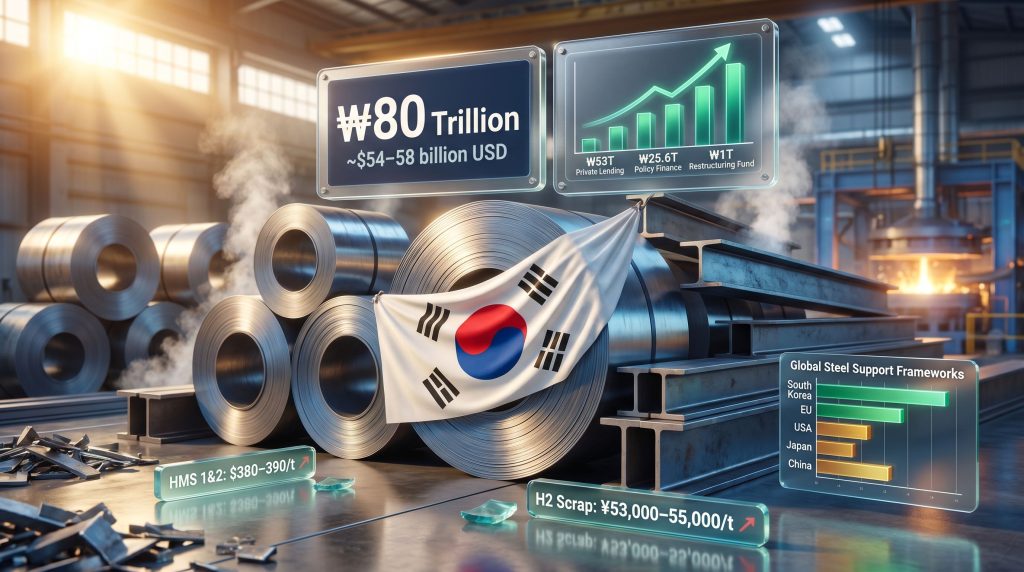
The history of government intervention in heavy industry rarely begins with a single crisis. More often, it reflects the slow accumulation of structural vulnerabilities that, over time, become impossible to manage through market mechanisms alone. South Korea's steel sector is now at precisely that inflection point. The country's Financial Services Commission announced on April 17, 2026 a sweeping ₩80 trillion won package (approximately $54 billion USD) targeting several of its most strategically significant industries, with steel occupying a prominent position among them. The South Korea steel support package reflects a convergence of pressures that have eroded the financial and operational foundations of Korean steelmakers over several years.
When big ASX news breaks, our subscribers know first
Why Is South Korea Intervening in Its Steel Sector Now?
The Convergence of Three Structural Crises Forcing Government Action
Industrial support packages of this magnitude do not emerge from a single bad quarter. The South Korea steel support package reflects distinct but mutually reinforcing pressures that have accumulated over time, ultimately compelling government action at a scale the sector has not previously seen.
The first pressure is trade barrier escalation. Both the United States and European Union have progressively tightened tariff frameworks affecting Korean steel exports. The broader dynamics around US tariffs and iron ore illustrate how interconnected these trade policies have become across raw material and finished steel markets alike.
The second pressure is the geopolitical freight shock triggered by conflict escalation in the Middle East. Following US and Israeli military operations against Iran on February 28, 2026, and the subsequent regional escalation, freight costs for steel raw material procurement surged dramatically. According to Fastmarkets, freight rates climbed to $28-35 per tonne, compared to approximately $18 per tonne before the conflict intensified, representing a cost increase of 55-94% per tonne on logistics alone. For an industry already operating on thin margins, this kind of input cost inflation is not a rounding error.
The third pressure is structural domestic demand weakness. South Korea's construction sector, historically one of the primary consumers of domestic steel output, has experienced prolonged softness. This is not a temporary inventory correction but a deeper demand deficit linked to housing market dynamics, infrastructure spending cycles, and demographic shifts. As one trade source familiar with Korean market conditions told Fastmarkets, the steel sector continues facing headwinds from weak construction activity despite prior government interventions.
Key Insight: South Korea's steel sector is not navigating a cyclical trough that monetary policy or demand stimulus can easily correct. It faces simultaneous structural, geopolitical, and competitive pressures operating across different timeframes and requiring different remedies.
How South Korea's Steel Industry Became a Strategic Vulnerability
Steel occupies a foundational role in South Korea's industrial economy, underpinning its automotive, shipbuilding, construction, and electronics manufacturing supply chains. Korean mills are particularly exposed to a dynamic that Japanese and Taiwanese peers face less acutely: the combination of heavy dependence on imported raw materials, significant export orientation in finished products, and geographic proximity to Chinese producers.
The China steel and iron ore market has been a persistent source of competitive pressure for over a decade. Its impact on Korean producers intensified as domestic Chinese demand softened, pushing export volumes into Southeast Asian and broader Asian markets at prices that compress Korean producers' pricing power. The earlier K-Steel Act, while representing an attempt at sector stabilisation, lacked the financial scale and structural depth required to address these compounding dynamics.
What Does the ₩80 Trillion Support Package Actually Include?
Breaking Down the Financial Architecture of the Package
The scale of the South Korea steel support package is substantial, but its architecture is more nuanced than a simple government bailout. The package combines private-sector credit mobilisation with targeted state lending and structural rehabilitation mechanisms.
| Component | Value | Source | Primary Mechanism |
|---|---|---|---|
| Private-sector lending facilities | ₩53 trillion | Commercial banks | Expanded credit access, reduced borrowing costs |
| Policy lender financing | ₩25.6 trillion | State-owned banks | Supplementary budget expansion |
| Corporate Restructuring Innovation Fund | ₩1 trillion | Government | Financial structure rehabilitation |
| P-CBO bond guarantee program | Part of broader package | Korea Credit Guarantee Fund | ~50 basis point reduction in issuance costs |
| Total package value | ₩80 trillion (~$54-58 billion USD) | Mixed public/private | Multi-instrument deployment |
The lending component alone accounts for the overwhelming majority of the package's headline figure, with more than ₩53 trillion mobilised from private financial institutions. This distinction matters significantly for investors and analysts assessing the fiscal impact on South Korea's public balance sheet, as much of the package represents credit facilitation rather than direct government expenditure.
Which Industries Share the Restructuring Fund?
The ₩1 trillion Corporate Restructuring Innovation Fund is distributed across six designated industrial sectors rather than being exclusively allocated to steel:
- Steel
- Petrochemicals
- Semiconductors
- Automobiles
- Display manufacturing
- Battery production
This multi-sector bundling reflects the Korean government's recognition that these industries share common structural vulnerabilities around financing, global competitiveness, and the transition to next-generation production technologies. Grouping them together also signals industrial ecosystem thinking, where the health of steel production is seen as interconnected with automotive manufacturing and battery supply chains.
What the P-CBO Program Means for Smaller Steelmakers
The P-CBO (primary collateralised bond obligation) program is particularly significant for mid-tier and smaller Korean steelmakers who lack the credit profiles of large integrated mills like POSCO or Hyundai Steel. Under this mechanism, the Korea Credit Guarantee Fund provides guarantees that backstop bond issuances from lower-rated corporate borrowers, enabling companies that would otherwise face punitive borrowing costs to access capital markets.
A reduction of approximately 50 basis points in bond issuance costs may appear modest in isolation, but for a capital-intensive industry already operating under margin compression, this represents meaningful relief. For a steel producer carrying substantial debt to fund raw material procurement and capital maintenance, a half-percentage-point reduction in financing costs can translate directly into operational sustainability.
SME steel producers are expected to begin accessing this mechanism from June 2026 onward, with the Korea Credit Guarantee Fund acting as the program's guarantor. Furthermore, this P-CBO mechanism builds on an earlier Korean government initiative involving a KRW 400 billion steel export guarantee program, though the scale and structural ambition of the new package substantially exceeds that prior effort.
How Are Rising Input Costs Reshaping Korean Steel Economics?
The Freight Rate Shock: A Quantified Impact Analysis
For Korean steelmakers dependent on imported raw materials, the freight cost environment since early 2026 represents one of the most acute near-term margin pressures in years. The trajectory is stark:
- Pre-conflict freight benchmark: approximately $18 per tonne
- Post-conflict freight range: $28-35 per tonne
- Implied cost increase: 55-94% surge in per-tonne logistics costs
- Trigger event: US and Israeli military operations against Iran on February 28, 2026 and subsequent regional escalation
What makes this freight shock particularly damaging for Korean mills is that it compounds rather than substitutes for other input cost pressures. Higher scrap prices, elevated energy costs, and weaker export pricing power are occurring simultaneously with the freight surge, creating a multi-front margin squeeze that no single relief mechanism can fully offset.
Steel Scrap Price Trajectory: March to April 2026
Fastmarkets' price assessments document the specific scrap cost escalation affecting Korean mills during this period:
| Scrap Grade | March 6 Assessment | April 2 Assessment | Change |
|---|---|---|---|
| H2 Japan origin, cfr South Korea | ¥49,000-50,000/tonne | ¥53,000-55,000/tonne | +¥4,000-5,000/tonne |
| HMS 1&2 (80:20) deep-sea, cfr South Korea | $350-355/tonne | $380-390/tonne | +$30-35/tonne |
These price movements occurred within a single calendar month, illustrating how rapidly input cost conditions can deteriorate when geopolitical disruptions intersect with already-tight raw material supply dynamics. Korean electric arc furnace operators, who depend heavily on purchased scrap as their primary metallic input, face a direct and immediate cost impact from these price escalations that blast furnace operators using iron ore experience differently.
How Cost Escalation Is Altering Mill Behaviour
The operational consequences of this input cost environment are already visible. According to Fastmarkets, Hyundai Steel suspended new export offers for structural steel sections including H-beams, a direct response to the deteriorating economics of exporting at prevailing prices when input costs have surged.
When a major integrated producer exits export markets for specific product categories, it typically indicates that the margin between production cost and achievable export price has compressed to levels where additional volume generates losses rather than contributions to overhead recovery. This dynamic can create temporary supply tightness in markets where Korean H-beam exports previously competed, but it also removes revenue that Korean mills need to cover fixed costs and debt obligations.
Warning: The combination of elevated scrap prices, surging freight costs, and subdued construction demand creates a margin squeeze that financial liquidity support alone cannot fully offset. The package addresses the funding dimension of the crisis but cannot directly resolve the underlying cost and demand dynamics.
Is the ₩80 Trillion Package Enough to Stabilise Korean Steel?
Scenario 1: Optimistic Recovery
For the package to deliver its full intended effect, several conditions would need to materialise concurrently:
- Middle East conflict de-escalation normalising freight corridors within 12-18 months
- Domestic construction activity recovering on the back of sustained government infrastructure spending
- Successful bond market access for SME mills through P-CBO guarantees from June onward
- Chinese export volumes moderating under multilateral trade pressure
- Energy cost stabilisation reducing the compounding burden on mill operating economics
Under this scenario, the liquidity measures buy the critical time needed for structural adjustments to take hold before financial stress forces disorderly consolidation or insolvency among weaker producers.
Scenario 2: Partial Stabilisation
The more probable near-term outcome is a middle path in which the package prevents acute insolvencies among mid-tier producers but does not resolve the deeper structural challenges facing the sector. Larger mills like Hyundai Steel would use improved credit conditions to accelerate their pivot toward higher-value product segments, while smaller mills remain exposed to input cost volatility despite enhanced credit access.
Construction demand recovery would, however, remain sluggish through 2026-2027, maintaining pressure on domestic volumes. This scenario sees the package functioning as a stabiliser rather than a catalyst, holding the sector together during a difficult period rather than transforming its competitive position.
Scenario 3: Policy Inadequacy
The downside scenario involves several risk factors converging to limit the package's effectiveness:
- Prolonged Middle East disruption sustaining freight cost elevation beyond 18 months
- Additional US or EU tariff escalation narrowing Korean steel's export addressable market further
- Chinese material continuing to undercut Korean pricing in third-country markets with no regulatory countermeasure
- Structural fund deployment delays limiting the real-economy impact of the restructuring component
- Domestic construction demand remaining suppressed beyond government forecast timelines
A Singapore-based trade source consulted by Fastmarkets summarised the prevailing uncertainty concisely, noting that how developments ultimately play out remains to be seen. This measured assessment from a market participant close to Asian steel trade flows reflects the genuine unpredictability of the current operating environment.
What Strategic Shifts Are Korean Steelmakers Making to Survive?
The Product Portfolio Pivot: Moving Up the Value Chain
Against the backdrop of narrowing margins on commodity steel products, Korean mills including Hyundai Steel have been deliberately redirecting capacity toward product categories that offer superior pricing power and more defensible competitive positions. Two segments have emerged as particularly strategic priorities.
Automotive steel sheet represents a logical destination for Korean producers given the country's world-class automotive manufacturing base. High-strength automotive steels require precise metallurgical specifications, tight dimensional tolerances, and consistent surface quality that cannot be easily replicated by lower-cost producers. This creates a quality barrier to entry that insulates Korean mills from direct price competition with Chinese commodity producers in this segment.
Ultra-wide steel plate for offshore wind projects represents a newer but rapidly growing opportunity. Offshore wind turbine foundations, transition pieces, and monopile structures require extremely wide, thick plate with specific mechanical properties that only a limited number of global producers can manufacture. South Korea's ambitions in offshore wind energy development create a degree of domestic demand alignment with this product pivot.
The Green Steel Transition: A Medium-Term Strategic Imperative
South Korea's Steel Industry Advancement Plan, announced in November 2025, provides the policy framework underpinning the sector's longer-term transformation. The plan targets a structural transition across several dimensions:
- Scaling electric arc furnace (EAF) capacity to reduce dependence on coal-intensive blast furnace steelmaking
- Piloting hydrogen-based direct reduction steelmaking as a pathway to near-zero carbon production, building on advances in hydrogen iron ore reduction technology
- Securing domestic and regional scrap supply chains to support expanded EAF operations
- Developing premium-priced low-carbon steel product lines capable of commanding green premiums in European and North American export markets
The EAF transition is particularly noteworthy from a raw material perspective. As Korean mills expand electric arc furnace capacity, their demand for purchased scrap will increase, creating ongoing upward pressure on regional scrap markets and reinforcing the price trajectory already observed in Fastmarkets' assessments. Japanese scrap exporters, who supply a significant portion of South Korea's H2 scrap requirements, stand to benefit from this structural demand growth even as the transition creates short-term cost challenges.
How Korean Mills Compare to Global Peers on Decarbonisation Readiness
| Dimension | South Korea | Japan | EU (Germany/Sweden) | China |
|---|---|---|---|---|
| EAF share of production | Moderate, expanding | Moderate | High (EU policy-driven) | Low, growing |
| Hydrogen steelmaking pilots | Early stage | Advanced pilot stage | Commercial pilots active | Limited |
| Government decarbonisation support | Strong (new package) | Moderate | Extensive (CBAM-linked) | State-directed |
| Carbon border exposure | Moderate (EU CBAM) | Moderate | N/A (producer) | High |
South Korea occupies a middle position in this global decarbonisation landscape: more advanced than China in policy commitment and technology investment, but behind European producers who have been driven by the EU's Carbon Border Adjustment Mechanism to accelerate green steel transitions more aggressively. Consequently, Korean mills that successfully develop commercially viable low-carbon steel capabilities could capture green steel pricing trends premiums in export markets while those that lag face growing carbon-related trade barriers.
The next major ASX story will hit our subscribers first
How Does South Korea's Package Compare to Global Steel Support Frameworks?
A Cross-Country Policy Comparison
| Country/Region | Support Mechanism | Scale | Primary Focus |
|---|---|---|---|
| South Korea | ₩80 trillion mixed public/private package | ~$54-58 billion | Liquidity, restructuring, green transition |
| European Union | CBAM + state aid frameworks | Variable by member state | Decarbonisation, trade protection |
| United States | Section 232 tariffs + IRA incentives | Multi-billion (indirect) | Domestic production protection, green steel |
| Japan | Industrial competitiveness subsidies + green innovation funds | Tens of billions (yen) | Technology modernisation |
| China | State-directed capacity management + export support | State-integrated | Volume management, export competitiveness |
What Makes South Korea's Approach Distinctive
Several features differentiate this intervention from comparable measures in other major steel-producing nations. Furthermore, when viewed alongside the global crude steel outlook, the Korean package stands out for its dual-track architecture combining immediate liquidity relief with longer-term structural restructuring.
- The explicit multi-sector bundling of steel with semiconductors and batteries signals industrial ecosystem thinking rather than sectoral isolation
- The dual-track architecture combines immediate liquidity relief with longer-term structural restructuring, addressing both acute and chronic challenges simultaneously
- The Financial Services Commission indicated willingness to expand the package further if conditions deteriorate, introducing a dynamic rather than fixed policy commitment
- The alignment with the November 2025 Steel Industry Advancement Plan creates policy continuity that signals sustained government commitment beyond emergency response
This policy continuity signal matters for corporate planning horizons within Korean mills. When steelmakers can see that government support is embedded within a multi-year strategic framework rather than representing a one-time crisis response, they are better positioned to make the capital allocation decisions required for genuine structural transformation.
What Are the Global Market Implications of This Intervention?
Impact on Regional Steel Trade Flows
Improved liquidity conditions for Korean mills could sustain export volumes to Southeast Asian markets during a period when operational pressures might otherwise have forced production cutbacks. However, this support-driven volume maintenance could also create tension with other regional exporters who compete with Korean producers in markets like Vietnam, Thailand, and Indonesia.
Chinese producers face a particularly nuanced competitive dynamic. According to SteelOrbis, government-backed Korean competitors with improved credit access and a strategic mandate to upgrade product quality represent a more formidable threat in premium product segments than Korean mills struggling with liquidity constraints.
Implications for Iron Ore and Scrap Markets
The Korean intervention has direct read-through implications for raw material markets that extend well beyond the Korean peninsula:
- Sustained Korean EAF expansion will increase regional scrap demand, with Japanese scrap exporters as the primary volume beneficiaries
- If blast furnace output is maintained at current levels rather than reduced, Korean iron ore import volumes remain a price-relevant factor for Australian iron ore producers
- The scrap price trajectory documented by Fastmarkets serves as a leading indicator of Korean mill operating rates, with strengthening scrap prices signalling continued production activity rather than cutbacks
Signals for the Global Green Steel Premium
South Korea's commitment to EAF expansion and hydrogen-based steelmaking represents producer-side investment that signals growing confidence in the commercial viability of low-carbon steel production. Whether Korean mills can capture meaningful green steel price premiums in European and North American markets depends on several converging factors: the pace of CBAM implementation, buyer willingness to pay premiums for verified low-carbon steel, and the timeline to commercially competitive hydrogen steelmaking costs.
The ₩80 trillion package, by providing financial breathing room during the transition period, potentially accelerates rather than delays this green steel timeline by preventing the capital destruction that insolvency cycles would otherwise impose on the sector's modernisation capacity.
Frequently Asked Questions: South Korea Steel Support Package
What is the South Korea steel support package?
South Korea's Financial Services Commission announced an ₩80 trillion won (approximately $54-58 billion USD) industrial support package on April 17, 2026 that includes the steel sector among six targeted industries. The package combines private-sector credit mobilisation, state bank lending, corporate bond guarantees, and a structural restructuring fund aimed at addressing liquidity stress, funding market access, and longer-term industrial transformation.
How much of the package comes from the government versus the private sector?
Approximately ₩25.6 trillion derives from state-owned policy lenders under an expanded supplementary budget, while more than ₩53 trillion is expected to be mobilised from private-sector commercial banks. The private-sector component represents the majority of the headline figure, which is an important distinction for understanding the actual fiscal commitment from public funds.
Why is South Korea supporting its steel industry now?
The timing reflects the convergence of Middle East conflict-driven freight cost surges, US and EU tariff policies restricting Korean steel exports, persistent weakness in domestic construction demand, and intensifying competition from lower-priced Chinese steel imports, all occurring simultaneously and at a scale that market mechanisms alone cannot absorb.
Which other industries are included in the restructuring fund?
The ₩1 trillion Corporate Restructuring Innovation Fund covers steel, petrochemicals, semiconductors, automobiles, display manufacturing, and battery production, reflecting South Korea's view of these sectors as an integrated industrial ecosystem rather than isolated industries with separate challenges.
What is South Korea's long-term steel strategy?
Beyond immediate financial relief, the November 2025 Steel Industry Advancement Plan targets structural transformation toward EAF steelmaking, hydrogen-based reduction processes, high-value product development in automotive and offshore wind segments, and enhanced monitoring of lower-priced import competition. Financial support and strategic direction are intended to operate in parallel rather than sequentially.
How have steel scrap prices been affected?
Fastmarkets' price assessments show H2 Japan-origin scrap delivered to South Korea rising by ¥4,000-5,000 per tonne between early March and early April 2026, while deep-sea HMS 1&2 scrap strengthened by $30-35 per tonne over the same period, reflecting the broader input cost inflation environment facing Korean mills during the escalation of Middle East tensions.
Key Takeaways: What the South Korea Steel Package Signals for the Industry
- Immediate priority: Prevent liquidity-driven insolvencies among mid-tier and smaller steel producers through credit market intervention and bond guarantee programs
- Medium-term goal: Facilitate product portfolio upgrades toward higher-margin specialty steel segments including automotive sheet and offshore wind plate
- Long-term ambition: Position Korean steel as a globally competitive, low-carbon producer capable of accessing green steel price premiums in regulated markets
- Critical uncertainty: Whether financial support can bridge the structural gap until freight normalisation, construction recovery, and green steel demand materialise simultaneously
- Raw material consequence: Sustained Korean EAF expansion represents a structural source of regional scrap demand growth with multi-year implications for Japanese export volumes and pricing
Strategic Takeaway: The South Korea steel support package is most accurately understood not as a rescue operation but as a managed industrial transition fund. Its core function is purchasing operational time for Korean mills to restructure, upgrade, and decarbonise before the next evolution of global trade policy and climate regulation permanently reshapes steel market access conditions.
Readers seeking additional market intelligence on global steel pricing trends and supply chain dynamics may find value in exploring commodity price analysis available through platforms such as Fastmarkets, S&P Global, and SteelOrbis. This article contains forward-looking statements and scenario analysis that involve inherent uncertainties. Readers should not interpret this content as financial or investment advice.
Want to Identify the Next Major ASX Mineral Discovery Before the Market Moves?
While South Korea's $54 billion steel support package highlights how critical raw material supply chains have become, Discovery Alert's proprietary Discovery IQ model scans ASX announcements in real time, instantly alerting subscribers to significant mineral discoveries — including the iron ore, scrap metals, and critical minerals underpinning global steel supply chains. Start your 14-day free trial today and see why historic discoveries like those made by De Grey Mining and WA1 Resources have delivered extraordinary returns for early investors.