
June 22, 2026
The Hidden Mechanics of Oil-Backed Sovereign Debt: Why Frontier Markets Keep Getting Trapped
Commodity financing in frontier markets operates on a deceptively simple premise: a government with oil in the ground but cash-flow constraints today trades tomorrow's barrels for today's liquidity. In theory, both sides benefit. In practice, when production falters, pipeline infrastructure degrades, or competing creditors queue up for the same barrels, the entire structure can collapse into a jurisdictional battleground spanning multiple continents. The South Sudan BB Energy oil cargoes London ruling offers one of the most instructive case studies in recent memory of how these arrangements unravel and what the legal fallout looks like for every party involved.
When big ASX news breaks, our subscribers know first
Understanding Oil Prepayment Financing and Why It Dominates African Sovereign Borrowing
The Structural Logic Behind Prepayment Deals
Oil prepayment agreements have become the de facto financing instrument for resource-dependent governments across Sub-Saharan Africa that lack reliable access to international bond markets. The mechanism works as follows: a commodity trader or financial institution advances a lump sum of cash to a sovereign government or state-owned oil company, and repayment occurs not in currency but in physical crude oil deliveries scheduled across a defined period.
The key structural elements that define any prepayment agreement include:
- The size of the upfront cash advance
- A detailed cargo delivery schedule specifying volumes, vessel nominations, and timing windows
- Irrevocable allocation letters that legally designate specific crude cargoes to the creditor
- Governing law provisions, which in virtually all African commodity finance deals default to English law with London as the dispute resolution forum
The appeal for sovereign borrowers is obvious. Prepayment structures allow governments to monetise production that has not yet been extracted, without diluting equity in state assets or submitting to the disclosure requirements of international bond issuances. For commodity traders, the attraction lies in gaining preferential access to crude at pre-negotiated terms, often at favourable pricing relative to spot markets.
Where the Risk Concentrates
The fundamental vulnerability in any prepayment structure is the direct link between a nation's production capacity and its ability to service debt. Unlike a cash loan where repayment comes from general government revenues, an oil prepayment deal collapses the entire repayment mechanism into one variable: crude output. If production falls short due to conflict, infrastructure failure, aging fields, or simply competing obligations, the creditor absorbs the shortfall.
Furthermore, the geopolitical risk landscape across Sub-Saharan Africa adds another layer of complexity to these arrangements, making default scenarios far more common than lenders typically anticipate.
A critical but underappreciated risk is that prepayment creditors often have no effective claim on alternative government assets. When a sovereign cannot deliver barrels, the creditor's only recourse is litigation, and the only meaningful remedy available through the courts may be an injunction preventing future financing activity rather than any direct seizure of assets.
South Sudan's Fiscal Architecture: Petroleum Dependency as a Structural Constraint
An Economy With Almost No Fiscal Cushion
South Sudan's financial position is defined almost entirely by crude oil. According to a 2025 analysis by African Security Analysis, petroleum revenues account for between 85% and 90% of total government income, leaving virtually no alternative fiscal base through which the country could service debt obligations if oil delivery schedules slip. There is no meaningful tax base from non-resource sectors, no developed capital market, and no credible reserve cushion that could absorb extended production shortfalls.
This structural reality transforms every production disruption — whether caused by political instability, pipeline outages, or technical decline at aging fields — into an immediate sovereign debt event. Unlike a diversified emerging market economy where a commodity price correction might strain the budget while leaving other revenue streams intact, South Sudan has no such buffer.
The Scale of Overlapping Creditor Exposure
South Sudan's oil-backed debt burden extends well beyond the BB Energy transaction. According to Global Trade Review, three other significant creditors have extended financing under similar prepayment structures:
| Creditor | Instrument Type | Estimated Collective Exposure |
|---|---|---|
| Qatar National Bank (QNB) | Oil-backed loan | Part of $2B+ combined |
| Afreximbank | Oil-backed financing | Part of $2B+ combined |
| Nasdec General Trading (UAE) | Prepayment agreement | Part of $2B+ combined |
| BB Energy | Prepayment agreement | $100 million |
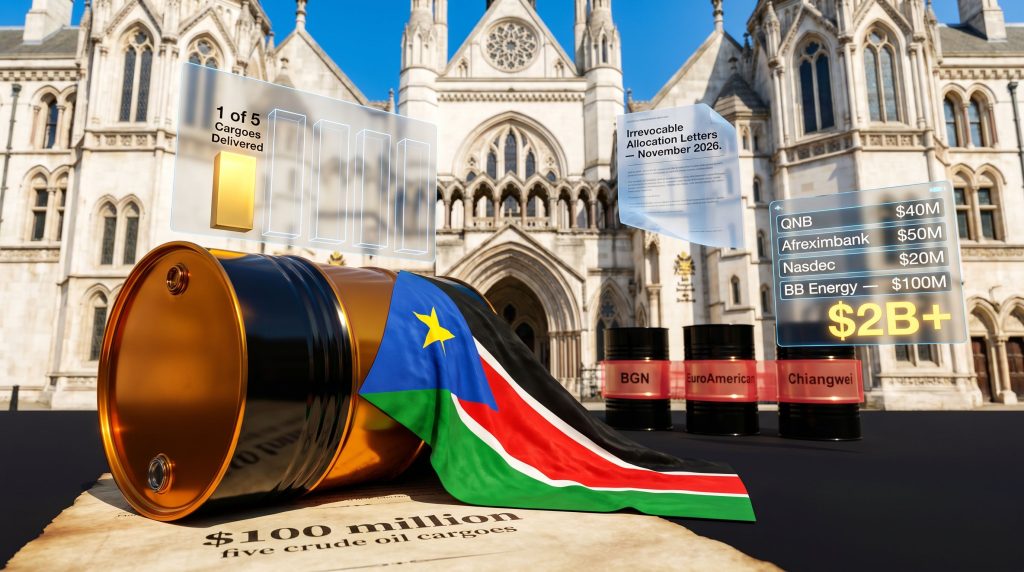
Global Trade Review has reported that QNB, Afreximbank, and UAE-based trader Nasdec General Trading have collectively extended more than $2 billion in oil-backed financing to South Sudan, with delivery obligations not fully honoured across multiple agreements. The BB Energy prepayment of $100 million sits on top of this already-strained delivery obligation stack.
Why Overlapping Pledges Create a Structural Impasse
When multiple creditors hold simultaneous allocation rights over the same future production stream, and when that stream is insufficient to satisfy all outstanding commitments concurrently, a prioritisation crisis becomes mathematically inevitable. South Sudan's daily production capacity simply cannot service all prepayment obligations in parallel.
Each successive prepayment deal entered into while prior obligations remain partially unmet compounds the delivery shortfall and deepens the legal exposure. This dynamic represents a systemic risk pattern that is not unique to South Sudan but is particularly acute there given the severity of fiscal concentration and the scale of outstanding commitments relative to production capacity. Consequently, the trade war economic impact on commodity-dependent economies further complicates the picture for sovereigns already stretched thin.
The BB Energy Case: A Chronological and Legal Anatomy
The Original Agreement and Its Breakdown
In February 2025, BB Energy advanced $100 million to the Government of South Sudan under a structured prepayment agreement. The contract stipulated delivery of five crude oil cargoes within the calendar year. More than twelve months after the advance was disbursed, only one of those five cargoes had been delivered. The four-cargo shortfall constituted a material breach and triggered BB Energy's legal response in the United Kingdom.
The First Procedural Battle: Freezing Specific Cargoes
BB Energy's initial legal strategy focused on blocking the delivery of three specific cargoes destined for rival traders BGN and A&M International, cargoes with a combined estimated value of approximately US$180 million. The legal argument rested on whether those cargoes could be treated as BB Energy's contractual entitlement.
According to Reuters, Justice Mark Pelling of the London High Court rejected this application. The ruling turned on a specific concept in English commodity law: ascertainability. The court found that the three cargoes had not been sufficiently identified and formally designated as belonging to BB Energy's prepayment allocation. Without that designation, the cargoes could not be treated as BB Energy's property for the purpose of a freezing order. The court further noted that intervening would create cascading commercial disruption for third-party sub-purchasers who had already executed contracts based on those cargoes.
This procedural outcome deserves careful framing. The rejection of the freezing application was not a ruling on the merits of BB Energy's underlying contract claim. It was a narrow determination that those specific barrels, at that specific moment, could not be legally attributed to BB Energy's prepayment entitlement under the applicable evidentiary standard.
The Injunction That Froze South Sudan's Financing Capacity
On May 15, 2026, a London court issued a broad injunction preventing South Sudan from entering into any new oil prepayment agreements or pledging future crude cargoes to additional creditors. The scope of this order was significant: it effectively suspended South Sudan's ability to raise new commodity-backed liquidity while the South Sudan BB Energy oil cargoes London ruling remained active as an ongoing legal matter.
On June 17, 2026, Judge Mark Pelling upheld the injunction and declined to lift it. The court found that BB Energy was entitled to the protective order absent compelling grounds for removal, including evidence that the injunction caused disproportionate harm to an uninvolved third party.
Three commodity traders sought to have the injunction removed: BGN, EuroAmerican, and Chiangwei, each arguing that the order was disrupting their own separate prepayment arrangements with South Sudan. All three applications were rejected. The court noted that BB Energy's legal representatives had formally notified all three firms as early as December 2025 that the dispute was active. Their decision to proceed with cargo transactions despite receiving that notice materially weakened their position before the court.
The Legal Concept at the Heart of This Dispute: Ascertainability in English Commodity Law
Why Identification of Specific Goods Matters
The legal test of ascertainability is central to any trader seeking to assert a proprietary or possessory claim over physical commodities under English law. For a claimant to successfully freeze or attach specific cargo, those goods must be identifiable and formally designated as corresponding to the claimant's contractual entitlement. Generic allocation promises over fungible barrels do not meet this threshold.
This distinction carries major practical implications for how prepayment agreements should be structured:
- Specific cargo nomination rights should be embedded directly in the prepayment contract rather than left as general delivery obligations
- Irrevocable allocation letters provide a stronger legal instrument than open-ended delivery promises and are harder to unwind once issued
- Formal cargo designation procedures triggered at specific milestones in the production and loading cycle can help establish ascertainability before a dispute arises
- English law jurisdiction clauses remain critical to enforcement because UK courts have established jurisprudence on these commodity finance structures
The Strategic Warning This Case Sends to Market Participants
The court's treatment of BGN, EuroAmerican, and Chiangwei signals something important beyond the specifics of this transaction. Commodity traders who enter prepayment agreements with a sovereign already subject to active litigation — particularly after receiving formal legal notice of that dispute — face a sharply reduced likelihood of judicial intervention on their behalf.
The courts appear unwilling to treat commercial convenience as a compelling reason to lift an injunction when the party seeking relief proceeded with full awareness of the legal landscape. However, understanding how oil trade and geopolitics intersect remains essential context for any market participant navigating these structures.
The June 2026 Partial Resolution: Irrevocable Letters and What Remains Open
What South Sudan Committed To
On June 18, 2026, BB Energy announced that South Sudan had issued irrevocable allocation letters confirming delivery of two crude oil cargoes by the end of November 2026. This commitment represents a partial resolution of the four-cargo shortfall. The irrevocable nature of those letters is legally meaningful: unlike a general delivery promise, an irrevocable allocation letter designates specific production entitlement to a named counterparty and is structurally resistant to unilateral reversal.
What Remains Unresolved
The partial commitment leaves significant open questions:
- The remaining two undelivered cargoes beyond those now committed remain unaccounted for under any confirmed resolution mechanism
- A two-day hearing was scheduled for early July 2026 to determine whether the broader injunction should remain in force as the full contractual dispute continues
- BB Energy's underlying claim for the full value of the prepayment shortfall remains active and unresolved
- South Sudan's ability to access new commodity-backed financing remains constrained for as long as the injunction holds
The next major ASX story will hit our subscribers first
Systemic Implications: London Courts as the De Facto Regulator of African Oil Finance
The Jurisdictional Reach of English Law
One of the most underappreciated dimensions of this case is what it reveals about the structural role that London courts now play in governing African sovereign commodity transactions. Because English law is the near-universal governing framework for oil prepayment agreements across Sub-Saharan Africa, UK courts have acquired substantial jurisdictional reach over how African governments can manage and monetise their own resource revenues.
An injunction issued by the London High Court can suspend a nation's ability to raise new commodity-backed financing, functioning as a form of judicial economic leverage with consequences far beyond the specific dispute at hand. For a country like South Sudan, where oil prepayment is not merely one financing option but effectively the only accessible source of sovereign liquidity, this reach becomes macroeconomically consequential.
Moreover, broader shifts in trade war oil markets mean that the pricing environment within which these disputes unfold can shift dramatically, adding further uncertainty to cargo valuations and settlement negotiations.
A Comparative Risk Framework for Oil-Backed Financing
| Risk Factor | Lower Exposure | Higher Exposure |
|---|---|---|
| Revenue diversification | Multiple export sectors | Near-total oil dependency |
| Production stability | Consistent, growing output | Conflict-affected or aging fields |
| Creditor concentration | Single prepayment lender | Multiple overlapping cargo pledges |
| Cargo legal clarity | Specific nomination rights in contract | Fungible allocations, no formal designation |
| Sovereign fiscal buffer | Adequate non-oil reserves | Minimal alternative revenue base |
The Escalating Risk for Future Transactions
As more African governments turn to oil prepayment structures to bridge fiscal gaps, and as existing obligations accumulate without full resolution, the probability of London court injunctions disrupting sovereign financing programmes will increase. The South Sudan BB Energy oil cargoes London ruling is unlikely to be an isolated incident. It reflects a structural tension that exists wherever production-constrained sovereigns have pledged the same future output stream to multiple creditors operating under the same English law framework.
Furthermore, tracking current crude oil prices is essential for understanding the real-time value at stake whenever a court freezes cargo delivery schedules in disputes of this nature.
The deeper policy question this raises is whether the current architecture of African commodity finance, heavily concentrated in English-law prepayment structures with London dispute resolution, adequately balances creditor protection with a sovereign state's capacity to manage its own natural resources. That question has no easy answer, but the South Sudan case has made it considerably harder to ignore.
Frequently Asked Questions
What is the South Sudan and BB Energy dispute about?
BB Energy advanced $100 million to South Sudan in February 2025 under a prepayment agreement requiring the delivery of five crude oil cargoes. With only one cargo delivered more than a year later, BB Energy pursued legal action in London and ultimately secured an injunction restricting South Sudan from pledging future oil to new creditors.
What did the London court rule in June 2026?
Judge Mark Pelling of the London High Court upheld an injunction on June 17, 2026, preventing South Sudan from entering new prepayment agreements while the BB Energy dispute remained active. A separate BB Energy application to freeze three specific cargoes worth approximately $180 million was rejected because those cargoes were not legally ascertainable to BB Energy under English commodity law.
What are irrevocable allocation letters?
These are formal legal instruments issued by an oil-producing state that designate specific crude cargoes to a named counterparty. Unlike general delivery commitments, they are structurally difficult to reverse and provide a stronger foundation for legal enforcement in commodity finance disputes.
How much oil-backed debt does South Sudan carry?
According to Global Trade Review, creditors including Qatar National Bank, Afreximbank, and UAE-based trader Nasdec General Trading have collectively extended more than $2 billion in oil-backed financing to South Sudan, in addition to the $100 million BB Energy prepayment.
What happens next in the case?
South Sudan has committed to delivering two cargoes by November 2026 under irrevocable allocation letters. A hearing scheduled for early July 2026 was set to determine whether the broader injunction should remain in force while the full contractual dispute is resolved. The remaining delivery shortfall and BB Energy's underlying contractual claim have not yet been fully settled.
Readers seeking ongoing coverage of energy sector financing developments across Africa can find relevant reporting and analysis through Ecofin Agency's energy and finance section.
Disclaimer: This article contains references to court proceedings, financial structures, and forecasts that involve inherent uncertainty. Nothing in this article constitutes legal, financial, or investment advice. Readers should conduct independent due diligence before drawing conclusions about any specific transaction or jurisdiction discussed herein.
Want To Identify the Next Major Resource Discovery Before the Broader Market Does?
Discovery Alert's proprietary Discovery IQ model delivers real-time alerts on significant ASX mineral discoveries, transforming complex resource data into actionable investment insights — explore the historic returns major discoveries have generated to understand the opportunity, then begin your 14-day free trial at Discovery Alert to position yourself ahead of the market.