July 19, 2026
The Monetary Architecture Problem Nobody Is Talking About
Most conversations about gold and silver pricing focus on the visible levers: inflation readings, Federal Reserve meeting outcomes, geopolitical flashpoints. What rarely enters mainstream financial commentary is a structural anomaly sitting quietly on the US Treasury's balance sheet — one that has persisted for more than five decades without serious public scrutiny. Understanding this anomaly is increasingly relevant to the debate around US Treasury gold revaluation and silver bottom price for anyone holding a position in precious metals.
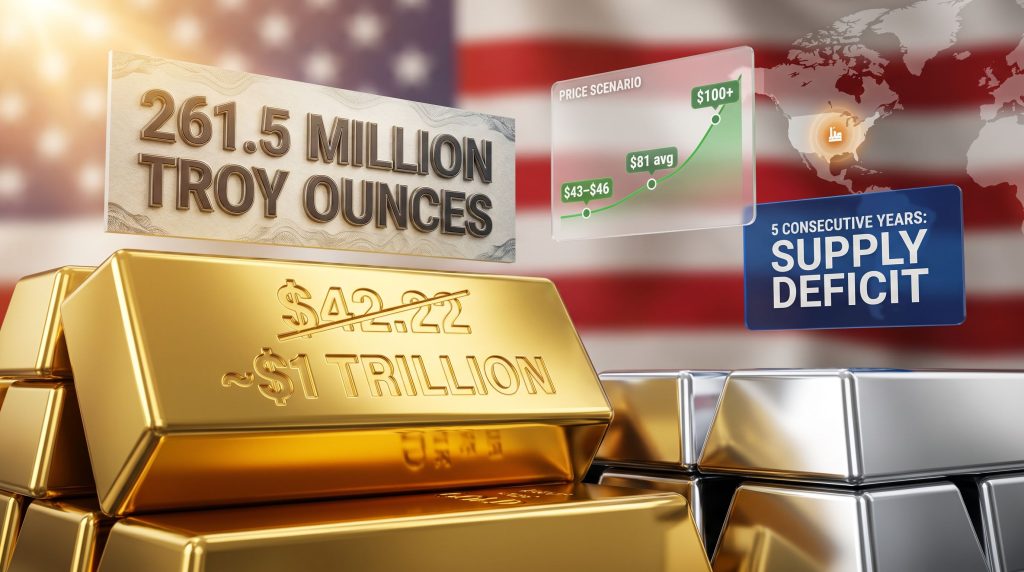
The US Treasury currently records approximately 261.5 million troy ounces (roughly 8,133 metric tonnes) of gold on its books at a valuation of just $42.22 per troy ounce. This figure traces directly back to the Nixon gold shock of the early 1970s — specifically a 1973 revaluation that was never subsequently updated to reflect market prices. At today's gold prices, the market value of this stockpile sits somewhere between $750 billion and over $1 trillion. The official balance sheet, however, reflects only around $11 billion. That gap is not a rounding error. It is one of the largest unrealised balance-sheet discrepancies in the history of sovereign finance.
When big ASX news breaks, our subscribers know first
Understanding the Treasury's Gold Position: Facts vs. Speculation
The distinction between what the US Treasury has actually announced and what analysts are speculating about is critical here. In March 2025, Treasury Secretary Scott Bessent clearly communicated that the Treasury was not pursuing a gold revaluation at that time. What Bessent did not do was categorically rule it out as a future instrument. For investors, that distinction carries meaningful weight. The space between not now and never is where much of the current analytical debate lives.
Société Générale has modelled a scenario in which gold is revalued to approximately $5,000 per ounce, which would generate roughly $2.1 trillion in balance-sheet gains for the Treasury. Even a more conservative mark-to-market exercise at current spot prices would credit the Treasury General Account with an estimated $750 billion to over $1 trillion without technically issuing new debt. The Federal Reserve's own internal assessments have referenced potential realised gains in the vicinity of 3% of GDP under such a scenario.
The step-by-step mechanics of how a revaluation would actually work are worth understanding clearly:
- The Treasury formally revalues its gold certificates from $42.22 per ounce to current market price
- The Federal Reserve credits the Treasury General Account with the corresponding gain
- The TGA balance increases by an estimated $750 billion to over $1 trillion
- Those funds become available to retire short-duration Treasury obligations or fund operations without new bond issuance
- No new debt is technically created, as this is a balance-sheet recognition event rather than a borrowing action
This is not a radical concept. Monetary economist Judy Shelton has discussed gold in the monetary system as a legitimate policy instrument within this framework. The legal and legislative pathway would require specific steps, but the conceptual mechanism already exists within US monetary law. What is speculative is the timing, scale, and political will to actually execute it.
The US Treasury Market Pressure Cooker
To understand why a gold revaluation is being discussed with increasing frequency, it helps to examine the financing pressures the US Treasury currently faces. The United States needs to sell an estimated $9 to $10 trillion in Treasury bonds over the next 12 months. This figure is often mischaracterised. The $8 trillion component represents existing debt that must be rolled over, meaning maturing bonds that require refinancing. The additional $2 trillion or so represents net new financing to cover the ongoing federal deficit. These are structurally different problems that require separate solutions.
The $8 trillion in rollover requirement and the $2 trillion in net new issuance should not be conflated. Conflating these numbers leads to overstated crisis narratives and understated structural risk simultaneously. Understanding the distinction is foundational to analysing Treasury market dynamics accurately.
Complicating this further is the behaviour of traditional foreign holders of US Treasuries. Japan, facing a weakening yen, may be compelled to liquidate additional Treasury holdings to defend its currency. European sovereign holders have also increased selling activity. This erodes the traditional buyer base for US government debt at precisely the moment when supply is elevated.
The historical playbook for stabilising Treasury markets offers some context:
| Period | Fed Treasury Holdings (Start) | Fed Treasury Holdings (Peak) | Market Outcome |
|---|---|---|---|
| Post-GFC (2012) | ~$1.7 trillion | ~$2.4 trillion | Yields stabilised |
| COVID Era (2020-22) | ~$2.5 trillion | ~$5.0 trillion | Yields suppressed for 18+ months |
| Current Cycle (2025) | Declining via QT | TBD | Revaluation scenario under discussion |
The new Federal Reserve posture under Chair Kevin Warsh adds another variable. Warsh has publicly indicated a preference for using trimmed core PCE as an inflation measurement, which currently reads around 2.3%, close to the Fed's 2% target. This framing effectively makes the inflation picture appear more benign than traditional core PCE would suggest. The practical implication is that Warsh is signalling a possible single rate hike in 2026 with cuts potentially arriving in 2027 and 2028. For hard asset holders, this trajectory shifts the interest rate calculus in ways that are not uniformly bearish for precious metals over the medium term.
Gold's Evolving Role in the Global Reserve Architecture
The divergence between institutional market behaviour and central bank behaviour in gold markets is not a contradiction. It reflects two entirely different time horizons and risk frameworks operating simultaneously.
| Function | Traditional Instrument | Gold's Advantage |
|---|---|---|
| Reserve Asset | US Treasury Bonds | No counterparty risk |
| Collateral Asset | Sovereign debt instruments | No duration risk exposure |
| Settlement Asset | USD wire transfers | Neutral, non-political settlement |
Central banks accumulating gold while institutional traders sell into rallies reflects a fundamental difference in objective. Institutional traders are responding to near-term signals: FOMC language, geopolitical de-escalation headlines, and revised price targets from major banks. Goldman Sachs recently reduced its gold price target by $500 in response to the latest FOMC meeting outcomes, illustrating how reactive short-term positioning can be. Furthermore, central bank gold demand continues to reflect decade-scale decisions about reserve architecture rather than short-term market signals.
The underlying concern for sovereign buyers is twofold. US Treasury bonds carry duration risk, meaning the real purchasing power of the currency at maturity is uncertain in an era of structural fiscal expansion. They also carry counterparty risk — a concept that has become less theoretical as the use of financial sanctions has expanded. Gold carries neither. It settles without intermediaries, carries no sovereign counterparty, and has no maturity date. For nations seeking to reduce exposure to dollar-denominated instruments, it functions simultaneously as a reserve asset, collateral asset, and settlement mechanism.
The Silver Strategic Equation: Industrial, Monetary, or Both?
Silver occupies an unusual position in global commodity markets. It is formally classified as a strategic critical mineral by both the US and Chinese governments, yet it trades at prices that many analysts argue significantly undervalue its structural supply-demand dynamics.
The supply picture is stark. Consequently, silver supply deficits have compounded for at least five consecutive years, meaning combined industrial, defence, and investment demand consistently outpaces new mine production. This is not a short-term imbalance driven by a single demand spike. It is a structural condition that has compounded annually.
The demand stack driving silver consumption continues to expand:
- Solar photovoltaic panel manufacturing, which consumes silver in its conductive paste
- Consumer and industrial electronics across virtually every product category
- Artificial intelligence hardware infrastructure, including data centre components
- Robotics and advanced manufacturing systems
- Electric vehicle drivetrain components and battery management systems
- Defence and missile systems manufacturing, where silver's conductivity and reliability properties are critical
What is less widely understood is the degree to which China dominates the refining side of the silver supply chain. China currently controls approximately 70% of global silver refining capacity. This concentration has developed precisely because silver prices have historically been low enough that refining operations in higher-cost Western economies are economically marginal. When a commodity's price is suppressed, processing gravitates toward the lowest-cost jurisdiction. That jurisdiction, in silver's case, is China.
The West-to-East Silver Flow: A Geopolitical Trade Dynamic
Over a recent six-month period, the West exported approximately 800 metric tonnes of physical silver via the LBMA and Comex to China. China's net import figure during that same period is estimated at around 500 metric tonnes, with a portion of the remainder being re-exported after processing. The scale of this transfer is significant when placed against annual global mine production figures.
One interpretation of this flow is that it represents a negotiated trade-off connected to the broader US-China trade dialogue. The hypothesis is that Western silver exports at suppressed prices formed part of an informal arrangement under which China agreed to resume some level of rare earth mineral exports to Western nations. This remains speculative and unconfirmed, but the timing and volume alignment with diplomatic developments makes it a serious analytical consideration rather than a fringe theory.
Is the US Government Planning a Silver Price Floor?
Reports emerging in mid-2025 suggest the US government may announce a minimum price mechanism for silver, potentially in the July timeframe. The strategic logic behind such a mechanism connects directly to the Tennessee silver refinery project — a facility being developed through a partnership involving the Pentagon, JP Morgan, and Korean Zinc. The project is being built on the foundation of an existing industrial site and is intended to become one of the world's largest silver refining operations.
The economic rationale for a price floor is straightforward. At current silver prices, running a large-scale refinery in the United States is not economically competitive with Chinese operations. To make reshoring of silver refining capacity viable, the economics of the business must be changed. A government-set minimum price accomplishes this by guaranteeing that domestic refining operations can generate a viable return regardless of short-term spot price movements.
If a silver price floor is implemented, it would function primarily as industrial policy designed to rebuild domestic critical mineral processing capacity. The secondary effect on global price discovery could be substantial, particularly given that current prices are partly a function of Chinese refining dominance.
This mechanism would not operate in isolation. It would interact with existing silver market dynamics, including the gold-silver ratio analysis, futures market positioning, and physical inventory flows. A government-set floor price in the world's largest economy would effectively establish a pricing reference point that other market participants would need to price around.
The next major ASX story will hit our subscribers first
Silver Price Scenarios: What the Data Actually Supports
The range of analytical forecasts for silver is wide enough to be unhelpful without proper contextualisation. The following table frames the main scenarios and their associated price implications:
| Analytical Framework | Implied Price Range | Timeframe |
|---|---|---|
| Conservative model forecast | ~$43-$46 | End-2026 |
| Broad bullion market forecast | ~$30-$50 | Near-term |
| Bear-case support zone | ~$55-$65 | 2026 |
| J.P. Morgan base case | ~$81 average / ~$85 year-end | 2026 |
| Bullish analyst scenarios | $100+ | Medium-term |
How US Treasury gold revaluation and silver bottom price interact operates through indirect transmission channels rather than a direct formula:
Scenario 1: No Revaluation. Silver price dynamics are driven entirely by industrial demand, gold-silver ratio compression, and speculative positioning. Support zone sits approximately in the $43-$65 range depending on macro conditions.
Scenario 2: Partial or Small-Scale Revaluation. A modest liquidity injection into the financial system causes gold to re-rate upward. Silver follows via ratio compression. Estimated silver price range in this scenario: $65-$85.
Scenario 3: Full Market-Price Revaluation. Using the Société Générale $5,000 per ounce scenario, approximately $2.1 trillion in balance-sheet gains flows into the Treasury General Account. In historical gold bull markets, the gold-silver ratio has tended to compress significantly, implying a silver price of $100 or more with potential for further extension.
Important disclaimer: No direct mathematical formula links a Treasury gold revaluation to a specific silver price floor. These scenarios are analytical frameworks for structuring thinking, not financial forecasts. Precious metals markets involve substantial uncertainty and individual circumstances vary. Always consult a qualified financial adviser before making investment decisions.
Why Central Banks Are Unlikely to Accumulate Silver at Scale
The question of whether central banks could follow Russia's limited silver accumulation signals and begin holding silver as a reserve asset runs into a structural conflict. Silver's dual identity as both a monetary metal and a critical industrial mineral creates an inherent tension for any government considering large-scale accumulation.
If a government were to begin stockpiling silver as a monetary reserve, it would effectively be competing with its own industrial sector for a resource that its manufacturers need to build solar panels, electronics, weapons systems, and electric vehicles. This is why silver stacking remains largely a civilian phenomenon, driven by individuals responding to silver's monetary history and inflation-hedging characteristics, rather than an institutional reserve management strategy.
Russia's limited silver accumulation signals are notable precisely because they are rare exceptions. The structural logic that prevents most central banks from building meaningful silver reserves is unlikely to change unless the industrial demand picture changes fundamentally. Given the trajectory of electrification, AI hardware deployment, and defence manufacturing, that seems unlikely over any relevant planning horizon.
Windfall Tax Risk and the Precious Metals Bull Run
A concern that surfaces during extended precious metals bull markets is the prospect of governments imposing windfall taxes on mining and royalty companies generating exceptional returns. Historical precedents exist in various resource jurisdictions, making this a non-trivial risk.
The more important nuance is where this risk is concentrated. Individual holders of physical silver and gold face meaningfully less regulatory exposure than publicly listed mining companies and royalty streaming businesses. A government seeking to capture value from a precious metals price surge would logically target the corporate entities generating the largest taxable profits rather than attempting to tax individual holders of physical metal.
The counter-argument to aggressive intervention rests on the US dollar itself. As long as the US government retains effective control over dollar monetary policy, it has alternatives to confiscatory metal taxation as a fiscal management tool. Gold revaluation itself is arguably a more elegant solution to Treasury liquidity pressure than windfall taxes, generating balance-sheet capacity without the political friction of direct taxation. For further context, this analysis from Kitco explores how revaluation would reset fiscal optics without fully resolving the debt challenge.
Stock Market Liquidity and the Precious Metals Connection
The relationship between stock market stability and precious metals pricing is more nuanced than a simple risk-on/risk-off binary. Historically, major equity market corrections have been preceded by periods in which the US Treasury market was operating under stress, prompting policy tightening that eventually became excessive. The sequence is typically: Treasury market instability, policy overcorrection, equity market correction, emergency liquidity injection, recovery.
The current environment does not yet fit that sequence. With approximately $9 to $10 trillion in Treasury bonds requiring rollover or new issuance over the next 12 months, the incentive structure for policymakers is strongly weighted toward maintaining liquidity rather than withdrawing it. A gold revaluation, in this context, functions as a non-inflationary liquidity injection mechanism that does not require new bond issuance or rate cuts.
Whether precious metals benefit more from a risk-off environment or from a liquidity expansion environment is a question worth examining carefully. The evidence from past cycles suggests liquidity expansion tends to be the more powerful driver for precious metals prices, as it reduces the opportunity cost of holding non-yielding assets while simultaneously raising concerns about the long-term purchasing power of fiat currencies. In addition, this broader discussion on gold-backed Treasury bonds offers useful perspective on alternative mechanisms being proposed to manage sovereign debt pressures.
Frequently Asked Questions
What is the US Treasury gold revaluation and has it happened yet?
The US Treasury gold revaluation refers to the theoretical process of updating the official book value of US government gold holdings from the current $42.22 per troy ounce to current market prices. As of mid-2025, Treasury Secretary Scott Bessent has confirmed that no revaluation has taken place, though the concept is actively discussed as a potential balance-sheet management tool.
How would a gold revaluation affect the silver price?
A gold revaluation would not directly set a silver price, but could affect it through several channels: gold price re-rating upward typically compresses the gold-silver ratio over time, a liquidity injection into the Treasury General Account could ease broader financial conditions, and improved monetary system confidence historically supports both metals.
What is the proposed US government silver bottom price and when might it be announced?
Reports suggest a US government minimum price mechanism for silver could be announced around mid-to-late July 2025, connected to the strategic silver refinery development in Tennessee. The specific price level has not been officially confirmed.
Why is the US Treasury's gold still valued at $42.22 per ounce?
This valuation stems from the 1973 Nixon-era monetary restructuring and has never been officially updated. It represents a dormant accounting convention rather than any reflection of economic reality, and its persistence is a function of institutional inertia rather than deliberate policy.
Could a gold revaluation actually reduce US national debt?
Not directly. A revaluation would increase the Treasury General Account balance, allowing the Treasury to retire certain short-duration obligations without new issuance. It does not reduce the total stock of outstanding debt but provides tactical liquidity that reduces near-term refinancing pressure.
Is silver currently undervalued relative to its industrial and strategic importance?
Based on five consecutive years of supply deficits, dual-use classification as both a critical mineral and a monetary metal, and China's dominant position in refining capacity creating a strategic vulnerability for Western economies, multiple analytical frameworks suggest silver is structurally undervalued at current prices.
What is the gold-silver ratio telling us about relative value?
The gold-silver ratio measures how many ounces of silver are required to purchase one ounce of gold. Historically, periods of monetary stress and gold price appreciation have been associated with ratio compression, meaning silver tends to outperform gold in percentage terms during sustained precious metals bull markets.
Key Takeaways for Investors
- The $42.22 per ounce official valuation of US Treasury gold represents one of the most significant unrealised balance-sheet positions in sovereign finance, with market value estimated at $750 billion to over $1 trillion
- A full mark-to-market revaluation could provide substantial Treasury General Account capacity without new debt issuance, but would not resolve the underlying structural debt challenge
- Silver's five consecutive years of supply deficit, combined with strategic classification by both the US and Chinese governments, creates a structurally different investment thesis from gold
- The proposed US silver price floor, if confirmed, would function primarily as industrial policy to reshore critical refining capacity currently concentrated in China, with secondary effects on global price discovery
- The Tennessee silver refinery project, developed through Pentagon, JP Morgan, and Korean Zinc partnerships, represents the physical infrastructure context for any price floor mechanism
- No direct formula links US Treasury gold revaluation and silver bottom price together; these are separate policy mechanisms operating through different transmission channels with overlapping but distinct market effects
- Windfall tax risk in a precious metals bull run is more concentrated in listed mining and royalty companies than in individual physical metal holders
Readers seeking to explore the broader debate around US Treasury monetary policy, gold revaluation mechanics, and silver's evolving strategic role in critical mineral supply chains may find additional perspectives from independent analysts and economists across platforms such as YouTube and Substack, where these macroeconomic frameworks continue to be actively discussed and refined.
Want to Be First When the Next Major Mineral Discovery Hits the ASX?
Discovery Alert's proprietary Discovery IQ model scans ASX announcements in real time, instantly identifying high-potential mineral discoveries across more than 30 commodities — turning complex data into clear, actionable opportunities for both traders and long-term investors. Explore how historic ASX discoveries have generated extraordinary returns, then start your 14-day free trial at Discovery Alert to position yourself ahead of the broader market.