July 19, 2026
The Supply Chain Time Bomb Hidden Inside the Clean Energy Transition
Most discussions about the clean energy transition focus on the rapid scaling of solar installations, EV sales milestones, and battery gigafactory announcements. What receives far less attention is the geological and financial infrastructure that must exist before any of those technologies can be manufactured at scale. Critical minerals sit at the foundation of every clean energy system, and the investment dynamics governing their supply are quietly moving in the wrong direction at precisely the wrong time.
Understanding why critical mineral investment falls despite booming demand requires looking beyond headline investment figures and examining the structural forces reshaping capital allocation across the entire value chain. These forces are deeply connected to broader questions of critical minerals and energy security that governments and investors are only beginning to fully appreciate.
When big ASX news breaks, our subscribers know first
The Distinction That Changes Everything
There is a critical difference between investment levels remaining positive and investment growth accelerating at the pace the energy transition demands. This nuance is frequently lost in mainstream reporting, yet it fundamentally changes the risk picture for supply chains, policymakers, and investors alike.
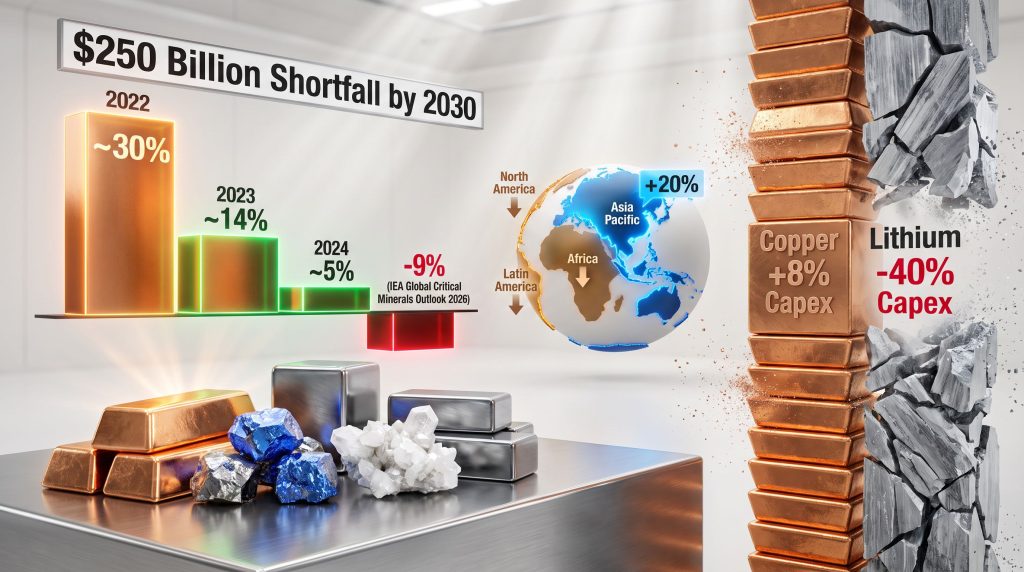
The International Energy Agency's Global Critical Minerals Outlook 2026 confirmed that global critical mineral investment declined by 9% in 2025, marking the first outright contraction after several consecutive years of expansion. However, the deterioration began well before that number appeared. The growth rate had been collapsing for years, creating a compounding deficit long before the headline figure turned negative.
| Year | Investment Growth Rate (Year-on-Year) |
|---|---|
| 2021 | ~20% |
| 2022 | ~30% |
| 2023 | ~14% |
| 2024 | ~5% |
| 2025 | -9% (IEA Global Critical Minerals Outlook 2026) |
In capital-intensive industries with multi-year development cycles, a decelerating growth curve is not a neutral signal. It is a leading indicator of future production shortfalls that will only become visible years after the investment decisions that caused them.
This lag effect is one of the most underappreciated dynamics in resource markets. Exploration spending, which declined by more than 10% in 2025 according to the IEA, typically precedes mine development by two to five years. Consequently, cutbacks made today will constrain production capacity between 2027 and 2030, precisely when clean energy manufacturing pipelines are expected to demand the most material throughput.
Battery Metals Bear the Brunt
Why Are Battery Metals Experiencing Such Severe Capital Withdrawal?
Not all minerals are experiencing the same level of capital withdrawal. The divergence between battery metals and copper tells an important story about how investor psychology, commodity price cycles, and supply chain geography interact. Furthermore, understanding the broader battery metals investment landscape helps contextualise just how severe this withdrawal has become.
Capital expenditure across battery metal segments fell by more than 20% in 2025, representing the steepest single-year contraction in over a decade. Within that category, the individual numbers are even more striking:
- Lithium-focused companies reduced capital expenditure by approximately 40%
- Nickel exploration budgets contracted by around 45%
- Lithium exploration spending declined by a similar 45%
- Copper-focused companies, by contrast, increased spending by 8%
The reasons for copper's resilience are structural rather than coincidental. Copper is a foundational conductor across all forms of electrification, not merely battery technology. Its demand base is broader, its supply geography is more distributed, and institutional investors have learned through multiple commodity cycles that copper projects with long lead times of 10 to 15 years from discovery to production require decade-long investment commitments that cannot be paused and restarted without significant cost.
Battery metal developers that replicate the structural characteristics of successful copper operators — specifically geographic diversification, strong balance sheets, and secured long-term offtake agreements — are demonstrably better positioned to attract capital through price downturns.
Regional Fault Lines in Exploration Capital
The geographic distribution of exploration spending is shifting in ways that carry significant long-term implications for supply chain concentration risk.
| Region | Exploration Budget Trend (2025) |
|---|---|
| Global Average | Declined (>10%) |
| Asia Pacific | +20% increase |
| Latin America | Contraction |
| Africa | Contraction |
| North America | Contraction |
Asia Pacific's 20% increase in exploration spending stands out sharply against the global trend. This divergence reflects the strategic positioning of state-aligned capital in the region, where longer investment horizons and industrial policy frameworks can sustain exploration activity through price cycles that force Western private capital to retreat.
Most Western-aligned jurisdictions recorded lower exploration budgets in 2025, which is particularly concerning given the stated ambitions of the United States, European Union, Canada, and Australia to diversify critical mineral supply chains. In addition, critical minerals policy support at the federal level has attempted to address this gap, though the distance between policy aspiration and capital deployment continues to widen rather than narrow.
Why Good Projects Still Can't Get Financed
What Is the Bankability Problem?
One of the least understood dimensions of the critical mineral investment challenge is the bankability problem. The barrier to scaling supply is not primarily geological scarcity. The Earth contains substantial reserves of lithium, cobalt, graphite, and nickel. However, the barrier is the inability of many technically sound projects to meet the risk-adjusted return thresholds that mainstream institutional capital requires.
Several factors compound the bankability challenge:
- Price volatility erodes projected revenue streams, making financial modelling unreliable over the 10 to 20 year project horizons that lenders require.
- Offtake uncertainty means that without committed buyers, projects cannot demonstrate revenue predictability to debt providers.
- Processing complexity adds cost and technical risk, particularly for minerals requiring multi-stage chemical processing before they become battery-ready materials.
- Permitting timelines in Western jurisdictions can extend project development schedules by years, increasing carrying costs and investor uncertainty.
- Chinese oversupply dynamics have systematically pushed lithium and nickel spot prices below the production cost thresholds of many non-Chinese producers, undermining the business case for new Western projects.
The commodity price cycle creates a particularly damaging feedback loop. Low prices signal apparent abundance to financial markets, reducing urgency around new supply development. Yet simultaneously, those same low prices destroy the cash flows and investment capacity of the producers who would otherwise be building tomorrow's supply infrastructure.
The Refining Gap: Mining's Invisible Bottleneck
Even where mining investment continues, a structural imbalance across the value chain is creating a bottleneck that raw ore extraction alone cannot resolve. According to the IEA's analysis of global mineral supply chains, refining and downstream processing capacity is not keeping pace with upstream mining development.
The most striking illustration of this imbalance is found in battery materials. Planned cathode production capacity currently represents approximately one-third of projected lithium mining capacity. This means that even if every planned lithium mine reaches production on schedule, the majority of that ore cannot be converted into battery-ready cathode materials without a proportional expansion of processing infrastructure.
Building mines without matching investment in refining and processing creates a false sense of supply security. Raw ore in the ground does not deliver functional materials to battery manufacturers.
This processing bottleneck is compounded by geographic concentration. China currently dominates global critical mineral refining and processing capacity across multiple battery material streams, including lithium hydroxide, cobalt sulphate, and natural graphite spheronisation. Western supply chain diversification efforts that focus exclusively on mine development without addressing the refining deficit will not achieve meaningful supply independence.
The next major ASX story will hit our subscribers first
Quantifying the Shortfall
The aggregate investment gap implied by current trajectories is substantial. To align with 2030 net-zero scenarios, the critical mineral sector may require between $360 billion and $450 billion in cumulative investment between 2022 and 2030. At current trajectories, the resulting shortfall could range from $180 billion to $270 billion, with analysts converging around a $250 billion gap as a central estimate.
The projected supply consequences of that underinvestment, without meaningful course correction, are significant:
| Mineral | Projected Supply Deficit by 2030 |
|---|---|
| Natural Graphite | ~46% |
| Cobalt | ~42% |
| Lithium | ~34% |
| Nickel | Significant (scenario-dependent) |
| Copper | Moderate (partially offset by recycling) |
Natural graphite's projected 46% deficit deserves particular attention because it receives far less mainstream coverage than lithium or cobalt. The emerging global graphite shortage reflects a structural vulnerability that extends well beyond price cycles. Graphite constitutes the largest component by weight in lithium-ion battery anodes, and synthetic graphite, while a partial substitute, is significantly more energy-intensive and expensive to produce.
These deficits translate directly into constrained EV production volumes, slower grid storage deployment, and structurally higher input costs across clean technology manufacturing supply chains.
Public Finance Enters the Gap
Against a backdrop of weakening private investment, governments in advanced economies have significantly expanded financial commitments to critical mineral projects. Public finance commitments in advanced economies reached approximately USD $65 billion in 2025, representing more than four times the level recorded in 2023, according to the IEA. Furthermore, efforts to establish European critical raw materials supply infrastructure reflect a broader recognition that domestic processing capacity is as strategically important as upstream mining.
The policy instruments being deployed include:
- Grants and concessional loans to reduce upfront capital risk on strategically important projects
- Equity participation by government-backed entities to provide anchor capital and signal project credibility
- Offtake guarantees and demand signals to improve the bankability of projects that cannot access commercial financing independently
- Supply chain diversification requirements embedded within trade and procurement frameworks
However, the IEA's analysis identifies a critical gap between announced commitments and actual disbursements. The speed at which committed capital is deployed into operational projects will ultimately determine whether public finance succeeds in mobilising private co-investment or remains a series of policy announcements without supply chain consequence.
Announced commitments that remain undeployed offer no operational benefit to project developers facing immediate financing constraints today.
Three Scenarios for the Path Forward
The trajectory of critical mineral supply through 2030 will be shaped by how effectively the investment gap is addressed over the next two to three years. Three plausible scenarios frame the range of outcomes.
Scenario 1: Policy Acceleration Closes the Gap. Governments rapidly deploy committed capital, effective risk-sharing mechanisms crowd in private investment, and permitting reforms accelerate project timelines. Supply chains diversify meaningfully, concentration risk reduces, and clean energy transition timelines remain broadly intact, though at higher cost than originally modelled.
Scenario 2: Partial Recovery With Persistent Bottlenecks. Public finance partially compensates for private capital retreat, but refining and processing capacity remains structurally insufficient. Battery manufacturers face periodic material shortages, creating price spikes and production delays. The energy transition continues but at a slower pace and with greater geographic inequality in access to clean technologies.
Scenario 3: Prolonged Underinvestment Creates a Structural Supply Crisis. Exploration cutbacks in 2024 and 2025 translate into production shortfalls between 2028 and 2030. Deficits in natural graphite, cobalt, and lithium become acute, driving significant cost inflation across EV and battery storage supply chains. Geopolitical competition for scarce mineral supply intensifies, increasing the risk of trade disruptions and resource nationalism.
Frequently Asked Questions
Has global critical mineral investment actually declined, or has growth just slowed?
Both dynamics are now present. Investment growth decelerated sharply from approximately 30% in 2022 to just 5% in 2024, before the IEA reported an outright 9% decline in 2025, the first contraction after several consecutive years of expansion. This is precisely why critical mineral investment falls despite booming demand has become such a pressing concern for supply chain planners.
Which minerals have seen the largest investment pullback?
Lithium-focused companies reduced capital expenditure by approximately 40% in 2025, while nickel and lithium exploration budgets each contracted by around 45%. Battery metals as a category experienced the steepest collective pullback in over a decade, according to the IEA's Global Critical Minerals Outlook 2026.
Why is copper investment growing while battery metal investment falls?
Copper benefits from a broader demand base, longer institutional investment horizons, and less concentrated supply chain geography. Battery metals face the compounding pressures of price volatility driven by Chinese oversupply, inadequate bankability frameworks, and investor uncertainty around near-term price recovery.
What is the estimated investment gap by 2030?
Analysts estimate a shortfall of approximately $250 billion relative to the investment pace required to meet 2030 clean energy supply targets, with total sector needs potentially reaching $360 to $450 billion over the 2022 to 2030 period.
What is the bankability problem?
Bankability refers to a project's ability to secure commercial financing based on its risk profile, revenue predictability, and return characteristics. Many technically viable mineral projects fail to meet risk-adjusted return thresholds required by mainstream institutional investors, leaving them stranded in development despite strong underlying long-term demand.
Why does the natural graphite deficit receive so little attention?
Natural graphite is the largest component by weight in lithium-ion battery anodes and is predominantly sourced and processed in China. Its projected 46% supply deficit by 2030 receives less attention than lithium or cobalt partly because graphite is not classified as a metal and partly because synthetic graphite substitution provides a partial buffer, though at significantly higher cost and energy intensity.
This article draws on publicly available data from the IEA's Global Critical Minerals Outlook 2026. All investment figures, supply projections, and scenario analyses reflect published IEA findings and independent industry analysis. Forward-looking projections involve inherent uncertainty and should not be interpreted as financial advice. Actual outcomes will depend on policy execution, commodity price movements, technological change, and geopolitical developments that cannot be predicted with certainty.
Want to Catch the Next Major Critical Mineral Discovery Before the Market Does?
Discovery Alert's proprietary Discovery IQ model scans ASX announcements in real time, instantly identifying significant mineral discoveries across lithium, graphite, copper, and more than 30 other commodities — translating complex geological data into actionable investment insights precisely when supply chain dynamics make early positioning most valuable. Explore historic discoveries and the substantial returns they generated, then begin your 14-day free trial at Discovery Alert to secure your edge ahead of the broader market.