July 19, 2026
When Corporate Architecture Becomes a Credit Event
India's industrial credit landscape rarely witnesses a single structural transaction reshape the borrowing costs and investor perception of multiple major entities simultaneously. Yet that is precisely what has unfolded across the Vedanta group following the completion of its corporate demerger. Rather than treating credit ratings as passive reflections of financial health, this episode reveals something more instructive: how deliberately redesigning a company's legal and operational architecture can unlock credit quality that was previously buried beneath conglomerate complexity.
The CRISIL upgrades Vedanta ratings after demerger story is not simply about better numbers. It is about what happens when a sprawling diversified industrial group separates its constituent businesses into ring-fenced entities, each capable of being assessed on its own operational merits, without the shadow of cross-entity risk distorting the picture. Understanding corporate restructuring strategies of this nature is increasingly relevant for investors monitoring large-scale industrial transformations.
When big ASX news breaks, our subscribers know first
What the Rating Action Actually Signals Beyond the Headlines
Three Entities, One Structural Inflection Point
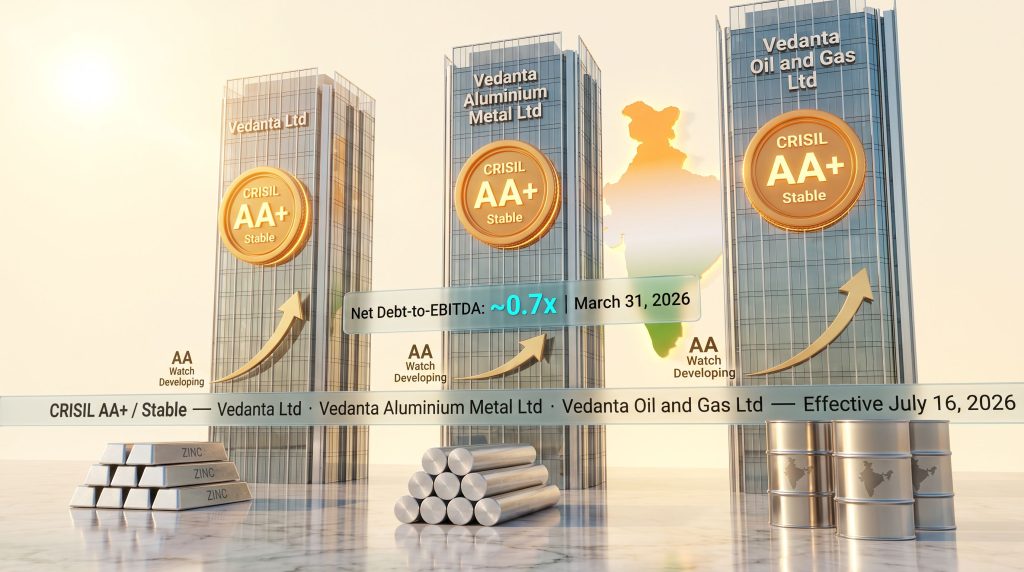
The rating actions announced on July 16, 2026 covered three distinct businesses, each carrying its own financial profile and sector dynamics. Understanding the scope of the changes matters before examining the drivers behind them.
| Entity | Prior Rating | New Rating | Outlook Change |
|---|---|---|---|
| Vedanta Ltd | CRISIL AA / Watch Developing | CRISIL AA+ / Stable | Watch Developing removed |
| Vedanta Aluminium Metal Ltd | CRISIL AA / Watch Developing | CRISIL AA+ / Stable | Watch Developing removed |
| Vedanta Oil and Gas Ltd | CRISIL A+ / Watch Developing | CRISIL AA+ / Stable | Two-notch upgrade |
All three entities also had their short-term ratings reaffirmed at CRISIL A1+, which is the highest achievable short-term designation within India's domestic credit framework. The demerger became legally operative on May 1, 2026, with the rating actions following shortly after on July 16.
Within CRISIL's rating scale, AA+ sits one notch below the theoretical ceiling. For industrial and natural resources companies, reaching this threshold is genuinely significant. It places these entities in the same credit tier as major financial institutions and infrastructure companies, unlocking access to capital pools that carry strict investment-grade mandates. For Vedanta Ltd specifically, this represents its strongest credit position since 2014.
A "Watch Developing" designation tells debt markets that a rating could move in either direction, and investors price event-risk accordingly. Its removal is not a technicality. It signals that the structural uncertainty which had kept borrowing costs elevated has been definitively resolved.
Furthermore, the CRISIL rating rationale document published in April 2026 provides detailed methodology behind each upgrade, offering investors a transparent view of the analytical framework applied across all three entities.
The Conglomerate Discount: Why Demergers Create Credit Events
Understanding How Group Structures Suppress Individual Credit Quality
One of the least discussed dynamics in corporate credit analysis is the conglomerate discount applied by rating agencies. When diverse businesses operate under a single legal entity, rating agencies must assess the entire group's risk profile, including cross-subsidisation risk, where the earnings of stronger businesses may be used to prop up weaker ones, obscuring the true credit quality of each individual operation.
This structural opacity is not a Vedanta-specific problem. It is an inherent feature of diversified industrial groups globally. The challenge is that a zinc business generating strong free cash flow and a cyclical commodity operation with higher debt loads get bundled into a single credit assessment, with the aggregate result being weaker than the sum of the best individual parts.
The demerger addressed this at its root by creating:
- Clean, independently assessable balance sheets for each business
- Transparent debt allocation proportionate to each entity's earnings capacity
- Sector-specific benchmarking against genuine industry peers rather than conglomerate averages
- Elimination of cross-entity guarantees and intercompany funding arrangements from the primary credit assessment
Debt Reallocation as the Technical Mechanism
A critical and often overlooked element of the demerger's credit impact was the reallocation of debt across the separated entities. Vedanta Ltd's existing Non-Convertible Debentures totalling ₹6,089 crore were transferred to Vedanta Aluminium Metal Ltd as part of the structural reorganisation. The original NCD rating was subsequently withdrawn from Vedanta Ltd.
This reallocation was not cosmetic. By placing debt with the business entity that generates the earnings to service it, the post-demerger structure eliminated the credit distortion that occurs when group-level debt sits at the parent entity while cash flows are generated by operating subsidiaries several layers removed.
The outcome: Vedanta Ltd's net debt-to-EBITDA ratio fell to approximately 0.7 times as of March 31, 2026, after accounting for guarantees extended to group entities. For a diversified natural resources company of this scale, a sub-1.0x leverage ratio is considered genuinely conservative and well within investment-grade territory.
Vedanta Ltd Post-Demerger: The Hindustan Zinc Concentration Strategy
Why HZL Dominance Is a Feature, Not a Risk
Hindustan Zinc Ltd contributed more than 95% of Vedanta Ltd's post-demerger earnings in fiscal year 2026. At first glance, this level of concentration might appear to introduce single-asset risk. In practice, the nature of HZL's business makes this concentration a source of stability rather than vulnerability.
HZL operates as one of the world's lowest-cost zinc producers, with integrated mining, smelting, and refining operations in Rajasthan. Its cost position on the global zinc cost curve insulates earnings through commodity price cycles in ways that higher-cost producers cannot replicate. Strong free cash flow generation, consistent profitability, and a history of dividend distribution make HZL a fundamentally different type of concentrated exposure than a single mine or a single project.
CRISIL's decision to fully consolidate HZL with Vedanta Ltd reflects the depth of strategic, operational, and financial integration between the two entities. The relationship functions closer to a parent-subsidiary structure than a conventional holding arrangement, and the rating agency's framework formally recognises this distinction. Broader commodity price impact considerations also reinforce why isolating high-quality operations from weaker group exposure is a materially credit-positive outcome.
The Diversification Runway
While zinc dominates the current earnings profile, CRISIL's stable outlook incorporates an expected earnings contribution pathway from:
- Zinc International operations, extending the group's zinc exposure across geographies
- Copper operations, providing exposure to a metal with strong structural demand growth linked to electrification
- Ferro alloys businesses, broadening the industrial metals footprint
This diversification is expected to develop over the medium term rather than being required to materialise immediately for the current ratings to hold. The stable outlook implicitly acknowledges that zinc-anchored earnings are sufficient to sustain AA+ quality while additional revenue streams mature. In addition, evolving copper market trends globally suggest that Vedanta's copper exposure could become a more meaningful earnings contributor as supply constraints tighten.
Vedanta Aluminium Metal Ltd: A New Benchmark for Indian Primary Aluminium Credit
The Operational Foundation Behind the Rating
Vedanta Aluminium holds a dominant position in India's primary aluminium sector, combining large-scale smelting capacity with captive power infrastructure that fundamentally separates its cost structure from grid-dependent competitors. In an industry where electricity costs can represent 35 to 40 percent of total production costs, captive power is not merely an operational advantage but a structural credit differentiator.
CRISIL's upgrade to AA+/Stable reflects both current profitability and a forward-looking expectation of further margin improvement, suggesting the agency sees operational leverage continuing to build as production scales. Bharat Aluminium Company Ltd (BALCO) remains fully consolidated within Vedanta Aluminium due to the close operational and strategic interdependencies between the two entities.
India's Aluminium Demand Context
The domestic market into which Vedanta Aluminium is selling is itself undergoing structural expansion. Several demand drivers are converging simultaneously:
| Demand Driver | Sector | Relevance to Vedanta Aluminium |
|---|---|---|
| Infrastructure investment | Construction, transport | High volumes of structural aluminium products |
| Electric vehicle adoption | Automotive | Lightweight aluminium demand for EV bodies and components |
| Packaging sector growth | Consumer goods | Foil, sheet, and can stock demand |
| Defence and aerospace | Government programs | Premium product demand for high-specification alloys |
Leverage Discipline While Investing for Growth
Despite ongoing capital expenditure programs, CRISIL expects Vedanta Aluminium's leverage to remain below 1.0 to 1.25 times over the medium term. This is a particularly instructive metric for debt investors: the company is simultaneously expanding capacity and maintaining conservative leverage, which implies that internal cash generation is sufficient to fund most capital investment without significant incremental borrowing.
For institutional investors with investment-grade mandates, an AA+ rating for a standalone Indian primary aluminium producer opens an asset class that was previously inaccessible at these terms. It suggests domestic aluminium companies can now compete for long-term capital on terms historically reserved for financial institutions and infrastructure developers.
Vedanta Oil and Gas Ltd: Decoding the Most Dramatic Credit Reassessment
What a Two-Notch Upgrade Actually Means in Practice
The upgrade of Vedanta Oil and Gas Ltd from CRISIL A+ to CRISIL AA+ in a single rating action is exceptional by historical standards within India's domestic credit market. Rating agencies typically move in single-notch increments, reflecting incremental financial improvement. A two-notch jump signals a fundamental reassessment of the entity's standalone risk category, not merely a modest improvement.
The explanation lies in what the demerger revealed rather than created. Prior to the structural separation, the oil and gas business was assessed as a component of a diversified conglomerate, carrying embedded group-level risk in its credit profile. Post-demerger, the business stands alone and is assessed purely on its own operational and financial characteristics, which are considerably stronger than the group-consolidated assessment implied. However, tracking oil price trends remains essential context for understanding the commodity-side risks that continue to influence this entity's forward earnings trajectory.
Operational Footprint: Scale, Concentration, and Cost Position
Vedanta Oil and Gas operates 44 exploration and production blocks covering more than 47,000 square kilometres across India, with production during fiscal 2026 reaching approximately 87 kilo barrels of oil equivalent per day (kboepd).
Key characteristics of the asset base:
- More than 80% of production is derived from Rajasthan operations, which benefit from established infrastructure and low lifting costs
- A healthy reserve base supports medium-term production planning
- Competitive operating costs provide a buffer against commodity price volatility that capital-intensive, high-cost operators cannot match
- Ongoing exploration activity across the broader block portfolio is expected to support reserve replacement over time
The Production Decline Risk: What CRISIL Is Watching
CRISIL explicitly identified declining production volumes as the primary risk monitorable for Vedanta Oil and Gas. This reflects the geological reality of maturing hydrocarbon fields: without continuous investment in reservoir management, enhanced recovery techniques, and new exploration success, production from established fields naturally declines as pressure depletes.
This is a risk that every exploration and production company faces, but its significance varies with the quality of the exploration portfolio and the operator's technical capabilities. CRISIL's AA+ rating implicitly incorporates the view that ongoing exploration activity is likely to partially offset natural field decline, though the degree of success remains uncertain and commodity price exposure adds an additional layer of inherent variability.
The next major ASX story will hit our subscribers first
The Financial Architecture That Made the Upgrades Possible
Record Profitability Across the Group
CRISIL cited record profitability across the Vedanta portfolio as a foundational driver of all three upgrades. This is an important distinction: the rating actions were not solely a consequence of structural reorganisation but reflected genuine underlying earnings growth across zinc, aluminium, and oil and gas operations simultaneously.
Strong EBITDA generation created the cash flow base from which debt reduction became possible, and the combination of earnings growth with disciplined debt allocation produced a group financial profile that the pre-demerger structure had concealed.
The CRISIL Group Notch-Up Framework
CRISIL applied its group notch-up methodology to all three entities, recognising that the Vedanta group intends to operate as an integrated whole while maintaining financial flexibility across individual entities. This framework formally acknowledges that parent entities with the capacity and strategic intent to support their operating businesses deserve a credit premium that purely standalone assessments would not capture.
The practical consequence for debt investors is meaningful:
- AA+ rated NCDs from Vedanta Aluminium Metal Ltd become accessible to insurance companies, pension funds, and mutual funds operating under investment-grade mandates
- Lower coupon rates on future debt issuances reduce interest costs and improve free cash flow generation
- CRISIL A1+ reaffirmation ensures access to commercial paper markets at the most competitive short-term rates
- Reduced event-risk premium across all three entities now that the demerger outcome has been definitively resolved
Furthermore, the improved credit standing opens up a broader range of capital raising methods that were previously less accessible at conglomerate-level pricing, a dynamic relevant to any major industrial group navigating post-restructuring debt markets.
What the Vedanta Demerger Model Reveals About Indian Conglomerate Strategy
Structural Reform as a More Powerful Tool Than Asset Sales
Vedanta's experience demonstrates a thesis that has implications well beyond this particular group: corporate structural reform can unlock more credit improvement than asset divestments or equity raises, at least in the near term. By separating businesses, the group revealed credit quality that the conglomerate structure had actively obscured rather than created it from scratch.
Other large Indian industrial groups carrying diversified business portfolios with varying credit profiles may find the Vedanta demerger a useful case study. The lesson is not that demergers are universally credit-positive but that when the underlying business quality exists and leverage is manageable, the conglomerate premium being paid in borrowing costs can be substantial.
A New Credit Benchmark for India's Natural Resources Sector
The AA+ ratings assigned to Vedanta Aluminium and Vedanta Oil and Gas establish a new reference point for what standalone Indian natural resources companies can achieve in domestic credit markets. As India accelerates infrastructure development, manufacturing expansion, and its broader industrial policy agenda, the ability of domestic resource producers to access capital at near-sovereign rates becomes a genuinely meaningful competitive advantage over imported commodity suppliers.
Consequently, the CRISIL upgrades Vedanta ratings after demerger outcome may well become a template that other diversified Indian industrials examine carefully in the years ahead. The combination of structural clarity, conservative leverage, and record earnings has proven that credit quality can be engineered through thoughtful corporate architecture, not merely inherited through favourable market conditions.
Readers seeking broader context on India's aluminium industry dynamics and global primary aluminium market developments may find value in the industry coverage available at AL Circle, which covers developments across the global aluminium ecosystem.
This article is intended for informational purposes only and does not constitute financial or investment advice. Credit rating upgrades reflect current assessments based on available information and may change. Forward-looking statements regarding earnings, leverage, and production involve inherent uncertainty. Readers should conduct their own due diligence before making investment decisions.
Want to Identify the Next Major Resource Discovery Before the Market Moves?
While Vedanta's demerger demonstrates how corporate restructuring can unlock hidden value in established industrial groups, the most transformative returns in natural resources often come from being positioned in significant mineral discoveries at the moment of announcement. Discovery Alert's proprietary Discovery IQ model scans ASX announcements in real time, instantly converting complex geological and commodity data into actionable insights across more than 30 commodities — visit the Discovery Alert discoveries page to explore historic examples of extraordinary returns, and begin a 14-day free trial to ensure the next major discovery doesn't pass unnoticed.