July 19, 2026
When Resource Nationalism Meets Supply Chain Dependency: The Indonesia-China Mineral Standoff
The global transition toward electrification has quietly redrawn the map of geopolitical leverage. Nations sitting atop reserves of nickel, cobalt, and lithium have discovered that raw material abundance is now a form of sovereign power, and they are increasingly willing to exercise it. Nowhere is this dynamic playing out with greater consequence than in the relationship between Indonesia and China, where China seeks stable transparent mineral rules from Indonesia as a collision between resource nationalism and industrial dependency forces both governments to confront the limits of their bilateral partnership.
When big ASX news breaks, our subscribers know first
The Investment Trap: Why China Cannot Simply Walk Away
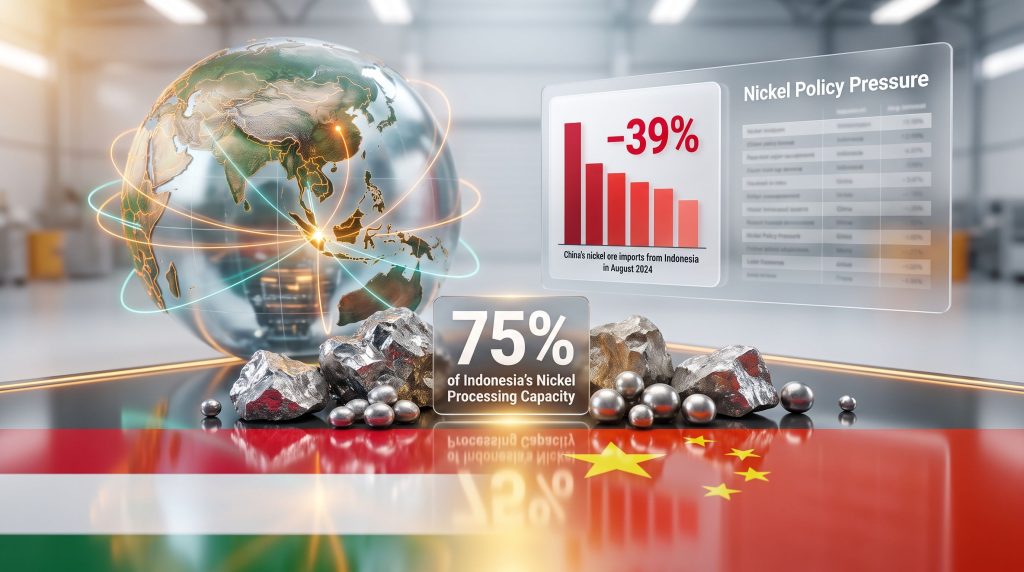
Understanding why China seeks stable transparent mineral rules from Indonesia requires examining the sheer scale of sunk capital at stake. The Indonesian nickel industry now accounts for approximately 75% of the country's nickel processing capacity, largely built on years of Chinese company investment. This is not a portfolio investment that can be liquidated at will. Smelters, rotary kiln-electric furnace (RKEF) processing lines, and refinery infrastructure represent fixed, illiquid assets that take years to construct and require predictable operating conditions to generate acceptable returns.
The Indonesian archipelago holds the world's largest known nickel reserves, and the ore deposited across islands like Sulawesi and Halmahera is predominantly of the laterite variety, specifically saprolite and limonite types. Saprolite ores, with typically higher nickel grades of 1.5% to 2.5% Ni, are better suited for ferronickel and nickel pig iron (NPI) production, which feeds directly into stainless steel and, increasingly, electric vehicle battery precursor supply chains. Chinese investment was structured precisely around this geological profile.
Indonesia's export restrictions on unprocessed nickel ore contributed to a 39% decline in China's nickel ore imports from Indonesia in August 2024, triggering an immediate search for alternative sourcing strategies across the Philippines, New Caledonia, and parts of West Africa.
That supply shock was not merely a trade statistic. It was a strategic warning to Beijing that dependence on a single jurisdiction for a critical battery input creates systemic vulnerability, particularly when that jurisdiction begins rewriting the rules of engagement mid-game. Furthermore, China's nickel investment in the region has grown so entrenched that walking away would represent a generational loss of strategic positioning.
Nickel's Role in the EV Battery Ecosystem: Why the Stakes Are So High
How Battery Chemistry Drives Geopolitical Tension
For investors and policymakers unfamiliar with the technical underpinnings of this dispute, understanding nickel's role in battery chemistry is essential context. High-nickel cathode chemistries such as NMC 811 (containing 80% nickel, 10% manganese, and 10% cobalt) and NCA formulations are the preferred architectures for high-energy-density EV batteries. Higher nickel content translates directly into greater energy storage per kilogram, enabling longer vehicle range.
The downstream implication is straightforward: as global EV adoption accelerates, demand for battery-grade nickel, specifically Class 1 nickel with purities above 99.8%, is structurally increasing. Indonesia's high-pressure acid leach (HPAL) plants, many of which carry significant Chinese capital involvement, are positioned to convert laterite ore into mixed hydroxide precipitate (MHP), the key intermediate product for battery-grade nickel sulfate production.
This is precisely why Indonesian nickel in the energy transition has become so strategically significant. China's diplomatic requests to Indonesia are not merely about protecting existing investments; they are about preserving an integrated supply chain architecture that runs from Indonesian laterite deposits through to cathode materials manufacturing in China and, ultimately, into EV battery cells destined for global markets.
What Beijing Is Formally Requesting and Why Transparency Matters
During bilateral meetings in Shanghai in July 2026, China's Commerce Minister Wang Wentao and Foreign Minister Wang Yi each made distinct but complementary requests of Indonesian Coordinating Minister for Economic Affairs Airlangga Hartarto. The core asks can be organised across three dimensions.
China's Three Core Policy Requests
| Priority Area | What China Is Asking For | Underlying Concern |
|---|---|---|
| Policy stability | Consistent, predictable regulatory settings | Protect capital already deployed in processing infrastructure |
| Transparency | Clear licensing, permitting, and compliance frameworks | Reduce regulatory arbitrage and compliance uncertainty |
| Fair investment environment | Non-discriminatory treatment of Chinese-funded operations | Counter economic nationalism affecting foreign operators |
| Supply chain continuity | Opposition to decoupling narratives | Preserve integrated Sino-Indonesian industrial value chains |
| BRI advancement | Progress on green and critical mineral cooperation frameworks | Deepen long-term bilateral resource agreements |
The Foreign Minister's explicit call for Indonesia to oppose decoupling narratives is notable. It signals that Beijing interprets some of Jakarta's recent regulatory moves not simply as domestic policy choices but as alignment with broader Western-led efforts to restructure global critical mineral supply chains away from Chinese industrial participation.
Indonesia's Regulatory Architecture: What Has Changed and Why
Key Regulations Reshaping the Investment Environment
President Prabowo Subianto's administration has introduced a cluster of regulatory measures that, taken together, represent a fundamental shift in how Indonesia manages foreign participation in its resource sector. Government Regulation No. 25/2024 formalised mandatory downstream processing requirements, effectively prohibiting the export of raw nickel ore and compelling all operators to add industrial value within Indonesian borders before product can leave the country.
Layered on top of this are phased divestment requirements compelling foreign-owned mining operations to progressively transfer equity to Indonesian entities over defined timeframes. Combined with reduced export quotas, higher fiscal levies, and restrictions on the deployment of foreign technical personnel, the full regulatory stack creates a complex compliance environment for any operator with significant foreign capital exposure.
Regulatory Pressure Matrix: Impact on Foreign Investors in Indonesia's Nickel Sector
| Regulatory Measure | Operational Mechanism | Financial Impact |
|---|---|---|
| Domestic processing mandate | Prohibits raw ore export; forces local refining | Requires capital redeployment into Indonesian infrastructure |
| Phased equity divestment | Scheduled transfer of ownership stake to local entities | Dilutes long-term return profiles and exit optionality |
| Export quota reductions | Caps volumes available for international commodity flows | Disrupts upstream supply feeding China-based processors |
| Increased tax and royalty burden | Higher fiscal extraction from mining and processing operations | Compresses project margins and internal rate of return assumptions |
| Foreign workforce restrictions | Limits deployment of expatriate technical and managerial staff | Creates operational bottlenecks and knowledge transfer constraints |
A less-discussed but critically important issue is the transparency gap in how Chinese-funded smelter projects operate within this regulatory framework. Many project-level environmental assessments and licensing arrangements lack mandatory public disclosure requirements, creating an information asymmetry that paradoxically undermines the very stability Beijing claims to be seeking.
Indonesia's Sovereignty Argument: Economic Nationalism as Industrial Strategy
Jakarta's position is grounded in a legitimate development economics argument. For decades, resource-rich nations in the developing world exported raw materials at low unit values while industrial economies captured the high-margin downstream processing and manufacturing steps. Indonesia's regulatory tightening is explicitly designed to break this pattern.
Indonesian officials have framed tighter mineral regulations as a sovereign right to ensure that value-added industrial production and the economic benefits it generates remain within Indonesian borders rather than flowing predominantly to foreign investors and their home economies.
President Prabowo's creation of a dedicated downstream development task force, with a mandate to mobilise domestic capital rather than relying exclusively on foreign direct investment, is a signal that Jakarta is willing to accept some near-term investment friction in pursuit of longer-term structural transformation. However, critics of this approach argue that the regulatory sequencing has been poorly communicated and inconsistently applied, creating precisely the unpredictability that deters the very investment Indonesia needs.
There is also a less visible dimension to Indonesia's calculus. The country has observed how nickel price dynamics shifted dramatically following its 2020 ore export ban, transforming itself from a raw material exporter into an integrated nickel products supplier. The question now is whether the same logic can be extended further down the value chain, toward battery precursor chemicals and ultimately cathode materials, without triggering capital withdrawal at a scale that stalls the entire transition.
The next major ASX story will hit our subscribers first
Scenario Analysis: Three Pathways for the Bilateral Mineral Relationship
The trajectory of the China-Indonesia mineral relationship is genuinely uncertain. Consequently, investors with exposure to nickel, the broader battery metals investment landscape, or downstream EV supply chains should model their positions across multiple scenarios.
Scenario 1: Negotiated Stability
Both governments formalise a bilateral investment framework that codifies licensing timelines, environmental standards, and investor protection mechanisms. Chinese operators gain the regulatory predictability they need to commit additional capital, while Indonesia advances its downstream ambitions with continued access to Chinese technical expertise and processing capital. This is the most constructive outcome but requires sustained political will from both sides.
Scenario 2: Managed Divergence
Indonesia continues tightening domestic content requirements incrementally, while China systematically accelerates mineral sourcing diversification across the Philippines, Papua New Guinea, Brazil, and nickel-bearing laterite deposits in parts of Africa. Bilateral dependency gradually reduces without a formal rupture. Nickel supply remains adequate but increasingly fragmented across jurisdictions with varying governance and environmental standards.
Scenario 3: Regulatory Escalation
Continued policy unpredictability triggers capital withdrawal by major Chinese smelter operators, leading to output disruptions in Indonesian nickel production. Global battery-grade nickel supply tightens, price volatility increases, and EV manufacturers face input cost uncertainty. This scenario carries the highest risk of being underpriced by markets currently focused on near-term oversupply conditions in nickel.
The Belt and Road Complication: Agreements Without Accountability
The Two Countries, Twin Parks initiative, a bilateral framework designed to create linked special economic zones facilitating joint manufacturing and supply chain integration, has been advanced as a potential vehicle for stabilising the relationship. However, many Belt and Road-linked agreements between China and Indonesia have historically lacked robust public disclosure mechanisms, making it difficult to assess whether commitments on investment protection, environmental compliance, and technology transfer are being met.
This opacity creates a structural contradiction. China is requesting transparency from Indonesia's regulatory environment while simultaneously participating in deal structures that are themselves not fully transparent to Indonesian civil society or independent oversight bodies. Resolving this contradiction may be as important to long-term bilateral stability as any specific policy concession.
What This Dispute Reveals About the Future of Resource Diplomacy
The China-Indonesia mineral standoff is not an isolated bilateral dispute. It is, in addition, a concentrated expression of tensions emerging wherever large volumes of foreign mining capital intersect with governments newly alert to the strategic value of their mineral endowments. As critical minerals demand intensifies globally, these dynamics are only likely to sharpen.
Several structural conclusions are worth drawing for investors and policymakers watching this space.
- Regulatory risk has become a first-order variable in critical mineral investment decisions, not an afterthought to be managed through legal structuring.
- The tension between resource sovereignty and foreign capital is intensifying globally, and Indonesia's experiment is being watched closely by governments in the Democratic Republic of Congo, Zimbabwe, and beyond.
- Bilateral mineral frameworks require embedded transparency mechanisms to be credible, and frameworks lacking independent verification are vulnerable to breakdown as political conditions change.
- Nickel's geological complexity adds a layer of technical risk often underappreciated by generalist investors: the distinction between sulphide and laterite ore types, between saprolite and limonite fractions, and between NPI-grade and battery-grade processing pathways each carry distinct investment risk profiles that interact with regulatory conditions in non-linear ways.
- Supply chain diversification is accelerating regardless of how the China-Indonesia talks resolve, and jurisdictions with more stable regulatory environments, even if they lack Indonesia's scale, may attract a growing share of capital over the medium term.
Furthermore, the broader lesson is that China seeks stable transparent mineral rules from Indonesia not merely as a bilateral preference but as a model for how resource partnerships should function across the developing world. How Jakarta responds will set a precedent that resonates far beyond their shared archipelago.
Disclaimer: This article is for informational purposes only and does not constitute financial or investment advice. Forecasts, scenario analyses, and market projections involve inherent uncertainty and should not be relied upon as the basis for investment decisions. Readers should conduct their own due diligence and consult qualified financial advisers before making investment decisions related to the sectors or companies discussed.
Want to Stay Ahead of the Next Major Mineral Discovery?
Discovery Alert's proprietary Discovery IQ model delivers real-time alerts on significant ASX mineral discoveries — cutting through complex geological and regulatory noise to surface actionable investment opportunities the moment they emerge. Explore Discovery Alert's dedicated discoveries page to see how historic mineral discoveries have generated substantial market returns, and begin your 14-day free trial today to position yourself ahead of the broader market.