August 6, 2026
When More Barrels Require Fewer Hands: The Structural Transformation of U.S. Oil and Gas Labor
Every major industrial revolution eventually reaches a tipping point where output and headcount decouple permanently. Manufacturing crossed that threshold decades ago, producing vastly more goods with a fraction of the workforce that once sustained it. The U.S. oil and gas sector is now navigating the same inflection, and the data arriving in mid-2026 confirms what productivity economists have been tracking for years: oil and gas employment hits a low even as production sets records, and the two trends are not in conflict. They are, in fact, the same story told from opposite ends of the production function.
When big ASX news breaks, our subscribers know first
Understanding the "More Barrels, Fewer Workers" Phenomenon
What the Employment Data Actually Reveals About Industry Structure
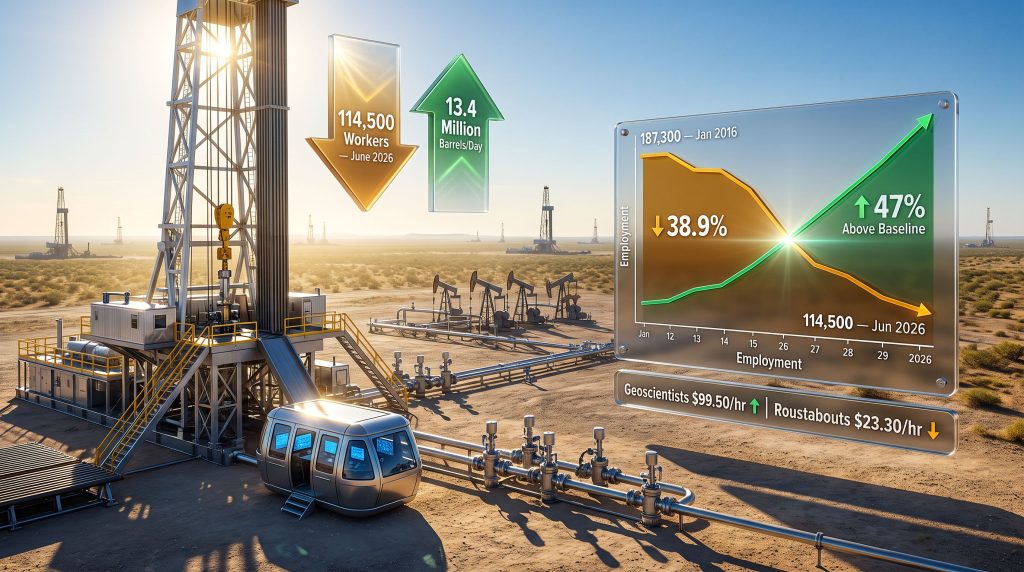
U.S. oil and gas extraction employment registered 114,500 workers in June 2026, the second-lowest June reading in Bureau of Labor Statistics history, surpassed only by the pandemic trough of 2021. The year opened at 115,500 positions in January, briefly climbed to 116,200 in February, then declined consecutively through mid-year.
That May-to-June contraction is not anomalous. The same seasonal window has produced negative employment readings in 7 of the last 11 years, pointing to a structural floor that resets lower with each passing cycle rather than recovering toward prior peaks.
Key Insight: Single-month employment figures are subject to material revision. May 2026's initial reading of 115,600 was subsequently revised down to 115,300, underscoring the importance of directional trend analysis over point-in-time readings. Investors and analysts relying on unrevised monthly snapshots risk misreading the trajectory entirely.
Extraction vs. Oilfield Services: Two Workforce Layers, One Shared Decline
The 114,500 extraction figure represents only the visible surface of the sector's total labor footprint. Oilfield services, encompassing drilling contractors, completions crews, pressure pumping, and well intervention, employs approximately 627,000 workers, more than five times the extraction headcount. Services employment has contracted at an accelerated rate relative to direct extraction, amplifying the sector-wide workforce compression considerably.
The ripple effects extend even further downstream. Estimates suggest every upstream position anchors approximately 232,000 supply chain roles and supports a further 421,000 positions through downstream spending, meaning the total labor ecosystem connected to upstream oil and gas activity exceeds 850,000 jobs, many of which are now feeling structural pressure they have little direct visibility into.
The Decade-Long Workforce Compression: A Statistical Summary
| Metric | January 2016 Peak | June 2026 | Decade Change |
|---|---|---|---|
| Extraction Employment | 187,300 | 114,500 | ↓ 38.9% |
| Total Sector Jobs (est.) | ~1.26 million | ~1.0 million | ↓ ~20% |
| U.S. Oil Production | Baseline | +47% above baseline | ↑ Record High |
| U.S. Gas Production | Baseline | +45% above baseline | ↑ Record High |
| Daily Output | Lower | 13.4 million barrels/day | ↑ All-time peak |
The sector has shed an estimated 72,800 extraction positions from its January 2016 peak, with total upstream employment including services declining by roughly 260,000 positions over the same period. What makes this compression analytically remarkable is that it occurred while domestic oil and gas output climbed to all-time records, a combination that defies the intuitive relationship between industrial activity and employment. As reported by E&E News, this divergence between output growth and workforce decline has become one of the defining structural features of the modern upstream sector.
What Is Actually Driving the Workforce Contraction?
Automation and Operational Efficiency: The Productivity Engine Behind the Paradox
Output per worker-hour in U.S. oil and gas extraction surged 11.4% in 2023 while labor input remained essentially flat, according to Bureau of Labor Statistics productivity data. Total factor productivity swung from a 14.7% decline in 2021 to a 30.2% gain in 2023, a 45-percentage-point reversal achieved without a proportional increase in headcount.
Modern wellsite operations increasingly run on sensor-based remote monitoring, predictive maintenance systems, and automated drilling systems — technologies that structurally reduce the number of on-site personnel required per barrel produced. A lateral that once required a full drilling crew cycling through multi-week shifts can now be managed with a fraction of the boots-on-ground presence that was standard practice a decade ago.
Operational Reality: The Permian Basin and Eagle Ford continue to set output records not because more workers are drilling more wells, but because each well is being drilled faster, completed more efficiently, and monitored remotely, compressing the labour intensity of every barrel produced. The efficiency gains are embedded in technology infrastructure, not recoverable by adding headcount.
A lesser-known dimension of this transformation is the role of pad drilling, where multiple wellbores are drilled from a single surface location using a shared rig. This technique, now standard across major shale plays, dramatically reduces the total rig-moves, crew relocations, and surface preparation required per productive well, delivering output growth that is invisible to employment statistics but highly visible in production volumes. Furthermore, automation transformed operations across multiple resource sectors well before the current upstream efficiency wave, establishing a clear precedent for what the oil and gas industry is now experiencing at scale.
Merger-Driven Workforce Rationalization: The Consolidation Effect
The current layoff cycle is primarily a function of corporate consolidation rather than commodity price weakness, a critical distinction for workforce forecasting. When two upstream operators combine, their field infrastructure, back-office functions, and regional management layers become redundant regardless of production volumes or oil price market dynamics.
The scale of announced reductions in 2026 illustrates the point:
- Chevron is executing the largest workforce reduction in company history, up to 9,000 positions (approximately one-fifth of its global headcount), as it integrates the $53 billion Hess acquisition and targets $2 to $3 billion in synergy savings
- ExxonMobil eliminated 2,000 positions following completion of its Pioneer Natural Resources acquisition
- BP reduced its permanent staff by more than 5% and released approximately 3,000 contractors as part of a $2 billion cost restructuring
- ConocoPhillips is cutting 20 to 25% of its workforce in post-merger integration
- Imperial Oil is eliminating approximately one-fifth of its workforce and closing its Calgary headquarters entirely
Structural Note: These reductions would have proceeded regardless of where oil was trading. The synergy targets that justify acquisition premiums in upstream mergers are largely realised through headcount elimination, not organic efficiency improvement. That makes this wave of job losses fundamentally different from the price-driven contractions of 2015 and 2020.
Rig Count Dynamics and Services Sector Exposure
While integrated majors are cutting for consolidation reasons, the services sector is responding to a different but equally structural pressure. The U.S. drilling activity decline of approximately 14% between June 2023 and June 2024 created a direct transmission mechanism into oilfield services employment. Halliburton executed multi-division reductions across at least three business units in 2026, with some divisions contracting 20 to 40%. SLB (formerly Schlumberger) undertook parallel restructuring and operational reshuffling across its business lines.
Services companies operate with high revenue sensitivity to rig count fluctuations because their business model is fundamentally transactional: they bill for activity, not for production. When operators drill fewer wells, services revenue contracts almost immediately, and workforce reductions follow within one to two quarters. This structural exposure makes the services layer of the industry a leading indicator for broader upstream labour trends.
The Skills Mismatch: Why the Industry Can't Fill the Jobs It Actually Needs
The Wage Stratification Problem in U.S. Upstream Labor
The roles being eliminated and the roles going unfilled sit at opposite ends of the compensation spectrum, a mismatch that complicates simple supply-and-demand analysis of the upstream labour market.
| Role Category | Median Hourly Wage | Estimated Annual Compensation | Employment Trend |
|---|---|---|---|
| Geoscientists | $99.50/hr | ~$206,960/yr | Stable / Growing |
| Petroleum Engineers | $86.58/hr | ~$180,086/yr | Stable |
| Wellhead Pumpers | $36.62/hr | ~$76,170/yr | Declining |
| Roustabouts (Entry-Level) | $23.30/hr | ~$48,464/yr | Declining fastest |
The roles disappearing at the greatest velocity are the lowest-compensated, highest-physical-labour positions. The roles going unfilled despite industry-wide headcount reductions are technically specialised: electricians, automation technicians, sensor systems operators, and remote operations specialists. Approximately 50% of mining and extraction employers report difficulty sourcing qualified electricians and skilled trades workers, even as total sector employment contracts, according to U.S. Department of Energy workforce survey data.
Why Existing Workers Can't Simply Pivot
A modern automated wellsite operates on sensor integration, real-time data telemetry, and predictive maintenance software — competencies built over years of technical training. Workers whose careers were constructed around physical wellsite operations face genuine retraining barriers that proximity to job openings alone cannot resolve.
Veterans represent approximately 9% of the broader energy workforce, above their share of the general economy, and workers under 30 account for roughly three in ten energy employees. Both cohorts are being actively recruited by adjacent sectors including geothermal development and AI data centre infrastructure, creating competition for the industry's most adaptable talent precisely when internal retraining capacity is contracting. In addition, the energy transition workforce shift occurring across resource sectors more broadly is compounding the competition for technically capable workers.
The Permian Basin's Emerging Dual Identity: Oil Field and Power Grid
How AI Infrastructure Is Rewriting the Permian's Labor Demand Profile
The most structurally significant labour market development unfolding in the Permian Basin in 2026 is not drilling activity. It is electricity generation for AI data centre infrastructure, and it is reshaping who the basin needs to hire.
Microsoft is in advanced discussions with Chevron and Engine No. 1 regarding a $7 billion dedicated gas-to-power plant near Pecos, Texas, designed to supply an AI data centre directly from Chevron's own gas wells, bypassing the overloaded ERCOT grid entirely. OpenAI's Stargate campus in Abilene, Texas, operates on the same captive-power model: a dedicated gas plant providing electricity without grid dependency.
The resource demands of these facilities are substantial in oilfield terms. A single large-scale AI data centre can consume 5 to 6 million gallons of water per day, equivalent to approximately 143,000 barrels in volumetric oilfield terms, reshaping the basin's resource utilisation calculus in ways that production statistics alone do not capture.
Labor Market Implication: The Permian's emerging power infrastructure buildout is generating demand for electricians, power technicians, welders, and grid engineers — not additional frack crews. The basin's job listings are shifting in composition even as total upstream headcount declines, pointing toward a fundamentally different employment base than the one that characterised the shale boom era.
Texas Employment Dynamics: A Microcosm of Sector-Wide Contradictions
Texas upstream employment grew for three consecutive months through May 2026, then reversed sharply in June, shedding 1,500 to 2,000 positions in a single month, representing one of five negative employment months for the state's upstream sector in 2026.
Despite the contraction, Texas posted 10,409 oil and gas job listings in May, a 6% increase from April and the highest listing volume of any U.S. state, with Houston alone accounting for nearly 2,700 listings. The majority of active listings are concentrated in support activities and services, the same layer of the industry absorbing the deepest structural cuts elsewhere in the country. This divergence between listing volume and net employment gains reflects the bifurcated nature of the current labour market: high turnover in lower-skill roles generating perpetual listing activity without producing net headcount growth.
Where Do Displaced Oil and Gas Workers Actually Go?
Geothermal Energy: The Closest Skills-Transfer Pathway
Geothermal development represents the highest-fidelity skills transfer pathway for displaced upstream workers, and the gap between available talent and current deployment is substantial enough to constitute a genuine structural opportunity.
- A 2024 U.S. Department of Energy assessment identified approximately 300,000 workers already possessing the drilling and subsurface competencies required for geothermal operations
- The current U.S. geothermal workforce stands at approximately 8,870 workers, representing a structural absorption capacity that remains almost entirely untapped
- Workers who have transitioned from conventional drilling to geothermal operations consistently describe the technical overlap as near-complete: wellbore construction, casing, cementing, and safety protocols transfer with minimal retraining
- The Department of Energy has committed $171.5 million to next-generation geothermal technology testing and demonstration
- A federal advisory panel has recommended establishing dedicated training centres to facilitate structured transitions from upstream oil and gas into geothermal operations, alongside mentorship frameworks designed to preserve institutional wellsite knowledge before experienced workers exit the industry
What makes geothermal particularly compelling from a skills-transfer standpoint is the technical depth of the overlap. Drilling engineers managing wellbore pressure, casing design, and cementing programmes in conventional upstream operations are solving the same engineering problems in geothermal contexts. The subsurface target differs, but the mechanical and safety disciplines are essentially identical — a distinction that conventional retraining programmes often fail to communicate clearly to workers evaluating their options.
Clean Energy Sector Absorption: Scale vs. Geography
| Sector | Current U.S. Employment | Growth Rate vs. Economy | Key Constraint |
|---|---|---|---|
| Clean Energy (total) | 3.56 million | ~3x faster | Geographic mismatch |
| Oil, Gas and Coal (total) | ~1.9 million | Declining | Skills surplus in wrong locations |
| Texas Clean Energy | 283,000+ | Slowing | Only 29% of state energy workforce |
Clean energy employment now exceeds oil, gas, and coal combined by a factor of approximately 1.9x and is growing roughly three times faster than the broader U.S. economy, according to Department of Energy workforce reporting. However, the geographic distribution of clean energy job creation does not align with the locations experiencing upstream oil and gas job losses.
Workers do not reliably relocate for adjacent-sector employment even when their technical skills transfer cleanly, creating a structural absorption failure that retraining programmes and policy interventions have not yet resolved at meaningful scale. Federal policy rollbacks embedded in 2026 budget legislation are estimated to put approximately 830,000 clean energy positions at risk nationally, further compressing the sector's capacity to absorb displaced upstream workers over the medium term.
The next major ASX story will hit our subscribers first
Is This a Structural Reset or a Cyclical Trough?
The "More Oil, Fewer Jobs" Model: Permanent or Temporary?
Industry analysts and institutional research consistently characterise the current employment trajectory as structural rather than cyclical, meaning a return to 2014 or 2016 headcount levels is not anticipated even under sustained high commodity prices. According to analysis from IEEFA, the productivity gains that enabled record output with a workforce nearly 40% smaller than its peak are embedded in technology and operational practice, not recoverable by adding back labour when margins improve.
The jobs being eliminated at the greatest velocity — entry-level physical labour positions and redundant post-merger corporate functions — are not jobs that return when prices recover. They are positions that technology adoption and consolidation logic have permanently displaced from the production function.
Analytical Framework: The oil and gas sector is undergoing a labour intensity compression that mirrors what manufacturing experienced over the prior two decades. Output continues to grow while the workforce required to generate that output shrinks on a per-barrel basis. The sector is not contracting; it is restructuring its production function around a smaller, more technically specialised, and better-compensated workforce tier.
What a Leaner Workforce Means for Per-Worker Economics
A reduced headcount against stable or growing output mathematically improves revenue per employee, output per worker-hour, and operating margin per barrel. Workers who survive consolidation cycles frequently transition into higher-specialised, better-compensated roles than the positions they previously occupied, reflecting the bifurcation underway across the sector's labour market.
The sector's employment base is not deteriorating uniformly. It is sorting into two trajectories: eliminating a broad base of lower-skill positions while concentrating demand in a narrower tier of high-skill, high-compensation technical roles. For investors, this bifurcation implies that per-worker productivity and margin metrics will continue improving even as headline employment figures decline — a dynamic that equity analysts accustomed to reading employment as a proxy for sector health will need to reframe.
Frequently Asked Questions: Oil and Gas Employment vs. Production
Why is oil and gas employment falling if production is at record highs?
Record production levels and declining employment are not contradictory. They reflect a fundamental shift in how the industry generates output. Automation technologies, including remote monitoring systems, automated drilling platforms, and predictive maintenance software, allow modern operations to extract significantly more oil and gas per worker-hour than was possible a decade ago. Additionally, a wave of major corporate mergers has generated large-scale workforce rationalisation as companies eliminate redundant functions across combined operations.
Which oil and gas companies have announced the largest layoffs in 2026?
The largest announced workforce reductions include Chevron (up to 9,000 positions, approximately 20% of global headcount), ConocoPhillips (20 to 25% reduction), BP (more than 5% of permanent staff plus approximately 3,000 contractors), ExxonMobil (2,000 positions), and Imperial Oil (approximately 20% of workforce with full Calgary office closure).
What types of oil and gas jobs are disappearing fastest?
The roles contracting most rapidly are entry-level and semi-skilled physical labour positions — roustabouts at a median of approximately $23.30 per hour, wellhead pumpers at around $36.62 per hour, and general rig hands. These roles are being displaced by automation and operational efficiency improvements. Simultaneously, demand for technically specialised workers, including electricians, automation technicians, remote operations specialists, and data systems engineers, remains unmet despite sector-wide headcount reductions.
Can oil and gas workers transition to clean energy or geothermal jobs?
The technical skills overlap between conventional upstream operations and geothermal development is high. Drilling, wellbore construction, casing, and subsurface management competencies transfer with minimal retraining. The U.S. Department of Energy estimates approximately 300,000 oil and gas workers already possess the core skills geothermal operations require, against a current geothermal workforce of under 9,000. The primary barrier to transition is geographic rather than technical, as clean energy job creation is concentrated in different regions from where upstream oil and gas layoffs are occurring.
Will oil and gas employment recover when oil prices rise?
Analysts broadly characterise the current employment decline as structural rather than cyclical. The productivity improvements and consolidation-driven efficiencies that enabled record production with fewer workers are permanent features of the industry's operating model. Consequently, a sustained price recovery is unlikely to restore the entry-level and redundant corporate positions that automation and merger logic have eliminated. This aligns with the broader observation that oil and gas employment hits a low even as production sets records — a pattern that historical price cycles alone cannot explain.
Key Takeaways: The Structural Transformation of U.S. Oil and Gas Labor
- U.S. oil and gas extraction employment reached 114,500 in June 2026, near a multi-decade low, while domestic output approached all-time production records
- The workforce has contracted approximately 39% from its January 2016 peak of 187,300, with total sector employment including services declining from approximately 1.26 million to around 1.0 million
- The primary drivers are automation-driven productivity gains, post-merger workforce rationalisation, and rig count contraction, not energy transition displacement
- Output per worker-hour rose 11.4% in 2023 alone; total factor productivity swung 45 percentage points in two years without proportional labour growth
- The skills mismatch is acute: approximately half of extraction employers cannot fill electrician and automation technician roles even as total headcount shrinks
- Geothermal development offers the highest-fidelity transition pathway, with a potential absorption pool of 300,000 qualified workers against a current geothermal workforce of fewer than 9,000
- The sector's labour market is bifurcating permanently, with fewer, more specialised, higher-compensated roles replacing a broader base of lower-skill positions
- The Permian Basin is developing a dual identity as both an oil production hub and an AI power infrastructure corridor, generating a fundamentally different mix of labour demand than the upstream drilling cycle historically produced
This article is intended for informational and educational purposes only and does not constitute financial, investment, or employment advice. Employment figures cited from Bureau of Labor Statistics data are subject to revision. Forward-looking statements regarding workforce transition pathways, sector employment trajectories, and energy transition dynamics involve material uncertainty and should not be construed as forecasts or guarantees of future outcomes.
Want to Track the Next Major Mineral Discovery Before the Market Does?
While the oil and gas sector restructures around automation and consolidation, significant mineral discoveries on the ASX continue to create substantial opportunities for investors who act quickly — Discovery Alert's proprietary Discovery IQ model scans ASX announcements in real time, delivering instant, actionable alerts on high-potential discoveries across more than 30 commodities, just as it did for landmark finds like De Grey Mining and WA1 Resources. Explore historic discovery returns on Discovery Alert's dedicated discoveries page and begin a 14-day free trial to position yourself ahead of the broader market.