
July 9, 2026
Oil-Backed Prepayment Financing: The Structural Fault Line Running Through African Sovereign Debt
Across frontier commodity markets, a quiet financial architecture operates almost entirely out of public view. While multilateral lenders and bond markets dominate headlines about sovereign borrowing, a significant portion of Africa's resource-dependent governments fund their day-to-day public expenditure through a far more opaque mechanism: pledging barrels of crude oil that have not yet been extracted, to trading counterparties willing to pay today for delivery tomorrow. When this system functions, it is invisible. When it fractures, the consequences ripple across public finances, humanitarian operations, and international legal courts simultaneously.
The South Sudan BB Energy oil prepayment financing dispute, which reached a critical inflection point in July 2026, offers one of the most instructive case studies in how this architecture can fail, and what partial repair looks like in practice.
When big ASX news breaks, our subscribers know first
What Oil Prepayment Financing Actually Does, and Why Frontier Nations Depend on It
At its core, an oil prepayment facility is a structured commodity finance instrument where a sovereign or state-owned entity commits to delivering specific volumes of crude oil at defined future intervals, in exchange for a lump-sum cash advance paid upfront by a commodity trading counterparty. The structure functions as a credit facility for governments that cannot access conventional sovereign bond markets at viable interest rates, or that face geopolitical and reputational barriers to multilateral lending windows.
Three parties typically anchor these arrangements:
- The sovereign seller, who pledges future production volumes as collateral.
- The commodity trading counterparty, who provides the upfront capital and assumes delivery risk.
- The legal and logistical infrastructure, encompassing pipeline operators, port authorities, and the jurisdiction-specific contracts governing delivery obligations.
This differs meaningfully from traditional export credit arrangements or project finance. Export credit facilities typically require a defined project asset as collateral. Project finance is structured around specific infrastructure with identifiable cash flows. Oil prepayment, by contrast, is backed by the sovereign's future production capacity and political willingness to deliver, making it inherently more exposed to both operational risk and governance risk simultaneously.
For nations where hydrocarbon revenues represent between 85% and 90% of total government income, according to African Security Analysis, these structures are not discretionary financing tools. They are the primary pipeline through which public spending is funded. South Sudan sits at the extreme end of this fiscal concentration spectrum, with a public finance architecture that rests almost entirely on crude oil exports and the handful of commodity trading giants willing to advance capital against them.
Structural Context: When a government's entire revenue base flows through a single commodity channel, any legal, operational, or political disruption to prepayment access does not function as a commercial inconvenience. It functions as a fiscal emergency with direct humanitarian consequences.
The Architecture of South Sudan's $142 Million Dispute with BB Energy
How the Facility Was Constructed
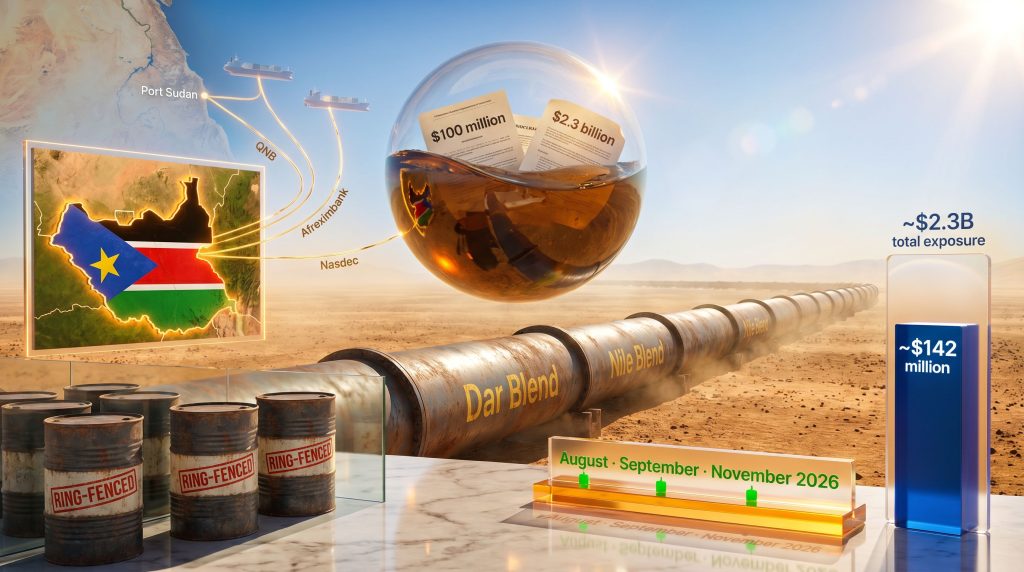
In February 2025, London-based commodity trader BB Energy extended a $100 million advance facility to the Republic of South Sudan. The repayment structure was straightforward in design: five scheduled crude oil cargo tranches, each comprising approximately 600,000 barrels of Dar Blend and Nile Blend crude, to be delivered across a defined timeline.
Dar Blend and Nile Blend are South Sudan's two principal export grades. Both are transported via pipeline infrastructure running through Sudan to Port Sudan on the Red Sea, making them entirely dependent on transit infrastructure that South Sudan does not control. This geographic dependency is not a minor operational detail. It represents a fundamental vulnerability in the repayment architecture, because any disruption to the pipeline corridor, whether from conflict, infrastructure damage, or political interference in Sudan, directly impairs South Sudan's ability to honour delivery commitments regardless of its intentions.
The Breakdown and Its Compounding Factors
By February 2026, only one cargo had been successfully delivered. The remaining four tranches had stalled. What transformed this from a straightforward delivery dispute into a multi-party legal crisis was the emergence of a double-pledging problem. South Sudan had allegedly allocated the same physical cargo pools to multiple trading counterparties simultaneously, with Dubai-based entities BGN, Chiangwei, and A&M each reportedly having paid advance funds for the same oil volumes.
This created a competing creditor environment with no centralised resolution mechanism. Furthermore, as commodity market volatility pushed crude prices higher during this period, the economic exposure on BB Energy's side expanded well beyond the original facility amount, with estimates placing the total claim in the range of $150 million to $180 million, ultimately crystallising at a stated figure of $142 million.
Risk Framework: The simultaneous pledging of the same physical cargo to multiple prepayment counterparties is one of the most acute structural vulnerabilities in sovereign commodity finance. Unlike a bank loan secured against a property that exists independently, oil cargo pools are dynamic and finite. Double-pledging them is not merely a governance failure; it is a mathematical impossibility that guarantees creditor conflict the moment delivery volumes fall short.
The London High Court Injunction: What It Froze and What It Did Not
In May 2026, the High Court in London issued an injunction barring South Sudan from entering into any new prepayment financing arrangements until its outstanding obligations to BB Energy were addressed. The choice of English law jurisdiction is not incidental. A substantial proportion of African commodity finance agreements are governed under English law, making London courts the natural forum for disputes of this nature. English law provides commodity trading counterparties with relatively efficient routes to injunctive relief compared to enforcing judgments directly against sovereign assets in domestic courts.
Critically, the injunction did not freeze South Sudan's existing oil production or ongoing export operations. Its scope was specifically targeted at the government's ability to pledge future cargoes as collateral for new advance payments from third parties. The distinction matters enormously: oil continued to flow, but the government's ability to monetise that future flow through new prepayment deals was severed.
For a government that uses prepayment structures as its primary working capital mechanism, the practical effect was equivalent to cutting off access to a line of credit with no immediate substitute available. The broader geopolitical risk landscape surrounding the region further compounded the government's limited options for alternative financing channels.
South Sudan's broader debt position amplifies the severity of this constraint. According to reporting by Global Trade Review (GTR), the country carries approximately $2.3 billion in outstanding obligations across multiple oil prepayment arrangements, with creditors including Qatar National Bank, Afreximbank, and Emirati trader Nasdec.
| Creditor | Financing Type | Estimated Exposure |
|---|---|---|
| BB Energy | Oil prepayment facility | ~$142 million (disputed) |
| Qatar National Bank (QNB) | Oil-backed lending | Part of ~$2.3B collective exposure |
| Afreximbank | Oil prepayment / structured lending | Part of ~$2.3B collective exposure |
| Nasdec (UAE) | Oil prepayment facility | Part of ~$2.3B collective exposure |
The July 2026 Consent Order: A Partial Resolution Framework
Terms of the Agreement
On July 3, 2026, both parties filed a consent order with the London High Court formalising a partial resolution framework. Under its terms, South Sudan committed to delivering three additional crude oil cargoes to BB Energy, each comprising approximately 600,000 barrels of Dar Blend and Nile Blend, scheduled for August, September, and November 2026. BB Energy secured irrevocable letters of award from the South Sudanese government confirming these delivery commitments.
In return, BB Energy agreed to partially relax the injunction, restoring South Sudan's ability to accept new prepayment financing from third parties, subject to a critical carve-out: the three awarded cargoes are legally ring-fenced exclusively for BB Energy and cannot be pledged to any other counterparty under any circumstances.
The partial suspension of the injunction remains operative only until the end of November 2026, after which the full injunction can be reinstated if no comprehensive final settlement has been achieved.
What Has and Has Not Changed
| Dimension | Pre-Settlement Position | Post-Settlement Position |
|---|---|---|
| New prepayment access | Blocked by injunction | Restored with cargo ring-fencing |
| BB Energy cargo rights | Disputed and undelivered | Secured via irrevocable letters of award |
| Injunction status | Fully operative | Relaxed until end of November 2026 |
| Remaining debt resolution | Entirely unresolved | Deferred to post-November negotiation |
| Total outstanding claim | ~$142 million | Partially offset; full remaining balance undisclosed |
Why the Ring-Fencing Mechanism Is Structurally Significant
The ring-fencing of the three awarded cargoes directly addresses the double-pledging vulnerability that ignited the original dispute. By legally isolating specific cargo tranches for a single creditor before any new prepayment agreements are entered, the consent order creates a priority claim structure that did not previously exist.
This matters beyond the immediate dispute. African sovereign commodity finance has historically operated without formal creditor priority frameworks, leaving the sequencing of creditor recovery to depend largely on which party moves fastest through available legal channels. The cargo ring-fencing approach embedded in the BB Energy consent order offers a rudimentary but practically meaningful template for structuring creditor protections in future prepayment arrangements across the continent.
BB Energy's head of business development indicated publicly that the company viewed the South Sudanese government's engagement as constructive and expressed a preference for maintaining the commercial relationship while pursuing full resolution of the remaining balance. This framing reveals something important about the commercial logic underpinning the decision to relax the injunction.
Why BB Energy Chose Partial Relief Over Maximum Legal Pressure
The decision to ease rather than maintain the injunction reflects a sophisticated assessment of recovery probability. A sustained, unrestricted injunction that permanently blocks South Sudan from accessing new prepayment financing creates a zero-sum dynamic. If the government cannot monetise its future oil flows through advance agreements, its fiscal position deteriorates further, reducing the pool of resources from which any settlement can ultimately be drawn.
By restoring South Sudan's financing access under tightly controlled conditions, while simultaneously ring-fencing its own priority cargoes, BB Energy improves the sovereign's capacity to generate oil revenue flows sufficient to service the remaining obligation. This approach converts what could become an unrecoverable legal claim into a structured, time-bound recovery pathway.
It also reflects a broader truth about creditor strategy in sovereign commodity finance disputes: the threat value of an injunction often exceeds its operational value once a debtor's fiscal position deteriorates beyond a certain threshold. However, the South Sudan BB Energy oil prepayment financing case demonstrates that measured legal leverage, applied strategically, can produce tangible partial outcomes even in highly complex multi-creditor environments.
The next major ASX story will hit our subscribers first
The Road to November 2026 and Beyond
Key Variables Shaping the Negotiation Window
The relaxed injunction creates a defined negotiation corridor extending to the end of November 2026. Several variables will determine whether a comprehensive settlement is achievable within that window:
- Crude oil price trajectory: Higher prices improve South Sudan's revenue per barrel and increase its capacity to service the remaining BB Energy obligation while meeting other creditor commitments.
- Pipeline access stability: Continued access to the Sudan pipeline corridor is non-negotiable for cargo delivery. Renewed conflict or infrastructure disruption in Sudan could derail the August, September, and November delivery schedule entirely.
- Competing creditor behaviour: QNB, Afreximbank, and Nasdec each have their own prepayment claims. If any of these counterparties pursue independent legal action during the negotiation window, the multi-creditor environment becomes significantly more complex.
- South Sudan's production capacity: Actual wellhead output, which has faced operational challenges in recent years, must be sufficient to supply the ring-fenced BB Energy cargoes while also supporting new prepayment commitments to other counterparties.
Scenario Pathways
| Scenario | Key Condition | Likely Outcome |
|---|---|---|
| Full settlement by November 2026 | Stable pipelines, firm oil prices | Injunction permanently lifted; BB Energy fully compensated |
| Partial settlement with extended timeline | Moderate production recovery | Injunction extended under renegotiated terms |
| Negotiation breakdown | Pipeline disruption or competing creditor action | Full injunction reinstated; South Sudan's financing access severed |
| Multi-creditor restructuring | Coordinated intervention by QNB, Afreximbank, or Nasdec | Formalised debt restructuring framework established across all creditors |
Systemic Lessons for African Commodity Finance Risk
South Sudan's situation is not an isolated anomaly. Multiple African oil-producing states have entered concurrent prepayment arrangements with different trading counterparties across overlapping timeframes, creating structural fragility that is invisible during periods of stable production but becomes acute the moment output volumes dip or infrastructure access is disrupted. In addition, global trade disruptions and shifting sanctions environments are placing further pressure on the financing channels that underpin these arrangements.
The South Sudan case exposes several systemic design failures that are replicable across the broader asset class:
- Oil prepayment structures rarely include robust cargo registry mechanisms that prevent the same physical volumes from being pledged to more than one counterparty.
- Pipeline dependency on transit states with their own political instability creates force majeure risk that is entirely outside the sovereign debtor's control but falls squarely within its legal delivery obligations.
- The absence of a formal sovereign insolvency framework means that when a government cannot service multiple concurrent prepayment claims simultaneously, resolution devolves to a race between creditors' legal teams rather than an equitable, structured process.
- English law jurisdiction provides a partial remedy through injunctive relief, but it cannot substitute for the governance frameworks and cargo registry systems that would prevent double-pledging from occurring in the first place.
Furthermore, oil market disruptions stemming from regional conflict and infrastructure damage remain an ever-present risk variable for any sovereign whose repayment obligations are tied directly to physical cargo delivery schedules.
Structural Warning: The South Sudan BB Energy oil prepayment financing dispute is less a story about one country's fiscal mismanagement and more a diagnostic of the entire prepayment finance architecture as it currently operates across African frontier markets. The instruments are powerful. The governance frameworks surrounding them are not.
Frequently Asked Questions
What is the BB Energy prepayment dispute with South Sudan about?
BB Energy extended a $100 million oil prepayment facility to South Sudan in February 2025, requiring repayment through five crude oil cargo deliveries. After only one cargo was delivered, BB Energy obtained a London High Court injunction in May 2026 blocking South Sudan from entering new prepayment agreements. A partial settlement formalised in early July 2026 requires South Sudan to deliver three additional cargoes between August and November 2026 in exchange for temporary relaxation of the injunction.
What are Dar Blend and Nile Blend crude oils?
Dar Blend and Nile Blend are South Sudan's two primary export crude grades, produced from oil fields in the country's interior. Both grades are exported via pipeline infrastructure that runs through Sudan to Port Sudan on the Red Sea coast, making their delivery contingent on stable access to transit infrastructure in a neighbouring country experiencing its own significant political and military instability.
How much does South Sudan owe across all oil prepayment agreements?
South Sudan's total outstanding obligations across all prepayment arrangements, including those with Qatar National Bank, Afreximbank, and Nasdec, are estimated at approximately $2.3 billion, according to Global Trade Review. BB Energy's specific claim under the South Sudan BB Energy oil prepayment financing arrangement stands at $142 million.
Why was the injunction issued in London rather than in South Sudan?
English law governs a significant proportion of African commodity finance agreements because London's legal system offers predictability, enforceability, and established case law around commodity trading disputes. South Sudan's domestic legal system does not offer comparable enforceability for commercial creditors, making English jurisdiction standard practice in these instruments.
What is double-pledging in commodity finance?
Double-pledging refers to the practice of allocating the same physical cargo volumes to more than one trading counterparty simultaneously as collateral for separate prepayment advances. Because oil cargo pools are finite, promising the same barrels to multiple parties is mathematically unresolvable when delivery time arrives and production volumes are insufficient to satisfy all claims. It represents one of the most acute governance risks in sovereign prepayment structures.
What happens if South Sudan fails to deliver the three cargoes by November 2026?
If the three scheduled deliveries are not completed or a comprehensive final settlement is not reached before the end of November 2026, BB Energy retains the legal right to reinstate the full injunction. This would again block South Sudan from entering any new oil prepayment financing agreements with third parties, severing its primary working capital mechanism until an alternative resolution is achieved.
Want to Track the Next Major Commodity Discovery Before the Market Does?
Discovery Alert's proprietary Discovery IQ model scans ASX announcements in real time, instantly identifying significant mineral discoveries across more than 30 commodities — from the oil and gas sector to critical metals — and delivering actionable alerts directly to subscribers. Explore historic discoveries and their returns to understand the opportunity, then begin your 14-day free trial at Discovery Alert to position yourself ahead of the broader market.