July 9, 2026
Why Brazil's Mineral Wealth Has Long Outpaced Its Financing Infrastructure
Across the global mining industry, a persistent paradox shapes how capital flows toward resource extraction: the nations holding the most significant mineral endowments are not always the ones best equipped to finance their development. Brazil exemplifies this dynamic with unusual clarity. Sitting atop world-class reserves of iron ore, copper, nickel, cobalt, and rare earth elements, the country has historically operated with a domestic financing ecosystem that trails the sophistication seen in peer jurisdictions like Australia and Canada. The broader junior mining investment landscape illustrates this structural gap clearly, and it is now being addressed through a coordinated capital deployment initiative — the Brazilian mining sector credit line — that could meaningfully shift how projects attract and secure funding through the decade ahead.
Understanding why this matters requires examining not just the headline figure of a US$2.9 billion credit line directed toward the Brazilian mining sector, but the deeper architecture of capital access, regulatory layering, and geopolitical timing that makes this facility strategically significant in 2026.
When big ASX news breaks, our subscribers know first
The Structural Capital Gap in Brazilian Mining
Why Junior and Mid-Tier Operators Face Disproportionate Barriers
Brazil's mining sector has historically been bifurcated between large integrated producers capable of accessing international capital markets independently, and a much larger population of junior and mid-tier operators who face considerably higher barriers to structured financing. This asymmetry is not unique to Brazil, but it is particularly acute here for several reasons.
Large producers like Vale operate with balance sheets substantial enough to access bespoke corporate debt facilities and international bond markets directly. Smaller operators, by contrast, depend on domestic development banking infrastructure or face the elevated cost premiums attached to cross-border lending arrangements. When domestic private banks apply conservative lending standards to early-stage or single-asset mining companies, the financing gap becomes structurally embedded rather than cyclical.
This is the environment into which Brazil's state-directed credit architecture was designed to intervene. The core thesis is straightforward: private markets systematically underprice the strategic value of mineral development at the national level, creating a legitimate rationale for state-intermediated capital deployment.
Structural Reality: The financing gap in Brazilian mining is not primarily a function of project quality. It reflects the mismatch between the long-duration, illiquid nature of mining assets and the shorter-horizon risk appetite of domestic commercial lenders.
How Brazil's Mining Finance Ecosystem Actually Functions
A Three-Layer Capital Stack
Brazil's mining finance architecture operates across distinct but interconnected layers, each serving a different segment of the operator landscape:
-
Layer 1: State Development Banking via BNDES. The Banco Nacional de Desenvolvimento Econômico e Social functions as Brazil's primary domestic credit conduit for resource-sector operators. BNDES provides long-tenor debt at subsidised rates, filling the gap between what commercial markets offer and what strategic projects require to achieve financial viability. According to Brazil's critical minerals investor guide, BNDES remains the cornerstone of state-led financing for strategic mineral development.
-
Layer 2: Strategic Mineral Debentures. These are tax-advantaged debt instruments targeting projects in cobalt, copper, nickel, and rare earth development. By offering concessions on Income Tax and Social Contribution obligations, debentures reduce the effective cost of capital without constituting a direct grant. This mechanism is structurally similar to Canada's JMEI model, though applied to debt instruments rather than equity.
-
Layer 3: International Institutional Lending. Foreign creditors dominate the upper tier of Brazilian mining finance. Between 2016 and 2021, the sector attracted approximately US$12.2 billion in international loans and underwriting, with France emerging as the largest single-country contributor through institutions including Crédit Agricole, followed by the United States with Bank of America among the leading underwriters, Germany through KfW and commercial partners, and Japan via JBIC and affiliated trading houses.
International Creditor Landscape (2016–2021)
| Creditor Nation | Role | Key Institutions |
|---|---|---|
| France | Largest single-country contributor | Crédit Agricole (lead creditor) |
| United States | Second-tier contributor | Bank of America (top underwriter) |
| Germany | Significant bilateral exposure | KfW and commercial banks |
| Japan | Strategic resource-aligned lending | JBIC and trading house affiliates |
| Total Sector | US$12.2 billion | Loans and underwriting combined |
The dominance of international creditors over domestic private banks reflects a deeper structural reality: Brazilian commercial banks apply risk pricing to mining that reflects their limited sector expertise, while international institutions often carry strategic resource-security mandates that make mining credit a policy priority rather than purely a commercial calculation.
Breaking Down the US$2.9 Billion Credit Line
Scope, Mechanics, and Context
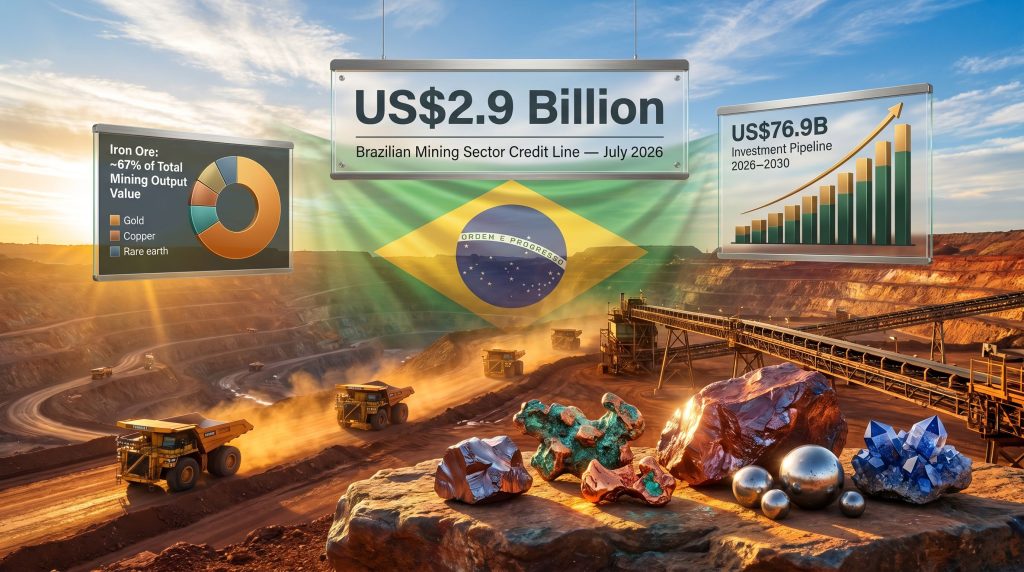
The Brazilian mining sector credit line announced in July 2026 represents one of the more significant state-directed financing initiatives directed at the sector in recent memory. At US$2.9 billion, it substantially exceeds the BRL 10 billion (approximately US$1.85 billion) tariff-response facility that BNDES deployed in 2025 to support companies affected by U.S. trade measures, though the two instruments serve meaningfully different purposes.
The 2025 facility was essentially a defensive instrument, designed to cushion Brazilian exporters from the broader US-China trade war impacts and other external trade disruptions. The 2026 credit line, by contrast, is oriented toward proactive capacity building within the mining sector itself, making it a more structurally significant mechanism for long-term investment pipeline development.
Which Commodities and Operators Are in Frame
Eligibility signals point toward a tiered priority structure:
-
Iron ore holds the dominant position, accounting for approximately 67% of total Brazilian mining output value. Operators within the iron ore supply chain, including downstream steel producers with direct linkages to mining, represent the largest potential beneficiary pool.
-
Copper and gold sit as secondary priorities, consistent with their classification under federal strategic mineral frameworks.
-
Vanadium and rare earth elements represent emerging eligibility categories. Vanadium's inclusion is particularly notable given growing global demand for vanadium redox flow batteries in grid-scale energy storage applications, an area where Brazil holds underexplored reserves. Furthermore, the link between critical minerals and energy security continues to shape how governments prioritise these commodity categories globally.
Regulatory Note: All facility access operates within the oversight framework of the National Mining Agency (ANM), which governs exploration licensing, and the Ministry of Mines and Energy (MME), which administers development concessions. Financial instruments must satisfy both technical compliance and fiscal standards set by these bodies before capital can be deployed.
Brazil's 2026–2030 Mining Investment Pipeline: A US$76.9 Billion Horizon
The Macro Conditions Shaping Capital Deployment Timing
The credit line does not exist in isolation. It enters a sector already positioned for substantial investment activity, with total projected mining investment in Brazil between 2026 and 2030 estimated at approximately US$76.9 billion. Government-directed mineral research funding functions as a demand-side catalyst here, effectively reducing exploration risk for private operators and improving the bankability of project pipelines.
The SELIC rate trajectory adds another dimension. With Brazil's benchmark interest rate projected toward approximately 10.5%, domestic borrowing conditions are expected to become meaningfully more favourable than the elevated-rate environment that constrained capital deployment during 2022–2024. For mining projects with 15 to 20-year development horizons, even moderate improvements in financing costs can have substantial effects on net present value calculations and internal rate of return hurdles.
Comparing Brazil to Peer Mining Finance Models
| Dimension | Brazil (BNDES) | Australia (NAIF/EFA) | Canada (EDC) | Chile (CORFO) |
|---|---|---|---|---|
| Primary State Lender | BNDES | NAIF + Export Finance Australia | Export Development Canada | CORFO |
| Strategic Mineral Focus | Cobalt, copper, nickel, REEs | Critical minerals priority | Clean tech minerals | Lithium, copper |
| Tax-Advantaged Instruments | Strategic debentures | Limited | Flow-through shares | Royalty-based incentives |
| International Co-Financing | US$12.2B (2016–2021) | Significant | Significant | Moderate |
| 5-Year Investment Pipeline | ~US$76.9B (2026–2030) | ~US$50B+ | ~US$40B+ | ~US$30B+ |
One area where Brazil's model lags its peers is in exploration-stage financing. Canada's flow-through share mechanism allows junior mining companies to pass exploration expenditure deductions directly to investors, dramatically lowering the effective cost of early-stage capital raising. Brazil's strategic debenture system, while effective for development-stage projects, does not offer an equivalent mechanism for pre-resource exploration programmes. This remains a structural gap that constrains the junior miner segment more than any other part of the industry.
Key Risks and Structural Challenges
Why Facility Announcement Is Not the Same as Capital Availability
Experienced observers of Brazilian industrial policy will recognise that a credit facility announcement and actual drawdown velocity operate on very different timelines. Several structural challenges deserve careful attention:
-
Eligibility complexity: Multi-agency compliance requirements spanning ANM, MME, and BNDES create administrative friction that disproportionately disadvantages smaller operators. Navigating three distinct regulatory bodies, each with its own compliance standards, is a meaningful transaction cost for companies without dedicated regulatory affairs teams.
-
Currency mismatch risk: A U.S. dollar-denominated credit line creates BRL/USD exposure for domestic operators whose revenue streams are primarily reais-denominated. When the Brazilian real depreciates, as it has done through multiple cycles, the real cost of servicing dollar-denominated debt rises in local currency terms, creating cash flow volatility that smaller operators may struggle to hedge efficiently.
-
Environmental conditionality: Following the Mariana (2015) and Brumadinho (2019) tailings dam disasters, lenders operating in the Brazilian mining sector have embedded substantially stricter environmental compliance covenants into credit structures. This is not merely a reputational consideration; it has become a hard contractual requirement that operators with legacy infrastructure may find difficult to satisfy quickly.
-
Concentration risk: Large integrated producers capable of accessing independent corporate credit facilities may crowd out smaller operators from state-backed programmes if allocation mechanisms are not structured to reserve capacity for mid-tier and junior companies.
Investor Warning: Credit line announcements in Brazil's mining sector have historically preceded multi-year deployment timelines. Distinguishing between facility establishment and actual capital drawdown velocity is essential for accurate project timeline forecasting.
Regulatory and Political Risk Dimensions
Beyond financial mechanics, two non-financial risk categories warrant attention. First, environmental licensing bottlenecks frequently constrain project advancement even when capital is technically available. A project that passes BNDES financial screening can still face years of delay at the environmental licensing stage, meaning capital access does not automatically translate into production growth. Second, changes in federal government priorities between facility announcement and full deployment can redirect or restructure credit mandates, particularly where congressional approval processes intersect with BNDES financing programmes.
The next major ASX story will hit our subscribers first
Strategic Implications for Investors and Operators
Reading the Policy Signal Correctly
The Brazilian mining sector credit line functions simultaneously as a capital instrument and a policy signal. For international investors monitoring Brazil as a mining jurisdiction, state-backed credit expansion of this scale suggests a government commitment to mining sector competitiveness that reduces one category of political risk — specifically the risk of regulatory withdrawal or fiscal instability — while leaving operational and environmental risks intact.
Brazil's positioning within the global critical minerals supply chain is also worth examining carefully. As Western economies accelerate efforts to diversify battery mineral supply chains away from single-source dependency, Brazil's reserves of nickel, cobalt, and rare earth elements acquire strategic value that extends well beyond their commodity price. This dynamic does not automatically translate into project-level support, but it does create a favourable backdrop for operators who can demonstrate both technical credibility and regulatory compliance. Completing a definitive feasibility study is consequently one of the most effective steps an operator can take to strengthen their position within this framework.
Practical Steps for Operators Evaluating Facility Access
- Confirm commodity eligibility against current ANM and MME strategic mineral classification lists, which are updated periodically.
- Assess BRL/USD currency exposure relative to the facility's denomination and evaluate hedging cost as a component of total financing cost.
- Review environmental compliance standing against post-2019 dam safety regulations before initiating a BNDES application.
- Engage BNDES directly to understand indicative drawdown timelines and any co-financing requirements that may apply to your project category.
- Explore whether complementary strategic mineral debenture structures can be layered alongside the credit facility to optimise your total weighted cost of capital.
- Model multiple SELIC rate scenarios to stress-test project economics against potential rate trajectory changes over the facility's drawdown period.
Frequently Asked Questions: Brazilian Mining Sector Credit Line
What is the US$2.9 billion Brazilian mining credit line?
A state-directed financing facility providing structured credit access to Brazilian mining sector credit line beneficiaries, announced in July 2026, covering iron ore, copper, gold, vanadium, and other strategic mineral producers within the federal government's industrial financing framework administered through BNDES.
Which regulatory bodies govern eligibility?
Eligibility operates across multiple layers. The National Mining Agency (ANM) governs exploration licensing, the Ministry of Mines and Energy (MME) oversees development concessions, and BNDES administers the financial compliance and drawdown mechanics. All three must be satisfied.
How do strategic mineral debentures reduce the cost of capital?
By offering concessions on Income Tax and Social Contribution obligations, strategic debentures lower the effective interest rate burden on qualifying projects without constituting a direct subsidy. The mechanism operates as an indirect reduction in financing cost rather than a cash transfer.
Can smaller mining companies realistically access this facility?
The structural design favours mid-tier and large operators due to compliance complexity. However, strategic mineral debentures offer an alternative pathway for exploration-stage companies in priority commodity categories, provided they can satisfy the underlying technical and regulatory requirements.
What is the total mining investment projected for Brazil between 2026 and 2030?
Approximately US$76.9 billion, supported by government mineral research funding and an anticipated easing of domestic borrowing costs toward a benchmark SELIC rate of approximately 10.5%.
Disclaimer: This article contains forward-looking estimates, projected investment figures, and interest rate forecasts sourced from publicly available industry reporting. These represent analytical projections rather than guaranteed outcomes. Investors and operators should conduct independent due diligence before making financing or investment decisions based on any figures cited herein. Further regional mining finance context is available through BNamericas, and the KPMG Brazil Country Mining Guide provides additional regulatory and investment context for the sector.
Want to Capitalise on the Next Major Mineral Discovery Before the Broader Market?
While Brazil's US$2.9 billion credit line signals growing institutional confidence in critical mineral development, the sharpest investment edges are often found the moment a significant discovery is announced — and Discovery Alert's proprietary Discovery IQ model delivers exactly that, translating complex ASX mineral announcements across 30+ commodities into clear, actionable alerts in real time. Explore how historic discoveries have generated substantial returns for early movers, and begin your 14-day free trial today to position yourself ahead of the market.