July 9, 2026
Africa's LNG Monetization Gap: Why Indigenous Project Leadership Is Becoming the Defining Challenge
Across the African continent, a persistent structural paradox has defined the energy sector for decades. Nations sitting atop vast natural gas reserves have repeatedly struggled to convert those resources into export-ready infrastructure without ceding project leadership to international oil companies. The UTM Offshore LNG project gas supply deal, executed in July 2026, represents the most structurally significant attempt yet to break from that precedent — and it arrives at a moment when the broader LNG supply outlook is shifting in ways that may reward early movers.
When big ASX news breaks, our subscribers know first
The Ownership Architecture That Sets UTM FLNG Apart
Understanding why the UTM Floating LNG project matters requires stepping back from the headline agreement and examining the equity structure underneath it. Most of Nigeria's large-scale LNG export infrastructure — most notably Nigeria LNG Limited — was constructed and operated under IOC-majority frameworks. UTM FLNG inverts that model.
The project's ownership configuration is as follows:
| Stakeholder | Equity Stake | Role |
|---|---|---|
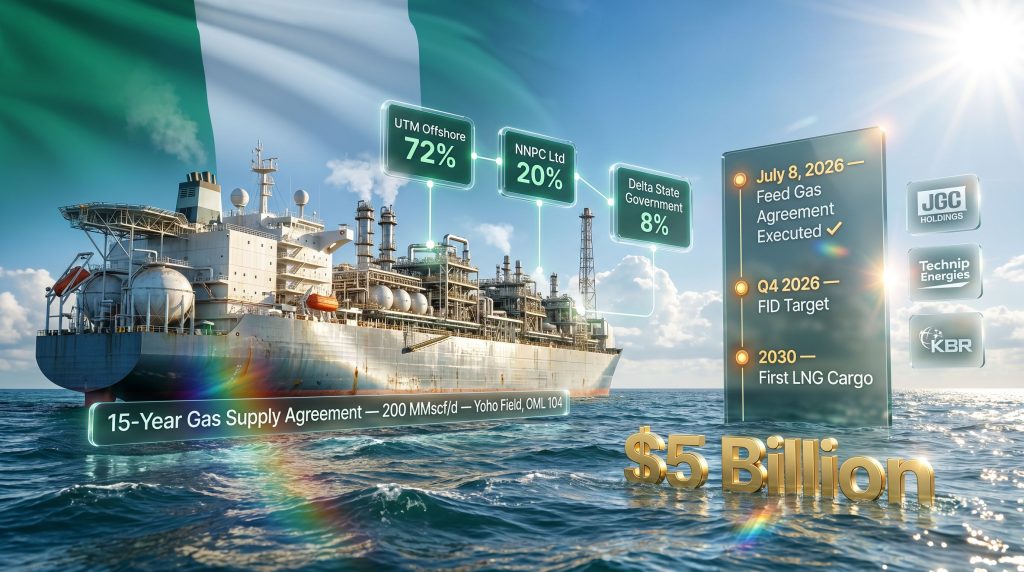
| UTM Offshore | 72% | Majority developer and project owner |
| NNPC Ltd | 20% | State oil company co-investor |
| Delta State Government | 8% | Sub-national government participant |
Several layers of strategic significance sit within this structure. First, a Nigerian private company holds majority control over a potential $5 billion energy megaproject — an uncommon configuration in West African LNG history. Second, the inclusion of Delta State government as an equity participant is a genuinely novel arrangement for infrastructure of this scale.
Sub-national government participation introduces a regional stakeholder with an explicit interest in project delivery, which can serve as an additional governance accountability mechanism and potentially smooths community relations in the producing region.
Third, and perhaps most consequentially for project financing purposes, the combined presence of a state-owned enterprise and a sub-national government alongside a majority private owner creates a layered sovereign credibility signal. Pure private-sector developers cannot easily replicate this arrangement, and it meaningfully strengthens the project's financing proposition. This model echoes emerging African project finance trends seen across the continent's resource sectors.
What the UTM Offshore LNG Project Gas Supply Deal Actually Delivers
The Feed Gas Agreement: Terms and Commercial Significance
On July 8, 2026, at the 25th Nigeria Oil and Gas Energy Week in Abuja, UTM Floating LNG Limited formalized a 15-year gas supply agreement with the NNPC/Seplat Energy joint venture. The agreement commits the JV to supplying 200 million standard cubic feet of gas per day (MMscf/d) to the UTM FLNG facility, drawn from the Yoho field on Oil Mining Lease OML 104, located offshore Akwa Ibom State in southern Nigeria. LNGPrime reported the deal as a landmark moment for indigenous-led LNG development in West Africa.
To contextualise the volume: 200 MMscf/d is equivalent to approximately 5.7 million cubic meters of gas per day, sufficient to underpin a targeted annual LNG production capacity of 1.8 million tonnes per annum (Mtpa).
Why This Agreement Functions as a Bankability Instrument: In project finance for LNG infrastructure, lenders do not assess a project on reserve potential alone. They require demonstrated contractual certainty over feedstock delivery before credit committees will approve capital deployment. A 15-year gas supply agreement of this volume converts upstream resource access into a quantifiable revenue certainty framework — one of the foundational pre-conditions for debt financing at this scale.
The Yoho field itself carries an important characteristic that is often overlooked in coverage of this deal. Unlike projects that rely on undeveloped or speculative upstream resources, the NNPC/Seplat Energy JV is drawing from an established, producing offshore asset within the Niger Delta petroleum province. This upstream maturity directly reduces the feedstock delivery risk that lenders would otherwise price into financing terms.
Why the NNPC/Seplat JV Is a Strategically Chosen Counterparty
The selection of NNPC/Seplat Energy as the gas supply counterparty is not incidental. NNPC Ltd's role as a state-owned entity introduces an element of sovereign-backed supply certainty that strengthens lender confidence in a way that a purely commercial JV counterparty cannot.
Seplat Energy, as an independent Nigerian operator with a track record on producing assets, adds commercial execution discipline to that sovereign anchor. The result is a supply chain that is Nigerian from wellhead to project ownership, reinforcing the indigenous character of the entire value chain rather than just the surface-level equity structure.
The $5 Billion Financial Architecture: How the Project Is Being Capitalised
Two-Phase Capital Structure
The UTM FLNG project carries a total estimated investment of $5 billion, structured across two phases:
- Phase 1: $2 billion, covering the initial FLNG vessel deployment and production ramp-up to first cargo
- Phase 2: $3 billion, covering capacity expansion to reach full operational production scale at 1.8 Mtpa
Afreximbank has been confirmed as the lead financier for Phase 1. The African Export-Import Bank's involvement is significant beyond its capital contribution. As a development finance institution with a continental mandate, Afreximbank's participation serves as an institutional endorsement signal.
In African infrastructure financing, DFI involvement at the lead position has historically catalysed commercial bank co-financing by substantially reducing the perceived execution and sovereign risk that pure commercial lenders might otherwise apply. Furthermore, the role of private equity in projects of this nature continues to evolve as institutional appetite for African energy assets deepens.
Technical Partners Providing Engineering Credibility
The project's technical consortium includes three internationally recognised firms:
- JGC Holdings (Japan): One of the most experienced EPC contractors in global LNG project delivery, with a track record across major liquefaction facilities in Asia and the Middle East
- Technip Energies (France/Netherlands): A European energy technology and engineering firm with deep FLNG-specific expertise, including involvement in some of the world's largest floating LNG projects
- KBR (United States): A diversified engineering and project delivery firm with hydrocarbon processing competencies
The presence of these three firms is not merely a technical arrangement. For project lenders and offtakers conducting due diligence, the participation of established EPC contractors with verifiable FLNG execution histories materially reduces perceived delivery risk and reinforces the project's credibility in financing negotiations.
Regulatory Milestones and the Path to First LNG Cargo
What Has Already Been Achieved
The UTM FLNG project has accumulated a meaningful body of completed milestones that position it closer to Final Investment Decision than most commentary has recognised:
- July 2023: NNPC and UTM Offshore execute an initial framework agreement establishing the project's structural parameters
- March 2024: UTM Offshore secures all regulatory approvals required for the design and construction phase, becoming Nigeria's first licensed floating LNG export facility
- July 8, 2026: 15-year gas supply agreement with the NNPC/Seplat Energy JV executed in Abuja
The March 2024 regulatory clearance is particularly underappreciated in the context of pre-FID conditions. Full design and construction approval removes a category of risk that has derailed comparable projects at late stages, and its completion over two years ahead of the targeted FID date provides meaningful lead time for financing close.
Step-by-Step: Sequential Milestones Remaining Before First Export
- Feed Gas Agreement Executed ✅ Completed July 8, 2026
- Project Financing Close — Formal debt and equity capital commitment; Afreximbank-led syndication process
- Offtake Agreements Finalised — Long-term LNG purchase agreements with creditworthy buyers to underpin revenue certainty
- Final Investment Decision (FID) — Targeted Q4 2026
- EPC Contracts Awarded — Formal engineering, procurement, and construction contract execution with technical partners
- FLNG Vessel Construction and Commissioning — Fabrication, conversion, and offshore deployment of the floating facility
- First LNG Cargo — Targeted 2030
Timeline Risk Consideration: The project has experienced earlier delays in reaching FID. While the feed gas agreement removes one of the most significant pre-FID conditions, financing close, offtake agreement execution, and EPC contract finalisation remain sequential milestones. Any one of these could influence the 2030 delivery target if negotiations extend beyond current projections.
Scenario Analysis: Probability-Adjusted Outlook for FID and Production
| Scenario | FID Timing | First Cargo | Key Conditions Required |
|---|---|---|---|
| Base Case | Q4 2026 | 2030 | Financing close achieved; offtake agreements executed |
| Optimistic Case | Q3 2026 | 2029 | Accelerated Afreximbank syndication; early EPC award |
| Delayed Case | H1 2027 | 2031–2032 | Financing negotiations extend; LNG market conditions shift |
The base case rests on the assumption that the feed gas agreement acts as the catalyst it is designed to be, unlocking the financing syndication process and enabling offtake negotiations to proceed in parallel. The delayed scenario reflects the reality that African large-scale energy infrastructure financing has historically run longer than initial projections, partly due to the complexity of assembling multi-institution capital structures across DFI and commercial lending counterparties.
The next major ASX story will hit our subscribers first
How UTM FLNG Fits Nigeria's Broader Gas Monetisation Imperative
The Stranded Gas Problem Nigeria Has Not Yet Solved
Nigeria's gas flaring record has long been one of the most cited inefficiencies in African energy. For decades, associated gas produced alongside crude oil extraction has been burned at the wellhead rather than captured and monetised. The economic loss is substantial, and repeated policy frameworks aimed at eliminating routine flaring have produced incomplete results.
FLNG technology offers a structurally different pathway to gas monetisation compared to onshore liquefaction terminals. Its key advantages in a Nigerian context include:
- Lower infrastructure cost relative to building onshore liquefaction capacity with equivalent throughput
- Faster deployment timelines given that the floating vessel can be fabricated elsewhere and deployed offshore
- Reduced land acquisition complexity, avoiding the community and environmental negotiations that have complicated onshore infrastructure in the Niger Delta region
- Scalability, with the two-phase structure allowing production to commence before full capital commitment is required
Nigeria LNG Limited and the Diversification Argument
Nigeria LNG Limited (NLNG), the country's dominant LNG export vehicle, currently accounts for the overwhelming majority of Nigeria's liquefied gas export capacity. NLNG's Train 7 expansion project has been in development for years, highlighting both the appetite for additional capacity and the long timelines associated with even established LNG infrastructure expansion.
UTM FLNG would introduce a second, independently structured LNG export stream with a fundamentally different ownership model. From a national energy economics perspective, diversifying LNG export infrastructure reduces concentration risk in Nigeria's gas revenue base. In addition, these developments are occurring against the backdrop of broader resource export challenges reshaping global energy trade flows. If either project faces operational disruption, the other continues to generate foreign exchange earnings.
Notably, how future buyers structure their import arrangements will also matter. The LNG import tax structure in key markets such as India could influence the commercial terms that projects like UTM FLNG are able to negotiate with Asian offtakers — a dimension of the deal's long-term economics worth monitoring closely. According to UTM Offshore's official project documentation, the facility is designed to meet international safety and production standards consistent with global FLNG benchmarks.
Frequently Asked Questions: UTM Offshore LNG Project Gas Supply Deal
What is the UTM FLNG project?
UTM Floating LNG Limited is developing Nigeria's first floating liquefied natural gas export facility, majority-owned by Nigerian companies, targeting annual production of 1.8 Mtpa from an offshore floating vessel with a total investment of $5 billion.
Who signed the gas supply agreement?
UTM Floating LNG Limited signed a 15-year gas supply agreement with the NNPC/Seplat Energy joint venture on July 8, 2026, committing to 200 MMscf/d from the Yoho field on OML 104 offshore Akwa Ibom State.
When is the Final Investment Decision expected?
UTM Offshore is targeting a Final Investment Decision in the fourth quarter of 2026, with first LNG cargo targeted for 2030.
Who owns the project?
UTM Offshore holds 72%, NNPC Ltd holds 20%, and the Delta State Government holds 8%.
Who is financing Phase 1?
Afreximbank is the confirmed lead financier for Phase 1, which carries a capital requirement of $2 billion.
Why does this project matter for African energy development?
A successful UTM Offshore LNG project gas supply deal advancing to FID and production would establish a replicable commercial template for locally led, large-scale energy infrastructure across sub-Saharan Africa. It would potentially demonstrate that indigenous operators can assemble the capital, technical partnerships, and contractual frameworks required to compete with IOC-led project structures — without surrendering majority ownership.
This article is informational in nature and does not constitute financial or investment advice. Forward-looking statements regarding project timelines, capital structures, and production targets are subject to material risks and uncertainties. Readers should conduct independent due diligence before making investment decisions.
Want to Track the Next Major Resource Discovery Before the Market Does?
Discovery Alert's proprietary Discovery IQ model delivers real-time alerts on significant ASX mineral discoveries, transforming complex resource data into actionable investment insights — just as major projects like UTM FLNG demonstrate how early positioning in resource developments can generate substantial returns. Explore historic discovery outcomes on Discovery Alert's discoveries page and begin your 14-day free trial to gain a market-leading edge before the broader market catches on.