July 9, 2026
Africa's LNG Ownership Paradox: Why the Continent's Richest Gas Exporters Capture the Least Value
For decades, a quiet irony has defined African energy development. Nations sitting atop some of the world's most significant natural gas reserves have watched the majority of commercial value flow outward to the balance sheets of European and American supermajors. Nigeria, the continent's largest gas producer and home to one of the world's most productive LNG export facilities, has operated almost entirely within this framework since its first LNG cargo left Bonny Island in 1999.
That structural dependency is now being challenged from within. The UTM FLNG gas supply deal in Nigeria, signed in July 2026, marks the moment when a Nigerian-majority-owned energy project crossed a threshold that no locally controlled initiative had previously reached at this scale: a bankable, long-term feed gas agreement with a credible state-backed counterparty. Understanding why that single contract carries such disproportionate significance requires looking beyond the deal itself and into the mechanics of how large-scale energy infrastructure actually gets financed.
When big ASX news breaks, our subscribers know first
What FLNG Technology Actually Does Differently
The Engineering Logic Behind Floating Liquefaction
Floating liquefied natural gas technology is frequently described as a capital efficiency solution, but the more precise characterisation is that it fundamentally changes who can develop offshore gas. Conventional onshore LNG infrastructure requires coastal land acquisition, pipeline networks running from offshore wellheads to shore, and multi-train liquefaction plants that typically carry price tags exceeding $10 billion before the first molecule of gas is processed.
FLNG vessels consolidate the entire value chain onto a single marine structure. Gas is extracted from the wellhead, piped directly to the floating vessel, processed, liquefied, stored, and then transferred to LNG carriers without any onshore footprint. For Nigeria's offshore Akwa Ibom State fields, where onshore pipeline routes face both logistical and security challenges, this architecture is not merely cost-efficient. It is the enabling condition for development at all.
The technical complexity, however, should not be underestimated. FLNG vessels must manage:
- Mooring stability in open water under variable sea conditions
- Cryogenic processing at approximately -162°C in a dynamic offshore environment
- Simultaneous LNG storage and ship-to-ship transfer operations
- Integrated power generation, utilities, and living quarters on a single hull
Only a handful of FLNG facilities have ever reached commercial operation globally, which makes the UTM project's regulatory and engineering milestones genuinely significant rather than procedural.
The UTM FLNG Project: Architecture and Ownership
A Structural Departure from Nigeria's LNG History
The project's ownership configuration is the detail that most sharply distinguishes it from anything previously attempted in Nigeria's gas sector. Furthermore, the African project finance trends shaping the continent's energy landscape make this ownership model particularly timely.
| Attribute | Details |
|---|---|
| Project Developer | UTM Offshore (subsidiary of UTM Floating LNG Limited) |
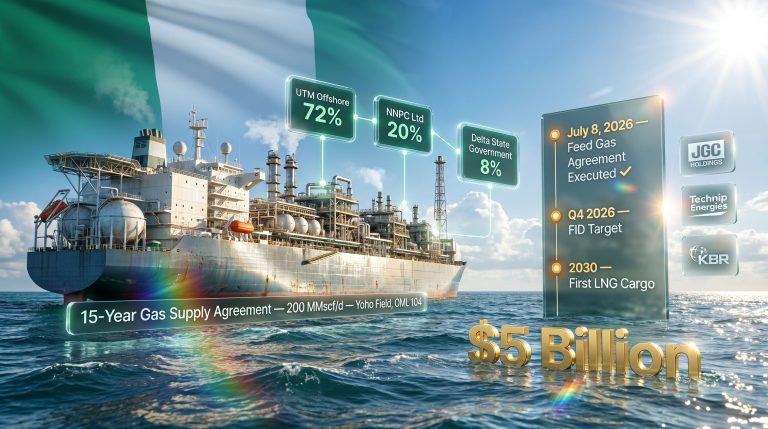
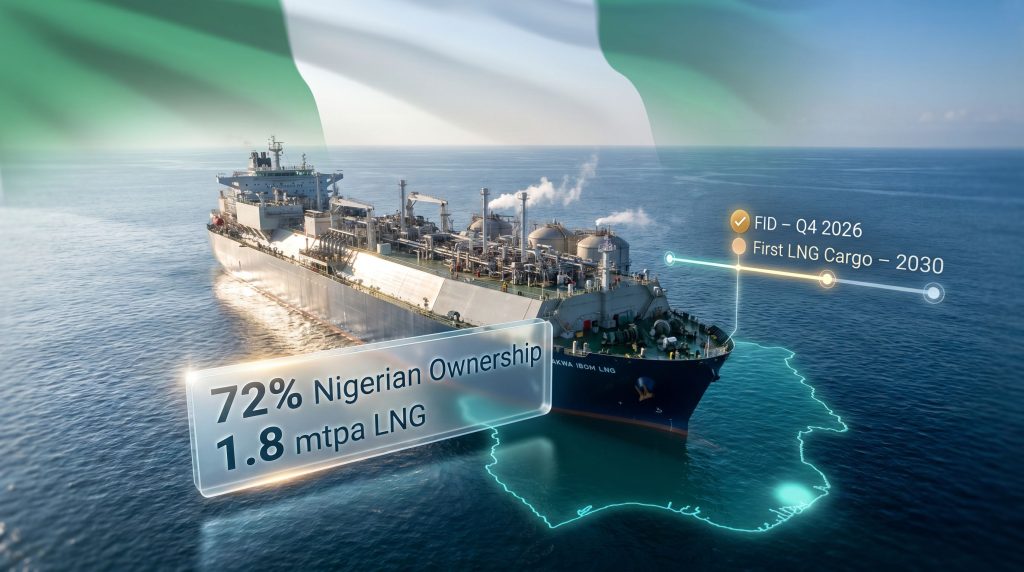
| Ownership Structure | UTM Offshore (72%), NNPC Ltd (20%), Delta State Government (8%) |
| Annual LNG Export Capacity | 1.8 million tonnes per annum |
| Domestic LPG Output | ~300,000 tonnes per annum |
| Total Project Investment | $5 billion (Phase 1: $2 billion; Phase 2: $3 billion) |
| Primary Gas Source | Yoho Field, OML 104 (offshore Akwa Ibom State) |
| Lead Development Financier | Afreximbank |
| Technical Partners | JGC Holdings, Technip Energies, KBR |
| Regulatory Milestone | First License to Construct for FLNG issued in Nigeria (September 2024) |
With 72% Nigerian private-sector ownership, the project sits in a category of its own within the country's energy history. Nigeria LNG Limited, operator of the established Bonny Island facility with approximately 22 million tonnes per annum of capacity, is structured around equity held by Shell, TotalEnergies, ENI, and NNPC. Revenue flows are correspondingly distributed toward international balance sheets.
The UTM model inverts this. Value capture, employment generation, and fiscal multipliers remain predominantly within the Nigerian economy. The Delta State Government's 8% equity stake further embeds regional economic participation in a way that IOC-led models have rarely replicated.
The Gas Supply Agreement: Why This Contract Is the Keystone
Breaking Down the 15-Year Feed Gas Framework
The UTM FLNG gas supply deal in Nigeria was executed on July 8, 2026, during the 25th Nigeria Oil and Gas Energy Week in Abuja. The agreement commits the NNPC/Seplat Energy joint venture to deliver 200 million standard cubic feet of natural gas per day from the Yoho Field on Oil Mining Lease OML 104, sustained across a 15-year contractual term.
As reported by LNG Prime, the deal represents a significant step forward for indigenous African energy development at commercial scale.
Feed gas agreements are the single most scrutinised document in any FLNG project financing process. Without a long-duration, creditworthy supply contract, project lenders cannot model the revenue certainty required to service debt on a multi-billion-dollar facility. The supply agreement is not one condition among many. It is the gateway condition.
The Yoho Field's selection as the feed gas source reflects several converging factors:
- Proximity: The field's offshore location reduces pipeline distance to the planned FLNG vessel, lowering operational cost and infrastructure complexity
- Established infrastructure: OML 104 carries an existing production track record and known reserve base
- Counterparty quality: The NNPC/Seplat Energy JV structure pairs Nigeria's national oil company with a leading indigenous operator, creating a counterparty profile that satisfies institutional lender requirements
- Offshore alignment: Keeping the entire supply chain offshore reduces onshore regulatory and logistical variables that have historically complicated Nigerian energy projects
How Project Finance Actually Works at This Scale
The Three-Gate Bankability Model for Large Energy Infrastructure
Large-scale energy projects do not reach final investment decisions through negotiation alone. They must satisfy a structured set of commercial conditions that project finance lenders and development finance institutions apply before committing capital. For the UTM FLNG project, those conditions map as follows:
- Secured feed gas supply from a creditworthy counterparty under a long-term contract (now fulfilled, July 2026)
- Offtake agreements confirming LNG buyers with purchase commitments that service debt obligations (in progress)
- Engineering and regulatory approvals including completed pre-FEED studies and construction licensing (fulfilled, September 2024)
Afreximbank's role as lead financier for Phase 1 carries significance beyond the dollar amount. The African Export-Import Bank has built a track record financing industrial and energy infrastructure across Sub-Saharan Africa, and its institutional involvement signals that the project's commercial structure has passed a rigorous internal credit assessment. When a continent-focused development finance institution anchors a $2 billion financing package, it changes the risk perception of other potential co-lenders who might otherwise apply a higher Africa-discount to their underwriting models.
Critical Milestone Tracker
| Milestone | Status |
|---|---|
| Regulatory approvals secured | Completed (March 2024) |
| License to Construct issued | Completed (September 2024) |
| Framework agreement with NNPC | Completed (July 2023) |
| 15-year feed gas agreement executed | Completed (July 2026) |
| Final debt financing package | In progress |
| Offtake agreements | In progress |
| Final Investment Decision | Q4 2026 (targeted) |
| First LNG export cargo | 2030 (targeted) |
Nigeria's Gas Sector at a Strategic Crossroads
Export Ambition Versus Domestic Energy Deficit
Nigeria presents one of energy economics' more striking contradictions. The country holds proven natural gas reserves exceeding 200 trillion cubic feet, making it one of the ten most gas-rich nations on earth. Yet millions of Nigerian households rely on firewood and charcoal for cooking, electricity generation remains severely constrained, and industrial activity is throttled by chronic gas-to-power shortfalls.
The UTM project's dual-output design partially addresses this tension. Beyond its 1.8 million tonne per annum LNG export capacity, the facility is engineered to produce approximately 300,000 tonnes per annum of liquefied petroleum gas for the Nigerian domestic market. LPG serves as a bridge fuel for household cooking energy, substituting for biomass combustion in a market where clean cooking access remains a significant public health challenge.
This dual-output architecture also strengthens the project's political economy. A facility that simultaneously earns foreign exchange through LNG exports and supplies domestic clean cooking fuel is more resilient to the policy reversals that have historically disrupted Nigerian energy projects than a pure-export model would be. In addition, the broader LNG supply outlook for 2025 and beyond reinforces the commercial case for new capacity entering the market.
The next major ASX story will hit our subscribers first
Comparing UTM FLNG Against Nigeria's Existing LNG Infrastructure
| Metric | NLNG (Existing) | UTM FLNG (Emerging) |
|---|---|---|
| Ownership Model | IOC-led (Shell, TotalEnergies, ENI, NNPC) | Nigerian majority (UTM 72%) |
| Infrastructure Type | Onshore liquefaction trains | Floating LNG vessel |
| Annual Capacity | ~22 million tonnes per annum | 1.8 million tonnes per annum |
| First Cargo | 1999 | 2030 (targeted) |
| Capital Model | IOC balance sheet financing | Project finance + DFI anchor |
| Gas Source | Multiple onshore fields | Yoho Field (OML 104, offshore) |
| Domestic Output | Negligible LPG component | ~300,000 tpa LPG |
The capacity differential is deliberate context, not a competitive framing. UTM FLNG is not designed to rival NLNG's scale. It is designed to prove a model: that Nigerian-majority entities can develop, finance, construct, and operate complex offshore gas infrastructure at commercial scale. If that model succeeds, it becomes replicable across West Africa's substantial inventory of stranded offshore gas fields.
The Indigenisation Multiplier: Why Ownership Structure Changes Economic Outcomes
Beyond Headline Capacity: Value Retention and the DFI Model
The economic case for majority-local ownership in resource infrastructure is well-established in development economics literature, yet rarely achieved in practice at the scale UTM represents. When profit repatriation flows to international shareholders, the domestic economic multiplier from a major infrastructure project is structurally limited to wages, local procurement, and tax revenues. Majority-local ownership shifts the equity return itself into domestic hands.
Afreximbank's anchoring role also merits deeper attention. The bank's involvement represents a maturation of African development finance, where continental institutions are increasingly capable of leading complex project finance structures rather than participating as junior co-lenders behind multilateral development banks or export credit agencies. This shift has significant implications for African infrastructure broadly. Consequently, the commodity price impacts flowing from successful indigenous projects of this kind will strengthen the investment case for future African energy ventures.
The UTM FLNG project, if it reaches commercial production by 2030 as targeted, would demonstrate that a Nigerian company can take a $5 billion energy infrastructure project from conception through financing, construction, and operation without ceding majority control to international capital. That precedent may ultimately matter more than the 1.8 million tonnes of annual LNG output.
The LNG import tax structure in key Asian markets, for instance, will also shape how competitive UTM FLNG's cargoes are once exports commence, particularly as India remains among the fastest-growing LNG demand centres globally. Meanwhile, resource and energy exports from other major producing nations demonstrate the trade headwinds that all new LNG projects must navigate in an increasingly competitive supply environment.
Frequently Asked Questions: UTM FLNG Gas Supply Deal in Nigeria
What is the UTM FLNG gas supply deal in Nigeria?
The UTM FLNG gas supply deal in Nigeria refers to a 15-year agreement signed on July 8, 2026, under which the NNPC/Seplat Energy joint venture will supply 200 million standard cubic feet of natural gas per day from the Yoho Field on OML 104 to the UTM Floating LNG facility. The agreement satisfies the primary bankability condition required to advance project financing. UTM Offshore's official website provides further background on the company's broader development strategy.
Who owns the UTM FLNG project?
UTM Offshore holds a 72% controlling stake, NNPC Ltd holds 20%, and the Delta State Government holds the remaining 8%. This makes it the first FLNG project in Nigeria's history to be majority-owned by Nigerian companies.
When is the Final Investment Decision expected?
The Final Investment Decision is targeted for the fourth quarter of 2026, subject to finalisation of offtake agreements and the full debt financing package. Construction is expected to follow shortly after FID approval.
Who is financing Phase 1 of the UTM FLNG project?
Afreximbank serves as the lead financier for Phase 1, which carries an estimated capital requirement of $2 billion. Equity contributions from NNPC Ltd and the Delta State Government provide complementary capital layers alongside the debt financing structure.
When will UTM FLNG deliver its first LNG cargo?
Subject to the FID being approved in late 2026 and construction proceeding on schedule, the first LNG export cargo is targeted for 2030. Technical partners JGC Holdings, Technip Energies, and KBR are engaged on the engineering and construction phase.
What domestic benefits does the UTM FLNG project offer Nigeria?
In addition to LNG exports that generate foreign exchange revenues, the facility will produce approximately 300,000 tonnes per annum of LPG for Nigerian domestic markets, supporting cleaner household cooking fuel access and reducing dependence on biomass combustion.
Key Takeaways
-
The 15-year feed gas agreement with the NNPC/Seplat Energy JV removes the most critical financing prerequisite for the UTM FLNG project and clears the path toward a Q4 2026 Final Investment Decision
-
With 72% Nigerian private-sector ownership, the project represents the most significant shift in Nigeria's LNG development model since the Bonny Island facility began operations in 1999
-
Afreximbank's lead financing role signals the maturation of African development finance institutions as credible anchors for complex, multi-billion-dollar energy infrastructure
-
The project's dual-output design, combining 1.8 million tpa of LNG exports with 300,000 tpa of domestic LPG, strengthens both its commercial and political economy resilience
-
Nigeria holds over 200 trillion cubic feet of proven gas reserves, yet domestic energy access remains severely constrained. The UTM model demonstrates a pathway to monetising stranded offshore reserves while generating domestic economic benefits
-
Success of the UTM FLNG model could catalyse a new generation of African-majority-owned energy infrastructure projects across West Africa's inventory of undeveloped offshore gas fields
This article contains forward-looking statements regarding project timelines, financing milestones, and production targets. These projections are subject to material risks including financing completion, regulatory developments, commodity price movements, and construction execution. Readers should not rely on these projections as guarantees of future outcomes.
Want to Invest in the Resource Projects Reshaping Emerging Markets?
Discovery Alert's proprietary Discovery IQ model delivers real-time alerts on significant ASX mineral discoveries, transforming complex resource data into actionable investment insights for both short-term traders and long-term investors — explore the historic returns major discoveries have generated and begin your 14-day free trial today to position yourself ahead of the broader market.