July 14, 2026
The Energy Arbitrage Secret Behind South Africa's Aluminium Industry
Industrial policy rarely fails loudly. More often, it fails quietly, embedded in decades of assumption, repeated in policy documents, and mistaken for wisdom simply because it has gone unchallenged long enough. The concept of beneficiation in South Africa fits this pattern almost perfectly. It is a doctrine built on an intuitive premise, widely celebrated across the political spectrum, and yet structurally disconnected from the commercial logic that actually determines whether downstream processing industries survive or collapse.
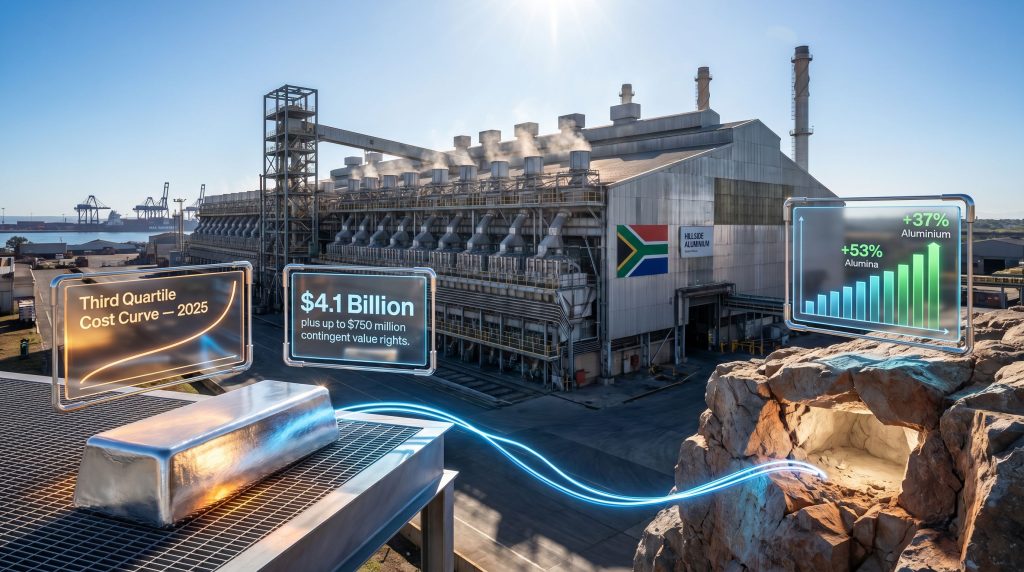
The South32 Alcoa deal beneficiation myth is not a theoretical debate. It is a live stress test, delivered in the form of a $4.1 billion transaction that transfers ownership of Hillside Aluminium in Richards Bay, alongside Worsley Alumina in Western Australia and bauxite and alumina interests in Brazil, from South32 to US aluminium giant Alcoa. Understanding why this deal happened, what it reveals about Hillside's cost position, and why Alcoa's synergy case depends so heavily on an Eskom electricity negotiation tells us more about the true mechanics of beneficiation than any policy document written in the past two decades.
When big ASX news breaks, our subscribers know first
What Beneficiation Policy Actually Claims to Achieve
South Africa's beneficiation framework, embedded within the Mineral and Petroleum Resources Development Act and reinforced through successive iterations of Department of Trade, Industry and Competition policy, rests on a fundamentally straightforward argument: that a country rich in raw mineral resources should capture a greater share of the value chain by processing those resources domestically before export.
The logic has genuine appeal. Why export raw ore when finished goods command higher prices? Why remain a quarry when you could become a machine shop? These questions carry moral weight alongside economic ambition, which is precisely why beneficiation rhetoric has found enthusiastic support from industrial development advocates, economic nationalists, and labour movements alike.
The problem is not with the aspiration. The problem is with the underlying assumption that mineral proximity automatically confers manufacturing advantage. It does not. Furthermore, aluminium is perhaps the most instructive example of why, as a bauxite production overview quickly reveals when you examine where processing capacity actually sits relative to ore bodies.
South Africa Has No Bauxite: The Inconvenient Geological Reality
Aluminium begins with bauxite, a laterite ore formed through the intense weathering of aluminium-rich rocks over millions of years in tropical and subtropical conditions. Bauxite is refined into alumina, and alumina is smelted into aluminium metal. This three-stage chain, from ore to oxide to metal, requires both the right geological endowment and the right industrial infrastructure at each stage.
South Africa possesses no commercially significant bauxite reserves. The country has no large-scale domestic alumina refining industry capable of bridging the gap between raw ore and smelter-ready feedstock. Hillside Aluminium in Richards Bay, which has operated as one of Africa's largest aluminium smelters for decades, has always run on imported alumina, sourced primarily from Australia and Brazil.
This is not a minor operational detail. It is a fundamental challenge to the entire narrative that Hillside represents mineral beneficiation in any meaningful South African sense. The country is not processing its own resources. It is importing a processed intermediate product from other countries and converting it into aluminium metal using domestically available inputs.
| Input Factor | Source | Strategic Significance |
|---|---|---|
| Alumina (feedstock) | Imported, primarily Australia and Brazil | No domestic bauxite-to-alumina conversion |
| Electricity | Eskom, negotiated industrial tariff | Core competitive advantage, estimated ~50% below standard Megaflex rate |
| Logistics | Richards Bay deepwater port | Critical export infrastructure |
| Capital | International mining company (South32) | No state-driven industrial investment |
The only genuinely South African input in Hillside's production chain was electricity. Cheap, coal-fired, abundantly available electricity, supplied by Eskom under long-term industrial contracts that made the economics work. Hillside was, in the most precise commercial sense, a beneficiation of South Africa's electricity surplus, not its mineral endowment.
The South32-Alcoa Transaction: Reading the Numbers Carefully
The deal structure itself is instructive for investors and policymakers alike. According to Alcoa's official announcement, the acquisition represents a transformative consolidation of global aluminium assets.
For South32, the transaction is strategically coherent. The company sheds a capital-intensive, lower-growth segment of its portfolio and rebalances toward higher-margin base metals, primarily copper, zinc, silver, and lead. Post-completion, aluminium exposure falls to roughly 15% of group EBITDA. South32 expects to return approximately $500 million to shareholders after deal completion, while retaining balance sheet flexibility for future acquisitions.
For Alcoa, the picture is more layered. The pro forma numbers are compelling on paper:
| Metric | Figure | Implication |
|---|---|---|
| Alcoa pro forma alumina production increase | +53% | Major consolidation of global alumina supply |
| Alcoa pro forma aluminium production increase | +37% | Substantial scale uplift |
| Alcoa pro forma adjusted EBITDA increase | +45% | Accretive on headline metrics |
| Implied EV/EBITDA acquisition multiple | 5.2x to 6.1x | Compared to Alcoa's 5-year average of 6.3x |
| Projected synergies | $900 million | Materially dependent on Eskom negotiations |
| Hillside cost curve position (2025) | Third quartile | Among higher-cost global producers |
Despite these numbers, Alcoa's share price fell after the announcement. The market was pricing in two concerns: partial share-based consideration creating dilution pressure on existing shareholders, and debt accumulation in a sector already characterised by significant capital intensity. There is also a third, less explicitly discussed concern: the third-quartile cost position of Hillside in 2025.
The assets are not all jewels. Alcoa's own presentation positioned Worsley-Boddington and the Brazilian assets as competitive strengths, while Hillside sits in the third quartile of the global cost curve, a structurally disadvantaged position that Alcoa will need active management and favourable electricity terms to address.
A further note on the valuation: 2025 was a strong year for alumina pricing, with South32's alumina earnings lifted by a 45% rise in realised alumina prices. The implied EV/EBITDA multiple of 5.2x to 6.1x is therefore calculated against an elevated earnings base, not a trough year. This is a meaningful qualifier for any through-cycle assessment of the deal's value. In addition, green metals pricing dynamics are increasingly influencing how aluminium assets are valued across the sector.
The Eskom Variable: Where Industrial Policy Meets Energy Economics
No discussion of Hillside's future is complete without examining its relationship with Eskom, and that relationship is deeply contradictory.
Eskom simultaneously depends on and subsidises Hillside. As a large industrial customer that consistently pays its electricity bills, Hillside is an anomaly in the South African utility landscape, where payment compliance across municipal and industrial accounts has historically been inconsistent. In that narrow sense, Hillside is a valued client.
Yet the economics of the relationship are structurally complex. Research published by Meridian Economics and referenced through documentation made available by Open Secrets indicates that Hillside's negotiated electricity agreement provides approximately a 50% discount to the standard large-user Megaflex tariff over the contract term. This concession is not unique to South Africa, as aluminium smelting operations globally cannot survive without long-term, competitively priced power agreements. However, it does create a tension: the arrangement effectively constitutes a sustained subsidy to a foreign-owned industrial asset at a time when Eskom faces its own deep financial and operational challenges.
The stakes become clearer when compared with South32's Mozal aluminium smelter in Mozambique, which was placed on care and maintenance after the company failed to secure sufficient affordable power. Mozal's suspension is not an outlier. It is a confirmation of the defining rule of aluminium economics: without competitive electricity, no smelter survives regardless of its other operational qualities. Energy cost is not one factor among many. It is the factor.
South African electricity tariffs have risen by approximately tenfold since 2008, a trajectory that has structurally eroded the input cost advantage that originally justified Hillside's existence. Alcoa's $900 million synergy estimate is therefore not simply a financial forecast. It is a bet on the outcome of future Eskom tariff negotiations, negotiations that carry enormous consequences for Hillside's position on the global cost curve and, ultimately, for the employment of thousands of workers in Richards Bay. The broader context of aluminium tariff impacts further complicates any straightforward path to cost competitiveness.
Seven Conditions That Actually Produce Viable Beneficiation
The lesson from Hillside is not that beneficiation is impossible in South Africa. It is that beneficiation is a commercial outcome, not a political instruction. It happens when a specific set of enabling conditions align, and it stops happening when those conditions deteriorate.
Genuine, durable downstream processing investment requires the following:
- Affordable and reliable electricity – the single most decisive input for energy-intensive processing industries, as aluminium smelting demonstrates without ambiguity
- Efficient port and logistics infrastructure – export competitiveness depends on throughput cost, port reliability, and turnaround time
- Functional rail networks – inland mineral movement to coastal facilities must be cost-competitive and operationally dependable
- Regulatory clarity and permit efficiency – long-horizon capital investment requires predictable approval timelines and stable regulatory frameworks
- Long-term fiscal and tax stability – smelters, refineries, and processing plants have capital payback horizons measured in decades, not quarters
- Skilled technical labour and engineering capacity – operational complexity at scale demands sustained investment in human capital
- Market access and trade agreements – processed goods must reach buyers on commercially competitive terms, without punitive trade barriers at destination markets
Comparing South Africa's approach against international peers reveals a consistent pattern: countries that have successfully built downstream processing industries did so by engineering competitive input conditions, not by penalising raw material exporters.
| Country | Mineral | Beneficiation Model | Key Enabling Factor |
|---|---|---|---|
| Australia | Bauxite | Domestic alumina refining at scale | Resource proximity and export infrastructure |
| Chile | Copper ore | Cathode and refined copper production | State-owned enterprise stability and fiscal predictability |
| Indonesia | Nickel ore | Domestic processing mandate with export ban | Policy enforcement paired with inbound Chinese smelter investment |
| South Africa | Imported alumina | Aluminium smelting at Hillside | Historically cheap electricity and Richards Bay port access |
| South Africa | PGMs | Refining by Impala, Anglo Platinum | Vertically integrated mining companies with domestic refinery infrastructure |
Indonesia's nickel processing model is worth examining carefully. The 2020 export ban succeeded in generating domestic smelting capacity specifically because it was accompanied by a wave of inbound foreign direct investment, predominantly from Chinese companies constructing nickel processing infrastructure. The policy created conditions for investment to flow toward processing. South Africa's beneficiation framework, by contrast, has more often been experienced by industry as a compliance cost layered onto mining operations, rather than an investment incentive designed to attract downstream capital.
The next major ASX story will hit our subscribers first
What the Deal Actually Means for South Africa's Industrial Future
The South32 Alcoa deal beneficiation myth is ultimately a story about systems, not assets. Hillside is not leaving Richards Bay. It remains a functioning smelter under Alcoa's ownership, with access to one of Africa's premier deepwater export ports. The transaction does not, in isolation, represent South Africa losing an industrial facility.
What it does represent is a stress test of whether the conditions that originally made Hillside viable, principally competitive electricity pricing and efficient port logistics, can be restored or sustained under increasingly difficult circumstances. South Africa's electricity cost trajectory since 2008 has consistently moved in the wrong direction for energy-intensive industry. If that trajectory continues, the risk facing Hillside is not foreign ownership. It is closure, a far more consequential outcome for regional employment and economic activity than any change in corporate parentage.
For policymakers, the appropriate response is not to treat this transaction as evidence that beneficiation has failed or that South Africa is permanently losing industrial ground. The appropriate response is a rigorous audit of the competitive input conditions that industrial investment actually requires: energy cost, logistics efficiency, permitting timelines, skills availability, and fiscal stability. Consequently, understanding how aluminium industry leaders are repositioning their global portfolios becomes directly relevant to this policy conversation.
Beneficiation policy that focuses on incentivising competitive inputs, rather than penalising raw material exports, is structurally more likely to generate durable industrial outcomes than any compliance framework imposed through mining legislation.
The distinction between encouraging a value chain and taxing it at the point of raw material export is one that South African industrial policy has not yet resolved with sufficient clarity. The South32-Alcoa transaction, and the underlying economics of Hillside Aluminium it exposes, offers a precisely calibrated opportunity to reconsider that distinction. Furthermore, the Alcoa strategic partnership context demonstrates how deliberately Alcoa has been constructing its global aluminium positioning before this next energy tariff renegotiation makes the question moot.
As Wood Mackenzie analysis confirms, the deal is strategically coherent for both parties, though the hard work of delivering on that coherence now falls to Alcoa's operational and commercial teams.
Frequently Asked Questions
What assets did South32 sell to Alcoa?
South32 divested its aluminium portfolio, comprising Worsley Alumina in Western Australia, bauxite and alumina interests in Brazil, and the Hillside Aluminium smelter in Richards Bay, South Africa, to Alcoa for an upfront consideration of $4.1 billion plus contingent value rights of up to $750 million.
Why did Alcoa's share price fall despite the deal appearing accretive?
The market responded negatively primarily because part of the consideration was paid in Alcoa shares, creating dilution pressure on existing shareholders, and because the transaction adds meaningful debt to Alcoa's balance sheet. Concerns about Hillside's third-quartile cost curve position also weighed on sentiment.
Does South Africa have bauxite resources?
No. South Africa has no commercially significant bauxite deposits. The Hillside smelter has always operated on imported alumina, meaning it does not process any domestically mined ore in the aluminium value chain.
What is the Eskom discount at Hillside, and why does it matter?
Research by Meridian Economics, drawing on contract details published through Open Secrets, indicates that Hillside's negotiated electricity agreement provides approximately a 50% discount to the standard Megaflex large-user tariff over its term. This discount is what makes Hillside commercially viable. Without it, the smelter cannot compete on the global cost curve. Alcoa's projected $900 million in synergies depends substantially on securing a continuation of competitive electricity pricing in future Eskom negotiations.
What does South32's portfolio look like after the deal?
Post-transaction, South32 becomes a more concentrated base metals company, with aluminium declining to approximately 15% of group EBITDA and the portfolio tilting toward copper, zinc, silver, and lead. The company expects to return approximately $500 million to shareholders following completion.
Disclaimer: This article contains forward-looking analysis, financial forecasts, and assessments of corporate transactions. These reflect analytical perspectives and publicly available information at the time of writing. They do not constitute financial advice. Investors should conduct independent due diligence before making any investment decisions. Deal metrics, synergy estimates, and cost curve positions are sourced from company presentations and publicly available research and are subject to change.
Want to Stay Ahead of Major ASX Mineral Discoveries Before the Broader Market Does?
Discovery Alert's proprietary Discovery IQ model scans ASX announcements in real time, instantly identifying significant mineral discoveries and turning complex data into actionable investment insights — explore historic discoveries and their extraordinary returns to understand the scale of opportunity, then begin your 14-day free trial at Discovery Alert to position yourself ahead of the market.