May 23, 2026
The Hidden Cost of Building Critical Minerals Infrastructure in America
Every major mining jurisdiction carries its own version of project risk. In Australia, it is water and environmental approvals. In Africa, it is political and logistics uncertainty. In Canada, it is Indigenous consultation timelines and weather. In the United States, however, a more complex and arguably less predictable combination has emerged in 2025 and 2026: trade policy volatility layered directly on top of an already constrained construction labour market. The result is a cost environment that no feasibility study, however rigorous, could have fully anticipated at the time of signing.
This collision of forces is precisely what is reshaping the economics of South32's Hermosa project in Arizona, specifically the Taylor deposit, which has become one of the most closely watched underground mine development stories in North America. The South32 Hermosa project tariffs and contractor woes narrative is not simply about cost overruns. It represents a structural stress test for the entire thesis of domestically built critical minerals supply chains.
When big ASX news breaks, our subscribers know first
Understanding the Taylor Deposit and Its Strategic Position
Located in Santa Cruz County in southern Arizona, the Hermosa project sits within a historically mineralised corridor of the American Southwest. The Taylor deposit is a sediment-hosted zinc-lead-silver system, a deposit type characterised by broadly tabular ore bodies that typically require underground development methods due to ore geometry and depth rather than open-pit accessibility.
Zinc, lead, and silver each carry distinct industrial relevance. Zinc dominates galvanising applications, providing corrosion resistance for structural steel used in wind turbines, power transmission infrastructure, and construction. Lead retains importance in grid-scale lead-acid battery storage and backup power systems. Silver is a critical input for solar photovoltaic cells, with average silver loadings per panel remaining significant despite efficiency improvements. Together, the commodity mix positions Hermosa at the intersection of traditional industrial demand and emerging energy infrastructure requirements.
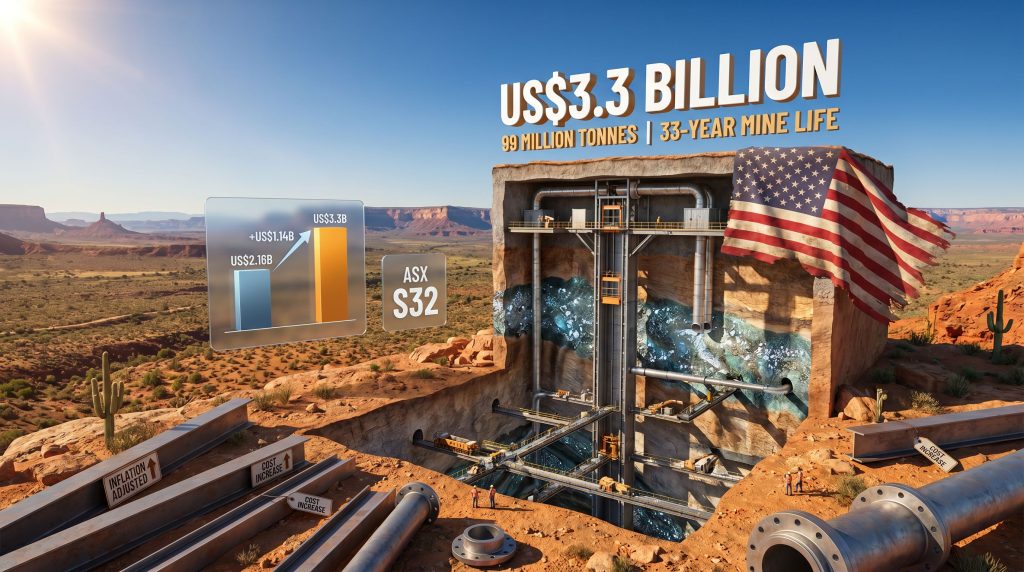
For South32 (ASX: S32), developing a domestic US asset of this scale represents a deliberate portfolio repositioning toward base and battery-adjacent metals, diversifying away from the company's historical exposure to aluminium and metallurgical coal. The Taylor deposit was formally sanctioned through a final investment decision in early 2024, with a baseline growth capital estimate of US$2.16 billion and a production start targeted ahead of the second half of FY28.
What the Revised Capital Budget Actually Reveals
The mid-development review completed in April 2026 produced figures that fundamentally altered the project's economic profile. The revised growth capital estimate now stands at approximately US$3.3 billion, equivalent to roughly A$4.6 billion at prevailing exchange rates. This represents an increase of more than US$1.1 billion, or approximately 52.8% above the original baseline. South32's official project documentation confirms the full scope of these revisions.
Annual sustaining capital has also been revised upward, from US$36 million to US$50 million, an increase of US$14 million per year, which compounds meaningfully across a multi-decade mine life.
| Cost Category | Original Estimate | Revised Estimate | Change |
|---|---|---|---|
| Growth Capital (Taylor deposit) | US$2.16 billion | US$3.3 billion | +US$1.14 billion (+52.8%) |
| Annual Sustaining Capital | US$36 million | US$50 million | +US$14 million (+38.9%) |
| Tariff-Attributable Increase | Not applicable | ~US$500 million | Material new exposure |
A cost increase exceeding 50% of the sanctioned capital envelope qualifies as a material event by any standard measure in project finance. However, what distinguishes this revision from a conventional cost overrun is that it stems from four distinct and simultaneously operating pressures rather than a single root cause. Furthermore, understanding the broader US mine development economics context helps explain why these pressures are proving so difficult to contain.
The Four Drivers of Cost Escalation
- US tariff-driven input cost inflation affecting steel, piping, electrical components, and concrete reinforcement
- Contractor underperformance and engineering procurement delays, particularly on the ventilation shaft
- Scope expansion arising from updated geological understanding of the ore body
- Broad US construction market inflation affecting labour rates and materials pricing
Each of these forces amplifies the others. Tariff-driven cost increases extend construction periods, which in turn expose projects to more contractor day-rate charges. Scope expansions require additional engineering procurement cycles, which further delay critical path activities. Understanding how these drivers interact is essential for assessing whether the revised US$3.3 billion estimate represents a credible ceiling or an interim position.
How US Tariffs Are Flowing Through to Underground Mine Construction Costs
The tariff transmission mechanism in an underground mine development project is more direct and more damaging than in surface operations. Underground mines are structurally steel-intensive on a per-tonne-of-ore basis. Shaft linings, headframes, winding equipment, underground support structures, ventilation ducting, conveyor systems, and electrical infrastructure all carry disproportionately high steel content relative to open-pit equivalents. When tariffs raise the landed cost of structural steel and fabricated metal goods, underground projects absorb those increases across virtually every construction activity simultaneously.
For Hermosa specifically, the tariff-attributable contribution to the capital cost increase is estimated at approximately US$500 million, representing the single largest component of the total uplift. The critical minerals tariff landscape has shifted dramatically since the project was sanctioned, and the primary affected input categories include:
- Structural steel for shaft construction and underground support infrastructure
- Piping systems for dewatering, compressed air, and processing circuits
- Electrical switchgear and power distribution equipment
- Concrete reinforcement bar and prefabricated structural components
A critical contextual point is that the US$2.16 billion baseline capital estimate was finalised in early 2024, before the full scope of tariff escalation under current US trade policy became apparent. This timing gap between project sanctioning and tariff implementation means that the original feasibility assumptions were built on an input cost environment that no longer exists.
Three Tariff Scenarios and Their Project Implications
| Scenario | Tariff Environment | Impact on Remaining Capital | Timeline Risk |
|---|---|---|---|
| Base Case | Current tariff regime sustained | Full US$500M absorbed into revised budget | FY28 first production maintained |
| Optimistic Case | Partial rollback or exemptions secured | US$150-200M potential cost recovery | Timeline unchanged |
| Downside Case | Further tariff escalation on new categories | Additional US$100-200M+ exposure | FY28 target at risk |
Strategic procurement responses available to project developers in this environment include domestic supplier substitution, tariff exemption applications through the US Trade Representative's office, and forward procurement hedging to lock in pre-escalation pricing for materials with long lead times.
The deeper structural tension here is difficult to ignore. The US critical minerals strategy explicitly aims to rebuild domestic manufacturing and critical minerals supply chains. Yet the tariff regime that supports those objectives simultaneously raises the cost of constructing the very infrastructure required to achieve them. For the South32 Hermosa project, tariffs and contractor woes have placed the project at the centre of this policy contradiction.
Shaft-Sinking Failures and the Cascade of Contractor Risk
Shaft sinking is the defining critical path activity in any underground mine development. Before any ore can be extracted, processed, or sold, the vertical infrastructure connecting surface operations to underground ore bodies must be completed. Delays in shaft sinking do not simply push back one milestone; they compress or defer every subsequent construction activity that depends on underground access.
At the Taylor deposit, productivity shortfalls in shaft-sinking operations have materialised as a primary execution risk. Engineering and procurement delays on the ventilation shaft have created particularly acute schedule consequences, given that ventilation infrastructure must be operational before intensive underground development activities can proceed safely and at scale.
How Contractor Delays Compound Into Capital Cost Growth
- Shaft productivity shortfall leads to extended sinking duration, increasing contractor day-rate costs beyond budgeted assumptions
- Ventilation shaft delays defer underground access, compressing the downstream construction schedule for all dependent activities
- Compressed downstream schedule requires premium labour rates and overtime to recover lost time
- Extended construction period increases exposure duration to tariff-elevated input prices
- Scope expansion integration triggers additional engineering and procurement cycles, further consuming schedule float
This cascade structure explains why the cost increase cannot be reduced to a single line item. Each delay creates downstream costs that interact with the tariff environment to produce a compounding spiral that is difficult to interrupt once established. As reported by the Australian Financial Review, South32 has directly attributed a significant portion of the cost blowout to the combined impact of tariffs and contractor underperformance.
The Structural Shortage of Underground Mining Contractors in North America
A less widely understood dimension of this issue is the supply-side constraint facing project owners who need specialist underground mining contractors. The pool of experienced shaft-sinking and underground development crews in North America has contracted significantly over the post-COVID period as demand-supply dynamics shifted in contractors' favour.
Industry analysis, including assessments from professional services firm Grant Thornton, has noted that mining industry cost pressures are a product of renewed activity across the sector. This observation, while framed positively from the contractor's perspective, carries an important implication for project owners: when contractor demand is high relative to supply, contractors carry greater pricing power, face less competitive pressure on performance accountability, and require longer mobilisation lead times. For a project like Hermosa already contending with tariff pressures, contractor market conditions represent a second simultaneous structural headwind.
The Reserve Expansion That Changes the Long-Term Calculus
Alongside the capital cost revision, South32's updated geological modelling has produced a result that materially strengthens the project's long-term value proposition. Ore reserves at the Taylor deposit have grown by 52% to 99 million tonnes, driven by improved understanding of the deposit's geometry and grade distribution.
This reserve increase extends the projected mine life to 33 years, a substantial uplift from prior estimates. The economic significance of this extension is often underappreciated in cost-overrun narratives because headline capital figures dominate investor attention.
| Milestone | Previous Position | Revised Position |
|---|---|---|
| Ore Reserves | ~65 million tonnes (estimated prior) | 99 million tonnes (+52%) |
| Mine Life | Prior estimate | 33 years |
| First Production | Earlier H2 FY28 target | Second half of FY28 |
| Full Production Capacity | Pre-FY31 | FY31 |
| Annual Sustaining Capital | US$36 million | US$50 million |
When capital cost per year of productive mine life is calculated across a 33-year operation, the picture changes considerably from the headline overrun figure. Annual sustaining capital of US$50 million spread across three decades represents a manageable long-run cost structure for a project of this scale. The revised Hermosa is, in fundamental terms, a structurally different asset than the one that was sanctioned in 2024.
A project that costs more but produces for longer, carries substantially larger reserves, and starts on a timeline consistent with the near-original target is not the same risk profile as a conventional cost blowout. Reserve expansion reframes the capital increase as investment in a larger asset rather than pure cost inefficiency.
The next major ASX story will hit our subscribers first
Regulatory and Environmental Risks Adding Complexity
The cost and contractor pressures at Hermosa operate alongside a distinct set of regulatory and environmental compliance challenges that introduce additional timeline and cost uncertainty.
On the permitting front, state-level approvals have been secured, and the US Forest Service's Draft Record of Decision signals progress toward federal approval. However, the final Record of Decision remains outstanding, representing the last major federal permitting milestone before full development authorisation is confirmed.
An environmental compliance issue of specific concern involves the detection of antimony discharge exceeding regulatory limits in late 2024. Antimony is a naturally occurring element associated with certain sulphide mineral deposits, and its detection in discharge waters triggered active remediation obligations. Consequently, the antimony supply risks dimension of this issue extends beyond Hermosa, reflecting broader concerns about antimony's role in critical supply chains. Separately, the US Environmental Protection Agency has ordered revisions to the project's air quality permits, introducing an additional layer of regulatory process risk to the construction timeline.
| Risk Category | Current Status | Potential Impact |
|---|---|---|
| State Permits | Secured | Low near-term risk |
| Federal Approval (Forest Service ROD) | Draft positive, final pending | Moderate timeline sensitivity |
| Antimony Discharge Compliance | Under active remediation | Medium, potential operational constraints |
| EPA Air Quality Permit | Under revision | Medium, timeline sensitivity |
Environmental compliance failures can interact with construction schedules in costly ways. Regulatory-ordered work stoppages, required monitoring programmes, or modified operational parameters can each introduce delays that compound the existing contractor and tariff pressures already embedded in the revised budget.
Capital Intensity Benchmarking and the Domestic Premium Question
One of the most analytically important questions surrounding the revised US$3.3 billion estimate is whether it is defensible as a cost ceiling or whether it represents a further interim position subject to additional revision. Benchmarking capital intensity against peer projects provides one framework for assessment.
Underground zinc-lead-silver projects in North America have historically carried capital costs in the range of US$25 to US$45 per tonne of ore reserve depending on depth, ground conditions, ore geometry, and processing complexity. At 99 million tonnes of reserves, Hermosa's revised capital estimate implies a capital intensity of approximately US$33 per reserve tonne, which sits within the historical peer range but toward the upper end when adjusted for today's construction cost environment.
The concept of a structural domestic premium for US-built mining projects is increasingly relevant. Projects constructed in the United States carry higher labour costs, more complex regulatory compliance obligations, and now tariff-elevated input costs compared to analogous projects in Canada, Mexico, or Australia. These premium costs are partially offset by factors including proximity to US markets, supply chain security positioning, and potential access to domestic procurement incentives.
However, it is important to note that any benefits from US policy frameworks such as the Inflation Reduction Act or critical minerals incentive programmes are not confirmed as specifically applicable to the Hermosa project through publicly available ASX announcements. Policy tailwinds at the national level should not be interpreted as project-specific financial support unless explicitly confirmed by South32.
What Investors and Industry Observers Should Watch
The forward-looking indicators most relevant to assessing Hermosa's trajectory include:
- Shaft-sinking advance rates in South32's quarterly construction progress reports, which serve as the leading indicator of whether schedule recovery is being achieved
- US trade policy developments affecting steel, fabricated goods, and mining equipment tariff classifications
- Final US Forest Service Record of Decision, the outstanding federal permitting milestone
- Antimony discharge remediation outcomes, which will signal whether environmental compliance issues are trending toward resolution or escalation
- Contractor performance metrics, including whether South32 pursues contract restructuring, additional contractor mobilisation, or schedule resequencing
The broader implication extends beyond Hermosa. Every developer planning a US-based underground critical minerals project in zinc, lithium, copper, or battery metals must now incorporate a structural tariff premium and a constrained contractor market into their capital estimates. The Hermosa experience demonstrates that feasibility studies built on pre-2025 cost assumptions may require material revision before final investment decisions are taken.
The South32 Hermosa project tariffs and contractor woes story is ultimately a case study in what happens when industrial policy objectives and trade policy instruments operate at cross purposes. The US government's stated commitment to domestic critical minerals supply chain development is genuine and substantive. The tariff regime simultaneously makes building those supply chains significantly more expensive. South32's ability to navigate this contradiction, complete the Taylor deposit on a revised but credible schedule, and deliver a 33-year producing asset will be closely watched by every critical minerals developer with ambitions in the American market.
This article contains forward-looking statements, cost estimates, and scenario projections that are subject to material uncertainty. Investors should conduct independent due diligence and consult qualified financial advisers before making investment decisions. All financial figures are sourced from publicly available information and should be verified against South32's official ASX disclosures and project documentation.
Want to Stay Ahead of Major ASX Mineral Discoveries as They Happen?
While the Hermosa project highlights the complexity of large-scale mine development, Discovery Alert's proprietary Discovery IQ model cuts through the noise by delivering real-time alerts on significant ASX mineral discoveries — explore historic examples of exceptional discovery returns that demonstrate why timing matters, then begin your 14-day free trial at Discovery Alert to position yourself ahead of the broader market.