May 20, 2026
The Capital Logic That Separates Surviving Mines From Stagnating Ones
In the global copper industry, the most consequential investment decisions are rarely the ones that build new mines. They are the ones that keep existing mines alive, efficient, and economically viable across decades of changing ore grades, deepening pit geometries, and evolving environmental standards. The distinction between sustaining capital and growth capital is one of the most underappreciated concepts in mining finance, yet it fundamentally determines whether a producing asset remains a cash engine or gradually deteriorates into a liability.
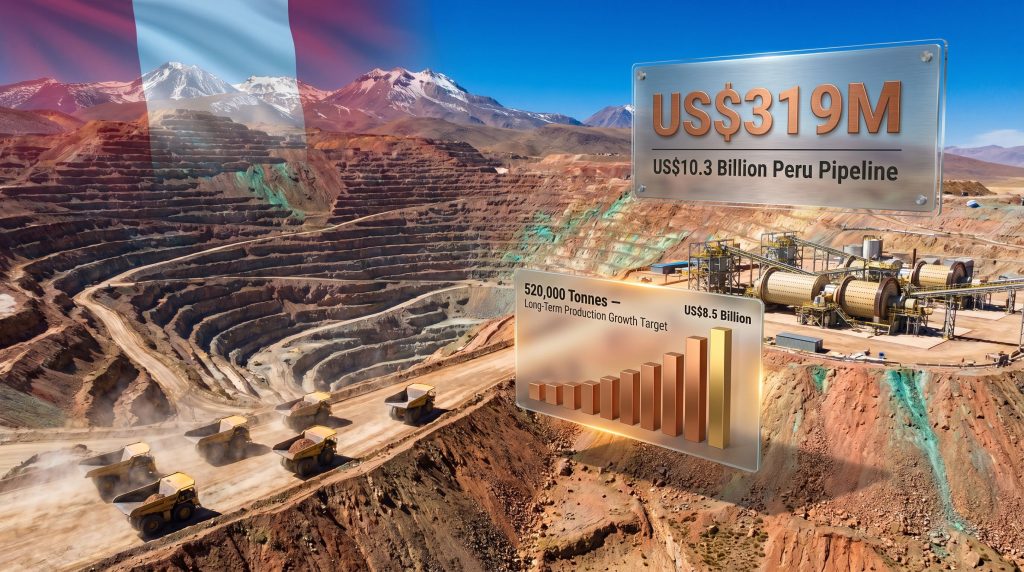
Southern Copper's commitment of approximately US$319 million toward optimising the southern Cuajone production pace investment at its open-pit operation in southern Peru is a textbook example of this logic in action. Understanding why this investment matters requires looking beyond the headline figure and examining the operational mechanics, portfolio strategy, and long-term production architecture that make Cuajone irreplaceable within Southern Copper's broader Peruvian ambitions.
When big ASX news breaks, our subscribers know first
What Sustaining Capital Actually Does in a Mature Open-Pit Copper Mine
The term sustaining capital is frequently misread by non-specialists as maintenance spending, but it encompasses something considerably more strategic. In open-pit copper mining, sustaining capital covers the reinvestment required to prevent throughput degradation as a mine ages. This includes concentrator upgrades, haul road realignment as pit floors deepen, waste stripping programmes that expose future ore zones, and tailings storage facility expansions that accommodate growing volumes of processed material.
Without continuous reinvestment, an open-pit mine does not hold steady — it declines. Ore grades typically decrease as operations move deeper into a deposit. Haul distances extend, increasing diesel consumption and equipment wear per tonne of ore moved. Concentrator circuits that were sized for higher-grade feed become less efficient when processing leaner material. The compounding effect of deferred sustaining investment can, furthermore, be severe.
Critical Insight: In open-pit copper mining, deferred sustaining capital does not simply delay costs — it multiplies them. A programme deferred by two to three years can generate throughput shortfalls and remediation expenditures that significantly exceed the original investment value, often within a single fiscal cycle.
For Cuajone specifically, which has been operating as a large-scale porphyry copper system in the Moquegua region of southern Peru for decades, the requirement for recurring optimisation cycles is deeply embedded in the mine's geological and operational character.
Cuajone's Geological Profile and Why It Demands Continuous Capital Commitment
What Makes a Porphyry System So Capital-Intensive?
Cuajone is a classic Andean porphyry copper deposit — a geological category that dominates global copper supply and is characterised by large tonnages of disseminated copper mineralisation at relatively modest grades, typically ranging between 0.3% and 0.8% copper across most major Andean systems. These deposits are well suited to bulk open-pit extraction but require large volumes of ore to be processed to recover meaningful copper output, making concentrator efficiency a central economic variable.
Porphyry copper systems of Cuajone's type also exhibit grade variability with depth. Supergene enrichment zones near the surface often carry higher copper grades, while primary hypogene mineralisation at depth tends toward leaner, more refractory ore. As Cuajone's open pit extends deeper into primary ore zones, concentrator circuits require upgrading to maintain recovery rates that would have been achievable naturally at shallower, enriched ore horizons.
This geological transition from enriched to primary ore is a well-understood phenomenon at Andean porphyry mines, but its capital implications are frequently underestimated in external analysis. The shift demands not just new equipment but reconfigured flotation chemistry, adjusted reagent dosing programmes, and in some cases, additional grinding capacity to liberate copper from more competent primary ore. These are, in addition, precisely the types of interventions that fall under an optimisation and sustaining capital mandate. Understanding the copper processing benefits of modern leaching technologies further illustrates why concentrator efficiency upgrades are so critical at operations like Cuajone.
How the Southern Cuajone Production Pace Investment Fits the Broader US$10.3 Billion Portfolio
The US$319 million Cuajone programme does not exist in isolation. It sits within a capital hierarchy that Southern Copper has assembled across its Peru and Mexico operations, with a total identified project portfolio valued at approximately US$10.3 billion and a long-term ambition to add roughly 520,000 tonnes of annual copper production capacity.
The portfolio's structure reveals a sophisticated bridging strategy:
| Project | Estimated Investment | Development Phase | Strategic Function |
|---|---|---|---|
| Cuajone Optimisation | ~US$319M | Active / Near-Term | Protect existing production throughput |
| Tía María | Part of US$10.3B pipeline | Development | Greenfield copper volume growth |
| Michiquillay | Part of US$10.3B pipeline | Pre-Development | Long-term reserve addition |
| Los Chancas | Part of US$10.3B pipeline | Pre-Development | Early 2030s production contribution |
| Ilo Smelter Expansion | Part of US$10.3B pipeline | Infrastructure | Processing capacity uplift |
The critical insight embedded in this table is timing. Projects like Michiquillay and Los Chancas are broadly expected to reach production in the early 2030s, while Tía María, despite years of development progress, has faced permitting and community-related delays that have repeatedly shifted its contribution timeline. Consequently, Cuajone's role as a producing asset becomes indispensable. Every tonne of copper that Cuajone delivers through the late 2020s is a tonne that does not need to come from a greenfield project still navigating Peruvian environmental permitting.
This dynamic also reflects the broader trend of major copper project development globally, where timelines frequently stretch well beyond initial projections, reinforcing the value of operational assets already in production.
Strategic Context: Southern Copper's net production growth target of 520,000 additional tonnes is measured against an existing production base. If that base erodes due to underinvestment at Cuajone or Toquepala, the incremental growth figure becomes misleading — since the company would need additional new capacity just to maintain its current output level.
Scenario Analysis: The Production Consequences of Deferring the Cuajone Optimisation
To appreciate the strategic urgency of the southern Cuajone production pace investment, it is worth stress-testing two alternative scenarios:
Scenario A: Investment Proceeds as Planned
- Concentrator performance is stabilised or improved, maintaining ore processing volumes through the late 2020s.
- Waste stripping programmes remain on schedule, ensuring access to planned ore zones without grade disruption.
- Cuajone continues contributing to Peru's output as Tía María progressively ramps toward its production target.
- Southern Copper preserves its position as a reliable copper supplier, supporting long-term offtake relationships.
Scenario B: Investment Is Deferred by Two to Three Years
- Throughput at the concentrator begins declining as ageing circuits struggle with increasing volumes of primary ore.
- Waste stripping deferrals expose future ore access to grade dilution risk, reducing copper recovery per tonne processed.
- Unit operating costs rise as older infrastructure demands reactive maintenance rather than planned capital work.
- Community and regulatory stakeholders interpret deferred investment as reduced operational commitment, elevating social licence risk.
The asymmetry between these two scenarios illustrates a principle that experienced mining executives understand but outside investors frequently underweight: in a mature open-pit mine, doing nothing is not a neutral choice — it is an active decision to allow decline.
Peru's Position in Global Copper Supply and the Regional Capital Reallocation Trend
Peru consistently ranks among the world's top three copper-producing nations, contributing an estimated 10 to 12 percent of global mine supply in recent years, according to data from the United States Geological Survey (USGS). The country's copper output is heavily concentrated in large-scale porphyry systems operated by major international mining companies, with Southern Copper's Peruvian operations representing a significant component of national production.
Across Latin America more broadly, a structural shift in capital allocation has been underway for several years. Rising development costs for greenfield copper projects — driven by deeper ore bodies, more complex environmental impact assessments, and increasingly sophisticated community engagement requirements — have pushed capital toward brownfield optimisation programmes at existing operations. Permitting timelines for new Andean copper mines in Peru, Chile, and Ecuador frequently now extend beyond seven to ten years from initial application to construction approval.
However, this reality makes existing operations with established permits, community agreements, and functioning infrastructure enormously valuable — not just as production assets but as strategic capital deployment platforms. The Cuajone optimisation programme reflects this dynamic directly. This trend is also accelerated by the ongoing copper supply crunch, which is placing sustained pressure on producers to maximise output from existing permitted assets. According to Peru mine spending data, capital expenditure across the country has reached an eight-year low, signalling further tightening in supply that makes Cuajone's continued investment all the more strategically significant.
The next major ASX story will hit our subscribers first
Water, Seismicity, and Social Licence: The Three Structural Risks at Cuajone
Water Resource Constraints
Cuajone operates in the Moquegua region, one of Peru's most arid highland environments. Concentrator operations require substantial water inputs for ore grinding, flotation, and tailings management. Water access is a structural constraint rather than a cyclical one, and any optimisation programme must incorporate water recycling infrastructure, desalination supply chains, or secured water rights to remain operationally viable. This adds both capital cost and regulatory complexity to the programme.
Seismic Infrastructure Requirements
Southern Peru sits within a seismically active zone of the Andes. Infrastructure at Cuajone — including tailings storage facilities, concentrator buildings, and haul road embankments — must be engineered to seismic resilience standards that exceed those applicable in lower-risk regions. These requirements add meaningfully to sustaining capital budgets and extend construction timelines for infrastructure-intensive components of the optimisation programme.
Social Licence and Community Relations
The 2022 community blockade at Cuajone, which resulted in a production suspension lasting several weeks, demonstrated with unusual clarity that social licence is not a soft risk but a hard operational variable. Post-disruption investment programmes at Andean mines typically incorporate enhanced community engagement budgets and local infrastructure commitments. Southern Copper's capital allocation following this event likely reflects lessons learned about the cost of social licence failure relative to the cost of proactive community investment.
Furthermore, Southern Copper's US$10.3B investment in Peru underscores that these community engagement strategies are embedded within a much larger long-term capital commitment — one that depends on sustained social licence to function.
Comparing Cuajone to Global Sustaining Capex Benchmarks
To contextualise the scale of the Cuajone investment, it is useful to position it against industry-wide sustaining capital intensity metrics:
| Metric | Cuajone Programme | Industry Benchmark Range |
|---|---|---|
| Investment Classification | Sustaining and optimisation | Brownfield sustaining capex |
| Typical Sustaining Capex Intensity | Varies by mine age and ore complexity | US$1,500 to US$4,000 per tonne of annual capacity |
| Programme Duration Focus | Near-to-medium term | 3 to 7 years for major sustaining programmes |
| Primary Technical Focus | Concentrator efficiency, throughput | Ranges from tailings to processing depending on mine age |
| Geological Driver | Primary ore transition in porphyry system | Common across ageing Andean copper operations |
The US$319 million figure aligns with the kind of investment intensity expected for a large-scale porphyry operation managing the ore character transition that Cuajone is navigating. It is neither unusually high nor conservatively low for an operation of this scale and geological complexity. In addition, definitive feasibility studies for comparable brownfield programmes routinely validate sustaining capital budgets of this magnitude at ageing porphyry systems. Mining industry consolidation trends further reinforce that assets with committed sustaining capital programmes command premium valuations relative to those with deferred investment profiles.
Key Takeaways for Understanding the Cuajone Optimisation Decision
- The US$319 million southern Cuajone production pace investment is a sustaining and optimisation programme protecting throughput continuity at one of Southern Copper's two flagship Peruvian operations.
- Cuajone functions as an essential bridge asset, maintaining copper output while the larger greenfield pipeline — valued at approximately US$10.3 billion — matures toward early 2030s production timelines.
- Southern Copper's long-term target of adding 520,000 tonnes of copper production capacity is mathematically dependent on protecting the existing production base, making Cuajone's operational health a prerequisite, not an optional enhancement.
- The geological transition from enriched supergene ore to primary hypogene mineralisation at depth is a known driver of increased capital requirements at ageing porphyry copper operations, and Cuajone is no exception to this pattern.
- Water resource management, seismic infrastructure standards, and social licence maintenance represent the three most structurally significant non-financial risk factors capable of disrupting the optimisation programme's timeline or cost profile.
- The broader shift toward brownfield optimisation over greenfield development across Latin American copper is a structural trend — not a cyclical preference — driven by permitting complexity and rising development costs that favour existing permitted operations.
Disclaimer: This article contains forward-looking analysis, scenario modelling, and investment context. It is intended for informational purposes only and does not constitute financial advice. Readers should conduct independent research and seek professional financial guidance before making investment decisions. All financial figures referenced are sourced from publicly available reporting and industry data.
Want To Capitalise On The Next Major Copper Discovery Before The Broader Market?
Discovery Alert's proprietary Discovery IQ model delivers real-time alerts on significant ASX mineral discoveries, transforming complex mineral data into clear, actionable insights for both short-term traders and long-term investors — explore historic discoveries that have generated substantial returns to understand the opportunity, then begin your 14-day free trial at Discovery Alert to position yourself ahead of the market.