July 8, 2026
When Major Miners Step Back, What Happens to the Asset They Leave Behind?
The global race to secure non-Chinese sources of titanium feedstock and battery-grade graphite has fundamentally reshaped how investors, governments, and mining majors evaluate project risk. In this environment, the departure of a large strategic partner from an operational role is rarely a simple story. The reflexive assumption that a major miner stepping back signals trouble with the underlying asset is one of the most persistent and costly misreadings in the critical minerals demand space. Understanding the mechanics of what actually changes, and what does not, is essential context for anyone tracking the Sovereign Metals Kasiya project Rio Tinto withdrawal narrative.
When big ASX news breaks, our subscribers know first
The Asset Beneath the Partnership Structure
Before examining the implications of any corporate decision, it is worth anchoring the analysis in the geology. The Kasiya Rutile-Graphite Project in Malawi is not a speculative early-stage discovery. It is considered potentially the world's largest rutile deposit and the second-largest natural graphite deposit globally, a dual-commodity profile that is essentially without parallel among development-stage projects currently seeking financing and offtake partners.
Rutile is a high-purity form of titanium dioxide feedstock. Unlike ilmenite, the more common titanium mineral, natural rutile requires minimal upgrading before it can be used in pigment manufacturing, welding electrodes, and increasingly in aerospace-grade titanium metal production. This processing advantage translates directly into a pricing premium that makes large-scale natural rutile deposits disproportionately attractive relative to their ilmenite equivalents.
The graphite dimension adds a separate strategic layer entirely. Natural graphite is the dominant anode material in lithium-ion batteries, and as of recent years, China controls an estimated 60 to 70 percent of global natural graphite production and an even higher share of the downstream processing capacity. For Western battery manufacturers and their government counterparts, this concentration represents a structural vulnerability that projects like Kasiya are uniquely positioned to address within the broader battery materials supply chain.
Furthermore, rare earth elements have also been identified at Kasiya, adding a third strategic commodity stream to a project that is already exceptional by the standards of its peer group. The significance of these discoveries cannot be overstated given the increasing pressure on rare earth supply chains globally.
Rio Tinto's Investment Architecture: What Was Built and What Remains
Rio Tinto's involvement in the Kasiya project was structured across two financial stages that together represented a meaningful commitment of capital to a junior miner's flagship asset.
| Investment Stage | Amount (AUD) | Resulting Stake |
|---|---|---|
| Initial Equity Entry | A$40.4 million | ~15% |
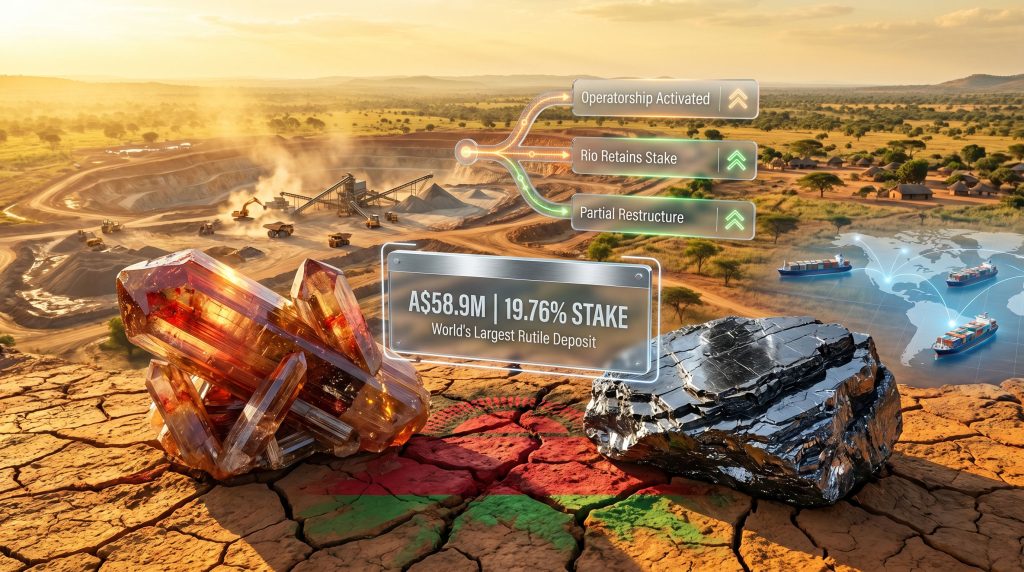
| Option Exercise | A$18.5 million | ~19.76% |
| Total Committed Capital | ~A$58.9 million | ~19.76% |
This staged entry structure is common in major-junior partnerships within the critical minerals sector. The initial equity purchase establishes financial exposure and board access, while the subsequent option exercise reflects a deliberate decision to deepen involvement following technical due diligence. Rio Tinto's exercise of its option, bringing its total commitment to approximately A$58.9 million, occurred with full visibility over the project's geology, metallurgy, and development economics.
The structure also included a joint technical committee that oversaw the Definitive Feasibility Study process, giving Rio Tinto direct input into the technical assumptions underpinning the project's development pathway. This level of involvement means Rio Tinto's understanding of Kasiya's asset quality is unusually thorough by the standards of a minority shareholder.
Critically, Rio Tinto retains an approximately 18.2% equity stake in Sovereign Metals and its associated board nomination rights following the operatorship decision. The company has not exited the investment. The financial exposure remains intact.
Rio Tinto's decision not to exercise its operatorship option reflects its internal strategic review of the iron and titanium segment, not a reassessment of Kasiya's geological or commercial merits. These are categorically different signals, and conflating them is a common analytical error.
Understanding the Operatorship Option: A Governance Mechanism, Not an Ownership Transfer
The operatorship option that Rio Tinto chose not to activate was a contractual right triggered by the completion of the Definitive Feasibility Study results, which reached completion in Q1 2026. Exercising this option would have granted Rio Tinto project control, technical authority over development execution, and exclusive marketing rights over approximately 40% of Kasiya's annual production output.
It is important to understand what this structure is and is not. It is not equivalent to a buyout, an acquisition, or even a traditional joint venture with shared equity in the project vehicle. The operatorship model places operational decision-making and commercial marketing authority in the hands of the operator, while the underlying asset ownership structure remains separate.
Rio Tinto's financial participation through its equity stake in Sovereign Metals was always distinct from any operational authority it might have assumed. With the operatorship option now having lapsed, the exclusive marketing rights over 40% of production have also fallen away. Consequently, Sovereign Metals advances as the project's sole operator, retaining the full strategic and commercial flexibility that was previously constrained by the partnership's contractual architecture.
Three Forward Scenarios for the Kasiya Project
With Rio Tinto's operatorship option resolved, the project's development trajectory now bifurcates across a set of realistic forward scenarios. Each carries distinct implications for timeline, capital structure, and commercial positioning.
Scenario One: Sovereign Metals as Independent Operator
This is the scenario now unfolding. Sovereign Metals assumes sole operational leadership while retaining the benefit of Rio Tinto's approximately A$58.9 million equity investment and its continued shareholding. The company's existing commercial negotiations with Mitsui and Co. for rutile supply and Traxys North America for Western distribution of both rutile and graphite provide a credible independent offtake framework.
The International Finance Corporation, the private sector lending arm of the World Bank Group, has been engaged as a potential development financing partner. IFC involvement in a mining project of this nature carries significant signalling value for institutional capital, as it reflects multilateral development bank confidence in the project's bankability and environmental governance standards.
For investors, the key variables to monitor in this scenario include:
- Finalisation of binding offtake agreements with Mitsui and Traxys North America
- Advancement of IFC financing terms and any co-financing arrangements
- Sovereign Metals' ability to attract additional strategic investors to replace the operational capacity Rio Tinto might have contributed
- Progress through Malawi's regulatory and permitting framework
Scenario Two: Strategic Reinvestment by a Competing Major
The Sovereign Metals Kasiya project Rio Tinto withdrawal creates a strategic opening. With approximately 40% of future production no longer subject to exclusive marketing rights, the project's commercial profile is arguably more attractive to a new strategic partner than it was while those rights were held by a competitor. Titanium-focused processors, Japanese trading houses, and Western industrial companies with exposure to the titanium supply chain would all have logical reasons to evaluate a partnership.
The Mitsui and Co. rutile supply agreement, which was announced in March 2026, demonstrates that Japanese industrial capital already has direct exposure to Kasiya's output. Deepening that relationship or attracting a comparable partner from the US industrial base represents a plausible pathway. In addition, the project's alignment with the critical minerals strategic reserve agenda strengthens its appeal to sovereign-backed investors.
Scenario Three: Hybrid Governance with Retained Technical Input
A less discussed but structurally possible outcome involves renegotiating the terms of Rio Tinto's involvement to preserve access to its technical capabilities in titanium feedstock processing, without the full governance implications of operatorship. Rio Tinto's Iron and Titanium business carries deep institutional expertise in mineral sands processing that would be genuinely valuable to Kasiya's development. A technical services or advisory arrangement could preserve that knowledge transfer while allowing Sovereign Metals to retain operational control.
Why the Rio Tinto Internal Review Does Not Reflect on Kasiya's Fundamentals
Rio Tinto's stated rationale for its operatorship decision relates to an internal review of its iron and titanium business segment. This type of portfolio review is a normal feature of major miner capital allocation cycles and has historically preceded both divestments and acquisitions depending on prevailing commodity price environments and internal return threshold adjustments.
Major miners regularly reassess exposure to specific commodity segments as part of capital allocation optimisation. These reviews evaluate how individual business units fit within broader portfolio return targets, balance sheet management strategies, and long-term commodity demand forecasts. A decision emerging from such a review process is by definition an internal capital allocation judgment, not a technical assessment of any single project.
Corporate portfolio reviews and project-level merit assessments are entirely separate analytical exercises. Conflating the two leads to systematic mispricing in junior miner equities, which is a pattern that experienced critical minerals investors have learned to exploit.
The next major ASX story will hit our subscribers first
The Supply Chain Context That Gives Kasiya Its Strategic Weight
The global titanium feedstock market is structurally concentrated. High-grade natural rutile production is dominated by a small number of operations in Australia, Sierra Leone, and South Africa. The Kasiya deposit, if developed to its potential scale, would represent a material new source of natural rutile at a time when demand from the titanium metal sector, driven by aerospace recovery and defence procurement cycles, is placing upward pressure on feedstock pricing.
The graphite dimension intersects with an equally significant supply constraint. The US Inflation Reduction Act and its associated critical minerals provisions have created financial incentives for battery manufacturers to source anode materials from non-Chinese origins. Natural graphite processed outside China commands a growing strategic premium in this environment, and Kasiya's scale positions it as one of the few projects capable of supplying that demand at meaningful volume.
Kasiya's Commercial Structure Compared to Peer Projects
| Project Attribute | Kasiya (Malawi) | Typical Peer Project |
|---|---|---|
| Commodity Profile | Rutile + Graphite + REE | Single commodity |
| Major Miner Involvement | ~18.2% retained equity | Varies |
| DFS Status | Completed Q1 2026 | Pre-DFS to DFS stage |
| Offtake Agreements | Mitsui and Traxys NA | Often unsigned |
| Development Finance | IFC engagement | Typically commercial banks |
| Geopolitical Alignment | US and allied supply chain | Varies |
The multi-commodity profile is a feature that is easy to undervalue in a simple asset comparison. Most development-stage mineral sands projects are assessed against a single commodity price curve. Kasiya's simultaneous exposure to rutile pricing, battery graphite demand, and rare earth co-product revenues creates a revenue diversification structure that reduces single-commodity price risk while maintaining exposure to multiple thematic demand drivers.
Frequently Asked Questions: Kasiya Project and the Rio Tinto Operatorship Decision
Has Rio Tinto withdrawn entirely from the Kasiya project?
No. Rio Tinto retains an approximately 18.2% equity stake in Sovereign Metals, along with board nomination rights. The decision that has been resolved relates solely to the operatorship option, not to Rio Tinto's financial position in the company.
What did the operatorship option actually entitle Rio Tinto to?
If exercised following DFS completion, the option would have granted Rio Tinto project control, technical authority over development execution, and exclusive marketing rights over approximately 40% of Kasiya's annual production output.
What commercial partnerships does Sovereign Metals hold independently of Rio Tinto?
Sovereign Metals has an announced rutile supply agreement with Mitsui and Co., a graphite and rutile distribution partnership under negotiation with Traxys North America, and active engagement with the International Finance Corporation as a potential development finance partner.
Why is natural rutile strategically significant compared to other titanium feedstocks?
Natural rutile contains titanium dioxide concentrations typically above 90 percent, requiring minimal beneficiation before use in downstream applications. This contrasts with ilmenite, which requires energy-intensive upgrading. The processing efficiency advantage translates into a sustained price premium for natural rutile in global feedstock markets.
What does Malawi's emergence as a critical minerals jurisdiction mean for project risk?
Malawi represents a relatively underexplored jurisdiction in the context of its mineral endowment. The country has been developing its regulatory framework for large-scale mining investment, and its geographic position in Eastern Africa provides logistics access via established southern and eastern corridor infrastructure. Jurisdiction risk is a real consideration for investors, and it is one that development finance institution involvement, such as IFC engagement, partially addresses through governance and risk-sharing structures.
Key Developments to Watch as Sovereign Metals Advances
The next phase of the Kasiya project's development story will be shaped by several converging milestones. Investors and industry observers tracking the Sovereign Metals Kasiya project Rio Tinto withdrawal and its downstream consequences should monitor the following:
- Binding offtake agreement execution with Mitsui and Co. and Traxys North America
- IFC financing mandate and co-financing partner announcements
- Any new strategic investor entry into the project's capital structure
- Sovereign Metals' development timeline assumptions under sole operatorship
- Broader US and allied critical minerals procurement policy developments that affect demand for non-Chinese rutile and graphite
What the Kasiya story ultimately illustrates is a recurring dynamic in the critical minerals sector: the most consequential strategic assets frequently pass through periods of partnership uncertainty before their full development potential is realised. The underlying geology does not change when a boardroom decision is made. What changes is who controls the commercial pathway — and in this case, that control has returned to the company that discovered and developed the deposit.
Ready to Identify the Next Major Critical Minerals Discovery Before the Broader Market?
Discovery Alert's proprietary Discovery IQ model delivers real-time alerts on significant ASX mineral discoveries — including critical minerals such as rutile, graphite, and rare earths — instantly transforming complex geological and market data into actionable investment insights. Explore how historic discoveries have generated substantial returns by visiting Discovery Alert's dedicated discoveries page, then begin your 14-day free trial to position yourself ahead of the market.