July 8, 2026
When Byproducts Become Strategic Assets: The New Logic of Critical Minerals Investment
For most of the twentieth century, metals like germanium, gallium, and antimony occupied a quiet corner of the industrial economy. They were byproducts, trace elements recovered almost incidentally from zinc and lead smelting operations, sold into niche markets with little fanfare. That era is over. Today, these same metals sit at the centre of a geopolitical contest reshaping how governments think about national security, industrial policy, and the very definition of strategic infrastructure.
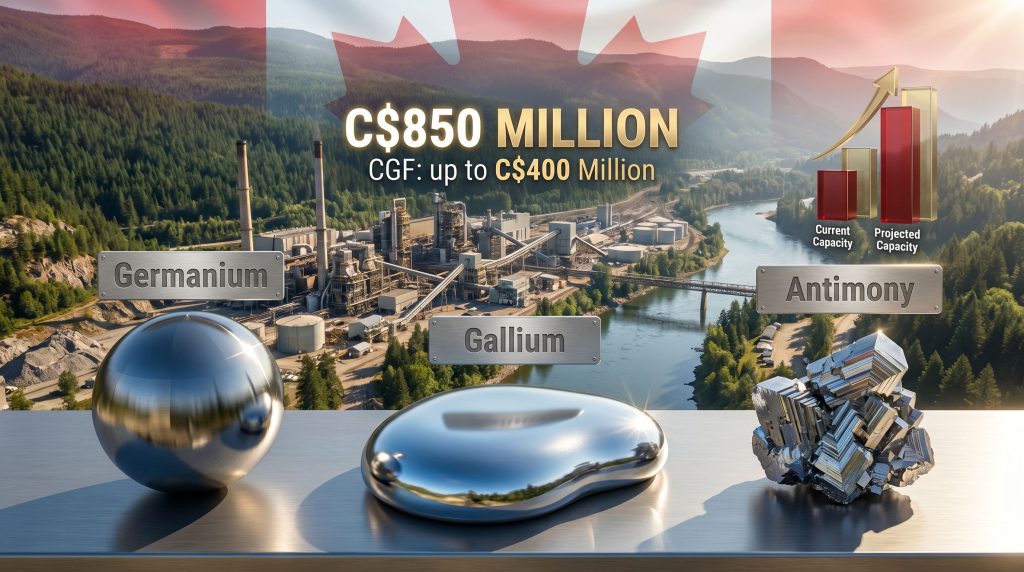
The Teck Canadian investment for germanium gallium antimony scale-up at Trail Operations in British Columbia represents one of the clearest expressions of this new reality. A three-party agreement between Teck Resources, Natural Resources Canada, and the Canada Growth Fund (CGF) has established a framework for up to C$400 million in equity-like investment, forming part of a broader C$850 million total capital commitment directed at expanding and sustaining critical minerals processing capacity at one of the world's most significant polymetallic smelting complexes.
Understanding why this investment matters requires looking beyond the dollar figures and into the structural forces that made it both necessary and inevitable.
When big ASX news breaks, our subscribers know first
The Metals Nobody Talked About (Until They Had To)
Germanium, gallium, and antimony share a characteristic that makes them uniquely difficult to replace in a supply chain emergency: they have no commercially viable substitutes for their most critical applications.
Germanium is essential in fibre optic cables, infrared optical systems, and certain semiconductor architectures. Its transparency to infrared wavelengths makes it irreplaceable in military night-vision equipment and thermal imaging systems. Gallium, in its compound forms such as gallium nitride (GaN) and gallium arsenide (GaAs), underpins high-frequency electronics including radar transmitters, 5G base station amplifiers, and satellite communications hardware.
Antimony serves dual roles in flame retardants and in lead-acid battery grids, while also appearing in ammunition primers and certain military-grade alloys. Furthermore, the antimony shortage risks for Western defence industries have grown considerably more acute since China's export restrictions took hold.
| Metal | Primary Applications | Key Defence/Tech Uses |
|---|---|---|
| Germanium | Fibre optics, infrared optics, semiconductors | Night-vision systems, satellite thermal imaging |
| Gallium | High-performance semiconductors, telecommunications | Radar, 5G hardware, military electronics |
| Antimony | Flame retardants, batteries, alloys | Munitions primers, energy storage, armour |
What unites all three is a production geography historically dominated by a single country. China has accounted for the overwhelming majority of global refined output across all three metals, in some cases exceeding 80% of world supply. That concentration was tolerated for decades because the metals were cheap, the volumes were small, and the geopolitical temperature was lower.
China's Export Controls and the Western Supply Chain Shock
The turning point arrived when China began deploying export restrictions on these materials as instruments of trade and geopolitical leverage. China's export controls on gallium and germanium exports were introduced in mid-2023, followed by antimony restrictions that took effect in late 2024. The cascading effect on Western defence contractors, semiconductor manufacturers, and fibre optic producers was immediate and sobering.
Supply concentration in any single jurisdiction creates systemic fragility. When that jurisdiction controls more than three-quarters of refined output for a defence-critical material, the importing nations effectively surrender a degree of strategic autonomy they cannot easily recover without years of investment.
For North American industries in particular, the exposure was acute. The United States imported the vast majority of its germanium dioxide from Asian sources. Gallium faced a similar picture, with domestic production capacity essentially negligible relative to demand. Antimony supply chains were arguably the most fragile of the three.
Canada's response has been to leverage an asset it already possessed: Trail Operations, a facility that had been quietly recovering these metals as byproducts for years, without the strategic recognition those outputs now command.
Trail Operations: Why This Facility Is Uniquely Positioned
Located in Trail, British Columbia, Teck's Trail Operations is not a conventional mine or a single-commodity smelter. It is one of the world's largest fully integrated polymetallic smelting and refining complexes, producing 19 distinct refined products from a single processing infrastructure. Its primary revenue base comes from refined zinc and lead, but the facility's real strategic value lies in its byproduct recovery capabilities.
Trail already holds the position of North America's largest germanium producer, recovering the metal as a byproduct of processing zinc concentrates from Teck's Red Dog mine in Alaska. This upstream feedstock relationship is critical: Red Dog is one of the world's largest zinc-lead operations, and its concentrates carry trace germanium content that Trail is uniquely equipped to capture and refine into commercial-grade germanium dioxide, the primary form supplied to US customers.
The facility's polymetallic model confers structural advantages that greenfield alternatives simply cannot replicate:
- Existing smelting infrastructure eliminates the need to build primary processing circuits from scratch, dramatically reducing capital intensity
- Integrated feed handling allows multiple concentrate streams to be processed simultaneously, maximising byproduct recovery rates
- A diversified feed source portfolio insulates the facility from single-mine supply disruptions
- Decades of operational knowledge in specialty metal recovery create technical barriers that new entrants would require years to develop
What Trail currently lacks is sufficient capacity to meet the scale of demand that Western governments and industries now require. The C$850 million investment framework is designed to close that gap.
Anatomy of the Investment: A New Model for Strategic Capital Deployment
The financial architecture of this agreement reflects an evolving approach to government-backed industrial investment, one that prioritises risk absorption over direct subsidy.
The CGF's contribution of up to C$400 million takes the form of an equity-like instrument rather than a grant or concessional loan. This distinction matters considerably. Equity-like structures mean the government participates in the upside of the investment if the facility succeeds commercially, rather than simply transferring public money to a private operator.
It also means the CGF absorbs certain categories of commercial risk that would otherwise prevent private capital from committing at this scale and timeline. This approach mirrors models seen elsewhere in strategic antimony financing arrangements, where sovereign risk absorption has proven essential to unlocking private capital.
Capital stack summary:
| Contributor | Instrument | Amount |
|---|---|---|
| Canada Growth Fund | Equity-like investment | Up to C$400 million |
| Teck Resources | Own capital | Balance of C$850 million total |
| Export Development Canada | Additional federal channel | Referenced in framework |
The "up to" language in the CGF commitment is significant for investors and analysts tracking the agreement. It signals that disbursements are likely linked to performance milestones or phased development triggers rather than being delivered as a single upfront allocation. This structure protects public capital while aligning incentives for Teck to execute on specific capacity targets before accessing the full commitment.
Critically, the agreement also establishes a formal offtake framework giving the Government of Canada rights to purchase a portion of future germanium, gallium, and antimony production from Trail. This element of the deal addresses the demand-side risk that often deters investment in specialty metals capacity. By committing as an anchor buyer, the government effectively reduces the revenue uncertainty that project financiers would otherwise price into any capital structure assessment.
An offtake agreement, in plain terms, is a pre-negotiated commitment to purchase a defined quantity of production at agreed pricing terms before that production exists. For specialty metals with thin spot markets and volatile pricing, having a sovereign buyer anchoring part of the revenue stream can be the difference between a bankable project and one that stalls at the financing stage.
Projected Outcomes: What C$850 Million Could Actually Deliver
Teck's own assessment of what the investment could achieve is notable for what it implies about the current capacity gap relative to projected demand.
The investment framework is expected to potentially double existing germanium and antimony processing capacity at Trail. Given that Trail is already North America's largest germanium producer, doubling output would represent a material shift in the global supply balance for a metal where Western production has been structurally insufficient. This aligns directly with the broader critical minerals demand surge that analysts have identified across multiple strategic sectors.
For gallium, the investment targets something more transformational: the introduction of entirely new production capability at a facility that currently produces no gallium output. Building gallium recovery into an existing integrated smelter is substantially more capital-efficient than constructing a dedicated gallium processing facility, because the base infrastructure, power, reagents, and workforce already exist.
The implications cascade outward:
- North American germanium self-sufficiency could improve materially if Trail doubles output, reducing the proportion of US demand that must be sourced from non-allied jurisdictions
- Domestic gallium supply would gain a credible Western anchor for the first time, providing defence and semiconductor supply chains with a non-Chinese alternative
- Antimony production expansion supports both the energy storage sector and defence applications that have faced acute supply pressure since China's 2024 export controls
The next major ASX story will hit our subscribers first
The Apex Mine Dimension: Teck's Strategic Pivot Toward Processing
One of the less-discussed elements of Teck's broader critical minerals repositioning is the company's agreement to divest the Apex germanium and gallium mine in Utah to Blue Moon Metals. Apex is a legacy underground mine with documented germanium and gallium mineralisation, and Blue Moon Metals has indicated plans to redevelop it as a dedicated North American source of both metals.
The divestiture reveals something important about Teck's strategic logic: the company is deliberately concentrating its critical minerals value proposition in processing and refining rather than upstream mine ownership. Trail can theoretically source feed material from multiple mines, multiple jurisdictions, and multiple concentrate streams. That flexibility makes the refinery more durable than any single upstream asset.
This processing-first model is increasingly recognised as the decisive strategic lever in critical minerals competition. Nations and companies that control refining infrastructure hold the ability to convert raw or intermediate materials from allied sources into finished products, regardless of where the original ore originated.
British Columbia's Role and the Provincial Priority Framework
The province of British Columbia has designated Trail Operations as one of 18 priority resource projects in the province. This designation reflects BC's broader ambition to position itself as a critical minerals processing hub within North America's evolving supply chain architecture, with considerable energy security implications for the wider region.
Priority project status typically facilitates more coordinated engagement with provincial regulators and agencies, which can reduce administrative friction during permitting and approvals processes. The province has indicated it is actively working with Teck to identify further opportunities to support the project's advancement.
What This Signals for the Broader Critical Minerals Investment Landscape
The Trail agreement is notable not just for its scale but for the template it establishes. As reported by the National Post, several features are worth highlighting for investors and policymakers tracking the global critical minerals sector:
- Equity-like instruments over grants represent a more sustainable model for government co-investment, aligning public and private incentives rather than transferring risk entirely onto taxpayers
- Sovereign offtake rights as a demand anchor may become a standard feature of future critical minerals deals where thin spot markets create financing barriers
- Processing capacity over mine ownership is emerging as the strategic priority, given that refining infrastructure is scarcer and harder to replicate than additional mine development
- Polymetallic facilities that can recover multiple specialty metals from existing feed streams are disproportionately valuable in a world where supply chain resilience is priced at a premium
The CGF's C$15 billion capitalisation gives it substantial capacity to deploy similar frameworks elsewhere in Canada's critical minerals sector. According to The Globe and Mail, the Trail agreement may prove to be a proof-of-concept for a new generation of government-industry partnerships designed not to pick winners but to absorb the categories of risk that prevent private capital from moving at the speed the strategic situation demands.
Consequently, the Teck Canadian investment for germanium gallium antimony scale-up at Trail may well be remembered as a defining moment in North America's long-overdue critical minerals reckoning. The structural logic is compelling, the financial architecture is innovative, and the strategic imperative is undeniable.
Disclaimer: This article contains forward-looking statements and projections regarding investment outcomes, production capacity, and supply chain developments. These involve assumptions and uncertainties that may cause actual results to differ materially. Nothing in this article constitutes financial or investment advice. Readers should conduct their own due diligence before making any investment decisions.
Frequently Asked Questions
What is the Canada Growth Fund?
The Canada Growth Fund is a C$15 billion arm's-length federal investment vehicle established to attract private capital into Canada's clean economy and strategic industries. It uses equity-like instruments, contracts for difference, and other risk-absorbing tools to catalyse investment that would not otherwise proceed on commercial terms alone. It operates at arm's length from government to ensure investment decisions are made on economic rather than purely political grounds.
Why are germanium, gallium, and antimony classified as critical minerals?
All three metals combine high technological importance with significant supply concentration risk. They are essential inputs for defence systems, telecommunications infrastructure, and advanced semiconductors, yet global production has historically been dominated by a small number of jurisdictions. The absence of commercially viable substitutes at scale, combined with the difficulty of rapidly standing up new production capacity, makes supply disruptions potentially severe in impact and slow to resolve.
How does Trail produce these metals if it is primarily a zinc smelter?
Trail operates on a byproduct recovery model. During the smelting and refining of zinc and lead concentrates, trace quantities of germanium, antimony, indium, and other specialty metals are present in the feed material. Trail's integrated processing circuits capture these elements at various stages of the refining process, concentrating and refining them into commercial-grade products. This model means that specialty metal output is partially a function of zinc throughput volume and feed source composition, making feed source diversity a key operational variable.
What does an offtake agreement mean for a project like Trail?
An offtake agreement is a contractual commitment by a buyer to purchase a defined volume of future production. In the context of the Teck Canadian investment for germanium gallium antimony scale-up, the Government of Canada has established offtake rights over a portion of future germanium, gallium, and antimony output. This provides revenue certainty that strengthens the project's financing case, effectively functioning as a demand guarantee that reduces the risk profile for both Teck's capital commitment and the CGF's equity-like investment.
Want to Invest in the Strategic Metals Reshaping Global Supply Chains?
Discovery Alert's proprietary Discovery IQ model scans ASX announcements in real time, delivering instant alerts on significant mineral discoveries across critical commodities — including the specialty metals now at the centre of Western supply chain strategy — so subscribers can identify actionable opportunities ahead of the broader market. Explore historic discoveries and their returns to understand the potential scale of major finds, then begin your 14-day free trial at Discovery Alert to position yourself at the forefront of the next significant ASX discovery.