July 8, 2026
When Industrial Peace Breaks Down: The Structural Forces Behind the BHP Port Hedland Iron Ore Strike
Labour relations in the resources sector rarely deteriorate overnight. The conditions that produce industrial action typically build across years, shaped by legislative shifts, wage compression relative to productivity gains, and evolving worker expectations. What is now unfolding at Port Hedland, one of the world's most strategically significant iron ore export terminals, is the product of exactly these long-cycle pressures reaching a critical inflection point.
The threatened BHP Port Hedland iron ore strike, with an initial eight-hour work stoppage scheduled for July 16, 2026, represents far more than a localised wage disagreement. It signals a structural recalibration of power between organised labour and mining operators across Australia's Pilbara region, with consequences that extend well beyond a single company's balance sheet.
When big ASX news breaks, our subscribers know first
Understanding the Scale of What Is at Stake
Port Hedland is not simply BHP's largest export hub. It is the single highest-volume iron ore export terminal on the planet, simultaneously servicing BHP, Fortescue, and Hancock Prospecting through shared infrastructure. Any disruption to operational continuity at this facility sends immediate ripple effects through global steel supply chains, particularly into the major Asian economies that depend on Pilbara ore as a primary steelmaking feedstock. Furthermore, the iron ore demand outlook from key Asian buyers adds another layer of complexity to the timing of this industrial action.
The financial exposure concentrated at this one location is striking when laid out directly:
| Metric | Estimated Value |
|---|---|
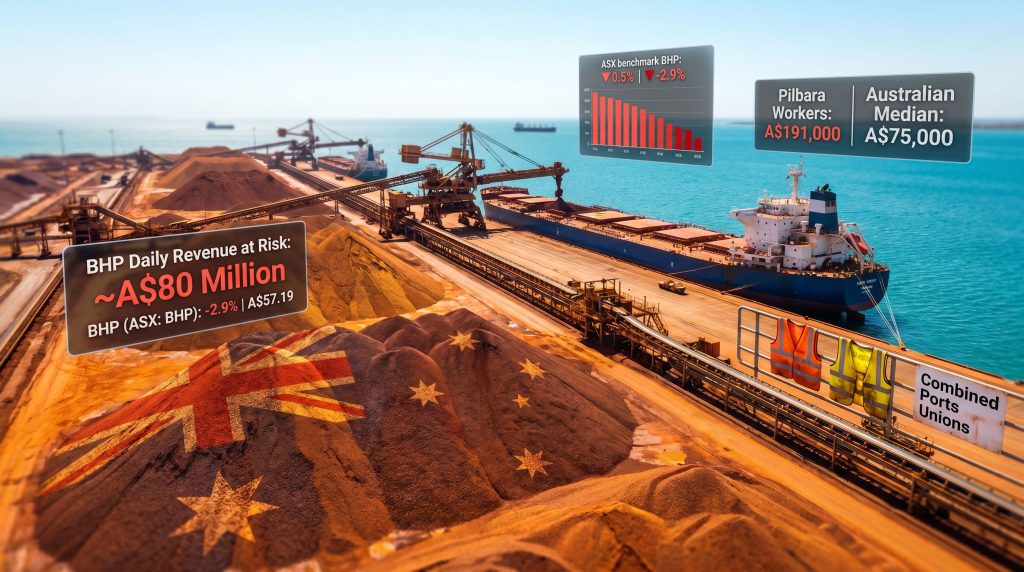
| BHP daily iron ore revenue at risk | ~A$80 million |
| Total daily iron ore throughput at Port Hedland | ~A$150 million |
| Potential daily royalty loss to Western Australia | ~A$7 million |
| BHP share price decline on announcement day | -2.9% (to A$57.19 / US$39.70) |
BHP's 2.9% share price fall on the day of the strike announcement materially outpaced the broader ASX benchmark index, which declined only 0.5% in the same session. That divergence reflects investor sensitivity to operational continuity risk at Port Hedland specifically, rather than any sector-wide headwind.
A prolonged escalation involving daily 24-hour rolling stoppages sustained across a two-week window could expose BHP alone to cumulative revenue losses approaching A$1.1 billion to A$1.7 billion, based on the A$80 million daily revenue baseline.
It is important to note that escalation scenarios of this scale remain speculative. Actual outcomes will depend on the trajectory of negotiations, Fair Work Commission involvement, and the pace at which contingency operations can partially offset lost throughput.
Nearly Two Decades of Industrial Peace, Now Fractured
The significance of what is occurring at Port Hedland is best understood through a historical lens. The last major work stoppage at this terminal occurred in 2008, meaning the Pilbara has operated under essentially uninterrupted industrial peace for roughly 18 years. That context makes the current threat categorically different from routine enterprise bargaining disputes.
Approximately 160 to 200 workers drawn from a total port and maintenance workforce of 450 are expected to participate in the initial eight-hour action. Four unions operating collectively under the Combined Ports Unions banner are coordinating the effort, and critically, the authorisation already in place covers unlimited rolling stoppages ranging from 30 minutes to 24 hours.
The initial stoppage is therefore not the ceiling of potential disruption but rather its opening move. As reported by Argus Media, more port workers have since been drawn into the strike action, underscoring the breadth of dissatisfaction across the workforce.
The most consequential aspect of this action may not be the July 16 stoppage itself, but what the existence of unlimited rolling strike authorisation means for BHP's operational planning horizon over the following weeks.
What Workers Are Actually Demanding
The Core Grievances
The core grievances driving the action are specific and quantifiable. Negotiations for a new four-year enterprise agreement have been deadlocked for over seven months since October 2025. At the centre of the dispute is a reported wage disparity of up to A$40,000 between employees performing functionally identical roles, a structural inequity that union representatives argue reflects historical contracting arrangements that have never been properly rationalised.
The Electrical Trades Union (ETU) and the Australian Manufacturing Workers' Union (AMWU) are the primary industrial bodies leading the campaign. ETU Western Australia Secretary Adam Woodage stated publicly that industrial action became the only viable path forward after months of negotiation reached no resolution. Woodage indicated the stoppage was intended to bring urgency to BHP management and its shareholders regarding the importance of securing a fair, safe, and productive outcome for the industry.
The broader demands include:
- Improved base pay structures that reflect the operational realities of fly-in fly-out (FIFO) work
- Resolution of documented wage disparities between workers in equivalent roles
- Enhanced safety conditions appropriate to the risk profile of port and maintenance operations
- Greater contract equity across the workforce, addressing historical inconsistencies in engagement terms
The FIFO Factor
The FIFO model deserves particular attention here. Workers at Port Hedland and across the broader Pilbara operate on roster cycles that require extended periods of separation from families, typically in remote locations with limited amenity access. This model creates a category of workplace hardship that does not appear in standard wage comparisons and that union representatives consistently argue justifies a compensation premium above what headline figures suggest.
How Do Pilbara Wages Stack Up Against the Broader Economy?
A common critique of mining industrial action is that workers in the resources sector are already exceptionally well compensated compared to the broader Australian workforce. The data supporting that view is real, but context matters enormously.
| Workforce Segment | Average Annual Earnings |
|---|---|
| Pilbara resources workers (2023/24) | A$191,000 |
| Australian median wage (all sectors) | A$75,000 |
| Registered nurses (median range) | A$85,000 to A$100,000 |
These figures, drawn from a Chamber of Minerals and Energy survey and Australian government wage data, confirm that Pilbara resources workers earn approximately 2.5 times the national median. However, the union position is not that workers are underpaid relative to the national average. It is that the specific conditions, risks, and lifestyle costs associated with FIFO work, combined with the company's own profitability trajectory, justify a settlement materially superior to what has been offered.
The South Flank Benchmark and Why Port Hedland Workers Rejected It
The week before the Port Hedland action was announced, workers at BHP's Mining Area C and South Flank operations in the broader Pilbara narrowly voted to accept a new enterprise agreement. BHP highlighted this outcome publicly as evidence of its capacity to deliver constructive results for its workforce.
That agreement covered approximately 1,800 workers and included:
- A guaranteed 16% pay increase across the four-year term
- Increases to site-based allowances
- A new payment mechanism to compensate for delayed flights
Port Hedland workers and their union representatives have explicitly rejected the South Flank deal as an adequate template for their own situation. AMWU State Secretary Steve McCartney described the South Flank outcome as insufficient relative to the demands placed on workers separated from their families for extended periods, characterising a 16% increase across four years as falling short of what current conditions warrant.
The narrow vote margin at South Flank itself is an underreported detail. A close ratification vote signals that dissatisfaction is not confined to Port Hedland but reflects broader sentiment across BHP's Pilbara workforce, even among those who ultimately accepted the deal.
The next major ASX story will hit our subscribers first
The Legislative Architecture Enabling This Action
Understanding why this dispute is happening now, rather than at some earlier point, requires an appreciation of Australia's changed industrial relations landscape. In 2022, the Labor government introduced legislative reforms that fundamentally altered the bargaining dynamics available to unions in the resources sector. The key changes included:
- The power to negotiate multi-employer wage agreements covering several companies simultaneously, meaning a precedent set at BHP could be directly applied to Fortescue and Hancock Prospecting
- Expanded scope for flexible work arrangement requests, increasing worker leverage in day-to-day negotiations
- Enabling mechanisms for industry-wide strike action, moving beyond the enterprise-level stoppages that had historically constrained union reach
These changes created structural conditions for the most coordinated union campaign into Australia's mining heartland in approximately three decades. The Port Hedland action is consequently not an isolated event driven purely by local discontent. It is the most visible expression of a sector-wide strategy enabled by a changed legislative environment.
Federal Resources Minister Madeleine King has acknowledged workers' legal right to take industrial action while expressing a preference for a negotiated resolution. No direct government intervention in the dispute has been announced or confirmed. Indeed, senior Labor figures have publicly backed the strikers at Port Hedland, adding a notable political dimension to the dispute.
Key Milestones and Decision Points
The timeline of this dispute has several critical junctures that investors and industry observers should monitor closely:
- July 7, 2026 — Scheduled negotiation meeting between BHP and union representatives; a productive outcome at this session could avert the July 16 stoppage
- July 16, 2026 — Initial eight-hour work stoppage (2:00 PM to 10:00 PM local time) if no agreement is reached beforehand
- Post-July 16 — Unlimited rolling stoppages of varying duration remain authorised; escalation pace depends entirely on negotiation momentum
- Enterprise Agreement Ratification — A four-year deal must ultimately be certified; sustained failure to reach terms opens the pathway to Fair Work Commission intervention
BHP has confirmed that contingency plans are in place to sustain operations during any stoppage, though the specific mitigation strategies involved have not been publicly disclosed. The effectiveness of those contingencies under extended rolling stoppages is a key unknown.
What a Resolution Would Likely Require
Any settlement capable of ending the BHP Port Hedland iron ore strike and securing workforce ratification will almost certainly need to:
- Materially exceed the South Flank benchmark on base pay, allowances, and contract equity
- Directly address the reported A$40,000 wage disparity between workers in equivalent roles, which union representatives have indicated is a non-negotiable precondition for agreement
- Deliver improvements to safety conditions that reflect the specific risk profile of port and maintenance work
- Include mechanisms robust enough to prevent equivalent disparities from re-emerging over the four-year term
The challenge for BHP is that any settlement above the South Flank benchmark at Port Hedland will almost immediately become the reference point for future bargaining rounds across its Pilbara operations, and potentially across competitor operations that share the same legislative environment.
The Broader Implication for ASX-Listed Mining Majors
The Port Hedland dispute carries implications that extend well beyond the immediate parties to the negotiation. In addition, the broader global iron ore market impact of sustained supply disruption could further amplify pressure on iron ore prices at a particularly sensitive moment.
- BHP (ASX: BHP): Faces immediate revenue exposure, reputational risk, and longer-term structural upward pressure on labour costs across Pilbara operations. A settlement above the South Flank level will reset the baseline for future bargaining.
- Fortescue (ASX: FMG): Carries indirect exposure through shared port infrastructure and faces the precedent-setting risk of a higher wage floor flowing through to its own enterprise agreement negotiations under the multi-employer bargaining framework.
- Hancock Prospecting: As a private operator sharing Port Hedland infrastructure, faces analogous infrastructure disruption risk and potential precedent pressure without the quarterly disclosure obligations that make BHP's exposure more visible.
Furthermore, China steel demand dynamics mean that any prolonged interruption to Pilbara supply arrives at a moment when Chinese steelmakers are already navigating their own structural pressures. Meanwhile, Australia's iron ore leadership position in global markets, and the iron ore trade pressures already weighing on the sector, make a swift resolution all the more important for maintaining Australia's reliability as the world's dominant supplier.
The outcome of this dispute will function as a leading indicator of labour cost inflation across Australia's iron ore sector. If the final settlement materially exceeds the South Flank benchmark, investors in ASX-listed iron ore producers should begin factoring structurally higher Pilbara labour costs into their long-term earnings models, particularly given that the 2022 legislative changes make multi-employer bargaining a durable feature of the industrial landscape rather than a temporary experiment.
Disclaimer: This article contains forward-looking scenarios and financial estimates that are inherently speculative. Actual outcomes will depend on the progress of negotiations, regulatory developments, and market conditions that cannot be predicted with certainty. Nothing in this article constitutes financial advice. Readers should conduct independent research before making any investment decisions.
Frequently Asked Questions: BHP Port Hedland Iron Ore Strike
When was the BHP Port Hedland iron ore strike scheduled to begin?
The initial eight-hour work stoppage was scheduled for July 16, 2026, running from 2:00 PM to 10:00 PM local time. This follows a five-day notice period and would represent the first significant industrial action at Port Hedland since 2008.
How many workers are involved in the BHP Port Hedland strike?
Approximately 160 to 200 workers from a total workforce of 450 covering port and maintenance operations are expected to participate. Four unions coordinate under the Combined Ports Unions banner at the site.
How much daily revenue could BHP lose from the Port Hedland strike?
BHP's daily iron ore revenue exposure at Port Hedland is estimated at approximately A$80 million. Port Hedland as a whole handles around A$150 million in daily iron ore exports across all operators, with Western Australia estimated to forfeit approximately A$7 million per day in royalties during a full shutdown.
What are the unions demanding in the BHP Port Hedland enterprise agreement?
Workers are seeking improved base pay, resolution of wage disparities of up to A$40,000 between employees in equivalent roles, better safety conditions, and fairer contract structures across the workforce.
Has the Australian government intervened in the BHP Port Hedland dispute?
Federal Resources Minister Madeleine King acknowledged workers' legal right to engage in industrial action and expressed a preference for a negotiated resolution. No direct government intervention has been announced or confirmed.
Want To Stay Ahead of Major ASX Mineral Discoveries as Market Conditions Shift?
Structural labour disruptions and commodity supply shocks create the exact conditions in which significant ASX mineral discoveries can generate outsized returns — and Discovery Alert's proprietary Discovery IQ model delivers real-time alerts the moment those discoveries are announced, ensuring subscribers can act before the broader market catches up. Explore historic discovery outcomes to understand the scale of opportunity, then begin a 14-day free trial at Discovery Alert to position yourself ahead of the next major find.