July 8, 2026
India's Coal Block Allocation Architecture: How the State Directs Supply Before the Market Gets a Say
In large emerging economies, the way governments distribute access to underground mineral wealth tells you more about their industrial priorities than any policy document ever could. India's approach to coal block allocation has long operated on two parallel tracks: the open competitive auction, where private players bid aggressively for production rights, and the direct state allocation channel, where public sector entities receive designated blocks without entering the bidding arena. The gap between these two pathways is not merely procedural. It is financial, strategic, and in some cases, generational in its consequences.
The recent central government approval granting the Tadicherla-2 coal block to Singareni Collieries Company Ltd (SCCL) is a textbook example of how that second track functions, and why it matters so profoundly for the long-term economics of state-owned coal production in India.
When big ASX news breaks, our subscribers know first
How India's Dual-Track Coal Block System Actually Works
Understanding the significance of the Tadicherla-2 coal block allocation to Singareni Collieries Company Ltd requires first understanding the legal scaffolding that makes such decisions possible. India's Mines and Minerals (Development and Regulation) Act, as amended over the years, provides the statutory basis for both competitive auctions and direct allocations. The Union Ministry of Coal and Mines sits at the apex of this system, holding the authority to designate blocks for state-owned enterprises when specific conditions are met.
Competitive auctions typically involve private and commercial bidders submitting premium offers above a reserve price, creating upward price pressure that inflates the long-term cost of production for whoever wins. For state-owned miners operating with public interest mandates, this creates a structural tension: participating in open-market bidding can saddle them with cost burdens that compromise their financial viability for decades.
Direct allocation bypasses this entirely. When a block is assigned directly to a public sector entity, the auction premium liability is eliminated, and the miner can proceed with lease negotiations and mine development planning without the overhead of having paid above-market rates for access rights. In the case of Tadicherla-2, this distinction is worth approximately ₹2,550 crore in avoided auction premium costs, according to statements made by Union Coal and Mines Minister G. Kishan Reddy. Furthermore, government intervention in mining of this nature illustrates how strategic allocation decisions can reshape an entire company's capital structure.
This cost saving does not simply represent a one-time financial benefit. Across a 40 to 50 year operational horizon, the compound effect of not carrying that premium liability reshapes SCCL's entire capital allocation calculus, freeing resources for workforce investment, safety infrastructure, and technology deployment.
The Godavari Valley Coalfield: Geology, Geography, and Reserve Estimates
The Tadicherla-2 block sits within Bhupalpally District in Telangana, embedded in the Godavari Valley Coalfield, one of India's most geologically productive and strategically important coal-bearing formations. This coalfield stretches across multiple districts and has historically anchored SCCL's production base, making the Bhupalpally corridor a natural extension of the company's existing operational network rather than a greenfield venture into unfamiliar territory.
| Attribute | Detail |
|---|---|
| Location | Bhupalpally District, Telangana |
| Coalfield | Godavari Valley Coalfield |
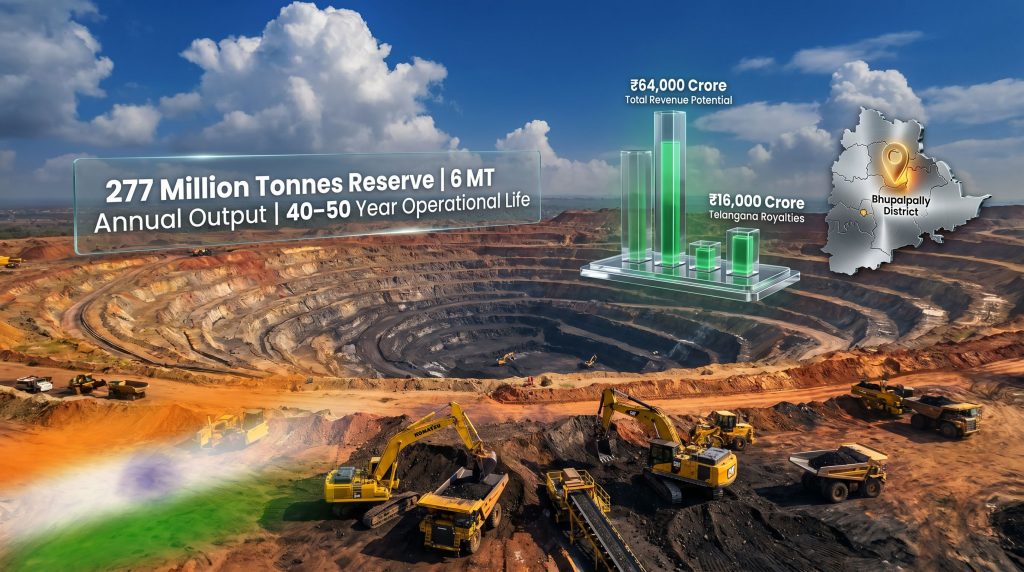
| Indicated Geological Reserve | 277 million tonnes |
| Ministerially Cited Reserve Estimate | ~182 million tonnes |
| Projected Annual Output | ~6 million tonnes |
| Estimated Operational Lifespan | 40 to 50 years |
Two reserve figures circulate in discussions about this block, and the distinction between them is worth understanding. The indicated geological reserve of 277 million tonnes represents the broader mineralised inventory mapped through exploration data, reflecting total coal-in-ground estimates. The ~182 million tonne figure cited by Minister Kishan Reddy reflects the operationally accessible reserve estimate, accounting for geological losses, mining method constraints, and practical extraction limitations.
Both numbers are material: the larger figure signals resource endowment, while the smaller figure drives production planning and mine life calculations. At a projected annual extraction rate of 6 million tonnes, the block is expected to sustain productive operations for four to five decades. That longevity is not incidental. It transforms Tadicherla-2 from a near-term production asset into a generational supply anchor for Telangana's energy infrastructure.
Pre-Mining Activity: Why Early Investment Matters
SCCL has not waited for formal lease execution to begin preparatory work at the Tadicherla Block-II site. Exploration activities and pre-mining groundwork are already underway, encompassing geological survey refinement, environmental baseline documentation, and infrastructure scoping. This approach reflects a sophisticated operational philosophy: by absorbing early-stage capital expenditure before the lease is formally inked, SCCL compresses the timeline between administrative approval and first coal production, reducing the period during which capital is deployed without generating revenue.
SCCL's Operational Scale and What Tadicherla-2 Adds
To appreciate what this single block contributes, it helps to understand where SCCL currently stands as a producing entity.
| Metric | Current Figure |
|---|---|
| Active Mines Operated | 39 mines across Telangana |
| Permanent Workforce | ~41,000 employees |
| Contract Workforce | ~31,000 employees |
| Total Workforce | ~72,000 workers |
SCCL is not a marginal player. It is the primary domestic coal supplier for Telangana's power generation sector, and its operational footprint across the state makes it a foundational pillar of the region's energy security architecture. The addition of Tadicherla-2 at 6 million tonnes per annum represents a meaningful increment to its existing production base, with the potential to gradually reshape its output profile as the mine moves through development phases toward full production capacity.
The economic projections attached to this block are substantial:
- Total project revenue potential exceeds ₹64,000 crore across the mine's operational life
- Telangana state government is projected to receive approximately ₹16,000 crore through royalties and associated revenue streams
- Approximately 1,200 direct employment positions are expected to be generated through development and operational phases
- Downstream economic multiplier effects in Bhupalpally district are likely to amplify these headline figures considerably
At a sustained annual output of 6 million tonnes over four to five decades, Tadicherla-2 represents one of the most consequential single-asset additions to SCCL's long-term production pipeline in the company's recent history.
The Political Timeline: A Decade of Inaction and What Changed
The Tadicherla-2 coal block did not emerge as an opportunity overnight. It sat unallocated for approximately ten years under the previous state administration led by the Bharat Rashtra Samithi, a period during which no formal request was advanced to the Central government for block allocation to SCCL. The reasons for this prolonged inaction are not entirely documented in public records, but the consequence was a decade-long gap in SCCL's resource pipeline development that the current state administration has moved swiftly to address.
The political transition in Telangana created new momentum. Deputy Chief Minister and Energy Minister Mallu Bhatti Vikramarka initiated direct engagement with Union Coal Minister Pralhad Joshi, which subsequently led to discussions involving Union Coal and Mines Minister G. Kishan Reddy. Minister Kishan Reddy has since urged the allocation of new coal blocks for SCCL, confirming that he personally sought Prime Minister Narendra Modi's approval and that the Prime Minister signed the relevant file, advancing the allocation to its current stage.
A joint meeting framework between Central officials, SCCL leadership, and state government representatives has been proposed to accelerate the formal mining lease execution process, recognising that administrative coordination across multiple agencies is often the rate-limiting step between political approval and operational commencement.
From Approval to Production: The Regulatory Pathway Ahead
Political approval and formal mine production are separated by a structured sequence of regulatory milestones. Understanding this pipeline is essential for calibrating realistic timelines.
- Formal mining lease documentation and execution between SCCL and the relevant state and Central authorities
- Environmental Impact Assessment clearance under Ministry of Environment, Forest and Climate Change guidelines, requiring detailed baseline studies and public consultation processes
- Forest clearance, if any portion of the block boundary overlaps with classified forest land, a particularly time-sensitive step given the Godavari Valley region's ecological complexity
- Mine development plan submission and approval by the Directorate General of Mines Safety
- Statutory safety inspections and operational readiness certification before first coal despatch
Each of these steps carries its own timeline dependencies and inter-agency coordination requirements. Environmental clearances in India have historically been a significant source of project delay, particularly in ecologically sensitive or forested zones. The Forest Rights Act and Panchayati Raj consultation requirements add additional procedural layers that cannot be abbreviated without legal risk. In addition, the broader coal supply challenges facing the sector mean that delays at this stage carry compounding consequences for Telangana's energy planning.
The next major ASX story will hit our subscribers first
Coal Gasification: A Strategic Overlay on a Conventional Mining Asset
One dimension of the Tadicherla-2 development that distinguishes it from a straightforward mining lease is the incorporation of coal gasification ambitions into the block's strategic roadmap. Coal gasification, the process of converting coal into synthetic gas through controlled chemical reactions, has been a central plank of India's broader coal sector diversification agenda.
Two distinct gasification models are technically applicable here. Underground coal gasification involves converting coal to gas in-situ, without physical extraction, by injecting oxidants into the seam and capturing the resulting syngas at the surface. Surface gasification involves conventional mining followed by above-ground gasification plant processing. Both carry significant capital intensity relative to conventional thermal coal extraction, and both face market readiness questions around regulatory frameworks, gas pricing, and offtake contracting.
The practical sequencing most likely to emerge at Tadicherla-2 involves conventional extraction in earlier production phases generating the cash flows needed to fund gasification infrastructure development, with pilot-scale gasification operations potentially following once the mine reaches operational maturity.
Three Scenarios for Tadicherla-2's Long-Term Trajectory
Scenario 1: Full Conventional Mining Execution
SCCL advances through the regulatory clearance sequence without material delays, commencing open-cast and underground operations within three to five years of formal lease execution. Annual output climbs toward the 6 million tonne target through the late 2020s and into the 2030s, providing Telangana's thermal power sector with a stable, cost-competitive domestic supply alternative.
Scenario 2: Hybrid Mining and Gasification Model
Conventional extraction in early phases funds the capital expenditure required for gasification infrastructure. A pilot gasification programme is launched in collaboration with Central government research agencies, positioning Tadicherla-2 as a demonstration project within India's national coal gasification mission. This scenario extends the block's economic life beyond the conventional mining horizon while adding synthetic gas production to SCCL's revenue mix.
Scenario 3: Delayed Execution Due to Regulatory Friction
Environmental and forest clearance processes extend project timelines by three to seven years beyond initial projections. Pre-mining investment in exploration and baseline studies creates holding costs without corresponding production revenue. State government pressure to protect its projected ₹16,000 crore royalty stream may ultimately accelerate administrative processing, but the timeline risk remains real.
Comparing Coal Allocation Models: What Direct Assignment Actually Means
| Allocation Type | Example | Outcome |
|---|---|---|
| Direct state allocation | Tadicherla-2 to SCCL | Cost savings, long-term supply security, no auction premium burden |
| Competitive commercial auction | Various private sector blocks | Market-driven pricing, higher upfront costs, profit-oriented extraction |
| Joint venture model | Select hybrid blocks | Shared capital risk, blended technical expertise, complex governance |
The direct allocation model is not without its critics. Opponents argue that bypassing competitive auctions reduces price discovery efficiency and may result in suboptimal resource utilisation if the allocated entity lacks the capital or technical capacity to develop the block at its full potential. In SCCL's case, however, the company's established operational infrastructure in the Godavari Valley coalfield, combined with its existing mine development expertise, substantially mitigates this concern. Moreover, proposals such as India's coal trading exchange proposal suggest the broader market architecture is evolving to complement rather than replace these state-directed mechanisms.
India's Energy Security Equation and the Long-Term Demand Question
India's renewable energy expansion programme is accelerating, with ambitious solar, wind, and storage targets shaping the medium-term power generation outlook. This creates an unavoidable analytical tension around a coal asset with a 40 to 50 year operational horizon: at what point does domestic coal demand peak, and how does that peak affect the economics of a block whose productive life extends well into the second half of the century?
India's stated net-zero commitments, while framed around mid-century timeframes, do not preclude substantial coal consumption through the 2030s and into the 2040s, particularly given the pace of industrial and residential electricity demand growth. The near-term supply security case for Tadicherla-2 is strong. Consequently, the long-term picture requires SCCL to think beyond conventional thermal coal markets, which is precisely where the gasification agenda becomes strategically coherent rather than aspirationally decorative.
Furthermore, the broader context of resource and energy exports across the Indo-Pacific region underscores how domestic allocation decisions in India reverberate through international supply chains and trading relationships. The energy transition demand pressures shaping global markets will ultimately test whether Tadicherla-2's long operational horizon remains financially coherent well into the 2050s and beyond.
For SCCL, Tadicherla-2 coal block to Singareni Collieries Company Ltd is not simply a production asset. It is a platform for navigating the energy transition on terms that preserve the company's financial health and workforce commitments across multiple decades of structural change in India's power sector.
This article contains forward-looking projections, revenue estimates, and reserve figures sourced from ministerial statements and publicly available reporting. These figures are subject to change as regulatory processes advance, geological assessments are refined, and market conditions evolve. Readers should not treat any forward-looking estimate in this article as a confirmed financial outcome. Independent verification is recommended before forming any investment or policy judgement based on this content.
Want To Stay Ahead of Major Mineral Discoveries on the ASX?
Discovery Alert's proprietary Discovery IQ model scans ASX announcements in real time, instantly identifying high-potential mineral discoveries across more than 30 commodities and turning complex geological data into clear, actionable investment insights — visit the Discovery Alert discoveries page to explore historic examples of exceptional returns, or start your 14-day free trial at discoveryalert.com.au to position yourself ahead of the broader market.