
July 8, 2026
The Hidden Pressure Point Inside Australia's Iron Ore Machine
Most discussions about iron ore supply risk focus on geological uncertainty, sovereign risk in emerging markets, or geopolitical friction in shipping lanes. Rarely does the conversation turn inward, toward the operational chokepoints embedded within Australia's own export infrastructure. Yet it is precisely these domestic pressure points, specifically the terminals, the trades workers, and the enterprise agreements that govern them, that can rapidly reshape global commodity flows when they fracture.
The current BHP workers strike at Port Hedland is not simply a wage negotiation that went sideways. It is the visible surface of a deeper structural tension that has been building across Australia's resources sector for years, one rooted in fragmented contracting arrangements, wage inequity between workers performing identical tasks, and the compounding frustration of a skilled workforce that feels its leverage has been systematically undervalued.
Understanding why this matters, and what it signals for Australian mining in 2026 and beyond, requires stepping back from the headline figures and examining the mechanics of how iron ore actually moves from the Pilbara to the blast furnaces of East Asia.
When big ASX news breaks, our subscribers know first
Why Port Hedland Cannot Be Substituted
Port Hedland, located on the northwest coast of Western Australia, is the largest bulk export port in the world by tonnage. It handles the overwhelming majority of Australia's iron ore exports and functions as the primary logistics gateway for the Pilbara's three dominant producers: BHP, Rio Tinto, and Fortescue.
BHP's bulk export terminal at Port Hedland is the final link in a supply chain that stretches hundreds of kilometres inland across one of the world's most productive iron ore corridors. Rail networks, processing hubs, and automated haulage systems all converge at this single interface point before ore is loaded onto vessels bound for China, Japan, South Korea, and Taiwan.
What makes this terminal strategically irreplaceable is the absence of viable alternatives. Unlike oil, which can be redirected through floating storage or alternative tanker routes, iron ore requires specific bulk handling infrastructure. There is no bypass. A disruption at Port Hedland is a disruption to the supply chain itself.
Steel mills in China and Japan that operate on lean inventory models, drawing down stockpiles with minimal buffer, are acutely exposed to even short-duration interruptions in scheduled shipments from Port Hedland.
Iron ore price benchmarks on the Singapore Exchange and the Dalian Commodity Exchange have historically shown sensitivity to Port Hedland throughput data. Traders and steel procurement teams monitor port shipment figures closely, and any confirmed reduction in export volumes can trigger immediate repricing in futures markets.
Seven Months to a Breaking Point: How the Dispute Escalated
The BHP workers strike at Port Hedland did not emerge abruptly. The foundations were laid across roughly seven months of enterprise agreement negotiations between BHP and the Combined BHP Ports Unions, a process that workers and union representatives characterised as failing to produce genuine progress on core workforce concerns.
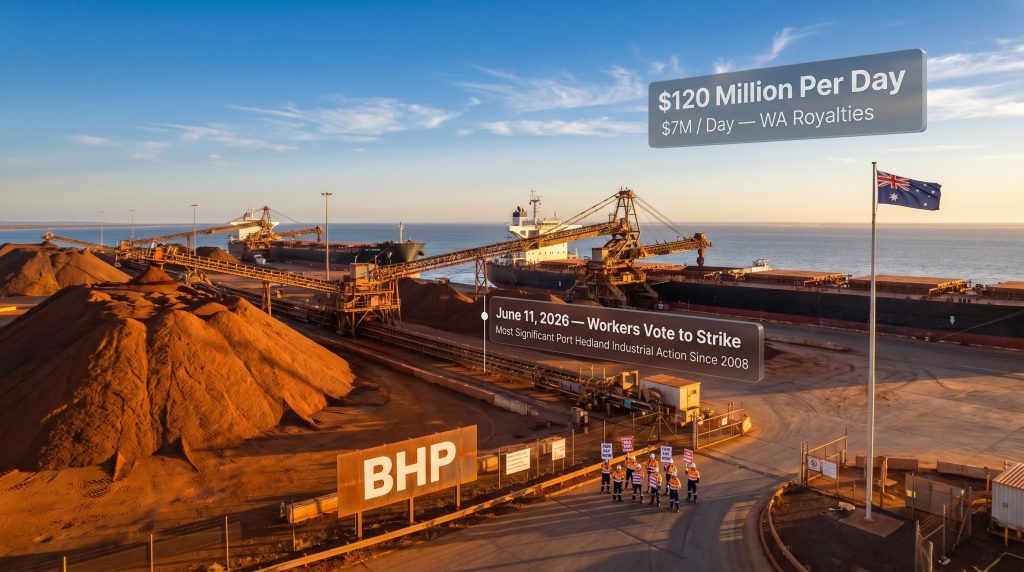
Reuters reported that on June 11, 2026, workers voted in favour of protected industrial action. The strike authorisation covers approximately 450 workers across multiple unions, including:
- Around 100 electrical workers represented by the Electrical Trades Union (ETU)
- More than 100 workers from the Australian Manufacturing Workers' Union (AMWU)
- Additional tradespeople and operational staff across other affiliated unions
The five-day notice requirement embedded in Australia's Fair Work framework means each stoppage must be telegraphed in advance, creating a structured cycle of pressure and negotiation that neither fully resolves the dispute nor allows either party to simply disengage.
The $40,000 Pay Gap That Ignited the Dispute
At the heart of the BHP Port Hedland workers' grievances is a wage equity issue that is both specific and systemic. Workers performing functionally identical roles at the terminal report earning up to $40,000 per year less than colleagues doing the same work under different contract classifications.
This is not a dispute about above-market pay demands. It is a dispute about internal consistency, about whether two workers standing side by side, performing the same task, should receive materially different compensation because of an administrative distinction in their contractual arrangement.
The core workforce demands driving the dispute include:
- Wage equity across all contract types for workers performing equivalent roles
- Improved safety conditions with formal contractual reinforcement, not merely policy commitments
- Standardised enterprise agreement terms regardless of employment classification
This multi-tier pay structure is a product of the resources sector's heavy reliance on labour hire and contractor arrangements during the expansion phases of the mining boom. What was initially adopted for operational flexibility has, over time, created entrenched internal pay disparities that are now becoming a significant industrial relations liability.
The Strategic Logic of Rolling Stoppages
The authorised industrial action takes a specific form: unlimited rolling stoppages ranging in duration from 30 minutes to 24 hours, with five days' notice required before each episode begins. This structure is deliberate and sophisticated.
Unlike a full indefinite walkout, rolling stoppages create sustained uncertainty without forcing a binary confrontation. BHP cannot fully plan around them, nor can it simply wait them out. Each notice period restarts the clock, keeping management in a state of managed unpredictability while preserving workers' right to resume action if negotiations stall.
The ETU's membership holds disproportionate leverage within this structure. Union representatives have argued that if licensed electricians withdraw their labour, the terminal's operational capacity is effectively eliminated. Electrical systems underpin virtually every function at a modern bulk export terminal, from conveyor systems and ship loaders to navigation lighting and safety infrastructure.
BHP has maintained that it has robust contingency measures capable of sustaining operations during stoppages. However, the practical viability of those contingency arrangements in an electrician-specific withdrawal scenario remains an open question that the market will ultimately answer through export volume data if stoppages proceed.
Quantifying the Financial Exposure
The financial stakes of a sustained Port Hedland disruption are substantial enough to register as a material event for BHP's group-level earnings, for Western Australia's budget position, and for the global iron ore market.
| Scenario | Duration | Estimated BHP Revenue Impact | WA Royalty Impact |
|---|---|---|---|
| Brief rolling stoppages | 1 to 3 days | ~$120M to $360M | ~$7M to $21M |
| Week-long disruption | 7 days | ~$840M | ~$49M |
| Extended industrial action | 30+ days | >$3.6B | >$210M |
Note: Figures are illustrative estimates based on reported daily impact rates of approximately $120 million per day in BHP revenue and $7 million per day in WA royalties. They do not account for partial operations, contingency throughput adjustments, or shipment deferrals.
BHP's iron ore division generates the highest margins of any business unit within the company's portfolio. A sustained interruption does not merely affect revenue; it compresses the free cash flow that supports dividends, capital returns, and debt management. Institutional investors tracking BHP's FY2026 production guidance, which was set before this dispute escalated, will be watching ASX disclosures closely for any material operational impact statements.
Western Australia's fiscal exposure is equally noteworthy. Iron ore royalty receipts form a significant component of the state government's budget revenue, meaning a prolonged stoppage carries consequences that extend well beyond a single company's balance sheet.
A Generational Shift in Pilbara Industrial Relations
The current dispute represents the most significant industrial action at Port Hedland in approximately two decades. The last comparable episode occurred in 2008, meaning an entire generation of workers has joined and grown within a labour environment characterised by relative industrial stability.
That stability is now fracturing. Earlier in 2026, on April 16, BHP faced protected industrial action from electrical workers across its broader Pilbara operations, an event described at the time as the first Pilbara strike of the century. The Port Hedland terminal dispute represents a second, larger escalation within the same operational year.
A condensed timeline of the dispute's progression:
| Date | Development |
|---|---|
| Late 2025 / Early 2026 | Enterprise bargaining negotiations commence |
| April 16, 2026 | First Pilbara strike of the century begins across BHP operations |
| June 11, 2026 | Workers vote in favour of strike at Port Hedland bulk export terminal |
| July 7, 2026 | Industrial action temporarily averted pending fresh negotiations |
| July 8, 2026 | Situation unresolved; rolling stoppage authorisation remains active |
The pattern suggests a structural deterioration in the industrial relations climate at BHP's Pilbara operations, not an isolated grievance at a single site. Furthermore, The Australian has reported that unions have pulled back from the brink as BHP has conceded some ground, though the resolution remains incomplete.
The next major ASX story will hit our subscribers first
Government Positioning and the Fair Work Framework
Federal Resources Minister Madeleine King has publicly acknowledged workers' legal entitlement to protected industrial action under Australia's Fair Work framework while simultaneously encouraging both parties to pursue a negotiated resolution. This reflects a carefully calibrated position that respects the legislative framework without appearing indifferent to the macroeconomic consequences of a prolonged shutdown.
Under the Fair Work Act, workers who have completed a valid protected action ballot are legally entitled to proceed with stoppages once notice requirements are met. The structured notice periods are not merely procedural; they function as a negotiation mechanism, creating recurring decision points at which both parties must assess whether settlement is preferable to continued disruption.
Legal analysts have noted that the rolling stoppage structure is deliberately calibrated to remain below the threshold that would trigger the public interest provisions of the Fair Work Act, under which the government could theoretically intervene to terminate the action. By keeping individual stoppages short and graduated, unions maintain their legal protections while maximising operational pressure.
Automation's Limits at the Export Interface
BHP has invested heavily in autonomous haulage systems, remotely operated drilling, and advanced processing technology across its Pilbara iron ore operations. These investments have meaningfully reduced the labour intensity of mine-site operations and have been cited as evidence of the company's long-term resilience against workforce disruption.
However, port terminal operations present a fundamentally different automation challenge. Licensed electrical tradespeople perform safety-critical functions at the export interface that cannot be replicated by remote control systems or algorithm-driven machinery in the near term. Certification requirements, live electrical systems, and the complexity of bulk handling equipment maintenance create a dependency on human skilled trades that the current automation roadmap cannot quickly resolve.
This structural reality gives the ETU membership at Port Hedland a form of leverage that is unlikely to erode significantly within BHP's current planning horizon. The company's long-term automation strategy may eventually reduce this exposure, but that transition is measured in years or decades, not months.
What the Outcome Means for the Broader Pilbara
The resolution of this dispute, in whatever form it takes, will function as a reference point across the Australian resources sector for years.
If workers secure meaningful wage equity and improved conditions, the precedent will be immediately applicable to upcoming enterprise agreement negotiations at Rio Tinto and Fortescue operations. Union bargaining teams will reference Port Hedland outcomes as benchmarks, and companies that have relied on multi-tier contracting arrangements will face intensified pressure to address internal pay disparities proactively.
If BHP successfully manages through rolling stoppages using contingency operations and reaches a modest settlement, it signals to other major miners that short-duration stoppages at critical infrastructure can be operationally contained, potentially reducing the perceived leverage of rolling stoppage strategies in future disputes.
The broader structural issue, multi-tier contracting arrangements that create persistent internal pay inequity, is not unique to BHP or to Port Hedland. It runs through the contracting architecture of Australian resources operations as a systemic feature of how labour was deployed during the expansion era. Consequently, enterprise agreement negotiations across the sector will increasingly be forced to confront this legacy, either through negotiated reform or through the kind of escalating industrial action now visible at Australia's most critical bulk export terminal.
In addition, the broader market implications extend beyond the Pilbara. The china steel and iron ore outlook for 2025 and 2026 already reflects softening demand conditions, meaning any supply disruption from Port Hedland arrives at a particularly sensitive moment for global price dynamics. Similarly, ongoing trade tariff pressures are already weighing on iron ore market sentiment, compounding the exposure for producers reliant on uninterrupted export throughput.
The $40,000 pay gap between workers doing identical jobs is not a Port Hedland anomaly. It is a Pilbara-wide structural issue that has simply reached its most visible pressure point at the worst possible location.
For institutional investors, commodity traders, and steel industry procurement teams, the BHP workers strike at Port Hedland is a reminder that Australia's iron ore supply chain, despite its scale and sophistication, remains anchored at critical points by human labour, enterprise agreements, and the negotiating dynamics that govern them. Furthermore, ongoing developments along the Onslow iron haul road serve as a broader reminder of just how infrastructure-dependent and operationally concentrated Australia's iron ore export capacity truly is.
Disclaimer: Financial impact figures referenced in this article are illustrative estimates based on reported daily revenue and royalty data. They are not sourced from BHP official guidance and should not be relied upon for investment decision-making. Industrial relations outcomes are inherently uncertain, and readers should consult independent financial advice before making investment decisions related to BHP or iron ore commodity exposure.
Want to Stay Ahead of Major ASX Mineral Discoveries Before the Broader Market?
While industrial disputes at Port Hedland highlight the operational vulnerabilities embedded in Australia's resources sector, Discovery Alert's proprietary Discovery IQ model scans ASX announcements in real time, instantly identifying significant mineral discoveries and delivering actionable alerts to subscribers — explore historic discovery returns on Discovery Alert's discoveries page and begin your 14-day free trial to secure a market-leading edge.