July 8, 2026
The Structural Disconnect Between Gold Prices and Mining Equity Valuations
Few distortions in financial markets are as striking as the current gap between gold's price trajectory and the valuations assigned to the companies that extract it. While physical gold has climbed toward record territory, gold mining stocks undervalued by broad market sentiment continue to trade as though the commodity had barely moved. Understanding why this disconnect exists, and whether it represents a genuine opportunity, requires examining the mechanics of capital flows, investor psychology, and valuation frameworks simultaneously.
Why Gold Prices and Miner Valuations Are Moving in Opposite Directions
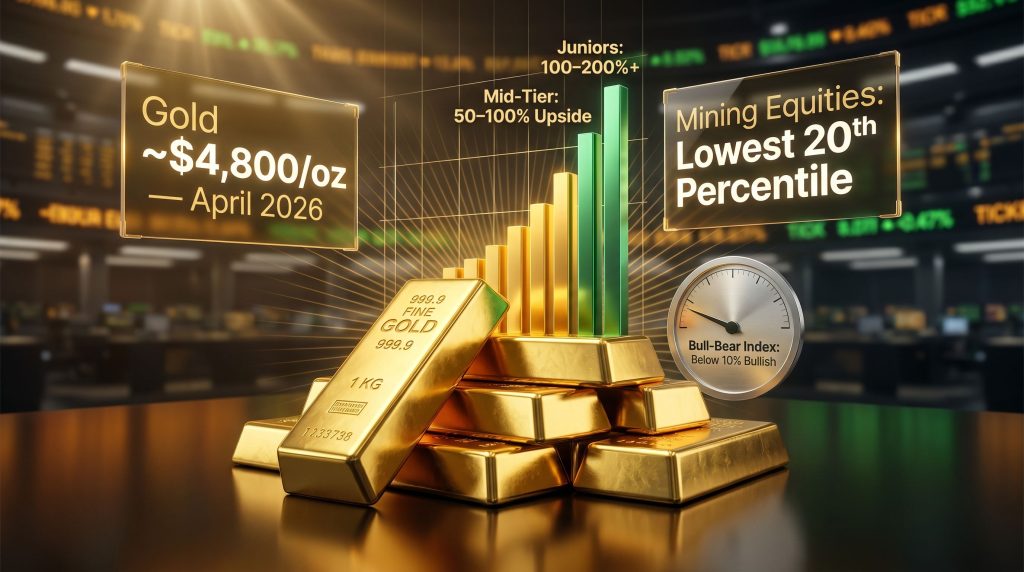
Gold is trading near $4,800 per ounce as of April 2026, yet a broad segment of gold mining equities continues to trade at multiples far below their historical averages. The explanation for this divergence is not simply that investors are irrational. Rather, it reflects the structural mechanics of how capital moves through the sector.
Passive investment vehicles, particularly exchange-traded funds like GLD, GDX, and GDXJ, have absorbed the majority of institutional gold exposure. When sentiment shifts negative, redemptions from these funds create cascading sell pressure across the entire sector, regardless of individual company fundamentals. This flow-driven dynamic has compressed valuations for producers and royalty companies alike, even as their underlying cash generation improves in a high gold price environment.
The result is a rare convergence: gold prices at or near historic highs, equity valuations at multi-decade lows, and sentiment indicators registering levels of pessimism that historically precede significant recoveries. For a broader view of where this may lead, the current gold market outlook suggests further structural tailwinds remain in place.
When big ASX news breaks, our subscribers know first
Is Gold Itself Undervalued? A Multi-Framework Valuation Analysis
Why Traditional Valuation Models Do Not Apply to Gold Bullion
Valuing gold is fundamentally different from valuing a productive asset. Discounted cash flow models, price-to-earnings ratios, and dividend yield analyses are all irrelevant for a commodity that generates no income stream. The criticism that gold pays no dividend is technically accurate, but it misses the point of why investors hold it.
Instead, gold must be measured relationally, against the monetary and fiscal environment in which it exists. When assessed through this lens, the picture is compelling.
Measuring Gold Against Inflation, Global Debt, and Money Supply Growth
When gold is compared against inflation-adjusted historical peaks, global debt levels, and the expansion of money supply, it remains materially undervalued relative to where it stood at previous cycle tops. Currency debasement is not merely a theoretical concern. It is a measurable, ongoing process, and gold's price has not yet fully reflected its magnitude.
Snapshot: Gold Price Implied by Monetary Metrics
Backing Scenario Implied Gold Price (USD) 100% USD Money Supply Coverage ~$21,000/oz 25% USD Money Supply Coverage ~$5,600–$5,700/oz Current Gold Price (April 2026) ~$4,800/oz These figures illustrate the degree to which gold remains structurally underpriced relative to monetary expansion and are not price targets or investment recommendations.
Gold vs. GDP, Debt, and Previous Cycle Peaks
Global debt has expanded dramatically faster than GDP over the past two decades. When gold is benchmarked against this debt expansion, rather than just inflation, the implied undervaluation becomes even more pronounced. Importantly, the argument is not that gold will reach these theoretical price levels, but that the current price does not represent a cyclical top by any historical measure.
The implication for investors is significant: gold appears positioned not merely to keep pace with currency debasement, but to gain in real terms relative to other asset classes, particularly if the cycle follows the pattern of previous bull markets and overshoots to the upside before a durable top forms.
How to Read the Cycle: Sentiment Indicators That Signal Tops and Bottoms
Why Sentiment Is the Most Reliable Timing Tool in the Gold Market
Because gold cannot be valued using conventional financial metrics, sentiment indicators carry unusual weight in identifying cycle turning points. The challenge is that extreme sentiment readings are uncomfortable to act on, precisely because the consensus at those moments is overwhelmingly one-directional. Understanding the relationship between gold price and mining equities helps contextualise why these signals matter so much.
Extreme Bearish Readings as Contrarian Buy Signals
The bull-bear sentiment index for gold measures the proportion of surveyed participants who hold bullish versus bearish views. Under normal market conditions, a reading of 40% bullish in either direction is considered a meaningful contrarian signal. In recent weeks, the gold bull-bear index has dropped to levels between 7% and 12% bullish, with at least one recorded session where the bullish reading registered at zero.
When a sentiment index records zero bullish participants, it does not mean gold is about to collapse. Historically, near-zero bullish readings have consistently preceded significant price recoveries, making them among the most reliable contrarian buy signals available in commodity markets.
Indicators of a Sentiment Cycle Bottom (Buy Zone):
- Bull-bear index readings below 10% bullish
- Sustained outflows from gold ETFs including GLD, GDX, and GDXJ
- Coin dealers reporting that approximately 80% or more of customer traffic involves sellers, not buyers
- Minimal mainstream media coverage of gold on major financial networks
Indicators of a Sentiment Cycle Top (Caution Zone):
- Gold dominates prime-time financial television and mainstream investment commentary
- Social conversations shift to gold price predictions among people with no prior involvement in the sector
- Premiums on physical gold ETFs rise to 3% to 6% above net asset value, indicating product scarcity
- Lines form outside bullion dealers composed primarily of buyers rather than sellers
- Unsolicited gold tips from non-financial acquaintances, Uber drivers, or other casual encounters
The Physical Gold Premium Signal
One of the more precise hard indicators worth monitoring is the price-to-NAV premium on major physical gold ETFs. Historically, sustained premiums of 3% to 6% above NAV on the largest physical gold vehicle preceded significant corrections or at minimum indicated a period of speculative excess. This dynamic does not develop overnight, but once it appears consistently, it warrants caution.
Exponential Price Moves as a Short-Term Reversal Warning
Exponential price appreciation in a short window is another warning signal worth taking seriously. When a commodity or asset class moves parabolically, the move itself becomes unsustainable regardless of the underlying fundamental thesis. Silver's behaviour in early 2026 illustrated this principle. An exponential spike does not necessarily mean the asset will be lower in twelve months, but it does indicate a high probability of a near-term pullback.
Are Gold Mining Stocks Undervalued Right Now? The Evidence Examined
Valuation Percentiles: Where Major Royalty and Streaming Companies Currently Sit
The valuation case for gold equities is not abstract. Specific, measurable data points illustrate how far current multiples have compressed relative to historical norms. Furthermore, analysts tracking undervalued mining stocks have noted that this compression appears increasingly disconnected from underlying cash flow performance.
Valuation Snapshot: Select Large-Cap Precious Metals Companies
Metric Current Percentile (Historical Range) Price-to-NAV Lowest 30th percentile Price-to-Cash Flow Lowest 20th percentile Price-to-Earnings (vs. historical average) Well below long-run average Based on publicly available financial disclosures and historical valuation ranges. Not investment advice.
Companies like Franco-Nevada, Wheaton Precious Metals, and Agnico Eagle, which represent the most conservative end of the gold equity spectrum, are currently trading at multiples well below their long-run historical averages. Franco-Nevada specifically is trading in the lowest 20th percentile on a price-to-cash flow basis and the lowest 30th percentile on a price-to-NAV basis.
Why Royalty and Streaming Models Offer Conservative Exposure With Asymmetric Upside
Royalty and streaming companies provide gold price exposure without bearing the full operational risk of mining. They receive a percentage of production or a fixed revenue stream in exchange for upfront financing, which means their cash flows rise with gold prices while their cost base remains largely fixed. At current valuations, this structure offers a combination of downside protection and upside leverage that is difficult to replicate elsewhere in the sector.
The Ounce-in-the-Ground Discount
One of the more overlooked valuation concepts in mining is the price the market assigns to resources that have not yet been extracted. Exploration and development stage companies often hold gold deposits that, on a simple per-ounce basis, are priced at a fraction of the spot price. This discount reflects execution risk, jurisdictional uncertainty, and time value, but in periods of extreme pessimism, the discount frequently overshoots rational bounds, creating opportunities for patient investors. For context, resources like five ASX gold stocks UBS thinks are undervalued illustrate how this dynamic plays out in practice.
Share Buybacks as a Value Signal
When mining company management teams prioritise share buybacks over exploration spending, it often signals that they believe their own stock is materially undervalued. This insider signal is worth tracking, particularly for mid-tier producers generating strong free cash flow at current gold prices.
Undervalued Gold Mining Stocks: A Structured Comparison of Key Opportunities
How to Categorise Opportunities Across the Market Cap Spectrum
Gold Mining Stock Opportunity Matrix (2025–2026)
Company Ticker Key Valuation Metric Projected Upside Primary Catalyst Atlyn ALTN.L Forward P/E: 8x, FCF Multiple: 2x ~60% (near-term) Low AISC, high gold price sensitivity Jaguar Mining JAG.TO EBITDA: 4x–5x (peer avg: 8x–10x) ~100% Production tripling program, Brazil operations B2Gold BTG Valuation Score: 29/100 (Rating: A) Not specified Strongest overall valuation rating in peer group Fortuna Mining FSM Valuation Score: 71/100 (Rating: A) Not specified 5 of 7 valuation checks passed Gold Fields GFI Valuation Score: 43/100 (Rating: A) Not specified 3 of 7 valuation checks passed i-80 Gold — Market Cap below $2B; 14Moz gold, 200Moz silver Not specified Nevada-based, high-grade, rapid production ramp
Projected upside figures are speculative estimates and do not constitute financial advice or guarantees of future performance.
Large-Cap vs. Mid-Cap vs. Junior: Risk-Return Profiles Compared
The return potential across the market cap spectrum varies significantly, and so does the risk profile. Investors entering the sector should understand what they are accepting at each level. In addition, resources such as gold stocks with 3x–5x upside potential offer further context on how analysts are modelling return scenarios across different tiers.
Projected Return Ranges by Market Cap Tier:
- Blue-chip miners (Barrick, Newmont): Projected upside of 15% to 30%, with lower volatility
- Mid-tier producers (B2Gold, Fortuna Mining): Potential upside of 50% to 100%, moderate operational risk
- High-grade juniors in Tier-1 jurisdictions: Potential upside of 100% to 200% or more, with commensurate exploration and execution risk
These ranges are illustrative and speculative. Individual outcomes will vary significantly based on project execution, commodity prices, and market conditions.
How to Evaluate Gold Mining Stocks: A Practical Framework for Investors
Why People Are the Most Underrated Factor in Junior Mining Analysis
For large-cap producers, conventional financial analysis applies. For junior and mid-tier companies, the standard toolkit is far less useful. The single most important variable is management quality, and not simply whether the individuals hold relevant credentials, but whether they have operated in the specific jurisdiction, with the specific commodity, in a directly relevant capacity.
A geologist who spent their career in Australian head office operations managing accounts is not the same as someone who drilled copper porphyry deposits in Peru. The distinction matters enormously when assessing whether a team can execute in the field.
Core Evaluation Framework for Junior and Mid-Tier Gold Miners
- Management quality and directly relevant track record – Has the team operated in this jurisdiction and commodity type before, in a hands-on capacity?
- Capital access, not just current cash position – Do anchor shareholders have a demonstrated history of supporting portfolio companies through difficult markets?
- Share structure integrity – Are there overhanging warrants or dilutive instruments priced near or below current levels that could suppress the stock?
- Property quality – For early-stage exploration companies, this is secondary to people and balance sheet strength
- Jurisdictional concentration – Companies operating across two or three stable, familiar regions offer better risk management than those spread across five or six disparate geographies
The Anchor Shareholder Advantage
One of the more nuanced due diligence signals in junior mining is the identity and behaviour of major shareholders. When a respected institutional mining investor holds a significant stake, typically 9% or more, it signals two things simultaneously: firstly, that the company passed a rigorous investment screen, and secondly, that it likely has access to capital when needed. This is critical because junior mining companies have no revenue, and the moments when they most need to raise capital are frequently the moments when markets are most hostile.
Known long-term supportive shareholders fundamentally change the risk profile of a junior. The ability to raise money in a bad market is not a minor advantage. It is often the difference between survival and failure.
Red Flags to Watch for When Evaluating Management Teams
Understanding management red flags is essential when assessing junior miners. Management quality is best assessed not only through what executives say, but through what they choose not to mention. A management team that avoids discussing known risks, such as a concentrated legacy shareholder whose estate may need to liquidate, or a warrant structure that will flood the market at current prices, is a significant warning sign. Strong management teams volunteer difficult information rather than waiting to be asked.
Due Diligence Questions Checklist
- What specific role did you hold at your previous company, and was that role directly relevant to this project's commodity and jurisdiction?
- What does your current warrant structure look like, and at what prices do outstanding warrants convert to shares?
- Who are your largest shareholders, and what is their history of supporting portfolio companies through market downturns?
- What is the single biggest operational or jurisdictional risk facing this project, and what steps are you taking to mitigate it?
- What is your funding runway over the next 18 to 24 months, and what are your options if you need additional capital?
The next major ASX story will hit our subscribers first
Single-Asset Producers and Mid-Tier Miners: Where the Real Value May Be Hiding
Why Single-Mine Companies Carry Elevated Risk
Single-asset producers offer direct leverage to gold prices, but they carry a concentration risk that is often underappreciated. A regulatory setback, geological surprise, or community dispute at a single mine has no offsetting buffer. The same operational challenges that affect large miners can affect small ones, but small ones lack the financial cushion to absorb them.
The M&A Optionality Factor
The prospect of takeover is frequently cited as a reason to invest in single-asset companies. The reality is more nuanced. When there is only one logical acquirer for a project, that acquirer has no competitive pressure and therefore no urgency. They will acquire on their own terms and timeline. The scenario that actually creates takeover premium is one where multiple credible acquirers are competing, creating urgency and driving the price up. Without competitive tension, obvious takeover candidates frequently disappoint investors who hold them for years waiting for a bid that arrives at a modest premium.
Why Two or Three Jurisdictions Offer the Optimal Risk-Return Balance
The optimal structure for a mid-tier producer is not maximum geographic diversification, but thoughtful concentration. A company operating four mines across two regions it understands deeply is far better positioned than one with seven assets spread across five continents. B2Gold's historical success across geographically diverse operations is possible because the management team built genuine expertise across those jurisdictions over time. For most teams, attempting similar breadth dilutes operational focus and execution quality.
Beyond Gold: Contrarian Commodity Opportunities That Share the Same Setup
Oil and Gas: A Decade of Underinvestment Setting Up the Next Bull Market
The structural dynamics that created the current opportunity in gold equities have a near-identical parallel in oil and gas. For approximately ten years, ESG-driven divestment pressure, combined with poor commodity prices, caused exploration and production companies to slash capital expenditure. The rational response for those companies was not to raise money at distressed prices and reinvest in the ground. It was to buy back shares and return capital to shareholders through dividends.
The irony is that this behaviour made oil stocks increasingly attractive on conventional valuation metrics precisely as the underlying business was contracting. The setup that results from a decade of underinvestment is a structural supply deficit, which eventually drives prices higher regardless of near-term demand noise.
Why ESG Pressure Created a Structural Supply Deficit
Large institutional funds, including many ESG-mandated pension vehicles, either divested oil holdings directly or declined to invest in funds that held them. This constrained the ability of oil and gas companies to raise equity capital, accelerating the investment withdrawal. The supply consequences of that withdrawal are now beginning to emerge in production capacity constraints.
Thermal Coal: Energy Security Driving Asian Demand
Thermal coal is arguably the most stigmatised commodity in developed-market investment circles. However, the energy security concerns triggered by recent supply disruptions have driven substantial new investment into coal production across Indonesia, Thailand, the Philippines, and other Asian nations. For countries with domestic coal reserves, energy security — meaning the ability to physically access fuel rather than simply pay a higher price for it — has become a policy priority.
Comparative Sentiment Analysis: Hated Commodities With Structural Tailwinds
Commodity Sentiment Status Key Structural Driver Investment Consideration Gold Extreme bearish (sub-10% bullish readings) Monetary debasement, debt expansion Equities severely discounted relative to spot price Oil and Gas Recovering from decade-low investment levels 10-year underinvestment cycle depleting supply capacity Stocks underperformed even at peak commodity prices Thermal Coal Deeply stigmatised in Western markets Asian energy security post-supply disruption Selective exposure to projects serving Asian and African markets
Portfolio Construction: How to Allocate Across the Gold Mining Spectrum
Why Your Existing Allocation Should Determine Your Next Move
Investors who have held gold equity exposure for several years may find that price appreciation has already done the work of increasing their allocation. An investor who held 20% in gold equities five years ago may now hold 40% simply through price gains, without adding a single share. For those investors, additional buying may be unnecessary. For investors who are new to the sector or significantly underallocated, the current entry point warrants serious consideration.
Suggested Allocation Framework by Investor Profile:
| Investor Profile | Large-Cap / Royalty | Mid-Tier Producers | Junior Explorers |
|---|---|---|---|
| Conservative | 70% | 25% | 5% |
| Balanced | 40% | 40% | 20% |
| Aggressive / Speculative | 20% | 30% | 50% |
This table is a general educational framework only and does not constitute personalised financial advice. Investors should consult a licensed financial adviser before making any investment decisions.
Key Risks That Could Undermine the Gold Mining Investment Thesis
No investment thesis is without risk, and the gold mining sector carries several specific vulnerabilities worth understanding before committing capital.
- Broad market correction risk: Gold mining equities, particularly smaller producers and juniors, are high-beta assets. A broad risk-off event can drive indiscriminate selling that temporarily overwhelms commodity fundamentals.
- Dilution risk: Junior mining companies must raise capital continuously. Excessive share issuance, particularly through heavily discounted placements or in-the-money warrant conversions, can destroy value for existing shareholders even when the underlying project is progressing well.
- Geopolitical and jurisdictional exposure: Operations in politically unstable regions carry risks that cannot always be priced or hedged. Royalty renegotiations, permitting reversals, and nationalisation threats are all real possibilities in certain jurisdictions.
- Operational execution risk: Even well-located, well-financed projects can disappoint. Cost overruns, geological surprises below the water table, processing challenges, and labour disputes are routine occurrences in the sector and require management teams with genuine operational depth to navigate.
Frequently Asked Questions: Gold Mining Stocks and Valuation
Are gold mining stocks a good investment right now?
Based on current valuation metrics, sentiment indicators, and the underlying gold price environment, many gold mining stocks undervalued by prevailing pessimism appear materially discounted relative to both their historical averages and the current commodity price. This does not guarantee future returns. Individual outcomes depend heavily on company-specific factors, market timing, and broader economic conditions.
What is the difference between investing in physical gold and gold mining stocks?
Physical gold provides direct commodity exposure with no operational risk, no dilution, and no management dependency. Mining stocks offer leveraged exposure to the gold price, meaning gains can be amplified significantly in a rising market, but losses can also exceed the percentage decline in the commodity itself. Mining stocks also carry company-specific risks that physical gold does not.
How do I know if a gold mining company is undervalued?
Key metrics include price-to-NAV, price-to-cash flow, and EV-to-EBITDA compared against the company's own historical ranges and peer group averages. A company trading in the lowest 20th to 30th percentile of its historical valuation range, in an environment of high gold prices, warrants further investigation. Consequently, interpreting drill results accurately becomes equally important when assessing whether underlying assets justify a re-rating.
What makes a junior gold mining company worth investing in?
Management quality, capital access, share structure integrity, and jurisdictional focus are the primary filters. A junior with a proven team, anchor shareholders with a history of supporting portfolio companies, a clean share structure, and a project in a stable region is far more investable than one with a spectacular property but an unproven or opaque management team.
What sentiment indicators should I watch to time the gold cycle?
The bull-bear sentiment index for gold, ETF flow data for GLD, GDX, and GDXJ, physical gold dealer traffic patterns, and price-to-NAV premiums on physical ETFs are all useful inputs. Collectively, they provide a more reliable timing signal than any single metric.
What is the ounce-in-the-ground valuation method?
This approach assigns a dollar value to each ounce of mineral resource held by a company, regardless of production status. In normal market conditions, development-stage ounces trade at a significant discount to spot price to reflect time value and execution risk. In pessimistic markets, this discount can overshoot, creating potential value for investors who correctly assess the probability of project advancement.
How does currency debasement affect gold mining stock valuations?
Currency debasement increases the nominal price of gold over time, which expands mining company revenues without a proportional increase in operating costs. This operating leverage amplifies free cash flow, particularly for low-cost producers, and should theoretically support higher equity valuations. When sentiment disconnects this relationship, as it has currently, the gap between intrinsic value and market price widens.
The Contrarian Case for Gold Mining Equities in 2026
Summarising the Three-Layer Opportunity
The current setup in gold mining equities is unusual because three independent signals are aligning simultaneously. Gold itself appears undervalued relative to monetary aggregates and historical precedents. Mining equities are trading at multi-decade valuation discounts relative to both their own history and the current commodity price. Furthermore, sentiment has reached extreme pessimistic readings that have historically preceded meaningful recoveries.
Each of these signals has standalone value. Their convergence is rarer and historically more significant.
What a Full Cycle Re-Rating Could Mean for Patient Investors
If gold continues to appreciate in real terms and mining equities re-rate toward historical valuation averages, the compounded effect for equity holders could be substantial. Mid-tier producers and high-quality juniors in stable jurisdictions tend to offer the greatest leverage to this scenario, while royalty and streaming companies provide the most conservative version of the same trade.
The Importance of Discipline: Buying Into Extreme Pessimism Requires Conviction
Contrarian investing is conceptually straightforward and practically difficult. Buying when sentiment registers near-zero bullish readings means acting against the prevailing consensus, often without immediate validation. The discomfort is the point. When every soft and hard indicator aligns with extreme pessimism, the margin of safety for long-term investors is at its widest.
When gold prices reach historic highs and gold mining stocks undervalued by depressed sentiment simultaneously trade at multi-decade valuation lows, while sentiment registers near-zero bullish readings, the convergence of all three signals creates a rare and historically significant entry window for disciplined, long-term investors.
This article is for general informational and educational purposes only. It does not constitute financial advice, an offer to buy or sell securities, or a solicitation of any kind. All projections, valuations, and forward-looking statements involve uncertainty and should not be relied upon as predictions of future performance. Readers should conduct their own research and consult a licensed financial adviser before making any investment decisions. Past performance in commodity cycles does not guarantee future results.
Want to Know When the Next Major ASX Mineral Discovery Hits the Market?
While gold mining equities remain deeply discounted relative to the underlying commodity, the most asymmetric returns in the sector have historically come from investors who identified significant new discoveries at the moment of announcement — exactly what Discovery Alert's proprietary Discovery IQ model is built to deliver, scanning ASX announcements in real time and converting complex mineral data into actionable insights. Explore historic discovery returns to understand the scale of opportunity, then begin your 14-day free trial to position yourself ahead of the broader market.