July 8, 2026
The Duck Curve Dilemma: Understanding Why Grid-Scale Battery Storage Is India's Most Urgent Energy Priority
Picture a power grid that is simultaneously flooded with excess electricity and unable to meet demand. This is not a hypothetical failure scenario. It is the operating reality of India's electricity system during virtually every 24-hour cycle in 2026. Grid-scale battery storage in India has emerged as the defining infrastructure question in Asia's largest democracy, with the mechanics behind this paradox representing one of the most consequential investment and policy challenges of the decade.
The concept known as the "duck curve" describes a characteristic pattern that emerges as solar penetration rises in any electricity market. Generation surges through daylight hours, pushing midday prices toward zero and sometimes negative territory, before dropping sharply as the sun sets. Demand, meanwhile, follows human behaviour rather than solar cycles, peaking in the early evening precisely when generation collapses. The deeper and wider this temporal mismatch grows, the more structurally unstable the grid becomes. India is now living this challenge at enormous scale.
When big ASX news breaks, our subscribers know first
The Scale of India's Grid Stress Problem
India's installed solar capacity reached approximately 157 GW as of May 2026, a figure that would have seemed extraordinary just a decade ago. Yet raw capacity has outpaced the grid's ability to manage it. The evidence of systemic stress is visible in electricity price data that no grid operator would consider healthy. Furthermore, the consequences of inaction are growing more acute with each additional gigawatt of solar added to the system.
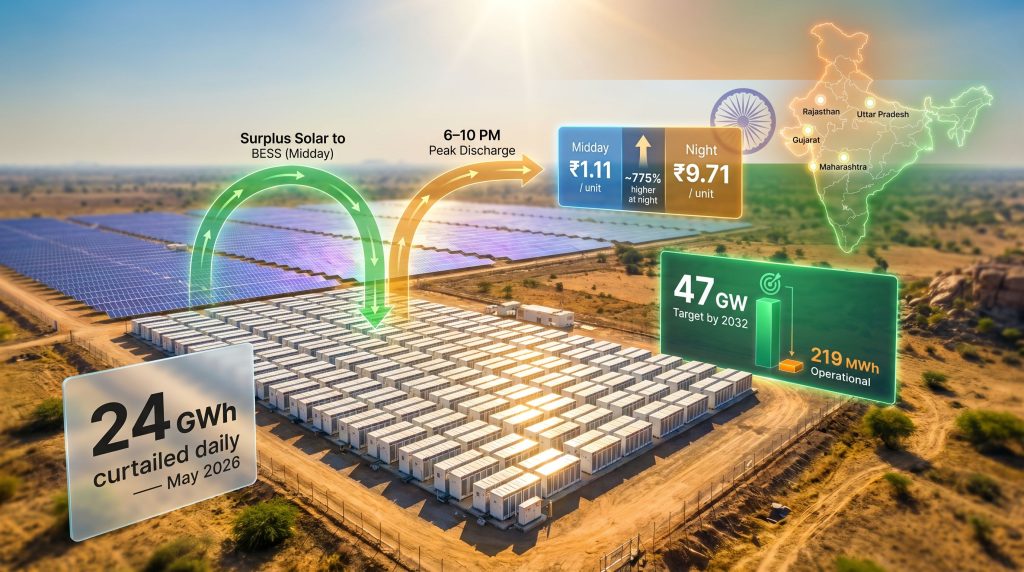
On the Indian Energy Exchange's day-ahead market, power prices averaged just ₹1.11 per unit around midday in May 2026, when solar generation was at its peak. By nightfall, the same market was pricing electricity at ₹9.71 per unit. That near-ninefold differential within a single calendar day is not a market efficiency signal. It is a structural alarm.
| Time Period | Average Power Price (May 2026) |
|---|---|
| Midday solar peak hours | ₹1.11 per unit |
| Night post-solar hours | ₹9.71 per unit |
| Intraday price differential | Approximately 775% higher at night |
The curtailment data reinforces this picture. Solar generation that the Indian grid could not absorb averaged 24 GWh per day in May 2026, a volume exceeding one quarter of Delhi's average daily electricity consumption. This is not wasted energy in the abstract sense. It represents real electrons generated at real cost, fed into infrastructure that had nowhere to send them, and ultimately suppressed rather than stored or consumed.
What makes this particularly striking from an analytical standpoint is that the evening demand going unmet is not a new or unpredictable load. It is the same residential and commercial peak demand that has characterised Indian consumption patterns for decades. The grid is not failing because demand is unusual. It is failing because supply has become temporally mismatched with that demand.
What Grid-Scale Battery Storage Actually Does
Grid-scale battery storage, primarily implemented through Battery Energy Storage Systems (BESS), operates at the megawatt to gigawatt scale and connects directly to transmission and distribution infrastructure. Unlike rooftop installations or behind-the-meter configurations, utility-scale BESS participates in wholesale electricity markets, provides ancillary services to system operators, and can be dispatched on command. The battery storage expansion occurring across India is, consequently, reshaping how the entire grid is planned and operated.
The arbitrage logic underpinning the Indian BESS investment case is straightforward but commercially powerful:
- Midday charging: Surplus solar floods the grid at ₹1.11 per unit or below. BESS absorbs this energy at near-zero marginal cost.
- Energy storage: Electrochemical systems hold the charge through the afternoon, sustaining no significant losses over typical four to six hour storage windows with modern lithium iron phosphate chemistry.
- Evening discharge: Stored energy is released into the grid during the 6 to 10 PM demand peak, when prices reach ₹9.71 per unit.
- Revenue generation: The spread between charge cost and discharge revenue, potentially exceeding ₹8 per unit, forms the primary economic engine of the storage business model.
When optimised across the full value stack, encompassing energy arbitrage, capacity firming, ancillary services provision, and deferral of expensive transmission and distribution upgrades, BESS profit margins in the Indian context range from 24% to 70%, depending on project configuration and market access.
A lesser-known dimension of BESS value in India involves the avoided cost of thermal plant ramping. Each time a coal or gas plant must ramp sharply up or down to compensate for solar intermittency, it incurs efficiency losses, increased maintenance costs, and accelerated asset degradation. Grid-scale storage absorbs these fluctuations, extending the operational life and efficiency of existing thermal assets. This avoided-cost benefit rarely appears in headline BESS economics but materially improves system-wide financial outcomes.
India's National Deployment Targets and the Execution Gap
India has established clearly defined national targets for BESS deployment as part of its broader ambition to reach 500 GW of non-fossil energy capacity by 2030. The Central Electricity Authority has quantified the total energy storage requirement at 411.4 GWh by 2031-32, with BESS accounting for 236.2 GWh of that figure. India's lithium market dynamics are closely intertwined with this deployment ambition, as lithium-based chemistry dominates the BESS landscape.
| Metric | Target |
|---|---|
| National BESS deployment target | 47 GW by 2032 |
| Total energy storage requirement (CEA) | 411.4 GWh by 2031-32 |
| BESS share of total storage requirement | 236.2 GWh |
| Cost-effective storage requirement (FY2032) | 97 GW / 362 GWh |
| VGF-supported capacity target | 4,000 MWh by 2030 |
The gap between ambition and execution is the sector's most pressing challenge. Between 2022 and May 2025, India auctioned approximately 12.8 GWh of BESS capacity. Of this pipeline, only 219 MWh is reported as operational, representing less than 2% of auctioned capacity. The remainder sits across various stages of development, procurement, financing, and construction.
This execution gap is not unique to India. International experience from markets including the United States, Australia, and the United Kingdom shows that the typical lag between auction award and commercial commissioning for utility-scale BESS is 24 to 48 months. India's lag, however, is proportionally larger, suggesting structural frictions beyond normal project development timelines. According to IEEFA's analysis of India's storage boom, getting execution right remains the sector's defining challenge.
Landmark Projects Establishing Technical Precedent
Two projects are particularly significant in establishing the technical and regulatory template for the sector:
India's First Commercial Standalone BESS:
- Capacity: 20 MW / 40 MWh
- Location: BRPL's Kilokari substation, New Delhi
- Status: Regulatory approval granted May 2024; commissioning expected within 18 to 20 months
- Significance: Creates the first replicable regulatory and commercial framework for standalone utility-scale storage in India
India's First Co-located Solar and BESS Facility:
- Configuration: 100 MW solar plant paired with 40 MW storage capacity
- Location: Rajnandgaon, Chhattisgarh
- Milestone: Completed one full year of commercial operation in February 2025
- Significance: Demonstrates that integrated renewable plus storage delivery is technically viable under Indian grid conditions and monsoon seasonality
The Cost Compression Driving Commercial Viability
Perhaps the single most transformative development in India's BESS landscape over the past two years has been the pace of tariff compression. BESS tariffs have declined by approximately 65% in two years, with the benchmark rate falling from ₹1.30 crore per MW per year to approximately ₹57.6 lakh per MW per year.
| Benchmark | Previous Rate | Current Rate | Reduction |
|---|---|---|---|
| BESS tariff (INR/MW/year) | ₹1.30 crore | ₹57.6 lakh | ~55-65% |
This compression reflects a convergence of global battery manufacturing scale, primarily driven by Chinese lithium iron phosphate cell production, falling battery raw materials costs, and competitive auction dynamics in India. What is less widely appreciated is that this cost trajectory still has significant room to run. Industry analysts project continued cost declines as India's domestic Advanced Chemistry Cell manufacturing base scales under the Production Linked Incentive programme.
The chemistry question matters more than most observers recognise. Lithium iron phosphate (LFP) cells, which dominate Indian BESS deployments, offer superior thermal stability and cycle life compared to nickel manganese cobalt alternatives, making them particularly well suited to the high-ambient-temperature conditions of Indian substations. The choice of cell chemistry directly affects bankability, insurance costs, and long-term degradation assumptions in project finance models.
Government Incentive Architecture
Viability Gap Funding Programme
The Viability Gap Funding mechanism provides up to 40% capital cost support for qualifying BESS projects, embedded within a ₹91 billion scheme targeting 43.2 GWh of storage deployment. VGF functions as a bridge instrument, designed to make projects commercially viable at current market tariffs while the sector scales toward unsubsidised competitiveness.
Production Linked Incentive for Advanced Chemistry Cells
- Programme size: ₹181 billion
- Target: Support domestic manufacturing of 50 GWh of Advanced Chemistry Cell batteries
- Strategic objective: Reduce dependence on imported cells and establish a domestic supply chain
The PLI programme represents a longer-horizon bet. Domestic cell manufacturing at competitive cost requires sustained volume commitments from project developers, which in turn require a pipeline of contracted storage projects. The interdependency between manufacturing scale and project deployment creates a sequencing challenge that both the VGF and PLI programmes are designed, in part, to resolve.
Regulatory and Legislative Frameworks
The draft Electricity (Amendment) Bill, 2025, and the draft Electricity (Rights of Consumers) Amendment Rules, 2026, introduce several structural changes relevant to BESS investment:
- Formal recognition of energy storage as an integral component of the power system
- Strengthened non-fossil purchase obligations for distribution utilities
- Provisions supporting demand-response mechanisms
- Time-bound implementation of time-of-day tariffs to incentivise consumption during solar hours
Energy Storage Obligation Escalation Schedule:
| Financial Year | Minimum Storage Obligation (% of procurement) |
|---|---|
| 2023-24 | 1% |
| 2029-30 | 4% |
Importantly, the escalating storage obligation creates a mandatory demand signal for BESS capacity that operates independently of voluntary market economics. Distribution companies will, therefore, be required to procure qualifying storage capacity regardless of short-term tariff considerations.
The next major ASX story will hit our subscribers first
The Contract Structure Problem No One Is Talking About
One of the most analytically underappreciated barriers to BESS scale-up in India involves the structure of existing solar contracts rather than new project economics. India's current 157 GW of installed solar capacity is contracted predominantly through plain vanilla power purchase agreements, under which generators supply electricity only at the moment it is generated, with no obligation or incentive to store and dispatch during peak demand hours.
This creates a systemic misalignment. As solar penetration rises, midday curtailment increases, but the evening peak demand remains structurally unserved by the existing contracted fleet. The solar capacity exists. The demand exists. However, the contract structure prevents the two from meeting across time.
A working paper by the Economic Advisory Council to the Prime Minister, authored by EAC-PM member Sanjeev Sanyal and joint director Satvik Dev, identifies this structural problem explicitly. It argues for an enabling framework under which willing generators and distribution companies could voluntarily convert existing solar contracts into storage-backed supply agreements extending into evening hours. This contract conversion pathway is conceptually simple but commercially complex, requiring renegotiation of offtake terms, capacity payments, and grid connection arrangements for thousands of existing installations.
Regional Priorities and Geographic Concentration
Grid-scale battery storage in India will not be geographically uniform across states. Investment is expected to concentrate in regions combining high solar irradiance with proximity to large load centres:
- Rajasthan: India's largest solar resource base and the state with the highest curtailment risk as capacity continues to expand
- Gujarat: Strong industrial load base combined with substantial existing renewable capacity
- Maharashtra: Large urban demand centres and relatively advanced distribution company infrastructure
- Uttar Pradesh: The country's highest population load and rapidly growing renewable integration requirements
- Andhra Pradesh and Telangana: Significant solar pipeline and active grid modernisation programmes underway
A nuanced point worth noting is that states with high wind penetration, including Tamil Nadu and Karnataka, may extract comparatively lower arbitrage value from four to six hour BESS deployments. Wind generation has a more distributed temporal profile than solar, creating less pronounced price spreads across the day. This distinction is material for investors comparing BESS project economics across states.
Key Barriers to Faster Deployment
Despite strong structural fundamentals, several friction points are constraining India's BESS scale-up:
- Underbidding risk: Competitive auction dynamics have produced tariff bids that may prove commercially unviable at project execution, particularly as financing and equipment costs remain volatile. This dynamic is already contributing to project delays and potential cancellations in the auctioned pipeline.
- Power purchase agreement delays: Slow finalisation of offtake contracts creates financing uncertainty that prevents projects from reaching financial close.
- Transmission interconnection backlogs: Grid connection queues and substation upgrade requirements add both lead time and cost, particularly in high-solar states where interconnection infrastructure has not kept pace with generation additions.
- Financing cost premiums: India's capital markets continue to price BESS projects at elevated risk premiums relative to mature solar or wind assets, reflecting the sector's limited operational track record. As the project pipeline matures and performance data accumulates, this premium should compress, but it remains a near-term constraint.
- Import dependency: The near-total reliance on imported battery cells exposes project economics to currency and supply chain risk that domestic manufacturing scale will eventually, but not immediately, resolve.
Frequently Asked Questions: Grid-Scale Battery Storage in India
What is the current operational BESS capacity in India?
As of mid-2025, approximately 219 MWh of BESS capacity is operational, against an auctioned pipeline of approximately 12.8 GWh, indicating that the large majority of committed capacity remains under development.
What is India's BESS target for 2032?
India has set a national target of deploying 47 GW of Battery Energy Storage Systems by 2032, with the Central Electricity Authority estimating a total energy storage requirement of 411.4 GWh by 2031-32.
How much have battery storage costs fallen in India?
BESS tariffs have declined by approximately 65% over two years, falling from ₹1.30 crore per MW per year to approximately ₹57.6 lakh per MW per year.
What government incentives support BESS projects in India?
Viability Gap Funding of up to 40% of capital costs is available for qualifying projects, alongside a ₹181 billion Production Linked Incentive scheme for domestic Advanced Chemistry Cell manufacturing.
Why does solar curtailment represent an economic problem?
Curtailed solar energy represents generation that was produced at real capital and operational cost but could not be consumed or stored. At 24 GWh per day in May 2026, India's curtailment volume represents a substantial and growing economic loss that storage infrastructure could convert into dispatchable peak-hour supply.
Which battery chemistry dominates India's BESS deployments?
Lithium iron phosphate chemistry is predominant, valued for its thermal stability in high-ambient-temperature environments, long cycle life, and relative cost competitiveness compared to alternative chemistries. Advances in direct lithium extraction technology are, furthermore, expected to support continued cost improvements across the lithium supply chain underpinning these deployments.
Closing the Ambition Gap
The structural case for grid-scale battery storage in India is now empirically robust. Price spreads of nearly nine times between solar and peak hours provide a compelling arbitrage foundation. Cost compression has brought BESS tariffs to levels approaching competitiveness without subsidy support in optimally structured projects. The regulatory architecture, while still evolving, is progressively creating mandatory demand signals through storage obligations and time-of-day tariff reforms.
The distance between 219 MWh of operational capacity and a 47 GW national target is, however, a distance measured not just in megawatt-hours but in financing frameworks, contract structures, grid infrastructure, and manufacturing supply chains. The broader critical minerals demand picture also plays a central role, as securing stable lithium and related material supplies underpins the entire deployment ambition. According to strategic pathways research from Berkeley's IECC, closing this gap requires a coordinated multi-stakeholder approach across policy, finance, and industry.
Closing that gap requires:
- Standardising and accelerating storage procurement frameworks to reduce PPA finalisation timelines
- Creating voluntary pathways for existing solar contracts to incorporate storage-backed supply obligations
- Deploying blended finance instruments to compress risk premiums and reduce the cost of capital for early-stage projects
- Scaling domestic battery cell manufacturing to reduce import exposure and support further cost reduction
- Implementing time-of-day tariffs at pace sufficient to create durable demand-side signals that reward storage investment across the project lifetime
The Economic Advisory Council to the Prime Minister's identification of grid-scale battery storage in India as the country's most urgent electricity infrastructure priority reflects a recognition that the renewable energy transition has entered a new phase. Gigawatts of generation capacity are no longer the binding constraint. The binding constraint is now the ability to deliver that electricity when it is actually needed. Storage is not a supplement to India's energy transition. It is the mechanism through which that transition becomes operationally complete.
This article is intended for informational purposes only and does not constitute financial or investment advice. Forecasts, targets, and projections cited herein are subject to policy changes, market conditions, and execution risks. Readers should conduct independent research before making any investment decisions.
Want to Invest in the Critical Minerals Powering India's Battery Storage Revolution?
Discovery Alert's proprietary Discovery IQ model delivers real-time notifications on significant ASX mineral discoveries — including the lithium and battery raw materials central to India's grid-scale storage ambitions — instantly transforming complex data into actionable investment opportunities. Explore how historic mineral discoveries have generated extraordinary returns and begin your 14-day free trial today to position yourself ahead of the market.