July 8, 2026
Why Commodity Cycles Make or Break Mining Giants Like BHP
Mining investment is fundamentally cyclical. Every supercycle carries within it the seeds of its own correction, and the ability to distinguish between a structural pullback and a temporary dip is what separates informed investors from reactive ones. For ASX investors assessing BHP shares buy sell or hold decisions in mid-2026, this distinction has rarely mattered more.
BHP Group Ltd (ASX: BHP) has delivered extraordinary returns over the past twelve months, yet a sharp retreat from its all-time high has triggered renewed scrutiny across broker desks and retail portfolios alike. Understanding why this pullback occurred, what it signals historically, and how different investor types should respond requires a multi-layered analytical framework, not a simple buy or sell call.
When big ASX news breaks, our subscribers know first
BHP's Position in the ASX 200 Landscape
BHP is not simply a large mining company. It is the largest company by market capitalisation on the ASX and functions as a proxy for global commodity sentiment, Chinese industrial demand, and the structural energy transition narrative simultaneously. Few stocks in Australia carry as many macro variables within a single share price.
Key Performance Metrics at a Glance
| Metric | Value |
|---|---|
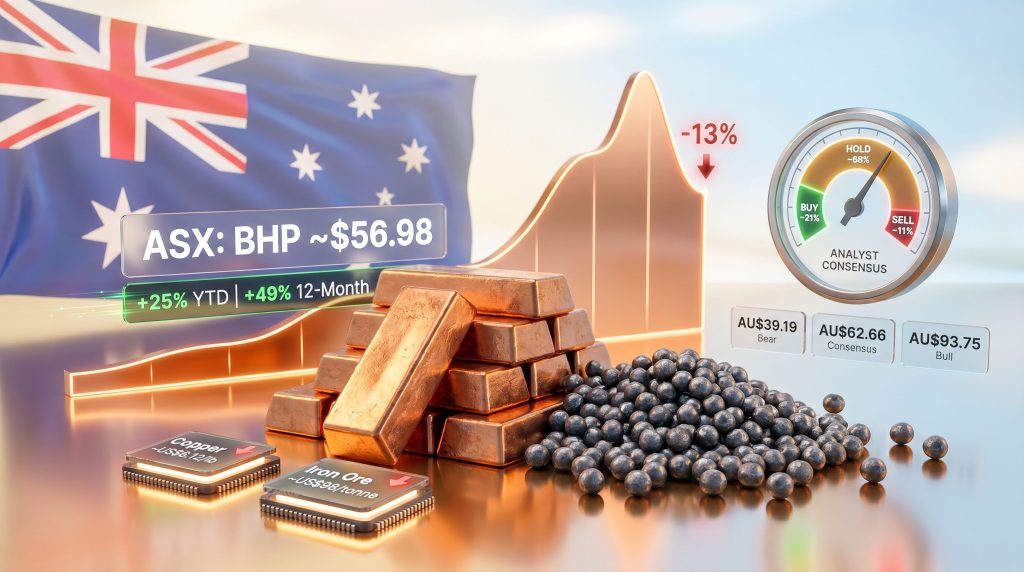
| Share price (at time of analysis) | ~AU$56.98 |
| Year-to-date performance | +25% |
| 12-month performance | +49% |
| Decline from all-time high (mid-June 2026) | -13% |
| Analyst consensus | Hold (majority view) |
| Average 12-month price target (consensus) | ~AU$62.66 to AU$63.54 |
| Bear case price target | AU$39.19 |
| Bull case price target | AU$93.75 |
Despite the recent sell-off, BHP's year-to-date and twelve-month gains remain exceptional by any historical measure. The 13% pullback from peak levels, while attention-grabbing, must be contextualised against the +49% gain recorded over the prior year.
What Is Driving BHP's Share Price Decline From Its All-Time High?
The Commodity Price Correction Explained
BHP reached a new all-time high in mid-June 2026, propelled by a sustained rally in copper prices and favourable commodity tailwinds across its broader portfolio. However, that momentum reversed quickly as both copper and iron ore softened. Understanding the iron ore price trends driving this reversal is essential context for any investor reassessing their position.
| Commodity | Recent Price | Prior Peak | Change |
|---|---|---|---|
| Copper Futures | ~US$6.12/lb | ~US$6.60/lb (June 2026) | -7.3% |
| Iron Ore | ~US$98/tonne | ~US$111/tonne (mid-May 2026) | -11.7% |
Iron ore is approaching what traders refer to as the psychological floor of US$90/tonne, a level that has historically triggered significant downward revisions to BHP's earnings forecasts. The speed of this correction, from US$111/tonne to near US$98/tonne in under two months, underscores how sensitive commodity markets are to macro sentiment shifts.
Four Macro Forces Weighing on BHP's Valuation
Several converging pressures have compounded the commodity price correction:
-
Geopolitical risk: Sustained conflict in the Middle East has dampened global risk appetite, with institutional investors rotating away from cyclical commodity exposures toward defensive assets.
-
Inflation persistence: Input cost pressures across the mining sector, including labour, energy, and equipment, have compressed operating margins even when headline commodity prices appear healthy.
-
Steel demand softening: Reduced downstream steel consumption signals have fed back into weaker iron ore demand expectations, particularly from major trading partners.
-
China property sector uncertainty: This remains the most structurally significant headwind. China accounts for roughly 70% of global seaborne iron ore demand, and its property sector, which drives approximately 30% of Chinese steel consumption, remains in a prolonged adjustment phase.
How Commodity Cycles Behave After a Peak
Historically, commodity price peaks are rarely clean inflection points. They tend to be followed by volatile consolidation periods where prices oscillate around a new, lower equilibrium before either recovering or declining further. For BHP investors, the critical question is whether current iron ore and copper prices represent a temporary consolidation or the beginning of a deeper structural decline.
Iron ore's dependence on Chinese steel output means that any credible stimulus package targeting Chinese infrastructure or housing could reverse the current downtrend rapidly. Furthermore, the China steel outlook for the coming years will play a decisive role in shaping BHP's earnings trajectory. Copper's trajectory, by contrast, is increasingly driven by energy transition demand, including electric vehicles, grid infrastructure, and renewable energy installations, which provides a more durable structural demand floor.
What Do Analysts Actually Think About BHP Shares Right Now?
Breaking Down the Broker Consensus
| Rating Category | Number of Analysts | Percentage of Coverage |
|---|---|---|
| Strong Buy / Buy | 4 | ~21% |
| Hold / Neutral | 12 to 13 | ~68% |
| Sell / Strong Sell | 1 to 2 | ~11% |
The overwhelming hold consensus across research platforms reflects a market that views BHP as trading close to fair value at current levels. This is neither a distressed asset nor an obvious momentum buy. It occupies the uncomfortable middle ground that frustrates both growth investors and deep value seekers. For broader context on how this compares with sector peers, the Rio versus BHP analysis offers a useful comparative lens.
Price Target Divergence: Why the Range Is So Wide
The spread between the most bearish and most bullish analyst price targets on BHP exceeds 130%, an unusually wide band even by mining sector standards. This dispersion reflects genuine uncertainty across three dimensions:
- The trajectory of Chinese economic recovery and its translation into commodity demand
- Long-term copper price assumptions underpinning growth valuations
- The capital cost and timeline risks associated with the Jansen potash project
"The range between the lowest and highest analyst price targets for BHP, spanning from approximately AU$39.19 to AU$93.75, represents one of the widest valuation dispersions among ASX 200 blue-chip stocks, reflecting the complexity of modelling a diversified global miner across multiple commodity cycles simultaneously."
Morgan Stanley's Bull Case: Copper as a Structural Advantage
Morgan Stanley has reaffirmed its buy rating on BHP with a 12-month price target of AU$67.50. The bank's thesis centres on BHP's copper exposure as a long-duration structural asset rather than a cyclical trade. Emerging copper market trends suggest that demand from electric vehicle manufacturing, grid-scale battery storage, and renewable energy infrastructure is forecast to accelerate through the late 2020s. BHP's existing copper assets, combined with its development pipeline, position it as one of the few diversified miners with meaningful exposure to this theme at scale.
DZ Bank's Upgraded Stance: From Sell to Hold
DZ Bank's recent upgrade from a sell rating to hold, accompanied by a price target of AU$65, signals a recalibration rather than a fundamental conviction shift. The upgrade appears driven by the view that the most significant downside risks have been partially priced in following the 13% pullback from peak levels.
Catapult Wealth's Buy Thesis: Balance Sheet and Dividend Appeal
Catapult Wealth maintains a buy rating, anchoring its thesis on BHP's balance sheet quality and dividend yield. For income-focused investors, BHP's ability to sustain meaningful dividend payments through commodity downturns distinguishes it from most ASX resources peers. BHP's net debt position and cash generation capacity give it significant flexibility to maintain shareholder returns even in lower commodity price environments.
Sanlam Private Wealth's Caution: Jansen and Pilbara Risks
Sanlam Private Wealth holds a more cautious hold position, flagging two specific risks that are often underweighted by retail investors. First, cost blowouts and potential impairment risks at the Jansen potash project in Canada. Second, the possibility of further industrial action at BHP's Pilbara iron ore operations, which would directly impact production volumes and revenue.
BHP's Fundamental Investment Pillars
Pillar 1: Copper Exposure and the Energy Transition Demand Cycle
Copper is frequently described as the metal most critical to the global energy transition. Each electric vehicle requires approximately 2.5 to 4 times more copper than a conventional internal combustion engine vehicle. Grid infrastructure upgrades, offshore wind installations, and solar farm construction all require substantial copper input. BHP's copper operations, including its Escondida mine in Chile — the world's largest copper mine by production volume — provide unmatched scale exposure to this secular demand theme.
Pillar 2: Iron Ore Operations and Margin Resilience
BHP's Pilbara iron ore operations in Western Australia produce some of the highest-grade ore in the world, with benchmark grades typically around 61 to 62% iron content. This grade quality is commercially significant because Chinese steel mills pay premiums for higher-grade ore, which produces less waste slag, consumes less coking coal, and generates lower carbon emissions per tonne of steel produced. Higher-grade ore therefore commands a price premium that lower-grade producers cannot replicate, providing BHP with a structural cost and revenue advantage.
Pillar 3: Balance Sheet Quality and Capital Allocation
BHP's balance sheet is one of the strongest among global diversified miners. The company maintains an investment-grade credit rating and has demonstrated consistent capital discipline through multiple commodity cycles. Its approach to capital allocation — balancing sustaining capital expenditure, growth investment, and shareholder returns — provides a degree of earnings predictability that single-commodity producers cannot offer.
Pillar 4: Dividend Yield as an Income Anchor
"BHP's dividend yield remains one of the primary reasons long-term investors maintain positions through commodity downturns. Unlike pure-play miners with single-commodity exposure, BHP's diversified portfolio provides a degree of earnings smoothing across cycles."
For income-focused ASX investors, particularly those managing self-managed super funds or retirement portfolios, BHP's dividend history provides a compelling case for position retention even when share price momentum is negative. The company's franking credit profile also adds value for Australian resident investors, enhancing the effective after-tax yield relative to international peers.
Pillar 5: The Jansen Potash Project — Long-Term Growth or Near-Term Risk?
The Jansen potash project in Saskatchewan, Canada represents BHP's most significant long-duration growth bet. Potash is a primary component of fertiliser, and global food security concerns, combined with supply disruptions from major producing regions, have elevated the strategic rationale for potash investment. However, Jansen is an extraordinarily capital-intensive project, with total development costs potentially exceeding US$10 billion across multiple stages.
Cost overruns at this scale carry real impairment risk, and the timeline to first production revenue remains extended, meaning investors must accept a long waiting period before this asset begins contributing meaningfully to earnings.
How Should Different Types of Investors Approach BHP Shares?
Investor Profile Framework
| Investor Type | Recommended Stance | Key Rationale |
|---|---|---|
| Income-focused long-term holder | Hold / Accumulate on weakness | Dividend yield + blue-chip stability |
| Growth-oriented investor | Selective buy on commodity dips | Copper upside leverage |
| Short-term trader | Caution / Wait for clearer signals | High price target dispersion |
| Risk-averse retiree | Hold existing position | Capital preservation priority |
| New investor building a portfolio | Consider partial entry | Diversified commodity exposure |
The Buy on Weakness, Sell on Strength Cycle Strategy
Experienced resources investors often apply a disciplined cycle strategy to stocks like BHP, accumulating positions during commodity troughs when sentiment is pessimistic and prices are depressed, then trimming exposure near cyclical peaks when optimism is excessive. The current 13% pullback from an all-time high sits in an ambiguous zone.
It is large enough to attract value-oriented buyers, but not deep enough to suggest the severe overselling that typically defines a generational buying opportunity. Indeed, the commodity price impacts on mining company performance further illustrate why entry timing matters so significantly in this sector.
Investors who purchased BHP at 12-month lows would currently be sitting on approximately 49% gains. Those who chased momentum near the June 2026 peak are nursing short-term losses. This asymmetry reinforces the discipline of buying resource stocks during pessimism rather than euphoria.
The next major ASX story will hit our subscribers first
BHP vs. the Broader ASX Resources Sector
Peer Comparison
| Company | Commodity Focus | Analyst Consensus | Key Risk |
|---|---|---|---|
| BHP Group (ASX: BHP) | Diversified (iron ore, copper, potash) | Hold | China demand, Jansen cost blowout |
| Rio Tinto (ASX: RIO) | Iron ore, aluminium, copper | Hold/Neutral | Iron ore price sensitivity |
| South32 (ASX: S32) | Base metals, coal, aluminium | Buy/Neutral | Commodity cycle timing |
| Mineral Resources (ASX: MIN) | Lithium, iron ore | Mixed | Lithium price weakness |
BHP's diversification across iron ore, copper, and potash provides a materially different risk profile to pure-play iron ore miners like Rio Tinto or lithium-exposed names like Mineral Resources. Investors seeking concentrated commodity bets may find single-commodity peers more suitable. Those prioritising portfolio stability and income reliability will generally find BHP's diversified earnings base more compelling.
Key Risks Investors Must Monitor
Risk 1: China's Property and Infrastructure Demand Trajectory
No single variable has more influence over BHP's near-term earnings than Chinese steel demand. The Chinese government's ability and willingness to implement credible infrastructure stimulus remains the most consequential unknown for iron ore pricing through 2026 and 2027.
Risk 2: Copper Price Volatility
While copper's long-term structural demand story is compelling, near-term price volatility can be severe. Copper futures have already retreated approximately 7% from their June 2026 peak. A further deterioration toward US$5.50/lb would have material implications for BHP's earnings guidance and may trigger further analyst target price downgrades.
Risk 3: Jansen Potash Capital Overruns
Capital-intensive greenfield projects in remote geographies carry inherent cost escalation risk. Construction cost inflation, labour shortages, and supply chain complexity can compound to push total project costs materially above original feasibility estimates.
Risk 4: Industrial Action at Pilbara Operations
BHP's Pilbara iron ore operations are among the most productive in the world, but they are also among the most scrutinised from a labour relations perspective. Sustained industrial action affecting production volumes would directly reduce revenue and could trigger earnings downgrades at a time when iron ore prices are already under pressure.
Risk 5: Global Macro Headwinds
Persistent inflation, elevated interest rates in major economies, and US dollar strength all create headwinds for commodity-producing companies. A stronger US dollar makes dollar-denominated commodities more expensive for non-US buyers, suppressing demand. Higher interest rates increase the discount rate applied to BHP's long-duration growth assets like Jansen, reducing their present value contribution.
"The spread between BHP's most bearish and most bullish analyst price targets exceeds 130%, an unusually wide band that reflects genuine uncertainty about commodity cycle direction, China's economic recovery pace, and the long-term economics of the Jansen potash project."
What Could Trigger a Re-Rating of BHP Shares in the Next 12 Months?
Upside Catalysts to Watch
-
A sustained copper price recovery back above US$6.50/lb would reignite momentum buying and prompt bull case analyst upgrades
-
Credible and sizeable Chinese property sector stimulus measures translating into higher steel production would support iron ore prices
-
Stronger-than-expected infrastructure spending from China, India, or major Western economies could absorb current commodity supply surpluses
-
Jansen project milestones delivered on time and within budget would reduce the risk discount currently applied to this asset
Downside Catalysts to Monitor
-
Iron ore prices falling through the US$90/tonne level would likely trigger a wave of analyst target price reductions
-
Escalation of Middle Eastern conflict disrupting global shipping lanes or broader trade flows could suppress commodity demand across BHP's entire portfolio
-
Further Jansen cost blowouts or formal impairment announcements would damage investor confidence in BHP's capital discipline narrative
-
Prolonged industrial action at Pilbara operations would simultaneously reduce production volumes and attract negative media attention
Frequently Asked Questions: BHP Shares
Is BHP a good buy right now in 2026?
The majority of analysts view BHP as fairly valued at current levels, with a hold consensus and an average price target implying modest upside of approximately 10 to 11%. It is not a screaming buy, but neither is it overvalued relative to its earnings capacity. The investment case depends heavily on an individual investor's time horizon and commodity cycle view.
What is the current analyst price target for BHP shares on the ASX?
Consensus price targets sit in the range of AU$62.66 to AU$63.54 across major research platforms. Individual targets range from a low of AU$39.19 to a high of AU$93.75, reflecting significant divergence in commodity price assumptions. Investors can also review live BHP consensus estimates on Investing.com for the most current broker data.
Why have BHP shares fallen from their all-time high?
The retreat from the mid-June 2026 peak reflects a combination of softening copper and iron ore prices, geopolitical uncertainty, persistent inflation concerns, and ongoing uncertainty around Chinese property sector demand.
Does BHP pay a reliable dividend?
BHP has a track record of maintaining meaningful dividend payments through commodity cycles, supported by its diversified earnings base and strong balance sheet. Australian investors also benefit from the franking credits attached to BHP dividends, which enhance effective after-tax returns.
How does China's economy affect BHP's share price?
China is the dominant buyer of BHP's two largest commodity exposures, iron ore and copper. Chinese economic conditions, particularly the health of its property sector and infrastructure investment pipeline, directly influence the demand outlook and therefore price for both commodities. Any sustained recovery in Chinese construction activity would be a material positive for BHP's earnings.
What is the Jansen potash project and why does it matter?
Jansen is a large-scale potash development project in Saskatchewan, Canada. Potash is a key fertiliser ingredient, and the project represents BHP's strategic bet on agricultural commodity demand growth. It matters to investors because of its enormous capital requirement, its long timeline to first revenue, and the risk of cost overruns that could require impairment charges on BHP's balance sheet.
Is BHP a better investment than Rio Tinto right now?
Both companies carry a hold consensus from the majority of analysts. BHP offers broader commodity diversification, including copper and potash exposure alongside iron ore. Rio Tinto is more concentrated in iron ore and aluminium. For investors seeking long-term copper leverage alongside income stability, BHP's portfolio is arguably better positioned. For those seeking pure iron ore exposure with lower development project risk, Rio Tinto presents a cleaner thesis.
The Verdict: Buy, Sell or Hold BHP Shares?
Synthesising the Evidence
The weight of evidence across valuation, analyst consensus, commodity cycle positioning, and fundamental quality points toward a hold as the most defensible stance for the majority of investors considering BHP shares buy sell or hold at current prices. BHP is not cheap enough to represent a compelling deep-value entry, nor is it so overvalued that selling becomes the rational choice.
Three Conditions That Would Shift a Hold to a Buy
-
A copper price recovery back above US$6.50/lb sustained over multiple weeks, confirming the June correction was a temporary dip rather than a trend reversal
-
A credible and large-scale Chinese stimulus package specifically targeting property and infrastructure, with early evidence of demand improvement feeding through to iron ore and steel data
-
A further share price decline of 8 to 12% from current levels that widens the margin of safety relative to consensus price targets and improves the dividend yield entry point
Why Long-Term Investors May View This Pullback Differently
Short-term traders respond to price momentum and sentiment, making a 13% pullback from an all-time high look alarming. Long-term investors who understand commodity cycle dynamics recognise that BHP has historically rewarded patient capital deployed during periods of negative sentiment. The current macro backdrop is challenging, but BHP's balance sheet strength, diversified commodity exposure, and dividend capacity mean it is far better placed to weather uncertainty than the majority of its sector peers.
For investors with a three to five year horizon, the more relevant question is not whether BHP will recover its June 2026 peak, but whether copper, iron ore, and potash demand will be structurally higher in the early 2030s than today. On that question, the long-term fundamental case remains intact. Investors seeking a broader perspective on the BHP shares buy sell or hold debate may find value in the community discussion on ASX forums, where retail investors share lived experience of navigating this stock through prior cycles.
Editorial Disclaimer: This article is intended for general educational and informational purposes only. It does not constitute personalised financial advice. All investment decisions should be made in consultation with a licensed financial adviser and with reference to your individual financial circumstances, risk tolerance, and investment objectives. Past performance is not indicative of future returns. Commodity prices, analyst ratings, and share prices referenced in this article are subject to change.
Readers seeking additional perspectives on BHP Group and the broader ASX resources sector may find value in exploring financial commentary available through Motley Fool Australia at fool.com.au, which regularly publishes broker analysis, earnings updates, and sector outlooks on major ASX-listed mining companies.
Want to Spot the Next Major ASX Mineral Discovery Before the Broader Market?
While BHP represents the established end of the ASX resources spectrum, some of the most significant wealth-creation opportunities in mining have historically emerged from the moment of a major new mineral discovery — and Discovery Alert's proprietary Discovery IQ model delivers real-time alerts the moment significant ASX discoveries are announced, turning complex geological data into actionable insights. Explore Discovery Alert's dedicated discoveries page to understand why historic discoveries have generated extraordinary returns, and begin your 14-day free trial to position yourself ahead of the market.