
July 8, 2026
The $120 Million Question: Inside the BHP Port Hedland Strike and What It Means for Australia's Resource Economy
Few events expose the structural vulnerabilities of a commodity-dependent economy quite like a labour dispute at its most critical export gateway. When the machinery stops at the world's largest bulk iron ore terminal, the consequences ripple outward with extraordinary speed, touching steel mill inventories in China, royalty accounts in Perth, and shareholder portfolios across three continents. The BHP Port Hedland strike represents exactly this kind of systemic pressure point, and understanding it requires looking well beyond the immediate headlines about pay disputes and picket lines.
When big ASX news breaks, our subscribers know first
Port Hedland's Outsized Role in Australia's Export Architecture
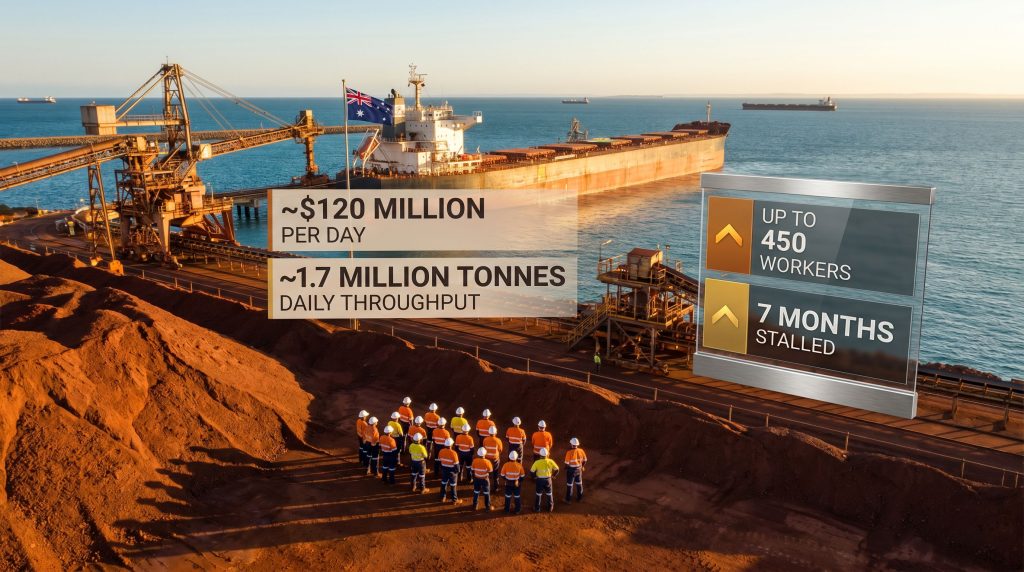
Port Hedland is not simply a large port. It is the singular artery through which the overwhelming majority of Australia's iron ore export volumes flow, processing approximately 1.7 million tonnes of iron ore every single day. At current market pricing, that daily throughput translates to roughly $120 million in revenue for BHP alone, before accounting for the broader port ecosystem that includes Fortescue and other Pilbara operators using adjacent facilities.
The port's fiscal significance extends directly to Western Australia's state budget. Iron ore royalties collected from Port Hedland-linked operations contribute approximately $6.85 to $7 million per day to the WA government's revenue base. Furthermore, the resources sector's economic contribution makes any sustained operational disruption a matter of genuine public finance concern rather than simply a corporate problem.
What makes Port Hedland uniquely vulnerable as an economic pressure point is its physical consolidation. Unlike industries where production is geographically distributed across dozens of sites, BHP's Pilbara iron ore exits through a single terminal. There is no redundancy, no alternative routing, and no buffer facility capable of absorbing displaced throughput at scale. This concentration is precisely why the BHP Port Hedland strike carries consequences that far exceed those of comparable industrial disputes in other sectors.
How This Dispute Compares to Nearly Two Decades of Industrial Quiet
To appreciate the significance of the current situation, it helps to understand just how unusual sustained industrial action in the Pilbara has been. The region's last comparable work stoppage occurred around 2008, meaning the resources sector has operated through nearly two decades of relative labour peace at its most critical export nodes. That stability was not accidental.
The Pilbara's workforce structure evolved through the 2000s and 2010s in ways that systematically reduced union density. The widespread use of contractor labour, fly-in fly-out (FIFO) rosters, and enterprise bargaining frameworks negotiated during periods of intense competition for skilled workers created conditions where many employees felt adequately compensated without collective bargaining pressure. The boom-era wages of the 2010s, when experienced tradespeople could command exceptional packages simply by virtue of scarcity, reinforced this dynamic.
The comparison between the 2008 industrial environment and the current dispute is instructive:
| Dimension | 2008 Pilbara Dispute | 2026 BHP Port Hedland Strike |
|---|---|---|
| Workers Involved | Varied by site | Up to 450 workers |
| Unions Engaged | Single union | ETU, AMWU, Combined Ports Unions |
| Action Type | Limited stoppages | Unlimited rolling stoppages (30 min to 24 hrs) |
| Daily Revenue at Risk | Lower (pre-expansion era) | ~$120 million |
| Government Position | Neutral | Supportive of workers' rights |
| WA Royalty Exposure | Undisclosed | ~$6.85 to $7 million per day |
The structural shift that changed this calculus was the Albanese government's 2022 industrial relations reform package, which expanded union access rights, strengthened multi-employer bargaining provisions, and altered the legal landscape for collective action in remote resource regions. Mining companies and Western Australia's Chamber of Minerals and Energy have since argued that these changes introduced systemic risk to the sector's labour relations model, while unions have characterised them as a necessary rebalancing after years of diminished worker power.
The Core Grievances: Pay Parity and the Structural Inequality Argument
At the heart of the BHP Port Hedland strike are pay disparities that workers and unions characterise as both inequitable and indefensible. The central flashpoint is a reported earnings gap of up to $40,000 per year between workers performing functionally identical roles but employed under different contract structures. This is not a marginal rounding difference. It represents a pay gap of between 20% and 25% for tradespeople whose total annual earnings reportedly range from $150,000 to $200,000.
The economic logic of working in the Pilbara has always involved a premium for hardship and isolation. FIFO workers sacrifice proximity to family, conventional lifestyle rhythms, and urban amenity in exchange for elevated compensation. When that premium is inconsistently applied across a workforce performing the same physical tasks in the same remote conditions, it generates a grievance that is genuinely difficult to defend on equity grounds.
Beyond wages, union representatives have identified two additional non-negotiable priorities:
- Safety conditions: The physical demands of operating heavy port equipment in extreme Pilbara heat create safety exposure that workers argue requires robust contractual protections, not just procedural guidelines.
- Equal contract terms across all workforce classifications: The structural inequality between directly employed workers and those engaged through different contracting arrangements has become a symbolic as much as practical issue.
Seven months of enterprise bargaining negotiations failed to bridge these differences. Unions characterised BHP's approach throughout that period as falling short of genuine good-faith engagement, ultimately leaving industrial action as the only remaining avenue of meaningful pressure.
Rolling Stoppages: Why Unlimited Authorisation Changes the Game
The legal and operational architecture of the authorised industrial action is arguably more significant than the initial eight-hour stoppage scheduled for July 16, 2026. The Combined Ports Unions have secured authorisation for unlimited rolling stoppages, ranging from 30-minute work bans to full 24-hour shutdowns, deployable with five days' advance notice.
This structure creates a form of sustained operational uncertainty that is, from a business continuity planning perspective, more difficult to manage than a single defined strike period. Consider the practical implications:
- BHP cannot pre-position vessel schedules, loader rosters, or logistics chains around a fixed disruption window because no such window is defined.
- The five-day notice requirement means the company faces recurring planning horizons with limited lead time.
- Rolling stoppages allow unions to modulate pressure in response to negotiating developments, escalating or de-escalating without triggering fresh legal authorisation processes.
- The unpredictability itself generates economic cost through vessel queuing, demurrage charges, and contract penalty exposure even during periods when no stoppage is active.
In addition, more port workers joining the authorised action further amplifies the potential operational impact across BHP's terminal network.
This is the key legal and operational distinction in the 2026 dispute. The authorisation of unlimited rolling stoppages transforms the industrial action from a single disruption event into an ongoing operational variable that BHP must manage indefinitely until resolution is reached.
Quantifying the Damage: Revenue, Royalties, and Supply Chain Exposure
BHP's Direct Revenue Risk
The revenue mathematics are straightforward but sobering. At approximately $120 million per day in revenue exposure, even a partial throughput reduction generates losses that accumulate rapidly:
| Stoppage Duration | Estimated Revenue Exposure |
|---|---|
| 1 day | ~$120 million |
| 5 days | ~$600 million |
| 10 days | ~$1.2 billion |
| 20 days | ~$2.4 billion |
BHP's iron ore division is the company's highest-margin operating segment, meaning disruptions here do not merely affect top-line revenue — they disproportionately compress the earnings that underpin dividend capacity and capital allocation decisions watched closely by institutional investors.
Western Australia's Fiscal Exposure
For the WA state government, iron ore royalties are not peripheral budget items. They represent a primary revenue pillar that funds infrastructure, health, and education spending. A sustained BHP Port Hedland strike extending across multiple weeks would create measurable budget pressure at the state level, adding political complexity to what is nominally a private sector labour negotiation.
Downstream Supply Chain Effects
China absorbs the overwhelming majority of Pilbara iron ore exports, primarily as feedstock for steel production. Consequently, the mechanics of how a Port Hedland disruption transmits into China's steel and iron ore market involves several lags and buffers worth understanding:
- Steel mill inventory buffers: Major Chinese steel producers typically maintain weeks of iron ore stockpile, meaning the immediate operational impact of a short stoppage is limited. It is sustained disruptions that force purchasing behaviour changes.
- Spot price dynamics: Any credible signal of reduced Pilbara supply tends to elevate spot iron ore prices, which can partially offset revenue losses for tonnage that continues to ship during rolling stoppages.
- Shipping and logistics: Vessel queuing at Port Hedland generates demurrage costs that are ultimately borne across the supply chain, affecting shipping operators, traders, and counterparties to supply contracts.
The next major ASX story will hit our subscribers first
BHP's Response and the Limits of Contingency Planning
BHP's public position has centred on two claims: that it remains committed to maintaining what it describes as industry-leading pay and conditions, and that it has contingency plans capable of sustaining safe reduced-capacity operations during any industrial disruption.
The contingency planning argument deserves scrutiny. Port operations at the scale of Port Hedland are not easily substituted. The specialised skills required to operate ship loaders, stackers, reclaimers, and associated port infrastructure safely are concentrated in exactly the workforce that unions represent. While management and contractor personnel may be able to sustain some throughput, the operational ceiling under contingency conditions is almost certainly well below normal capacity.
The South Flank and Mining Area C agreement provides a nuanced data point. When more than 1,800 workers at those BHP operations endorsed a new enterprise agreement by 58% of the vote despite active union campaigning against it, it demonstrated that workforce sentiment across BHP's Pilbara operations is not monolithic. Some worker cohorts have reached accommodation with BHP's bargaining approach. The Port Hedland port workers clearly have not, and their strategic leverage as controllers of the export terminal gives that distinction significant economic weight.
The Political Dimension: Government Positioning and IR Reform
The political environment surrounding the BHP Port Hedland strike reflects a broader realignment in Australian labour relations. Both WA Premier Roger Cook and Federal Resources Minister Madeleine King have publicly expressed support for workers' rights to pursue collective bargaining and industrial action, while stopping short of direct intervention in the negotiation process.
Minister King's observation that there appears to be a notable resistance to modern unionism within the Pilbara signals something more than political commentary. It identifies a cultural tension between the region's historically contractor-heavy, union-light labour model and the post-2022 legal environment that has strengthened workers' collective rights. That tension is structural, not episodic, and the current dispute is one manifestation of a longer realignment that will likely generate further friction across Pilbara operators.
Western Australia's Chamber of Minerals and Energy has taken the opposing position, arguing that increased industrial activity across the resource sector threatens national economic competitiveness. This argument carries genuine weight at a macro level, particularly given iron ore's contribution to Australia's trade balance, but it has found limited political traction in the current environment. However, iron ore price trends and shifting demand dynamics add further complexity to these broader competitiveness concerns.
Scenario Analysis: Resolution Pathways and Escalation Risks
Scenario 1: Negotiated Settlement Before Escalation
A rapid resolution requires BHP to move materially on the wage parity issue, the structural inequality in contract terms, and the safety provisions that unions have identified as non-negotiable. The precedent of the South Flank agreement demonstrates that enterprise bargaining in the Pilbara can produce outcomes acceptable to large worker majorities. Political pressure from both state and federal governments creates some incentive for expedited resolution. The timeline pressure is the quarterly reporting cycle, within which sustained disruption becomes impossible to characterise as operationally contained.
Scenario 2: Sustained Rolling Stoppages Through Mid-2026
If rolling stoppages persist through July and August, the cumulative effects become significant. Progressive throughput degradation, vessel scheduling disruption, and spot market price signals would accumulate alongside financial pressure on BHP's quarterly numbers. Union leverage typically increases as Chinese steel mill inventory buffers thin and buyers begin seeking alternative supply — a dynamic that takes weeks rather than days to materialise.
Scenario 3: Escalation to Extended Port Closure
The most severe scenario involves a breakdown of all remaining negotiation channels, triggering extended shutdowns that exhaust BHP's contingency capacity. At the $120 million per day revenue exposure rate, a ten-plus day sustained closure would represent exposure exceeding $1.2 billion. Government intervention mechanisms including Fair Work Commission arbitration, ministerial conciliation, or legislative action would become increasingly likely under this scenario, though the political appetite for overriding workers' authorised industrial action rights appears limited in the current environment.
Is the Pilbara's Era of Industrial Peace Permanently Over?
The deeper question raised by the BHP Port Hedland strike is whether the two-decade period of relative labour stability in the Pilbara was a durable equilibrium or simply a temporary condition created by specific economic and legal circumstances that no longer apply.
The 2022 industrial relations reforms have demonstrably altered the balance of power available to organised labour in remote resource regions. If the Port Hedland dispute resolves in ways that establish new benchmarks for wage parity and contract equality, those benchmarks will inevitably migrate across the Pilbara, affecting enterprise bargaining at Rio Tinto, Fortescue, and other major operators in subsequent negotiating cycles.
There is also an automation dimension worth noting. Mining companies have accelerated investment in autonomous haulage, remote operations, and robotic maintenance technologies partly as productivity improvements and partly as long-term hedges against exactly the kind of labour leverage that port workers currently hold. The political risk of visibly accelerating automation investment during an active industrial dispute is significant, but the strategic motivation to reduce future labour exposure will intensify regardless of how the current dispute resolves.
For international mining capital and sovereign wealth funds with exposure to Australian resource equities, the Port Hedland dispute raises legitimate questions about Australia's sovereign risk profile. Not because the dispute itself is unprecedented, but because the legal and political environment that enabled it has structurally shifted in ways that make future recurrence more probable than at any point in the past twenty years. Furthermore, broader regulatory shifts such as Trump's mining permit orders highlight how swiftly policy environments can reshape global resource investment landscapes.
Key Statistics at a Glance
| Metric | Figure |
|---|---|
| Workers Authorised to Strike | Up to 450 |
| First Confirmed Action | 8 hours (July 16, 2026) |
| Rolling Stoppage Range | 30 minutes to 24 hours |
| Negotiation Stalemate Duration | 7 months |
| Wage Disparity Cited | Up to $40,000 for equivalent roles |
| Tradesperson Annual Earnings Range | $150,000 to $200,000 |
| BHP Daily Revenue Exposure | ~$120 million |
| WA Government Daily Royalty Exposure | ~$6.85 to $7 million |
| Daily Iron Ore Throughput | ~1.7 million tonnes |
| Last Comparable Pilbara Strike | ~2008 (approximately 18 years ago) |
| South Flank/Mining Area C Vote | 58% in favour of new agreement |
| Workers Covered by South Flank EBA | More than 1,800 |
FAQ: BHP Port Hedland Strike
What is the BHP Port Hedland strike about?
Workers at BHP's Port Hedland iron ore port operations are pursuing industrial action after seven months of stalled enterprise bargaining. The core issues include wage disparities of up to $40,000 for equivalent roles, safety conditions, and unequal treatment across different workforce contract classifications.
When did the BHP Port Hedland strike begin?
The first confirmed stoppage was an eight-hour strike on July 16, 2026. Unions hold authorisation for unlimited rolling stoppages, meaning further action can be deployed with five days' notice.
How many workers are involved?
Up to 450 workers represented by the Combined Ports Unions, including the Electrical Trades Union, the Australian Manufacturing Workers' Union, and the Western Mine Workers' Alliance.
How much revenue could BHP lose?
Based on current operational data, the revenue exposure is approximately $120 million per day. A sustained ten-day stoppage could represent over $1.2 billion in lost revenue.
Is this the first major strike at Port Hedland?
This represents the most significant industrial action at Port Hedland in close to two decades, with the last comparable disruption occurring around 2008. The Onslow iron haul road developments illustrate how the broader Pilbara infrastructure landscape continues to evolve alongside these labour dynamics.
What is the government's position?
Both WA Premier Roger Cook and Federal Resources Minister Madeleine King have publicly supported workers' rights to strike and negotiate fair conditions, while stopping short of intervening directly in the bargaining process between BHP and union representatives.
Disclaimer: Revenue and royalty figures cited in this article are based on publicly reported operational data and independent analysis. Scenario projections involve assumptions about throughput, pricing, and duration that are subject to change. This article does not constitute financial advice. Readers should consult qualified professionals before making investment decisions related to the companies or sectors discussed.
Want to Stay Ahead of Major ASX Resource Sector Developments?
Discovery Alert's proprietary Discovery IQ model delivers real-time alerts on significant ASX mineral discoveries, transforming complex resource data into actionable investment insights the moment they are announced — explore Discovery Alert's discoveries page to understand how historic mineral discoveries have generated substantial market returns, and begin your 14-day free trial today to position yourself ahead of the broader market.