July 8, 2026
The Reindustrialisation Gamble: Can America Rebuild What Took 50 Years to Lose?
Primary aluminium smelting is one of the most capital-intensive, energy-hungry, and geopolitically significant industrial processes on the planet. Yet for the better part of five decades, the United States has been systematically exiting the business. The result is a domestic industry so hollowed out that a single proposed facility in northeastern Oklahoma is now being discussed in the same breath as national security, defence readiness, and the future of American manufacturing. That facility is the Oklahoma aluminium smelter project — a proposed USD 4 billion greenfield smelter that, if built, would produce more primary aluminium on its own than every remaining U.S. smelter combined.
The story of how America arrived at this point, and what it would take to reverse course, is worth understanding in full.
When big ASX news breaks, our subscribers know first
From 30 Smelters to Four: The Structural Collapse of U.S. Primary Aluminium
At its industrial peak, the United States operated more than 30 primary aluminium smelters, feeding millions of tonnes of metal annually into defence manufacturing, transportation systems, construction, and consumer goods. That era is now a distant memory.
The erosion did not happen overnight. Several compounding forces dismantled U.S. smelting capacity across multiple decades:
- The energy price shocks of the late 1970s made electricity-intensive smelting operations economically unviable at scale
- The California electricity market disruptions of the early 2000s sent power prices surging, forcing closures across the Pacific Northwest and beyond
- The 2008 global financial crisis delivered a final blow to several facilities already operating on thin margins
- Persistent competition from lower-cost overseas producers, particularly in the Gulf region and China, made new investment in U.S. capacity commercially difficult to justify
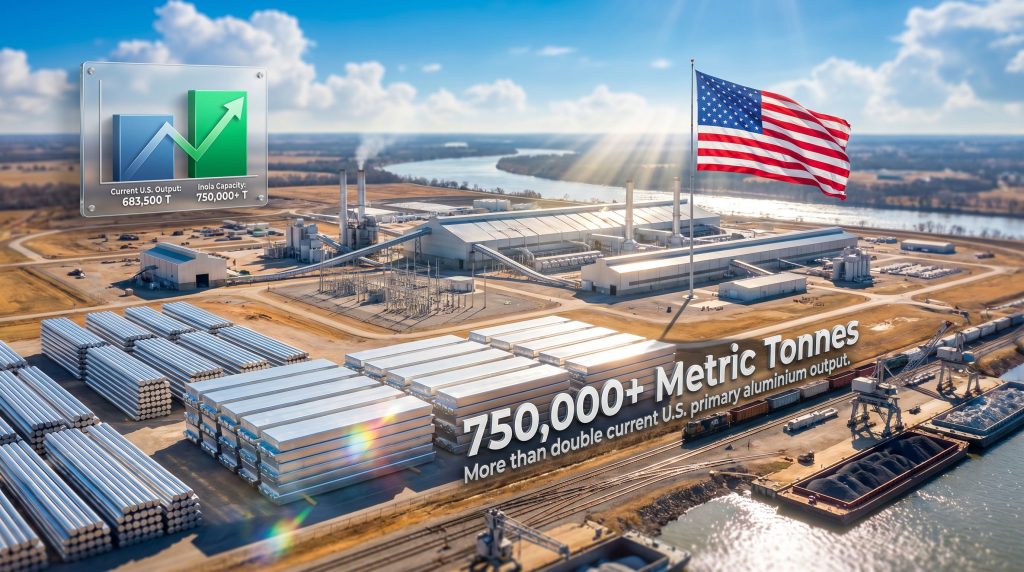
Today, the United States is left with just four operational primary aluminium smelters, producing a combined annual output of approximately 683,500 tonnes. For context, China alone accounts for more than 55% of global primary aluminium production — a dominance that has taken decades to build and will not be reversed without deliberate industrial policy and sustained capital commitment.
Why Primary Aluminium Cannot Simply Be Replaced by Recycled Metal
A common misconception is that secondary (recycled) aluminium can substitute for primary production across all applications. It cannot. The distinction matters enormously in practice:
- Primary aluminium is smelted directly from alumina derived from bauxite ore and carries no legacy alloying elements, making it essential for high-purity and high-specification applications
- Secondary aluminium is recovered from scrap and typically contains trace contaminants from previous alloy compositions, limiting its suitability for certain aerospace, defence, and advanced manufacturing uses
- Defence systems, aircraft structural components, and specific automotive applications require primary-grade metal that meets exacting chemical specifications
Adam Burstein, Technical Director for Strategic and Critical Materials, has publicly stated that aluminium is a vital material for modern defence systems while warning that U.S. dependence on foreign sources has reached a level that introduces measurable supply chain risk.
What Is the Oklahoma Aluminium Smelter Project?
Project Fundamentals at a Glance
| Feature | Detail |
|---|---|
| Project Name | Oklahoma Primary Aluminum |
| Total Investment | USD 4 billion |
| Location | Port of Inola, Rogers County, northeastern Oklahoma |
| Site Area | ~440 acres within a 2,200-acre industrial park |
| Annual Production Capacity | 750,000+ metric tonnes |
| Joint Venture Partners | Emirates Global Aluminium (EGA) 60% / Century Aluminum 40% |
| Permanent Jobs | ~1,000 direct positions |
| Construction Jobs | ~4,000 roles |
| Federal Incentive | USD 500 million U.S. Department of Energy grant |
| State Incentive Package | USD 255 million (direct funding + tax increment financing) |
| Construction Start Target | Q1 2027 |
| First Production Target | Before end of 2030 |
Emirates Global Aluminium: The International Partner
EGA is one of the largest primary aluminium producers outside of China, with deep operational expertise in large-scale, energy-intensive smelting. Its decision to commit capital to U.S. domestic production reflects a calculated read on long-term North American aluminium demand dynamics, combined with confidence that the regulatory and incentive environment is sufficiently attractive to justify the risk.
EGA brings its proprietary EX technology to the project — a next-generation smelting process that the joint venture describes as capable of making the Inola facility the most technologically advanced primary aluminium plant in the world. The 60/40 ownership structure, with EGA as the majority partner, signals where operational and technological leadership is expected to sit.
What is less widely understood is that EX technology is not merely an incremental improvement on existing smelting methods. It is designed to deliver meaningful reductions in per-tonne energy consumption and emissions intensity compared to conventional prebake cell technology — a distinction that will matter significantly when the facility faces environmental scrutiny.
Century Aluminum: The Domestic Anchor
The Alcoa joint venture model provides a useful comparison point here, as domestic partnerships have proven critical to navigating U.S. regulatory frameworks. Century Aluminum provides the domestic regulatory knowledge, community relationships, and U.S. market access that EGA, as a foreign investor, would struggle to replicate independently. Critically, Century was the recipient of the USD 500 million U.S. Department of Energy grant — one of the largest single federal investments in primary metals production in recent U.S. history. That grant reflects the DOE's formal classification of primary aluminium as a critical material for clean energy infrastructure, defence systems, and advanced manufacturing.
Why Port of Inola? The Strategic Logic Behind Site Selection
Location selection for a primary aluminium smelter is never arbitrary. The decision involves a complex optimisation across logistics costs, energy access, water availability, permitting environment, and workforce supply. Port of Inola scores strongly on several of these dimensions.
Multimodal Logistics Infrastructure
The facility will occupy approximately 440 acres within the 2,200-acre Port of Inola industrial park, a site chosen in large part for its direct connection to the McClellan-Kerr Arkansas River Navigation System. This inland waterway enables cost-effective barge transport of bulk raw materials — bauxite and alumina imported from overseas — and provides an efficient export route for finished aluminium products including billets, sheet ingots, foundry alloys, and high-purity aluminium.
Rail connectivity within the industrial park adds a second logistics mode, reducing supply chain concentration risk and providing flexibility in materials handling. For a facility that will depend entirely on imported raw materials at the front end and export-oriented finished product sales at the back end, this multimodal infrastructure is not a convenience — it is a strategic necessity.
The Power Question: Oklahoma's Most Complex Challenge
Primary aluminium smelting is among the most electricity-intensive industrial processes in existence. The Inola facility is projected to draw more than 1,000 megawatts of continuous power — a demand profile roughly equivalent to a mid-sized city.
Negotiations are ongoing with Public Service Company of Oklahoma (PSO) to structure a long-term electricity supply arrangement. The challenge is designing a power framework that meets the smelter's baseload requirements without creating structural stress on Oklahoma's broader grid. This is not a trivial engineering or commercial problem.
The electricity supply negotiation may prove to be the single most consequential variable in the project's long-term economics. Energy typically represents 30% to 40% of total primary aluminium production costs — meaning the terms of any power agreement will directly determine whether the Inola smelter can compete sustainably against lower-cost international producers.
Development Timeline: From Studies to First Metal
Phase 1: Technical Studies and Permitting (Active, 2025 to 2026)
- Technical studies commenced in December 2024 and are continuing alongside engineering work
- An air quality permit application was submitted to the Oklahoma Department of Environmental Quality (ODEQ) in February 2025, and remains under active review
- A bankable feasibility study is targeted for completion by September 2026
- Major permits and regulatory approvals are targeted before end of 2026
Phase 2: Construction (Planned, Q1 2027 through 2029)
- Site construction is scheduled to begin in the first quarter of 2027
- Approximately 4,000 construction jobs are expected to be sustained across the build period
- Civil, mechanical, and electrical infrastructure to be completed through 2029
Phase 3: Production Ramp-Up (Target, Before End of 2030)
- First hot metal production anticipated before the close of the decade
- Ramp-up to full capacity of 750,000+ metric tonnes per year
- At full output, the Inola facility would more than double current total U.S. primary aluminium production
Legal and Environmental Challenges: The Attorney General's Intervention
No article on the Oklahoma aluminium smelter project would be complete without confronting the most significant procedural risk it currently faces.
In June 2026, Oklahoma Attorney General Gentner Drummond filed a legal petition seeking to block the smelter's construction. The filing characterises primary aluminium smelting as one of the most polluting heavy-industrial activities in modern manufacturing, and raises specific technical concerns that deserve serious examination.
Key Concerns Raised in the Legal Filing
- Projected emissions of more than one tonne of hydrogen fluoride per day — a toxic compound produced as a byproduct of the aluminium smelting process
- Proximity of the proposed facility to residential communities and schools in Rogers County
- Risk of water contamination in the Verdigris River corridor, which runs near the site
- Broader public nuisance concerns for surrounding communities
Hydrogen fluoride is not a trivial pollutant. At elevated concentrations, it poses serious risks to human respiratory health, vegetation, and livestock — concerns that are well-documented in communities situated near older-generation aluminium smelters globally. The critical question is whether EGA's EX technology, combined with modern emissions controls and real-time monitoring systems, can genuinely reduce fluoride emissions to levels that protect community health within the regulatory thresholds set by the ODEQ.
The Developer's Environmental Response
The joint venture has outlined several mitigation commitments:
- Deployment of real-time emissions monitoring systems across the facility
- Enclosed material handling processes to reduce fugitive dust and chemical release
- Reliance on EGA's EX technology as the operational foundation for minimising environmental impact relative to conventional smelting
- Ongoing subject to environmental permitting oversight throughout the facility's operational life
The Attorney General's petition introduces meaningful timeline risk. Even if the legal challenge is ultimately resolved in the project's favour, a prolonged court process could push construction commencement beyond the Q1 2027 target and complicate the financing structure required ahead of a final investment decision.
Community Sentiment: Economically Supportive, Environmentally Cautious
A statewide survey found that 62% of Oklahoma residents support the smelter project, primarily viewing it as a major economic development opportunity. A six-hour public open house held in Inola in late June 2026 gave community members direct access to project representatives to raise questions.
However, the Inola Board of Trustees approved a 60-day moratorium on local approvals — a temporary pause that reflects genuine community-level uncertainty rather than outright opposition. Technical planning activities have continued uninterrupted throughout this period.
The next major ASX story will hit our subscribers first
Government Support: Federal and State Backing
The Oklahoma aluminium smelter project has attracted substantial public sector interest at both federal and state levels.
President Donald Trump has publicly endorsed the project as central to his domestic manufacturing and strategic materials agenda. A formal letter to the Inola City Council positioned the smelter as a pillar of efforts to restore U.S. production of materials with national security significance. Furthermore, the Trump mining policy impact on strategic materials has structurally improved the commercial case for domestic primary production, reinforced by the administration's aluminium tariff strategy.
The USD 500 million DOE grant awarded to Century Aluminum represents one of the largest federal investments in primary metals manufacturing in recent memory. Separately, Oklahoma has committed approximately USD 255 million in combined direct funding and tax increment financing, with negotiations on the full incentive structure ongoing alongside the regulatory review process.
Erran Persley, Chief Economic Development Officer for the City of Tulsa, has described an investment of this scale as a generational opportunity to anchor skilled employment in the region and attract downstream manufacturers seeking proximity to a domestic aluminium supply.
Audrey Robertson, Assistant Secretary of Energy for Critical Minerals and Energy Innovation, reinforced this view at a community meeting, stating that large industrial projects of this nature must deliver clear and demonstrable local benefits alongside their national economic objectives.
The National Security Dimension
Perhaps the most compelling and least commercially obvious argument for the Inola project comes from the defence community. In addition, the broader aluminium tariffs impact on supply chain security has sharpened the strategic urgency of domestic production capacity.
Brigadier General Andrew Ballinger, drawing on experience at the National War College and operational deployments abroad, has argued publicly that the growing reliance on imported industrial materials has created measurable vulnerabilities in the U.S. defence manufacturing base. His core observation is that many components essential to modern military systems are now sourced from supply chains concentrated in foreign jurisdictions — a structural weakness that becomes acute during periods of geopolitical tension or trade disruption.
The Inola smelter is framed by defence analysts not as a commercial investment but as a strategic industrial asset. Primary aluminium is embedded throughout modern weapons systems, military vehicles, naval vessels, and aerospace platforms. When domestic production capacity falls short of defence requirements, procurement becomes dependent on import sources that may not be reliable under stress conditions.
Brent Skarky, Senior Vice President of Communications for the State Chamber of Oklahoma, has described the Inola project as a once-in-a-lifetime opportunity to fundamentally change the industrial trajectory of Oklahoma — a sentiment that captures both the opportunity and the high stakes of the project's outcome.
What Success Would Mean: The Production Math
| Metric | Current U.S. Output | Post-Inola Projection |
|---|---|---|
| Operating Smelters | 4 | 5 |
| Annual Primary Production | ~683,500 tonnes | ~1,433,500+ tonnes |
| Inola Share of Total Output | N/A | ~52% |
| Years Since Last New Smelter | ~50 years | Reset to 0 |
The arithmetic is striking. A single greenfield facility would effectively double U.S. primary aluminium output — not as part of a multi-decade industrial policy rollout, but as a single capital deployment decision by two private sector partners backed by federal and state incentives.
The downstream implications extend well beyond raw production statistics. Reliable domestic primary aluminium supply has the potential to attract secondary manufacturers seeking supply chain security, reduce the pricing exposure of U.S. buyers currently subject to import tariff volatility, and strengthen Oklahoma's broader industrial base in ways that compound over time. Consequently, the top aluminium companies globally are watching the Oklahoma aluminium smelter project closely as a potential signal of broader U.S. reindustrialisation momentum.
Risk Factors That Could Derail the Project
| Risk Category | Specific Concern | Potential Impact |
|---|---|---|
| Legal | AG petition delays or blocks permitting | Construction timeline slippage; financing uncertainty |
| Environmental | ODEQ permit conditions impose operational constraints | Increased capital or operating costs |
| Energy | Failure to secure competitive long-term power supply | Project economics undermined |
| Political | Shift in federal administration priorities | Loss of DOE funding or tariff protection rationale |
| Community | Sustained local opposition | Reputational risk; further regulatory scrutiny |
| Market | Aluminium price deterioration | Reduced return on investment; feasibility reassessment |
However, it is worth noting that the steel and aluminium tariff exemptions framework adds another layer of policy complexity — the terms of any future exemptions could alter the competitive dynamics that currently favour domestic production.
Critical Milestones Between Now and a Final Investment Decision
- Completion of the bankable feasibility study (targeted: September 2026)
- Resolution of the Attorney General's legal challenge without material construction delays
- Finalisation of air quality permits through the Oklahoma Department of Environmental Quality
- Conclusion of long-term electricity supply negotiations with Public Service Company of Oklahoma
- Formal final investment decision by the EGA and Century Aluminum joint venture
The Inola project is being watched closely across the global aluminium industry, U.S. policy circles, and defence procurement as a test case for whether large-scale primary metals reindustrialisation is achievable in the current U.S. regulatory and energy environment. Success would likely catalyse further foreign direct investment in U.S. critical materials production. Failure would reinforce the structural barriers that have kept American primary aluminium capacity at historically low levels for half a century.
This article contains forward-looking statements and projections based on publicly available information. Timelines, production targets, financial figures, and regulatory outcomes are subject to change. Nothing in this article should be construed as investment advice. Readers are encouraged to consult independent sources and professional advisers before making investment decisions.
Want To Catch the Next Major Materials Discovery Before the Market Does?
Discovery Alert's proprietary Discovery IQ model scans ASX announcements in real time, instantly identifying significant mineral discoveries across aluminium, bauxite, and more than 30 other commodities — delivering actionable insights to subscribers ahead of the broader market. Explore how historic discoveries have generated substantial returns on Discovery Alert's dedicated discoveries page, and begin your 14-day free trial today to position yourself at the forefront of the next major find.