
July 12, 2026
When Giant IPOs Collide With Precious Metal Markets
History shows that the most disruptive forces in commodity markets rarely originate from within those markets themselves. Currency crises, sovereign debt events, and large-scale equity dislocations have repeatedly rippled into gold and silver pricing in ways that confounded investors focused solely on supply and demand fundamentals. The mechanism is not mysterious: when liquidity is drained from one corner of the financial system, correlations between seemingly unrelated asset classes tend to compress toward one.
Understanding this dynamic is arguably the most important analytical framework a precious metal investor can apply in 2025. Furthermore, the gold-stock market relationship offers critical context for understanding how equity dislocations feed into precious metal pricing during periods of systemic stress.
The SpaceX IPO impact on gold and silver is not a straightforward story about space exploration funding or aerospace-sector demand. It is a story about mechanical market forces, record-high margin debt, concentrated index rebalancing, and a correlation between gold and growth equities that has reached historically unusual levels. Investors who dismiss this as a technology story are potentially misreading the risk environment.
When big ASX news breaks, our subscribers know first
Gold's Shifting Correlation With Growth Equities
From Safe Haven to Sentiment-Driven Asset
For most of modern financial history, gold occupied a distinct role as a portfolio diversifier — a store of value that tended to move independently of, or inversely to, risk assets during periods of market stress. That characteristic is part of what has made it an enduring component of institutional and retail portfolios alike.
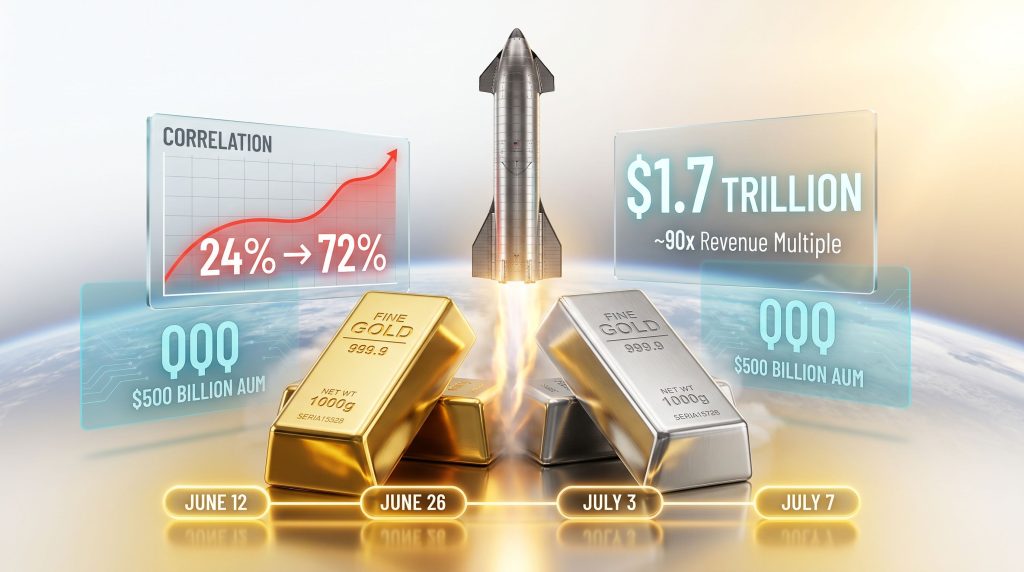
Recent data, however, reveals a meaningful departure from that historical pattern. Over a rolling 12-month window, the correlation between gold and QQQ, the ETF tracking the Nasdaq-100, sat at approximately 24% — a level broadly consistent with the traditional view that the two assets move with limited interconnection. Over the subsequent three-month window, that figure rose sharply to 58%. In the most recent one-month period, the correlation reached 72%, a level that effectively describes gold as trading in near-lockstep with large-cap technology equities.
This kind of rapid correlation compression is not a permanent structural shift, but it signals that momentum trading and leveraged positioning are dominating short-term gold price behaviour in ways that temporarily override its fundamental drivers.
The 2020 Liquidity Shock as a Historical Reference Point
The precedent most relevant to the current environment is the March 2020 COVID-driven liquidity crisis. During that period, gold sold off sharply alongside equities — not because its fundamental value had changed, but because leveraged investors across asset classes were forced to liquidate positions to meet margin calls. The mechanism was liquidity withdrawal, not a reassessment of gold's intrinsic worth.
Gold subsequently recovered and entered a sustained bull phase as central bank stimulus and real interest rate suppression reasserted themselves as dominant pricing drivers. That recovery took weeks, not years, which is a critical detail for investors trying to contextualise near-term volatility against long-term positioning. Indeed, market volatility and gold have historically maintained a complex relationship that rewards patient, informed investors.
Understanding the SpaceX IPO Structure and Valuation
A Revenue Multiple With No Modern Comparable
The SpaceX IPO represents a structural anomaly in public market history. The company is targeting a valuation of approximately $1.7 trillion, which, based on available revenue estimates, implies a price-to-revenue multiple of roughly 90 times. To understand why this number demands scrutiny, consider the following comparison:
| Company | Approximate Revenue Multiple | Market Context |
|---|---|---|
| Amazon | Under 4x | Mature e-commerce and cloud infrastructure |
| Alphabet (Google) | Under 11x historically | Dominant search and digital advertising |
| Nvidia | 19x to 24x (AI hype peak) | Described as expensive by analysts at this level |
| SpaceX (IPO target) | ~90x | No comparable precedent at this scale |
Note: Revenue multiples are approximations based on figures cited in primary source commentary. These should be independently verified against current financial data before being used for investment decision-making.
Nvidia's multiple during peak AI sentiment — a figure that attracted significant analyst concern about overvaluation — is less than one-quarter of SpaceX's implied pricing. The structural implication is that SpaceX shares are being priced almost entirely on narrative and future optionality rather than current earnings capacity. According to analysis from Proactive Investors, investors are still awaiting share allocations as Musk's bold experiment unfolds in real time.
The Constrained Float Strategy and Its Market Implications
A particularly notable feature of the SpaceX IPO structure is the deliberately restricted share float. Most companies listing at this scale make a proportionally larger number of shares available to the market to absorb institutional demand without creating artificial price inflation. SpaceX's approach inverts this convention.
By releasing fewer shares than demand warrants, the basic mechanics of supply scarcity push each available share's market price above what would otherwise be implied by fundamentals. When combined with the mechanical buying pressure that comes from index inclusion, this creates conditions where price appreciation becomes partially self-reinforcing — at least in the short term.
It is also worth noting that while early investors and insiders face a shortened lock-up period of approximately 70 days rather than the standard 180-day restriction, this still prevents immediate day-one selling. The concern about a rapid insider unwind is therefore partially overstated in the near term, though the reduced lock-up period does represent a compressed timeline relative to normal IPO structure.
The Nasdaq-100 Inclusion Mechanism and Its Forced Selling Effect
How Index Rebalancing Creates Systemic Pressure
The SpaceX IPO impact on gold and silver intersects most directly through the mechanics of Nasdaq-100 inclusion. SpaceX is expected to be fast-tracked into the index within as few as 15 trading days following its IPO listing — a timeline significantly accelerated compared to standard inclusion procedures.
The consequences for QQQ, which carries approximately $500 billion in assets under management, are mechanical and non-discretionary. When a new stock is added to the Nasdaq-100:
- All passive ETFs tracking the index must rebalance their portfolios to reflect the new composition
- Fund managers are required to purchase the newly included stock regardless of their individual views on its valuation
- Funding those purchases requires selling existing holdings, creating forced selling pressure across current index constituents
- SpaceX is expected to enter as one of the top 10 holdings by market capitalisation, meaning its weighting will be substantial
- The rebalancing is triggered off-cycle by the inclusion event itself, rather than waiting for a scheduled rebalancing date
The AI-Sector Stocks Most Exposed to Rebalancing Pressure
Approximately one-fifth of QQQ's composition consists of technology companies whose valuations are heavily driven by artificial intelligence sentiment rather than demonstrated earnings. Names including AMD, Broadcom, and Palantir have accumulated significant momentum-driven premiums. These are precisely the holdings that fund managers will need to trim or liquidate to accommodate SpaceX's weighting.
Estimates for the total capital rotation triggered by SpaceX's Nasdaq-100 inclusion range from as low as $15 billion to as high as $200 billion, reflecting the genuine uncertainty about how market dynamics will play out in real time. The spread of that estimate is itself a measure of systemic risk.
Margin Debt as an Amplifier of Forced Selling
The risk environment is further complicated by the state of margin lending in U.S. equity markets. According to FINRA data, total margin debt has exceeded $1.3 trillion, reaching an all-time record that has grown faster than overall market appreciation. This matters because margin debt creates a cascading dynamic: when forced selling begins, declining prices trigger margin calls, which force additional selling, which causes further price declines.
In an environment where a large portion of AI-sector holdings are financed on margin, a forced rebalancing event does not need to be large in absolute terms to generate outsized market instability.
Key Dates and Timeline for Precious Metal Investors
The Critical Window Between June and July 2025
For investors in gold and silver, the following timeline represents the most concentrated period of potential market disruption:
| Date | Event | Relevance to Precious Metals |
|---|---|---|
| June 12, 2025 | SpaceX IPO listing date | Initial market sentiment signal; risk-on vs. risk-off early indicator |
| June 26, 2025 | Fast-track Nasdaq-100 inclusion details published | Smart money front-running begins; correlation pressure on gold increases |
| July 3, 2025 | Earliest possible inclusion date (half-day session) | Thin liquidity amplifies price swings across correlated assets |
| July 7, 2025 | Most probable effective inclusion date | Peak rebalancing execution; highest window of gold and silver volatility |
The period between June 26 and July 7 represents the highest-risk window for spillover effects into precious metals. This is when institutional front-running of the rebalancing will be most active, and when the gap between SpaceX's constrained float and mechanically required purchases will be at its most acute.
Three Scenarios: How the IPO Could Affect Gold and Silver
Scenario A: Risk-On Outcome
If the IPO proceeds smoothly and investor confidence in high-growth equities strengthens, capital may rotate away from defensive assets including gold and silver. In this scenario:
- Institutional appetite for growth narratives increases at the expense of safe-haven positioning
- Gold faces short-term headwinds as momentum traders shift allocation toward SpaceX and correlated technology equities
- Silver's industrial demand story may temporarily recede in prominence relative to equity market excitement
- The correction, if it occurs, is likely modest and sentiment-driven rather than fundamentals-driven
Scenario B: Risk-Off Outcome
If market participants broadly conclude that SpaceX's 90x revenue multiple is structurally unsustainable, the IPO itself could become a catalyst for risk aversion. Under this scenario, perceived overvaluation triggers broader equity caution. Consequently, gold and silver benefit from renewed defensive positioning as investors seek capital preservation. Gold's safe-haven role becomes particularly prominent under these conditions.
Scenario C: Liquidity Cascade
This represents the most severe but not implausible outcome. Forced selling of overvalued AI and momentum technology stocks during the rebalancing triggers margin calls across leveraged positions. The correlation between gold and QQQ at 72% means that gold is temporarily dragged lower — not because of any change in its fundamental value, but because liquidity is being withdrawn from correlated markets simultaneously.
The 2020 COVID shock demonstrated that this kind of correlated, liquidity-driven selloff in gold is temporary. Once forced selling exhausts itself, gold's fundamental drivers — including real interest rates, inflation expectations, and currency dynamics — tend to reassert pricing control relatively quickly.
The next major ASX story will hit our subscribers first
What Silver Investors Need to Understand Specifically
Silver's Dual Exposure Creates Compounded Sensitivity
Silver occupies an unusual position in this framework because it functions simultaneously as a safe-haven asset and an industrial commodity. In a risk-off environment, silver benefits from defensive positioning. In a risk-on environment, its industrial demand narrative supports pricing. However, in a liquidity-driven equity drawdown, both of those characteristics can temporarily work against it.
Understanding silver's dual nature is therefore essential for investors assessing how a SpaceX-driven liquidity event might affect their silver positions differently from gold. When equity markets experience forced selling, silver's higher volatility relative to gold means it tends to experience sharper short-term price movements in both directions. The 8% single-day drop observed in silver during a recent period of market turbulence illustrates how quickly sentiment-driven corrections can materialise.
The SpaceX Silver Demand Narrative: Separating Fact From Speculation
Some commentary has suggested that SpaceX's space infrastructure and theoretical space-based solar programmes could drive meaningful future silver demand. This deserves careful qualification. Furthermore, as 247WallSt notes, while the IPO may eventually signal a silver boom, the aerospace sector's silver consumption is minimal in absolute terms when measured against photovoltaic panel manufacturing and consumer electronics — which are the primary industrial demand drivers for silver.
Any potential silver demand uplift from SpaceX's long-term orbital projects would take years to materialise and would likely represent a fraction of the volumes that move silver markets in the near term. This is speculative and forward-looking at best, and should not be incorporated into near-term pricing models.
Is Gold's Safe-Haven Role Permanently Impaired?
Temporary Correlation Versus Structural Change
The rise in gold's correlation with QQQ to 72% over one month does not indicate a permanent change in gold's nature as a financial asset. It reflects the current dominance of momentum-driven trading behaviour and the presence of leveraged positioning that makes short-term price movements sensitive to equity market dynamics.
Gold's long-term value drivers remain structurally intact:
- Real interest rate levels and their relationship to opportunity cost
- Inflation expectations and central bank credibility
- Currency debasement dynamics and reserve diversification by sovereign wealth funds
- Geopolitical uncertainty and demand for neutral reserve assets
None of these factors are altered by a technology company's IPO. What changes temporarily is the composition of the marginal buyer and seller in gold markets, skewing toward momentum traders whose behaviour is correlated with equity sentiment.
The Case for Viewing Near-Term Volatility as a Strategic Opportunity
A Momentum Reset Could Benefit Long-Term Precious Metal Bull Markets
Counterintuitively, a sharp but temporary correction in gold and silver driven by the SpaceX IPO impact on gold and silver could prove constructive for the long-term bull market thesis. Extended momentum-driven rallies accumulate speculative positioning that makes markets fragile and susceptible to disorderly unwinds.
A forced expulsion of leveraged momentum traders from precious metals — while uncomfortable in the short term — would leave behind a more structurally sound participant base. This would consist of investors with genuine conviction in gold and silver's fundamental value drivers. Historically, such resets have preceded sustained, fundamentals-driven advances rather than terminal declines.
Patient investors who understand the distinction between liquidity-driven short-term price dislocations and long-term fundamental value cycles are best positioned to treat potential summer 2025 weakness as a strategic entry point rather than a reason to exit.
FAQ: SpaceX IPO and Precious Metal Market Dynamics
Will the SpaceX IPO directly reduce gold demand?
The relationship is indirect. Capital rotation, investor sentiment shifts, and correlated equity market movements create the linkage — not any direct change in gold's supply and demand fundamentals.
Could the SpaceX IPO trigger a major gold price crash?
A fundamental-driven crash is unlikely. However, a liquidity-driven correction — particularly if AI-sector margin calls cascade during rebalancing — could produce a sharp but temporary pullback. The 2020 COVID shock provides the closest structural analogy, where the correction was severe but short-lived.
Does SpaceX's business directly increase silver demand?
Not in any near-term meaningful way. Aerospace silver consumption is marginal compared to photovoltaic and electronics manufacturing. Any future demand uplift from orbital or space-solar projects is theoretical and years from materialising as a pricing catalyst.
When is the highest-risk window for precious metal volatility?
The period between June 26 and July 7, 2025 is the most concentrated window, when Nasdaq-100 inclusion details are confirmed and the effective rebalancing date is executed. Thin liquidity on July 3 adds additional volatility risk during this window.
How should precious metal investors position during this period?
Reducing leveraged exposure, monitoring ETF rebalancing developments closely, and maintaining a long-term perspective on gold and silver's fundamental value drivers are the core positioning principles relevant to this environment. In addition, tracking the gold-silver ratio analysis throughout the June–July window can help investors identify relative value shifts between the two metals in real time.
Key Takeaways: The SpaceX IPO Risk Framework for Precious Metal Portfolios
- Gold's correlation with QQQ has accelerated from 24% over 12 months to 72% over the most recent month, making it temporarily vulnerable to equity-driven liquidity events
- SpaceX's $1.7 trillion target valuation at approximately 90x revenue represents pricing with no credible historical comparable at this scale
- QQQ's approximately $500 billion in assets under management means index rebalancing will generate substantial forced selling across current Nasdaq-100 holdings
- U.S. margin debt exceeding $1.3 trillion at record highs creates a cascading risk if rebalancing triggers margin calls across leveraged AI-sector positions
- Capital rotation estimates from the inclusion event range from $15 billion to $200 billion, reflecting genuine uncertainty about the scale of market impact
- Silver carries slightly higher short-term exposure than gold due to its hybrid industrial and safe-haven characteristics, but macro drivers remain dominant for both metals
- Any liquidity-driven weakness in precious metals this summer is structurally temporary; gold's long-term fundamental case — built on real rate dynamics, inflation expectations, and currency diversification demand — remains intact
This article contains forward-looking analysis, scenario projections, and commentary on market dynamics that involve inherent uncertainty. Nothing contained here constitutes financial advice. Investors should conduct their own research and consult qualified financial professionals before making investment decisions.
Want to Stay Ahead of the Next Major Mineral Discovery Before the Market Moves?
While macroeconomic events like the SpaceX IPO create short-term volatility across precious metals, Discovery Alert's proprietary Discovery IQ model cuts through the noise by delivering real-time alerts on significant ASX mineral discoveries — the kind that have historically generated substantial returns, as showcased on Discovery Alert's dedicated discoveries page. Begin your 14-day free trial at Discovery Alert today and position yourself ahead of the market before the next major discovery is announced.