July 12, 2026
The Infrastructure Gap That Could Define the Next Decade of Global Industry
Commodity markets have always carried geopolitical weight, but the current era is distinct. For the first time in modern industrial history, the materials required to build artificial intelligence infrastructure, manufacture semiconductors, and power defence systems are simultaneously concentrated in a single national supplier, subject to escalating export controls, and in structurally rising demand. This convergence is not a future risk scenario. It is an operating reality that procurement leaders, institutional investors, and policy architects are navigating right now.
Understanding why the Datavault AI and Patriot Strategic Metals critical minerals platform has attracted attention requires starting not with the companies themselves, but with the architecture of the problem they are attempting to solve.
When big ASX news breaks, our subscribers know first
Why Critical Mineral Supply Chains Are Under Systemic Pressure
The International Energy Agency has identified critical minerals demand as a frontline issue for global energy and economic security, particularly in an environment of elevated geopolitical tension. The scale of the concentration problem is stark when examined numerically.
| Metric | Figure |
|---|---|
| China's share of global mining output (2024) | ~60% |
| China's share of midstream/downstream battery supply chain | 80%+ |
| Key minerals in focus | Copper, Lithium, Cobalt |
These figures are not simply market share statistics. They represent structural dependencies embedded into the production systems of industries that are simultaneously experiencing explosive demand growth. When a single nation controls both the extraction of raw materials and the processing capacity required to make them industrially usable, the leverage implications extend far beyond commodity pricing.
The IEA has noted that a sequence of export controls on key materials and technologies has materially elevated supply risk for downstream manufacturers. Furthermore, the energy security risks for industries including AI data centre construction, semiconductor fabrication, and advanced defence hardware are not abstract vulnerabilities. They are procurement constraints already shaping capital allocation decisions.
Which Industries Carry the Greatest Exposure?
- Artificial intelligence infrastructure and data centre buildout, where copper intensity is high and lithium-based energy storage is critical
- Semiconductor fabrication, which depends on ultra-refined specialty metals at every stage of the wafer production process
- Defence systems manufacturing, where supply chain provenance and certification carry national security implications
- Robotics, advanced manufacturing, and electrification platforms, all of which require cobalt and lithium at scale
- Energy transition technologies, including grid-scale storage and electric vehicle platforms
The convergence of these demand vectors against a constrained and geopolitically sensitive supply base is what makes the architecture of new procurement infrastructure genuinely consequential.
What the Strategic Materials Acquisition Platform Is Designed to Do
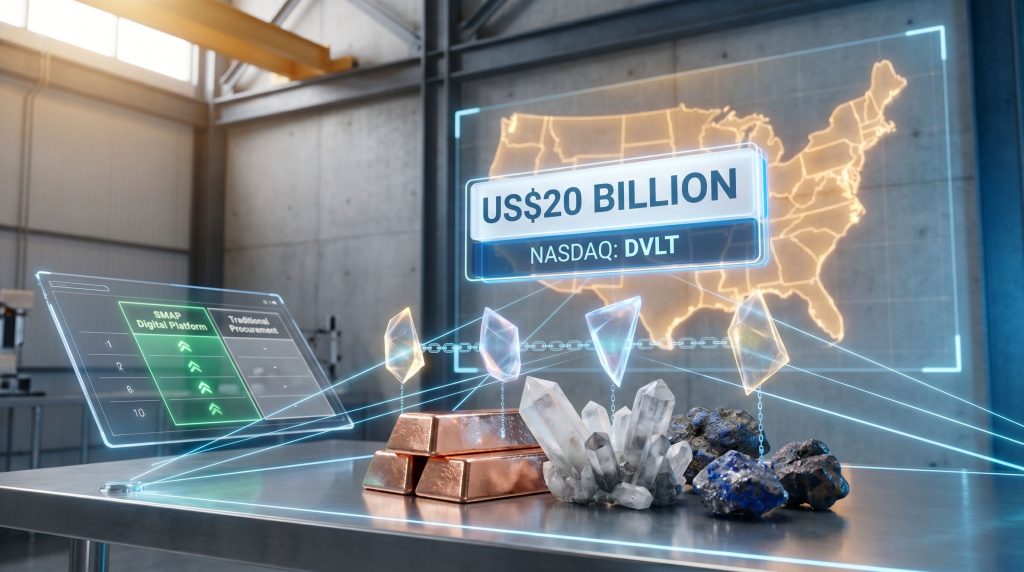
The Strategic Materials Acquisition Platform, or SMAP, represents a proposed new category of institutional mineral infrastructure. Rather than functioning as a trading desk or a logistics provider, SMAP is conceived as a full-stack platform that connects the physical world of mineral extraction with the digital systems of institutional finance.
At its core, SMAP is designed to convert illiquid physical mineral inventories into financeable digital assets, with the goal of accelerating capital velocity, improving transactional transparency, and reducing the friction that currently characterises cross-border mineral procurement.
The operational scope of the platform is deliberately comprehensive:
- Mining ownership and extraction interests across strategic metal categories
- Long-term offtake agreement structuring and management
- Refining operations and certified inventory storage
- Commodity trading and multi-party settlement
- Logistics, insurance, and distribution coordination via the International Elements Exchange
- Digital escrow mechanisms and smart contract automation for institutional transactions
This breadth reflects a recognition that fragmenting the supply chain into isolated components has historically been a source of inefficiency and counterparty risk. SMAP's design logic is integration across the full lifecycle, from extraction certification through to final distribution settlement.
Redefining Offtake Agreements in a Tokenised Environment
In conventional mining finance, an offtake agreement is a contract between a resource producer and a buyer committing to purchase a defined volume of future mineral output at agreed terms. These instruments are foundational to project financing because they provide revenue visibility that supports debt capital structures.
Historically, however, offtake agreements have been relatively illiquid. They are bilateral, documentation-heavy, and dependent on relationship networks to transfer or refinance. Tokenisation changes this dynamic by assigning a digital representation to the underlying physical asset, making the agreement potentially tradeable within institutional frameworks and enabling smart contract execution of settlement conditions without manual intervention.
For mining operations, this has meaningful implications. Financing access that once depended on established banking relationships and weeks-long documentation processes could, within a tokenised infrastructure, become faster, more transparent, and accessible to a wider pool of institutional capital.
The Technology Stack Powering SMAP
The platform's technical architecture draws on several converging innovations that have matured sufficiently for institutional deployment.
| Technology Layer | Function |
|---|---|
| RWA Tokenisation | Converts physical mineral assets into tradeable digital tokens |
| Blockchain Settlement | Provides immutable, transparent transaction records |
| Smart Contract Automation | Executes procurement and offtake terms without manual intervention |
| Digital Escrow | Secures institutional trade finance transactions |
| AI-Enabled Infrastructure | Optimises sourcing decisions and operational efficiency |
Real-world asset tokenisation, or RWA tokenisation, is the process of creating a blockchain-based digital token that represents ownership or economic rights in a physical asset. In the context of critical minerals, this means a certified quantity of copper, lithium, or cobalt held in a government-approved vault can be represented as a digital instrument, assigned to a trade finance framework, and settled via smart contract without the delays inherent in traditional paper-based documentation systems.
Datavault AI, listed on NASDAQ under the ticker DVLT, holds patented RWA tokenisation technology and has expanded its infrastructure through an integration with IBM's watsonx platform. This integration is oriented toward tokenising data at the point of creation, transforming raw inputs into authenticated and tradeable digital property in real time. Applied to mineral supply chains, this capability could enable end-to-end provenance tracking from extraction point through to final buyer, with an immutable audit trail at every stage.
Deloitte has observed that generative AI holds transformative potential for sourcing and procurement, enabling more proactive and intelligent operational decisions. The SMAP architecture reflects this direction by embedding AI-enabled infrastructure into the core of its sourcing optimisation and operational management functions.
How the Partnership Between Datavault AI and Patriot Strategic Metals Is Structured
The two entities bring complementary capabilities that, in combination, span the full spectrum from physical asset to digital settlement.
Patriot Strategic Metals contributes:
- Integrated mining interests across strategic metal categories
- An established long-term offtake agreement portfolio
- Refining capabilities and access to government-approved vault storage
- Existing commodity trading and supply chain operations with institutional counterparties
Datavault AI contributes:
- Patented RWA tokenisation technology
- Institutional-grade cybersecure digital infrastructure
- IBM watsonx integration enabling real-time data tokenisation
- Blockchain-based settlement and digital asset management capabilities
The partnership's managing member at Patriot Strategic Metals has characterised the arrangement as providing the technological foundation required to modernise how critical minerals are financed and moved through supply chains, combining RWA infrastructure with digital settlement and institutional trade finance in a single integrated system.
Datavault AI's chief executive has described the combination as bringing together physical strategic assets and institutional-grade cybersecure digital infrastructure, with the objective of building a framework that modernises how strategic mineral supply chains are financed, settled, and managed across the full lifecycle.
The Financial Architecture: Phase I and Beyond
The scale of the financial framework proposed for SMAP is notable, and warrants careful reading. The figures represent a contemplated structure, subject to finalisation of definitive agreements and satisfaction of applicable conditions.
| Component | Value |
|---|---|
| Phase I Platform Development Programme | Up to US$700 million |
| Datavault AI Technology Integration Allocation | Up to ~US$62 million |
| PSM Revolving Procurement Facility | Up to US$20 billion |
| Datavault AI Net Profit Participation | 25% of distributable platform profits |
The revolving procurement facility of up to US$20 billion is particularly significant as a structural instrument. A revolving facility in commodity procurement functions similarly to a revolving credit facility in corporate finance: capital is deployed to acquire mineral inventory, that inventory is sold or settled, and the proceeds cycle back through the facility to fund the next acquisition. At the scale proposed, this would represent a substantial institutional commitment to non-Chinese mineral supply chain infrastructure.
Datavault AI's participation in 25% of net distributable platform profits creates a direct revenue linkage between the technology provider and the platform's commercial performance, incentivising ongoing infrastructure development and optimisation.
Disclaimer: Financial projections, platform valuations, and revenue participation figures discussed in this article are based on proposed structures and are subject to material conditions including board approval, regulatory compliance, and financing confirmation. They do not constitute investment advice or a guarantee of future performance.
The next major ASX story will hit our subscribers first
From Extraction to Settlement: The SMAP Transaction Lifecycle
Understanding how SMAP would function in practice requires mapping the full transaction sequence.
- A mineral asset is extracted and certified at its source, establishing provenance documentation
- The physical asset is tokenised via Datavault AI's patented RWA infrastructure, creating a digital representation tied to the certified inventory
- The digital token is assigned to the institutional trade finance framework, enabling capital deployment against the asset
- Smart contracts execute offtake terms and settlement conditions according to pre-agreed parameters, without requiring manual authorisation at each step
- Blockchain records provide an immutable audit trail that satisfies compliance and certification requirements
- Distribution and logistics are coordinated through the International Elements Exchange
- Net proceeds are settled and distributed according to the platform's profit-sharing architecture
This sequence compresses what has historically been a multi-week, documentation-intensive process into a near real-time digital workflow.
How SMAP Compares to Traditional Procurement Models
| Dimension | Traditional Procurement | SMAP Digital Platform |
|---|---|---|
| Asset Liquidity | Low, illiquid physical inventory | High, tokenised and tradeable |
| Settlement Speed | Days to weeks | Near real-time via blockchain |
| Transparency | Fragmented, document-dependent | Immutable on-chain audit trail |
| Financing Access | Relationship-dependent and slow | Institutional trade finance integration |
| Geographic Diversification | Concentrated, single-source risk | Multi-source, platform-managed |
| Compliance and Certification | Manual and paper-based | Automated via smart contracts |
The efficiency differential between these two models is not marginal. For industries operating on tight manufacturing timelines with complex supply chain dependencies, the ability to settle mineral procurement in near real-time with transparent provenance documentation carries operational value that extends well beyond cost considerations.
Regulatory and Implementation Conditions
It is important to note that the Datavault AI and Patriot Strategic Metals critical minerals platform remains at the proposed stage. Several material conditions must be satisfied before the platform becomes operational:
- Finalisation of definitive partnership agreements between the two entities
- Completion of board approvals from both organisations
- Satisfaction of applicable regulatory requirements across relevant jurisdictions
- Confirmation of financing availability for Phase I deployment
For institutional adoption of RWA platforms in commodity markets, regulatory clarity is not merely a procedural box. It defines the legal enforceability of tokenised instruments, the compliance frameworks within which smart contracts can operate, and the standards that govern digital escrow and settlement. Consequently, as regulators in major jurisdictions continue to develop frameworks for real-world asset tokenisation, the pace of that regulatory evolution will materially influence how quickly platforms like SMAP can scale.
Frequently Asked Questions
What is the Strategic Materials Acquisition Platform?
SMAP is a proposed institutional platform designed to connect physical critical mineral supply chains with digital settlement infrastructure, combining mining interests, offtake agreements, and refining operations with RWA tokenisation and blockchain-based settlement systems.
What Minerals Does the SMAP Platform Cover?
The platform is focused on copper, lithium, and cobalt — three minerals that are central to AI infrastructure, semiconductor manufacturing, defence hardware, and energy transition technologies.
How Does RWA Tokenisation Work in Critical Minerals?
RWA tokenisation creates a blockchain-based digital token representing a certified physical mineral inventory. This token can be assigned to institutional finance frameworks, traded, and settled via smart contract, dramatically improving liquidity and reducing settlement friction compared to traditional documentation-based processes.
What is Datavault AI's Financial Stake in the Partnership?
Datavault AI is allocated up to approximately US$62 million for technology integration within Phase I, and would participate in 25% of net distributable platform profits generated through SMAP operations. The full proposed partnership structure is detailed in the official press release.
Is the Partnership Already Operational?
No. The arrangement is proposed and remains subject to finalisation of definitive agreements, board approvals, regulatory compliance, and confirmation of Phase I financing.
What is the International Elements Exchange?
The International Elements Exchange is the operational settlement ecosystem through which SMAP would coordinate acquisition, storage, transportation, certification, insurance, and distribution of strategic minerals sourced through the platform.
What Institutional Stakeholders Should Be Monitoring
For procurement leaders and institutional investors watching this space, several indicators will determine how consequential the Datavault AI and Patriot Strategic Metals critical minerals platform ultimately becomes.
The first is regulatory evolution around RWA tokenisation in major commodity trading jurisdictions. Frameworks that provide legal clarity for tokenised instruments in trade finance will accelerate institutional adoption and expand the addressable market for platforms like SMAP.
The second is the pace at which non-Chinese mineral supply alternatives develop sufficient scale and certification standards to satisfy the provenance requirements of defence critical minerals and semiconductor manufacturers. Institutional procurement decisions in these sectors are not purely price-driven. Origin certification, chain-of-custody documentation, and supplier diversification carry increasing weight in sourcing strategies.
The third is the broader maturation of blockchain settlement infrastructure in commodity markets. While the technology has existed for several years, institutional-grade deployment in physical commodity procurement remains relatively nascent. The integration of AI-enabled optimisation, smart contract automation, and digital escrow within a single platform represents a meaningful step toward the kind of end-to-end infrastructure that large-scale commodity buyers require.
In addition, the broader question of how European critical raw materials policy evolves will also shape demand for platforms designed to diversify away from single-source concentration risk. The convergence of AI infrastructure demand, mineral supply concentration risk, and digital finance innovation is creating conditions where platforms designed at the intersection of all three could become genuinely significant. Whether SMAP fulfils that potential will depend on execution, regulatory alignment, and the speed at which institutional capital commits to building supply chains that are architecturally independent of single-source concentration risk.
This article is intended for informational purposes only and does not constitute financial or investment advice. All figures relating to proposed financial structures are subject to conditions and should not be relied upon as confirmed commitments.
Want to Track the Next Major Mineral Discovery Before the Market Does?
Discovery Alert's proprietary Discovery IQ model delivers real-time alerts on significant ASX mineral discoveries across copper, lithium, cobalt, and more than 30 other commodities — instantly translating complex data into actionable investment insights for both traders and long-term investors. Explore historic discoveries and their returns to understand the scale of opportunity, then begin your 14-day free trial at Discovery Alert to position yourself ahead of the market.