July 12, 2026
When Energy Policy Meets Economic Reality: Colombia's Hydrocarbon Crossroads
Across Latin America's commodity-producing economies, few sectors carry as much macroeconomic weight as the hydrocarbon industry does in Colombia. Oil and gas revenues have historically underwritten public spending, anchored export earnings, and supported the fiscal architecture of the state. Yet a confluence of policy decisions, investment retreat, and accelerating reserve depletion has placed the Colombia oil and gas decline at the centre of what may become one of the most consequential energy crises in the country's modern history.
Understanding what went wrong, and whether it can be corrected, requires looking beyond headlines and into the structural mechanics of how upstream production cycles actually function. Furthermore, the oil and gas drilling policy shifts occurring globally provide important context for understanding Colombia's situation.
When big ASX news breaks, our subscribers know first
The Arithmetic of Depletion: How Deep Does the Decline Run?
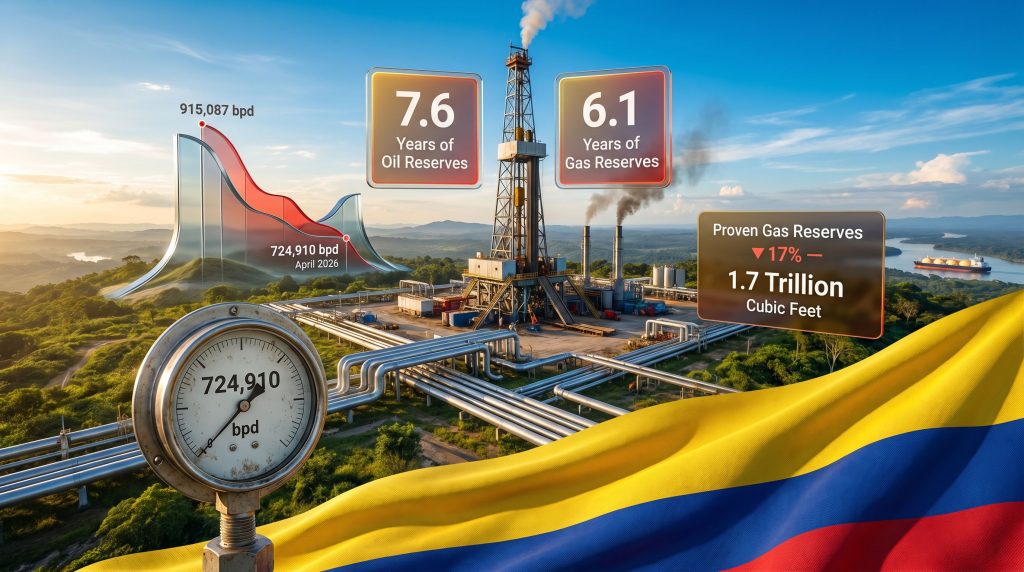
Colombia's crude oil output reached 724,910 barrels per day (bpd) in April 2026, the lowest recorded figure since June 2021. A decade earlier, the same month registered 915,087 bpd, meaning the country has shed more than 190,000 bpd of productive capacity over ten years. That is not a cyclical fluctuation. It is a structural erosion driven by field maturity, chronic underinvestment in replacement capacity, and a near-complete halt in frontier exploration.
The natural gas picture is arguably more alarming. Output fell approximately 14% year-over-year to 694 million cubic feet per day (MMcf/d) in April 2026, representing a decline of roughly 36% compared to volumes produced a decade earlier. For context, that same period a month earlier had registered approximately 1 billion cubic feet per day, illustrating how rapidly the productive base is contracting.
Reserve metrics reinforce the severity of the situation:
- Proven (1P) oil reserves declined nearly 1% in 2025 to just over 2 billion barrels
- Proven gas reserves collapsed 17% in a single year to approximately 1.7 trillion cubic feet
- At current depletion rates, oil reserves support roughly 7.6 years of production
- Gas reserves cover an even shorter window of approximately 6.1 years
These reserve life figures place Colombia's energy security in a precarious position. A 7.6-year oil runway and a 6.1-year gas runway, without active reserve replenishment, means critical supply thresholds could be breached well within the current decade.
The International Energy Agency projects Colombian output could decline further to 620,000 bpd by 2028, representing a 20.5% contraction from 2023 production levels if no material policy or investment change occurs. The crude oil price trends globally will also have a significant bearing on how quickly recovery investment can be justified.
What Triggered the Colombia Oil and Gas Decline?
The Exploration Moratorium and Its Upstream Consequences
In January 2023, Colombia's government under President Gustavo Petro formally ceased issuing new oil and gas exploration contracts as part of a broader energy transition agenda oriented toward renewables and emissions reduction. The decision was the single most disruptive regulatory intervention in the country's upstream sector in modern history.
The cessation of so-called wildcat drilling, the high-risk frontier exploration that discovers and validates new resource deposits, severed the reserve replenishment cycle that sustains long-term production. Without new contract issuances, the exploration pipeline did not simply slow. It stopped.
In oil and gas systems, the gap between exploration activity and actual production is typically measured in years, sometimes decades. The full consequences of a multi-year exploration freeze are therefore still unfolding, meaning the worst production impacts from this policy decision may still lie ahead.
The Investment Retreat
Regulatory uncertainty creates immediate capital flight in extractive industries, where long-dated projects require stable fiscal and legal environments before large capital commitments can be justified. The exploration ban sent precisely the wrong signal to international operators.
| Factor | Observed Impact |
|---|---|
| Exploration contract freeze | Eliminated new field development pipeline entirely |
| Regulatory uncertainty | Deterred both domestic and foreign upstream capital |
| Rising risk premium | Increased the cost of capital for Colombian projects |
| Investment decline forecast | Production investment projected to fall 7% to $3.5 billion in 2024 |
| Operational tempo reduction | Drilling activity and field maintenance programmes declined sector-wide |
The self-reinforcing nature of this cycle is what analysts have described as a structural trap. Declining reserves suppress the investment case, which prevents reserve recovery, which deepens the decline further. According to Reuters reporting on Colombia's upstream sector, investment was already projected to fall sharply even before the full downstream consequences of the moratorium had materialised.
The Economic Consequences: From Export Engine to Import Dependency
Colombia's Fiscal Exposure to Hydrocarbon Performance
Fossil fuels, primarily oil and coal, accounted for approximately 50% of Colombia's total export revenue in 2023. The fiscal consequences of sustained production decline have been estimated at losses approaching $4.59 million between 2022 and 2026, escalating to an estimated $26.5 million by 2032 if the trajectory is not reversed. The administration's fiscal deficit is already projected to reach 7 to 8% of GDP, making energy sector recovery a prerequisite for fiscal consolidation, not merely a growth ambition.
The LNG Import Trap
Colombia began importing liquefied natural gas in December 2016 to bridge the widening gap between domestic gas production and consumption demand. By 2026, the country imports nearly one-third of all natural gas it consumes. That dependency comes at a steep cost, and the broader LNG supply outlook for 2025 and beyond suggests import costs are unlikely to ease meaningfully in the near term:
- Regional gas prices have risen 25% to 36% as import costs pass through to domestic consumers
- Annualised inflation reached 5.84% in May 2026, the highest reading since 2024, partially driven by energy import costs
- Lower-income households, where natural gas is the primary cooking and heating fuel, are bearing a disproportionate share of this burden
- Global LNG supply disruptions linked to Middle East tensions have further tightened the market, compounding Colombia's import cost exposure
The Electricity Grid Vulnerability
Colombia's electricity system depends heavily on hydroelectric generation, which is inherently vulnerable to El Nino-driven drought cycles that reduce reservoir levels and curtail output. When hydroelectric capacity contracts during severe drought periods, gas-fired power plants are required to absorb the shortfall. With domestic gas supply shrinking and import costs rising, this fallback mechanism is becoming progressively more expensive and less reliable.
A severe El Nino event coinciding with continued gas supply deterioration could simultaneously compress hydroelectric output and exhaust affordable gas-fired backup capacity, creating a compound energy shock with significant macroeconomic consequences.
Diesel imports are also rising as domestic refining capacity fails to match consumption demand, particularly in agriculture and freight transport, adding another layer of balance of payments pressure.
Three Scenarios for Colombia's Hydrocarbon Future
The range of possible outcomes for the Colombia oil and gas decline is wide. Three distinct scenarios frame the trajectory, depending on the policy actions taken over the next 12 to 24 months.
Scenario 1: Managed Decline Without Policy Reversal
If the exploration moratorium remains in effect and no material investment stimulus is introduced:
- Production continues declining toward the IEA's projected 620,000 bpd by 2028
- LNG import volumes expand; balance of payments deterioration accelerates
- Fiscal deficit widens as export revenue falls
- Energy security risk intensifies ahead of the next major El Nino cycle
- GDP growth remains structurally constrained below the 7% target
Scenario 2: Partial Recovery Through Conventional Exploration Reactivation
If new exploration contracts are reinstated for conventional onshore and offshore acreage:
- Investment sentiment stabilises and upstream capital flows resume
- Production stabilises in the 750,000 to 800,000 bpd range by 2028 to 2029
- Gas reserve replenishment reduces LNG import dependency over a 3 to 5 year horizon
- Fiscal pressure eases modestly as export revenue begins recovering
Scenario 3: Transformational Recovery via Unconventional Resource Development
If hydraulic fracturing pilots are activated under strict regulatory conditions and validate Colombia's estimated unconventional resource base:
- Colombia's National Hydrocarbons Agency (ANH) estimates the country holds 3 billion recoverable barrels of shale oil and 34 trillion cubic feet of shale gas
- Successful pilot validation could fundamentally restructure the country's reserve base
- Production trajectory reverses toward or beyond 900,000 bpd over a 5 to 10 year development horizon
- LNG import dependency is progressively eliminated
- Energy sovereignty is restored over the medium term
Disclaimer: Scenario projections involve forward-looking assumptions subject to material uncertainty. Actual outcomes will depend on policy decisions, commodity prices, investment flows, and geological results not yet determined. These projections should not be relied upon as investment advice.
Fracking and the Unconventional Prize
What the Legal Framework Currently Permits
Colombia's Council of State, the country's highest administrative tribunal, issued a landmark ruling in 2022 affirming the government's authority to regulate and permit hydraulic fracturing operations. The ruling rejected a legal challenge seeking to overturn Bogota's right to authorise fracking, establishing a tested legal foundation for pilot programmes.
Under this framework, fracking pilots must satisfy several conditions before operations can commence:
- Operations must be restricted to geologically stable terrain with no identified seismic risk
- Projects must pose no threat to adjacent waterbodies or local ecosystems
- Indigenous rights in affected territories must be fully protected
- A formal social licence must be obtained through demonstrated community consent
These conditions are designed to address the most contested environmental and social objections to unconventional extraction, though they also introduce substantial lead times before any pilot can proceed to operations.
The Scale of the Unconventional Resource Base
| Resource Category | ANH Estimate |
|---|---|
| Recoverable shale oil | 3 billion barrels |
| Shale gas | 34 trillion cubic feet |
If pilot programmes validate even a portion of these estimates, the implications for Colombia's reserve life and production trajectory would be significant. For comparison, the country's current proven oil reserves stand at just over 2 billion barrels. A confirmed unconventional shale oil resource base of 3 billion barrels would effectively double the country's accessible oil inventory.
However, unconventional resource estimates carry inherent uncertainty until confirmed through drilling. The gap between geological potential and commercially recoverable volumes can be substantial, and Colombia's fracking services infrastructure remains underdeveloped relative to mature markets like the United States. The geopolitical risk landscape affecting global energy investment further complicates Colombia's efforts to attract the specialist capital and technology required for unconventional development.
The next major ASX story will hit our subscribers first
Ecopetrol's Role and the Natural Gas Bridge Strategy
As Colombia's state-controlled national oil company, Ecopetrol functions as both the sector's dominant upstream producer and the primary instrument through which government energy policy is executed. Its capital allocation decisions, exploration programme, and field development spending directly determine how quickly the country's production trajectory can be altered.
Any credible recovery framework depends on Ecopetrol's exploration budget being scaled up to accelerate reserve replenishment. The company also plays a central role in the bridge fuel strategy, which positions natural gas as the interim energy source connecting Colombia's current fossil fuel dependence with its longer-term renewable energy ambitions.
Increasing domestic gas production would simultaneously reduce LNG import costs, lower electricity generation expenses, and support industrial competitiveness. The bridge fuel strategy requires accelerating conventional gas exploration in the near term and, over a longer horizon, unlocking unconventional gas reserves through the regulated fracking pilot framework. The natural gas price forecast for 2025 underscores the urgency of reducing Colombia's exposure to volatile international import pricing.
Security, Infrastructure, and the Investment Environment
An often underappreciated dimension of Colombia's upstream recovery challenge is the role of security infrastructure. Illegal armed group activity targeting oil infrastructure, including pipeline attacks and illicit extraction operations, has historically suppressed investment returns and deterred capital deployment in frontier regions.
The risk-adjusted return on upstream investment in Colombia's more remote hydrocarbon-producing zones is materially affected by this security dynamic. Military operations targeting illegal structures in oil-producing regions are therefore an indirect but critical component of any credible sector recovery strategy. Improved security conditions in producing areas are a structural prerequisite for attracting the private exploration capital needed to reactivate Colombia's upstream pipeline.
Key Recovery Conditions: What Must Change
The Colombia oil and gas decline is not an irreversible process, but correction requires coordinated action across multiple dimensions simultaneously. Isolated policy changes are unlikely to be sufficient. As OilPrice.com has reported, the sector risks becoming locked in a self-perpetuating deterioration cycle without decisive intervention.
- Exploration contract reinstatement: Reversing the moratorium on new contracts is the single highest-impact near-term policy lever available to the incoming administration
- Investment confidence restoration: Regulatory certainty must be re-established as a precondition for attracting private upstream capital
- Fracking pilot activation: Strictly regulated unconventional pilots could unlock a transformational resource base, contingent on thorough community engagement and environmental management
- Ecopetrol capital deployment: The national oil company's exploration and field development budgets must be expanded to drive reserve replenishment
- Security environment improvement: Reducing illegal activity targeting oil infrastructure is essential to improving risk-adjusted returns in frontier regions
- LNG import reduction strategy: A phased plan to restore domestic gas supply is necessary to stabilise energy costs, reduce inflationary pressure, and correct the balance of payments trajectory
The window available to prevent a structural energy crisis is narrowing. Reserve life metrics for both oil and gas are pointing toward critical supply thresholds within the current decade. The policy decisions made in the next 12 to 24 months will determine whether Colombia stabilises, recovers, or slides further into import dependency.
This article is intended for informational purposes only and does not constitute financial or investment advice. Forward-looking statements regarding production, reserves, and economic outcomes involve uncertainty and should not be relied upon as predictions of future performance.
Want to Stay Ahead of the Next Major Resource Discovery?
Discovery Alert's proprietary Discovery IQ model delivers real-time alerts on significant ASX mineral discoveries, instantly transforming complex resource data into actionable investment insights — explore historic discoveries that have generated substantial returns to understand the opportunity, then begin your 14-day free trial at Discovery Alert to position yourself ahead of the broader market.