
August 1, 2026
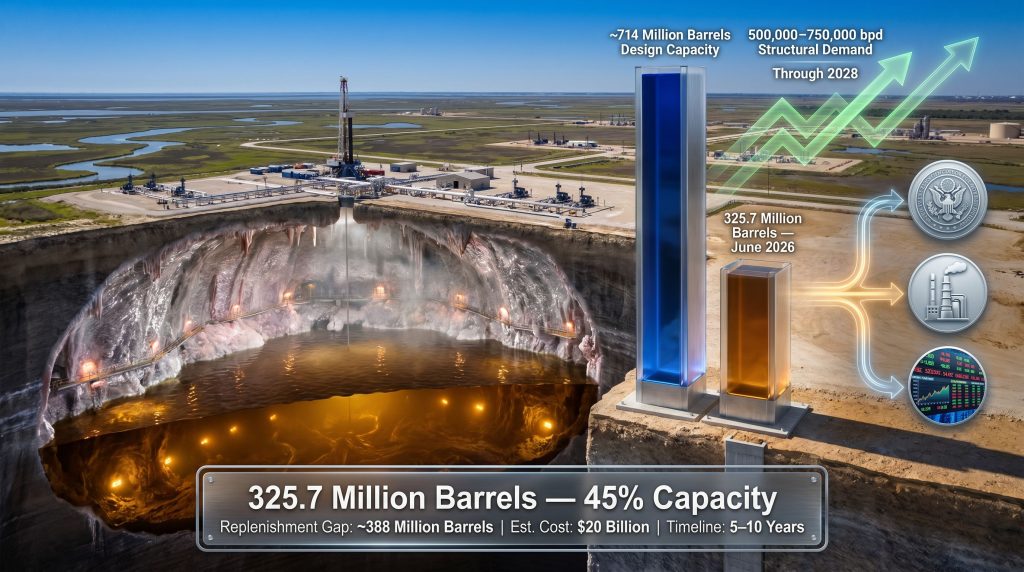
The World Entered This Crisis With an Empty Tank
Geopolitical shocks to oil markets have historically been assessed through a single, well-worn lens: how many barrels of production might be lost, and whether OPEC+ spare capacity can absorb the shortfall. This analytical framework dominated every major energy crisis from the 1973 Arab embargo through the post-invasion Iraqi disruptions and the 2022 Russian supply shock. It is now fundamentally incomplete.
The crisis unfolding across the Persian Gulf in mid-2026 is structurally different from its predecessors in one critical dimension. Previous disruptions struck markets that held substantial strategic buffers. The current episode is playing out against a backdrop of multi-decade lows in government-controlled emergency storage. The question facing physical crude markets is no longer how many barrels might disappear from production. It is how many hundreds of millions of barrels will need to be purchased to rebuild the world's depleted energy insurance.
That distinction carries profound implications for oil price formation through at least 2028, and understanding it requires stepping back from headline volatility to examine the mechanics of strategic petroleum reserve replenishment as a structural demand phenomenon. Monitoring crude oil price trends alongside reserve dynamics is, furthermore, essential context for any serious market analysis.
When big ASX news breaks, our subscribers know first
The Numbers Behind America's Depleted Emergency Buffer
Inventory Collapse: From Buffer to Baseline
The U.S. Strategic Petroleum Reserve entered the current crisis period in a severely weakened condition. As of late June 2026, the reserve held approximately 325.7 million barrels, representing roughly 45% of its 714-million-barrel design capacity. The replenishment gap stands at nearly 388 million barrels, a shortfall that U.S. Energy Secretary Chris Wright has estimated will cost approximately $20 billion to close.
| Metric | Current Status |
|---|---|
| SPR Inventory (June 2026) | 325.7 million barrels |
| Design Capacity | ~714 million barrels |
| Capacity Utilization | ~45% |
| Estimated Replenishment Gap | ~388 million barrels |
| Estimated Replenishment Cost | ~$20 billion |
| Projected Timeline | 5 to 10 years |
| Maximum Purchase Rate | ~3 million barrels per month |
The path to this point involved successive waves of emergency releases spanning two administrations. Biden-era drawdowns, executed in response to post-pandemic energy inflation and the disruptions triggered by Russia's invasion of Ukraine, drove inventories from near-capacity levels to multi-decade lows. Attempts to reverse course stalled in April 2024 when WTI prices exceeded the $79 per barrel purchase threshold built into the replenishment budget, making continued buying politically untenable.
The Trump administration inherited this structurally diminished reserve, then compounded the depletion problem in March 2026 when the United States contributed 172 million barrels to a coordinated 400-million-barrel IEA emergency release. The reserve's credibility as a crisis management tool has been substantially eroded, and the physical infrastructure underpinning it has been damaged in the process.
The Hidden Cost: Salt Cavern Degradation
One of the least-discussed consequences of repeated rapid drawdowns is the physical toll on the underground salt cavern storage sites located in Texas and Louisiana. Ageing infrastructure at these facilities has presented structural assessments identifying repair requirements exceeding $100 million, and these infrastructure constraints impose a hard ceiling on how quickly replenishment can proceed regardless of available funding. The maximum injection rate across the entire SPR system is approximately 3 million barrels per month, a physical limitation that cannot be overcome through political will or budget allocation alone.
This creates a mathematically unavoidable timeline. Even under ideal conditions, with consistent congressional appropriations, stable crude prices below the purchase threshold, and no further mandated sales, filling the current gap would require a minimum of ten years.
How SPR Exchange Agreements Manufacture Future Demand
Borrowed Barrels Are Not Free Supply
A critical feature of recent SPR management that markets have consistently underpriced is the structure of exchange agreements. Unlike outright sales, where crude is permanently transferred to buyers, exchange agreements are contractual arrangements under which companies receive crude today in exchange for a binding obligation to return equivalent volumes plus additional premium barrels at a specified future date.
These arrangements function economically like secured crude loans. Every barrel released through an exchange mechanism does not eliminate future demand, it defers it, and increases it, because the premium return obligation means more barrels must be delivered back than were originally received.
When markets celebrated emergency SPR releases as net supply additions, they were treating deferred demand as permanent relief. The structural reality is precisely the opposite. Governments and companies that accessed SPR crude through exchange mechanisms have locked in future purchasing requirements that will materialise regardless of market conditions at the time of repayment.
The Legislative Obstacle Course Slowing Replenishment
Congressional Appropriations and Mandated Sales Headwinds
Strategic petroleum reserve replenishment is not a simple procurement decision. The U.S. Department of Energy cannot purchase crude without prior congressional authorisation, creating a political dependency that introduces meaningful execution risk into what is fundamentally an energy security operation.
Funding secured through recent legislation illustrates both the scale of the commitment and its complexity:
| Funding Source | Crude Purchases | Infrastructure Repairs | Other |
|---|---|---|---|
| Working Families Tax Cut Law | $171 million | $218 million | $461M to cancel mandated 7Mb sale |
| House One Big Beautiful Bill Act | $1.32 billion | $218 million | — |
| Senate Proposal | $660.5 million | $218 million | — |
Complicating matters further, existing statutory requirements mandate the sale of 35 million barrels in both FY2026 and FY2027 unless Congress explicitly cancels these obligations. These mandated outflows directly offset any replenishment purchases, meaning the net accumulation rate will fall well below the headline injection figures unless legislative workarounds remain in place.
The budget assumptions embedded in current replenishment plans target crude acquisition costs of $75 to $80 per barrel. Any sustained price rally above that range risks triggering the same purchase freeze that halted replenishment in April 2024, introducing a self-defeating dynamic where the structural demand created by replenishment needs actually impedes the purchasing programmes designed to satisfy them.
From Supply Risk to Logistics Risk: A Market Transformation
Why Hormuz Doesn't Need to Close to Tighten Markets
The analytical community has long modelled geopolitical risk in crude markets through a binary frame: either the Strait of Hormuz remains open and supply flows, or it closes and prices spike dramatically. The current crisis is demonstrating that this framing misses a critical intermediate state.
War-risk insurance premiums for tankers transiting the Persian Gulf have risen substantially in response to renewed military tensions. Freight rates have increased. Voyage planning has become more complex and more expensive. These costs are embedded in the economics of every delivered barrel regardless of whether physical exports are interrupted.
Physical crude markets are responding accordingly. During periods of acute maritime tension, physical crude repeatedly traded at significant premiums over benchmark futures, a divergence reflecting delivery uncertainty and logistics cost inflation rather than outright production shortfalls. The market is, consequently, transitioning from pricing a supply-risk premium to pricing a logistics-risk premium, a distinction that fundamentally changes how tightness manifests in price discovery.
Saudi Arabia's active consideration of a major Red Sea pipeline expansion to bypass the Strait of Hormuz reflects institutional recognition that routing dependency is itself a strategic vulnerability requiring infrastructure investment to address. In addition, OPEC's market influence over production decisions continues to shape how these logistical risks are absorbed across the broader supply chain.
The Multi-Sovereign Demand Convergence Thesis
When Every Major Buyer Enters the Market Simultaneously
The replenishment challenge is not exclusively American. IEA member nations across Europe, Japan, and South Korea participated in coordinated emergency releases that drew down strategic inventories accumulated over decades of disciplined stockholding. Each of these nations now carries its own replenishment obligation, and collective political appetite for additional releases has diminished substantially as the cost of rebuilding depleted reserves becomes increasingly apparent.
Analysis of combined OECD strategic reserve rebuilding requirements suggests this process alone could generate between 500,000 and 750,000 barrels per day of additional structural crude demand through at least 2028. These are not speculative or discretionary barrels. They represent policy-driven purchasing requirements that governments must execute to restore credible emergency protection.
The convergence scenario, however, extends beyond official reserve rebuilding:
- Government agencies executing mandatory SPR and strategic stockholding refill programmes across OECD nations
- Refiners rebuilding precautionary operational inventories that were drawn down during the crisis period
- Commercial traders restoring working inventory positions to support normal trading operations
- Asian importers expanding strategic storage capacity whilst physical market conditions permit
When these four buyer categories enter the physical market simultaneously, the effect on available crude is additive and non-discretionary. Each category represents incremental demand competing for the same physical barrels, independent of underlying consumption trends.
China's Recovery: The Variable That Amplifies the Convergence
China's relatively subdued refinery activity during the initial phase of Persian Gulf tensions provided an unexpected buffer that softened the immediate demand impact of reduced Hormuz throughput. This condition is unlikely to persist indefinitely. Furthermore, the relationship between oil prices and China recovering import volumes means that as Chinese refinery utilisation recovers toward normal operating rates, the additional barrels required will arrive precisely when OECD strategic reserve rebuilding is most active.
India has separately announced plans to expand strategic oil reserves through ONGC storage infrastructure, adding another sovereign purchasing programme to the demand picture. Japan and South Korea maintain IEA-compliant strategic stockholding programmes that require replenishment following coordinated releases. The combined purchasing requirements across the Asia-Pacific region represent a structural demand increment that standard financial market models have not fully incorporated into their long-run price forecasts.
The next major ASX story will hit our subscribers first
The Forecasting Gap That Could Drive the Next Oil Bull Market
Why Consensus Price Models Are Missing the Replenishment Variable
Mainstream crude oil price forecasts are constructed primarily around consumption demand trajectories, OPEC+ supply management decisions, and non-OPEC production growth. The replenishment demand variable, estimated at 500,000 to 750,000 bpd through 2028, is either absent from or systematically underweighted in these models.
This creates a structural forecasting gap. As replenishment purchasing materialises across multiple sovereigns and commercial operators, prices will receive support from a demand source that most models treat as negligible. The divergence between consensus forecasts and observed market tightness could be substantial. For instance, revised OPEC demand forecasts have already begun adjusting upward in response to signals of sustained physical tightness.
History consistently shows that oil crises do not conclude when production recovers. They end when market confidence in supply reliability is restored. Restoring that confidence requires demonstrable rebuilding of strategic buffers, a process that is inherently time-consuming, capital-intensive, and price-supportive.
Key Indicators Worth Monitoring Through 2028
Investors and analysts tracking the replenishment-driven demand thesis should focus on the following leading indicators:
| Indicator | What to Watch | Bullish Signal |
|---|---|---|
| DOE Weekly SPR Reports | Net injection vs. withdrawal | Sustained weekly injections |
| Congressional Appropriations | SPR budget line items | Increased crude purchase allocations |
| IEA Emergency Stock Data | OECD collective inventory levels | Below 90-day import cover threshold |
| Physical vs. Futures Premium | Brent/WTI cash vs. front-month | Widening physical premium |
| War-Risk Insurance Rates | Gulf tanker premiums | Sustained elevation above baseline |
| Chinese Refinery Run Rates | Monthly CNOOC/Sinopec data | Recovery toward 90%+ utilisation |
Frequently Asked Questions: Strategic Petroleum Reserve Replenishment
How long will full SPR replenishment realistically take?
Based on the current injection ceiling of approximately 3 million barrels per month and a replenishment gap of roughly 388 million barrels, full restoration to near-capacity would require a minimum of ten years under ideal conditions, and longer if mandated statutory sales continue to offset purchases at the current rate.
Why can't the U.S. simply accelerate purchases to refill faster?
The binding constraint is physical infrastructure, not financial capacity. The underground salt cavern storage network in Texas and Louisiana has maximum injection rates that cannot be safely exceeded. Rapid drawdowns have already caused structural degradation requiring over $100 million in repairs, further limiting operational flexibility in the near term.
Does SPR replenishment directly cause oil prices to rise?
Not immediately or in isolation. However, when government replenishment purchasing overlaps with commercial inventory rebuilding and recovering consumption from major importers like China, the combined effect creates a structural demand floor that supports higher prices over a multi-year horizon. The estimated convergence could add 500,000 to 750,000 bpd of incremental demand through 2028.
What happens if geopolitical tensions escalate further before replenishment is complete?
Further emergency releases from an already-depleted reserve reduce its credibility as a crisis management tool. At some threshold, the absence of a functional emergency buffer itself becomes a price-supportive psychological factor, as markets begin pricing the loss of the stabilising mechanism rather than just the immediate supply disruption. The interplay between trade and geopolitics in this context could, consequently, amplify price volatility well beyond what supply fundamentals alone would suggest.
The Structural Price Floor Taking Shape
The coming oil cycle may prove genuinely different from its predecessors. Rather than beginning with dramatic production losses or a visible supply shock, the next sustained period of price strength could develop through an accumulation of policy-driven purchasing decisions that individually appear modest but collectively represent an enormous and sustained increment of physical demand.
Governments issuing tenders to refill depleted strategic reserves, companies satisfying exchange agreement return obligations, refiners rebuilding operational stockholding, and importing nations strengthening energy security through precautionary accumulation will not appear on production flow charts or OPEC+ quota tables. But from the perspective of the physical crude market, these purchases compete for available barrels with exactly the same force as consumption demand.
The paradox at the heart of the current situation is sharp: the very instruments designed to prevent oil price crises have now been so thoroughly depleted that the process of restoring them may become one of the primary price-supportive forces in crude markets through the remainder of this decade. Rebuilding that strategic flexibility will require hundreds of millions of barrels, years of disciplined purchasing, and tens of billions of dollars. Markets that treat strategic petroleum reserve replenishment as a footnote to the supply-demand balance do so at considerable analytical risk.
Disclaimer: This article contains forward-looking analysis and market commentary for informational purposes only. It does not constitute financial advice or investment recommendations. Oil market forecasts involve significant uncertainty, and actual outcomes may differ materially from projections discussed herein.
Want to Identify ASX Commodity Opportunities Before the Broader Market Does?
Discovery Alert's proprietary Discovery IQ model delivers real-time alerts on significant ASX mineral discoveries — including energy and resource stocks positioned to benefit from structural shifts in global commodity markets — instantly turning complex data into actionable investment insights. Explore historic discovery returns on Discovery Alert's dedicated discoveries page and begin your 14-day free trial today to secure a market-leading edge.