June 20, 2026
Brazil's Critical Minerals Corridor Is Rewriting the Global Supply Chain Map
The race to secure critical mineral supply chains is no longer confined to government policy documents or commodity trading floors. It is playing out in the red laterite soils of northern Minas Gerais, where a geological formation spanning thousands of kilometres has quietly become one of the most strategically significant mineral corridors on the planet. For investors tracking the intersection of geopolitics, energy transition, and resource discovery, the Vale do Jequitinhonha demands serious attention, and Spark Energy Minerals Vale do Jequitinhonha is a combination now appearing with increasing frequency in that conversation.
When big ASX news breaks, our subscribers know first
What Makes the Vale do Jequitinhonha a Global Mineral Flashpoint?
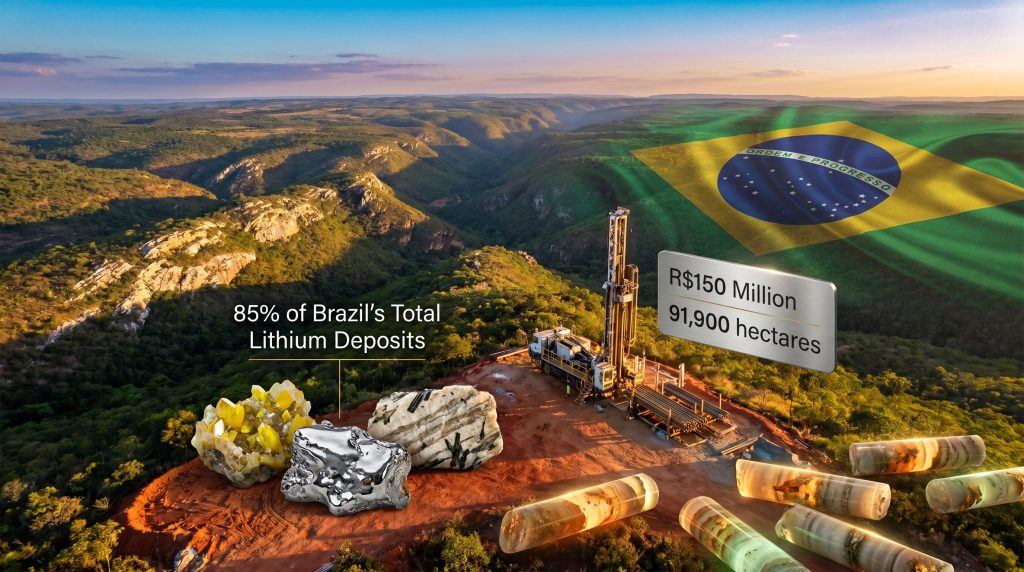
Most coverage of the Vale do Jequitinhonha anchors itself to lithium, and understandably so. The region hosts an estimated 85% of Brazil's total lithium deposits, and the corridor is projected to absorb approximately 78% of Brazil's total lithium investment through 2029, representing roughly USD $906 million in committed capital. These are not speculative figures drawn from promotional materials; they reflect the concentration of hard-rock spodumene pegmatites that have attracted some of the world's largest mining companies to this historically underserved region of Minas Gerais.
However, the lithium headline obscures a more complex geological reality. The same pegmatite belts that produce lithium in the region also carry rare earth elements (REEs) and gallium, two minerals that occupy a fundamentally different position in the global supply risk matrix. While the global lithium market has multiple producing nations and growing refining capacity across Australia, Chile, and China, gallium and REEs remain overwhelmingly concentrated in Chinese-controlled supply chains. This concentration is not incidental; it is the product of decades of deliberate industrial policy.
The Vale do Jequitinhonha is transitioning from a single-commodity lithium story into a multi-mineral critical resources district with strategic implications extending far beyond Brazil's borders.
The pegmatite geology of the region is particularly significant for understanding why REE and gallium mineralisation appears here. Pegmatites are coarse-grained igneous rocks that form during the final stages of magma crystallisation, and they are known globally as hosts for anomalously high concentrations of elements that don't fit into standard silicate mineral structures. Gallium, which substitutes for aluminium in feldspars and micas, and certain REEs follow this pattern, making the Vale do Jequitinhonha's pegmatite belt a logical exploration target for any company focused on these minerals.
The Arapaima Project: Exploring Where Others Aren't Looking
Spark Energy Minerals controls a 91,900-hectare contiguous land package in the Vale do Jequitinhonha, a position that represents one of the largest single exploration tenements held by a foreign-listed explorer in this district. The company's flagship Arapaima Project sits within the Padre Paraíso municipality, a jurisdiction that has gained recognition among geologists as a focal point for REE and gallium deposits exploration within the broader lithium valley framework.
The scale of the land holding matters strategically. In early-stage exploration, tenement size functions as an optionality multiplier. A larger footprint increases the statistical probability of intercepting additional mineralised zones beyond the initial discovery area, and it creates a defensible competitive position against later-arriving explorers who may be forced into less prospective ground.
What the Drill Results Are Telling the Geology Team
The project's exploration timeline has progressed in two distinct phases. An initial five-hole drill campaign confirmed broad intervals of REE and gallium mineralisation across the tenement, with a particularly important characteristic: mineralisation was identified at near-surface depths. This matters considerably for project economics at the pre-feasibility stage, because shallow ore bodies reduce the stripping ratios, haulage costs, and infrastructure requirements that dominate capital expenditure in open-cut operations.
Building on those results, the current expanded program targets approximately 20 drill holes at an average depth of around 100 metres per hole. The program has been designed to achieve several simultaneous objectives:
- Refine the three-dimensional geological model across the full 91,900-hectare tenement
- Test additional priority target zones identified during the first campaign but not yet drilled
- Evaluate the spatial continuity of mineralisation, which is critical for any future resource classification under JORC or NI 43-101 standards
- Generate the dataset required to support the next formal exploration phase
| Drill Program Stage | Holes Completed | Target Depth | Primary Objective |
|---|---|---|---|
| Initial Campaign | 5 holes | Variable | Mineralisation confirmation |
| Expanded Campaign | ~20 holes (planned) | ~100 metres avg | Model refinement and continuity assessment |
A maiden resource estimate, when it eventually arrives, will represent the first formal valuation anchor for Arapaima, transforming it from a geological concept into a quantified asset that can be interrogated by analysts, potential offtake partners, and institutional capital allocators.
R$150 Million and a Protocol of Intentions: What It Means in Practice
On 17 June 2026, the Secretaria de Estado de Desenvolvimento Econômico de Minas Gerais and the state's investment promotion agency Invest Minas formalised a Protocol of Intentions with Spark Energy Minerals during the Brazil Lithium & Critical Minerals Summit 2026 in Belo Horizonte. The agreement outlines a planned investment of R$150 million directed toward the Arapaima Project. Furthermore, this agreement was reported by BNamericas, which noted that Spark plans approximately US$30 million for the critical minerals project.
For investors unfamiliar with Brazilian mining governance, the Protocol of Intentions framework deserves explanation. These instruments operate as structured pre-investment declarations rather than binding contracts at the point of signing. Their practical value lies in several dimensions:
- They signal that state authorities have formally acknowledged the project and the investing company's intentions within their jurisdiction
- They create an institutional channel through which the company can engage with state-level permitting bodies and environmental licensing agencies
- They place the project on the radar of development banks and state investment agencies that track formally declared investment intentions
- They provide foreign capital with a degree of regulatory visibility before committing large capital outlays
Protocols of Intentions in Brazilian mining carry significant political weight even before they become binding. They are frequently the precursor to formal concession agreements, environmental licensing approvals, and state infrastructure co-investment discussions.
The choice of the Brazil Lithium and Critical Minerals Summit as the venue for the signing was not incidental. Events of this kind attract the institutional capital allocators, government procurement officers, and downstream processing companies that represent future commercial counterparties. A formalised agreement signed in that environment carries a visibility premium beyond its legal content.
Gallium and Rare Earths: The Strategic Case That Underpins the Investment Thesis
To understand why Spark Energy Minerals Vale do Jequitinhonha warrants attention beyond conventional mining circles, it is necessary to appreciate the supply chain vulnerability that gallium and REEs represent for Western economies.
Gallium is not mined directly. It is produced almost entirely as a byproduct of aluminium (bauxite) refining and zinc smelting, which means its supply is structurally dependent on the economics of other industries rather than dedicated extraction programs. China controls approximately 80% of global refined gallium supply, a dominance that became geopolitically visible in 2023 when Beijing introduced export controls on gallium and germanium — two materials critical to semiconductor fabrication, 5G infrastructure, LED manufacturing, and solar panel production.
Rare earth elements occupy a similar strategic position. Despite their name, REEs are not geologically rare in absolute terms, but economically viable deposits that can be extracted and processed outside of China are genuinely scarce. China controls both the majority of global REE mining and, more critically, the downstream processing capacity that converts raw ore into separated oxide products used in permanent magnets. Those magnets are the core enabling technology in electric vehicle drive motors and wind turbine generators, making rare earth supply chains a critical question for the energy transition.
The United States, European Union, Japan, Australia, and Canada have all published critical minerals strategies explicitly identifying REEs and gallium as priority supply diversification targets. Brazil's geological endowment combined with its established trade relationships with Western nations positions the Vale do Jequitinhonha as a credible alternative source, provided that exploration programs can convert geological potential into defined resources.
How Does Brazil's Supply Position Compare Globally?
In addition to their geopolitical relevance, advances in lithium extraction technologies are beginning to reshape how mineral-rich corridors like the Vale do Jequitinhonha are assessed by investors. Consequently, the broader critical minerals demand outlook for REEs and gallium continues to strengthen as energy transition infrastructure scales up globally.
Competitive Positioning Within the Vale do Jequitinhonha
Spark does not operate in isolation within this corridor. The broader competitive landscape of the Vale do Jequitinhonha includes established producers and advanced-stage developers, though their focus differs materially from Spark's strategic orientation.
| Company | Operational Status | Primary Target Mineral | Stage |
|---|---|---|---|
| Sigma Lithium | Active producer (Mine 1 resumed February 2026) | Lithium | Large-cap, producing |
| Companhia Brasileira de Lítio (CBL) | Active producer | Lithium | Established domestic producer |
| Spark Energy Minerals | Exploration phase | REEs and Gallium | Early-stage, Canadian-listed |
The distinction is important. Spark's REE and gallium focus places it in a segment of the district that currently has no direct competition from established producers. While Sigma Lithium and CBL navigate the operational and market challenges of active lithium production, Spark is pursuing a resource discovery thesis in an adjacent mineral category that carries its own separate demand drivers and pricing dynamics.
This differentiation also means that Spark's investment risk profile is fundamentally different from that of a producing company. Early-stage exploration carries binary-outcome characteristics: successful resource definition creates substantial value from a low base, while an absence of continuity in mineralisation can render a tenement uneconomic. Investors should treat the Arapaima Project as a high-optionality asset rather than a cash-flow story. This article does not constitute financial advice. Investors should conduct independent research and seek professional guidance before making investment decisions.
The next major ASX story will hit our subscribers first
The Social and Environmental Dimension That Investors Cannot Ignore
The Vale do Jequitinhonha has historically ranked among Brazil's most economically disadvantaged regions, and state governments have consistently positioned mining investment as a vehicle for socioeconomic development. That framing is not without merit, but it coexists with documented tensions that have emerged as extraction activity has intensified in recent years.
The expansion of lithium mining in the region following Sigma Lithium's operational commencement in 2023 generated community-level concerns across several categories:
- Reported seismic disturbances felt in surrounding villages attributed to blasting operations
- Water access disruption affecting both smallholder agriculture and domestic supply in communities adjacent to mine sites
- Air quality concerns linked to dust generation from open-cut operations and haul roads
- Uneven distribution of economic benefits, with concerns that employment gains accrue disproportionately to skilled workers recruited from outside the region
The tension between critical mineral extraction urgency and community wellbeing is a systemic feature of mineral districts globally, not a failure unique to any single operator. The pace of energy transition investment can structurally outrun the development of adequate social and environmental safeguard frameworks.
For Spark Energy Minerals Vale do Jequitinhonha, these dynamics create both a reputational obligation and a practical operating reality. Community engagement in the Padre Paraíso municipality will shape the pace of environmental licensing, the terms of any land access agreements, and the company's social licence to operate as the project advances toward resource definition. Formal ESG frameworks and community benefit agreements at the project level have yet to be publicly detailed, and their development will represent a meaningful marker of project maturity.
Project Milestones That Will Define Arapaima's Trajectory
The pathway from current exploration activity to a commercially viable operation involves a sequence of clearly defined milestones, each of which will provide new information to the market about the project's fundamental viability.
Near-term (2026): Completion of the expanded ~20-hole drill program and release of assay results. These results will determine whether the mineralisation intercepted in the initial campaign has the spatial continuity and grade characteristics required to support a resource estimate.
Medium-term: Geological model finalisation and preparation of a maiden resource estimate under an internationally recognised reporting standard. A maiden resource converts geological inference into a quantified asset and is typically the first point at which institutional investors and potential offtake partners engage seriously with a project.
Longer-term: Pre-feasibility and feasibility studies, environmental licensing under Brazilian federal and Minas Gerais state frameworks, and commercial discussions with downstream REE and gallium processors or strategic partners from G7 economies seeking supply chain diversification. For additional context on the company's broader strategic positioning, Net Zero Circle's analysis offers further insight into how Spark is unlocking Brazil's next critical minerals frontier.
The R$150 million investment commitment anchored by the Protocol of Intentions provides a capital framework within which this exploration-to-development pathway can be pursued. Whether that commitment translates into a producing operation will ultimately be determined by the geological data that the current drill program is generating beneath the soils of Padre Paraíso.
Readers seeking further context on Brazil's critical minerals landscape and ongoing developments across the Vale do Jequitinhonha can explore reporting published by Revista Minérios at revistaminerios.com.br.
Want to Catch the Next Major Critical Minerals Discovery Before the Market Does?
Discovery Alert's proprietary Discovery IQ model delivers real-time alerts on significant ASX mineral discoveries — cutting through the complexity of over 30 commodities to surface actionable opportunities the moment they are announced. Explore Discovery Alert's discoveries page to understand how historic finds have generated exceptional returns, and begin your 14-day free trial at Discovery Alert to position yourself ahead of the broader market.