
May 11, 2026
Understanding State Aid Scrutiny in Nuclear Energy Projects
The landscape of nuclear energy financing within the European Union operates under increasingly complex regulatory frameworks that balance strategic energy objectives with competitive market principles. When member states propose substantial public support for nuclear infrastructure, these initiatives must navigate intricate state aid regulations designed to prevent market distortions while enabling critical energy transition security.
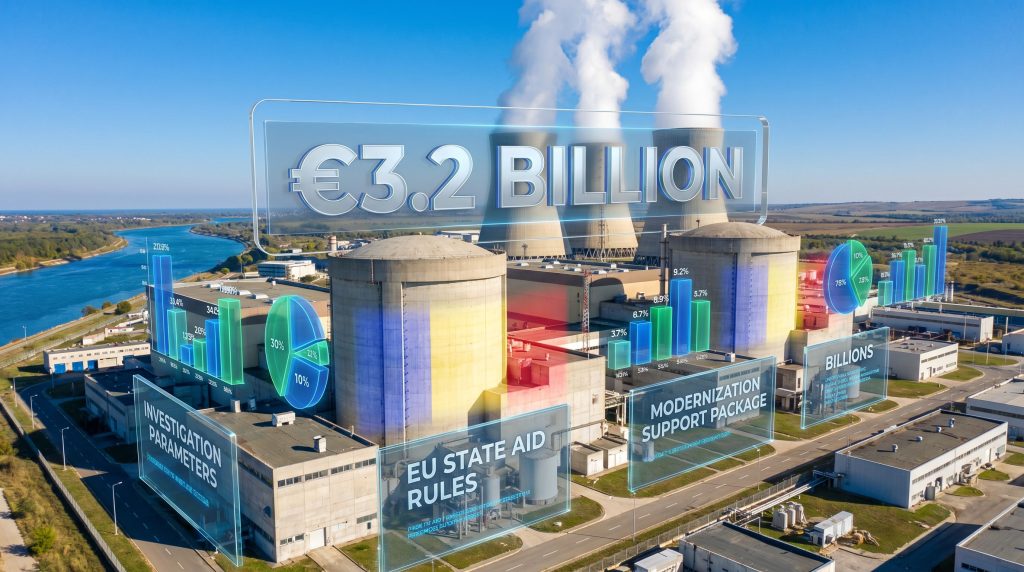
Romania's €3.2 billion support package for the Cernavoda nuclear plant represents a significant test case for how the European Commission evaluates large-scale nuclear infrastructure financing. The investigation, formally opened following Romania's notification in January 2026, encompasses four distinct support mechanisms and targets specific compliance areas that extend beyond traditional state aid considerations.
The Commission's preliminary assessment reveals a nuanced regulatory position. Officials have acknowledged that the project is necessary and facilitates legitimate economic development, yet expressed substantive concerns about full compliance with EU state aid rules. This dual recognition suggests the investigation reflects standard regulatory prudence rather than fundamental opposition to nuclear energy support.
Three primary investigation parameters frame the Commission's analysis: aid appropriateness and proportionality assessment, competitive impact evaluation across electricity markets, and compliance with Article 19d(2) of the Electricity Regulation. The specific reference to Article 19d(2) indicates that contract for difference mechanisms in nuclear projects must adhere to established design principles within the broader electricity regulatory framework.
When big ASX news breaks, our subscribers know first
Why Is the European Commission Investigating Romania's Nuclear Funding?
The scope of state aid concerns centers on Romania's comprehensive support structure for Cernavoda Unit 1's refurbishment project. This initiative, which began in 2017 and is currently in its second of three phases, seeks to extend the reactor's operational life to 60 years through extensive component replacement and system upgrades.
Nuclearelectrica, the majority state-owned operator and Romania's sole nuclear power company, serves as the beneficiary of this support package. The plant currently supplies approximately 10% of Romania's electricity generation through two 650 MWe CANDU-6 reactors, making this refurbishment project strategically significant for national energy security.
The Four Support Mechanisms:
• Direct Grant: €600 million for capital investment support
• State Loan Guarantees: Variable amounts to mitigate financing risks
• 30-Year Contract for Difference: Two-way revenue stabilisation mechanism
• Regulatory Change Protection: Safeguards against policy modifications during construction and operation
The project timeline demonstrates substantial international involvement and financial commitment. In December 2024, Nuclearelectrica signed the engineering, procurement and construction contract with a consortium comprising Korea Hydro & Nuclear Power, AtkinsRéalis's Candu Energy division, Canadian Commercial Corporation, and Ansaldo Nucleare.
Previous financing arrangements include a €540 million contract with a JP Morgan-led banking syndicate in September 2024 and equipment agreements with France's Arabelle Solutions in October 2024. These substantial investments reflect the complex international nature of nuclear refurbishment projects.
Phase three operations, scheduled for 2027 to 2029, will involve shutting down Unit 1 for comprehensive refurbishment work. This includes replacing all 480 fuel channels and 960 feeder tubes during what industry specialists describe as a high-precision rebuild process.
The technical complexity requires removing all reactor fuel and heavy water, isolating the unit from the power station, and inspecting thousands of components that remain inaccessible during normal operations. Furthermore, this meticulous approach ensures that all safety and operational standards are maintained throughout the refurbishment process.
What Are the EU's State Aid Rules for Nuclear Projects?
European Union state aid regulations establish specific criteria for evaluating public support of energy infrastructure projects, particularly those involving critical strategic assets. The regulatory framework must balance legitimate member state energy security objectives against internal market competition principles, creating a complex evaluation matrix for large-scale nuclear investments.
The Commission's investigation focuses on compliance with Article 19d(2) of the Electricity Regulation regarding contract for difference design principles. While the specific requirements of this provision are not detailed in available documentation, its prominence in the investigation suggests it contains mandatory design parameters for CfD mechanisms in electricity markets.
Core Assessment Criteria:
• Market failure identification and appropriate remedy mechanisms
• Aid necessity and proportionality relative to project objectives
• Competitive distortion minimisation across affected markets
• Consumer interest protection and cost allocation transparency
The evaluation process typically examines whether proposed support measures address genuine market failures that would otherwise prevent socially beneficial projects from proceeding. For nuclear refurbishment projects, this analysis must consider the unique economics of life extension investments, which require substantial upfront capital while providing decades of future electricity generation.
State aid assessments also evaluate proportionality by examining whether the level of support exceeds what is necessary to enable project viability. This calculation becomes particularly complex for nuclear projects given their long development timelines, substantial capital requirements, and exposure to regulatory and market uncertainties over multi-decade operational periods.
Consequently, the Commission must carefully balance these competing considerations while ensuring that any approved support mechanisms comply with broader EU competition law principles.
How Does Cernavoda's Refurbishment Fit EU Energy Strategy?
Cernavoda Unit 1's technical specifications and refurbishment scope reflect the broader strategic importance of nuclear life extension projects within European energy planning. The reactor began commercial operation in 1996 and represents mature CANDU technology designed for extended operational capabilities through comprehensive refurbishment programmes.
Technical Refurbishment Scope:
• Steam generator replacement for improved thermal efficiency
• Pressure tube renewal to maintain structural integrity
• Calandria tube replacement for reactor core functionality
• Complete feeder tube installation covering 960 individual units
• Comprehensive fuel channel replacement affecting all 480 channels
CANDU reactors utilise pressurised heavy water reactor technology initially designed for 30-year operational periods, with engineering provisions for additional 30-year extensions following major refurbishment. This design philosophy enables the preservation of substantial generating capacity through systematic component replacement rather than complete facility reconstruction.
The refurbishment process involves isolating the reactor from the broader power station infrastructure, dismantling key systems, and conducting detailed inspections of thousands of components. This comprehensive approach ensures that life-extended operations meet contemporary safety and performance standards while maximising the economic value of existing nuclear infrastructure investments.
"The €3.2 billion investment represents one of Eastern Europe's largest nuclear infrastructure projects, with implications extending across regional electricity markets and nuclear supply chain development."
However, the project's success depends heavily on regulatory approval and compliance with EU state aid requirements, which could influence similar initiatives across Europe's critical minerals and energy sectors.
What Are the Potential Outcomes of This Investigation?
The Commission's investigation typically concludes within 18 months, suggesting a potential decision timeframe extending into late 2027 or early 2028. During this period, stakeholders can submit comments and additional evidence while the Commission conducts comprehensive market analysis and economic impact assessments.
Approval with Modifications (Most Probable Scenario):
• Revised CfD structure alignment with electricity regulation requirements
• Enhanced consumer protection mechanisms and cost allocation transparency
• Modified state guarantee terms to minimise competitive distortions
• Strengthened competition safeguards and market monitoring obligations
Conditional Approval Requirements:
• Periodic aid effectiveness reviews and performance monitoring
• Market impact assessment obligations throughout project lifecycle
• Consumer cost pass-through limitations and pricing transparency requirements
• Competitive tender requirements for future nuclear support schemes
Rejection Scenarios (Lower Probability):
• Fundamental state aid rule violations that cannot be remediated
• Excessive market distortion potential outweighing strategic benefits
• Inadequate consumer protection measures or cost allocation mechanisms
The investigation's outcome will establish important precedents for future nuclear support schemes across the European Union, particularly regarding CfD design requirements and the balance between strategic infrastructure support and competitive market preservation. In addition, the decision will influence how member states approach uranium investment strategies in the context of state aid regulations.
How Do Contract for Difference Mechanisms Work in Nuclear Projects?
The two-way contract for difference mechanism provides revenue stabilisation by guaranteeing minimum electricity prices while capturing excess revenues during high-price periods. Romania's proposed 30-year CfD structure aims to provide Nuclearelectrica with revenue certainty necessary to justify the substantial refurbishment investment while protecting consumers from excessive cost exposure.
CfD Operational Framework:
• Strike price determination methodology based on project economics and market conditions
• Revenue sharing mechanisms during high-price periods to protect consumer interests
• Consumer cost allocation structures ensuring transparent pricing impacts
• Market price reference benchmarks for determining payment or repayment obligations
The Commission's focus on Article 19d(2) compliance suggests that CfD design must adhere to specific principles within the Electricity Regulation framework. While the exact requirements are not specified in available documentation, this regulatory reference indicates established parameters for how revenue support mechanisms should function within competitive electricity markets.
Contract for difference mechanisms in nuclear projects must balance several competing objectives: providing sufficient revenue certainty to justify long-term capital investments, maintaining competitive market dynamics, protecting consumer interests during varying price conditions, and ensuring compliance with broader electricity market regulations.
These considerations become particularly complex when factoring in uranium market volatility and potential supply chain disruptions that could affect operational costs over the contract's 30-year duration.
The next major ASX story will hit our subscribers first
What Does This Mean for Other EU Nuclear Projects?
The Cernavoda investigation establishes important precedents for member states planning similar nuclear infrastructure support programmes. Countries considering life extension projects or new nuclear construction must examine these regulatory parameters when designing public support mechanisms that comply with EU state aid rules.
Affected Project Categories:
• Nuclear plant life extension programmes across aging EU reactor fleets
• New reactor construction projects requiring substantial state support
• Nuclear fuel cycle infrastructure development and modernisation
• Decommissioning support schemes for end-of-life nuclear facilities
Eastern European member states face particular challenges balancing energy security objectives with state aid compliance requirements. These countries often operate nuclear fleets that provide substantial portions of national electricity generation while requiring significant investments to maintain operational capability through life extension or replacement programmes.
The Commission's decision will influence how member states structure future support for critical energy infrastructure while maintaining competitive market conditions. This regulatory guidance becomes increasingly important as European nuclear fleets age and require substantial investments to support continued operations or planned retirement and replacement.
For instance, potential uranium import restrictions from geopolitical tensions could further complicate the economic calculations underlying such support schemes, making regulatory clarity even more crucial for project viability.
Timeline and Next Steps
The investigation process enables comprehensive stakeholder input while the Commission evaluates compliance with EU competition law and electricity market regulations. Romania and interested third parties can submit comments and additional evidence throughout the assessment period.
Key Investigation Milestones:
• Stakeholder comment period and evidence submission (ongoing process)
• Economic impact analysis completion and market assessment
• Competitive effects evaluation and consumer protection review
• Final decision publication with detailed regulatory guidance
A non-confidential decision summary will appear in the official State Aid Register upon investigation completion, providing transparency for future nuclear support scheme development. This documentation will offer valuable guidance for member states and nuclear operators planning similar infrastructure support programmes.
The investigation's timeline aligns with Cernavoda's planned shutdown and refurbishment schedule, with Phase 3 operations beginning in 2027. This coordination ensures regulatory clarity before the most intensive refurbishment activities commence, reducing uncertainty for project stakeholders and financial partners.
Understanding the Broader Implications
The European Commission investigation on Cernavoda nuclear funding represents a critical examination of how member states can support strategic nuclear infrastructure while maintaining competitive electricity markets. The outcome will establish important precedents for nuclear support schemes across the European Union, particularly regarding revenue support mechanisms and state aid compliance requirements.
This investigation occurs within a broader context of nuclear fleet aging across Europe and increasing recognition of nuclear energy's role in decarbonisation strategies. The Commission's approach to evaluating Romania's support package will influence how other member states structure assistance for nuclear life extension projects and new construction programmes.
The balance between energy security objectives and competitive market preservation remains central to European energy policy development. The European Commission investigation on Cernavoda nuclear funding provides an important test of regulatory frameworks designed to enable strategic infrastructure investment while protecting consumer interests and maintaining competitive market dynamics across the European electricity sector.
Furthermore, the precedents established through this investigation will likely influence future nuclear support schemes across the EU, particularly as member states grapple with aging reactor fleets and the need for substantial infrastructure investments to maintain energy security objectives within competitive market frameworks.
Exploring Opportunities in Nuclear Energy Infrastructure?
Discovery Alert's proprietary Discovery IQ model delivers real-time alerts on significant mining and resource discoveries, instantly empowering subscribers to identify actionable opportunities ahead of the broader market. Understand why major mineral discoveries can lead to significant market returns by exploring Discovery Alert's dedicated discoveries page, showcasing historic examples of exceptional outcomes.