May 19, 2026
What Makes Steel Production Facilities Strategic Military Targets?
Modern steel production facilities represent critical nodes in global industrial infrastructure, operating through interconnected systems where electrical grids, natural gas supplies, and specialised equipment create vulnerabilities that extend far beyond individual manufacturing units. Understanding how targeted attacks on these complex operations reshape international commodity markets requires examining the cascading effects that ripple through supply chains, pricing mechanisms, and strategic procurement decisions. Recent events have highlighted how Iranian steel plants damaged by air strikes create broader implications for global steel markets.
Critical Infrastructure Vulnerabilities in Industrial Complexes
Steel manufacturing depends on multiple interconnected systems that create strategic vulnerability points. Power grid dependencies form the backbone of modern integrated facilities, where electrical supply interruptions halt continuous casting processes, blast furnace temperature regulation, and rolling mill operations simultaneously.
The targeting of specific infrastructure components reveals deliberate operational disruption strategies. Recent incidents affecting Iranian steelmakers demonstrate this approach, with damage documented at Mobarakeh Steel Company including substation infrastructure, specialised alloy production lines, and auxiliary power generation facilities.
Storage facility bottlenecks represent another critical vulnerability. Khouzestan Steel Company sustained damage to storage silos, which impacts finished product staging, raw material buffers, and production continuity during operational disruptions. These facilities serve as essential buffers that allow continuous production despite supply chain variations or temporary equipment maintenance.
Blast furnace operational requirements create restart complexities that extend disruption impacts. While Khouzestan's primary production units were offline during recent strikes, blast furnace restart procedures typically require 48-72 hours minimum for temperature stabilisation and safety protocols, with comprehensive restoration potentially taking 2-4 weeks depending on damage severity.
Economic Warfare Through Industrial Targeting
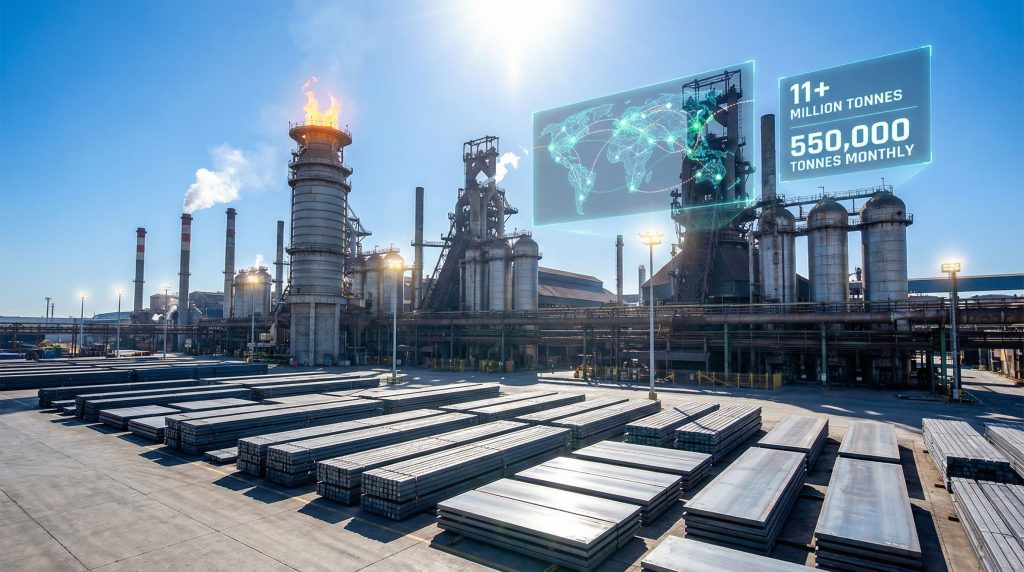
Steel production capacity directly supports military equipment manufacturing capabilities, making these facilities strategic assets beyond commercial considerations. The targeting of Iran's major producers, which combined represent 11.3 million tonnes of annual crude steel output, demonstrates understanding of steel's role in defence-related manufacturing from armour plating to structural materials for military applications.
Dual-use infrastructure implications extend beyond immediate production losses. Modern steel facilities produce materials essential for both civilian construction and military applications, creating strategic value in disrupting semi-finished steel exports that supply secondary mills across regional markets.
The strategic value of disrupting semi-finished exports becomes clear when examining Iran's baseline export capacity of approximately 550,000 tonnes monthly in semi-finished steel products. This represents significant regional supply that supports downstream manufacturing across Middle Eastern, South Asian, and African markets.
When big ASX news breaks, our subscribers know first
How Do Geopolitical Strikes Impact Regional Steel Supply Chains?
Production Capacity Assessment Framework
Iranian Steel Production Capacity Analysis
| Facility | 2025 Annual Output | Status Post-Strike | Export Impact Potential |
|---|---|---|---|
| Khouzestan Steel (KhSC) | 4.2 million tonnes | Storage damaged, furnaces offline | 1.4 million tonnes quarterly affected |
| Mobarakeh Steel (MSC) | 7.1 million tonnes | Multi-system damage, production checks ongoing | 2.4 million tonnes quarterly affected |
| Combined Impact | 11.3 million tonnes | Partial production suspension | 3.8 million tonnes quarterly |
The scale of potential disruption becomes evident when examining these facilities' combined capacity against Iran's total semi-finished steel export baseline. Furthermore, the affected facilities represent substantial portions of the country's industrial steel production capability, with Mobarakeh Steel alone accounting for 7.1 million tonnes of annual output.
Recovery timeline projections vary significantly by production unit and damage type. For instance, Khouzestan Steel's storage silo damage presents different restoration challenges compared to Mobarakeh's multi-infrastructure damage affecting electrical supply, specialised production lines, and auxiliary power systems.
Export Market Disruption Modelling
Semi-finished steel trade flow analysis reveals the broader impact of production disruptions. Iran's 550,000 tonnes monthly baseline consists primarily of billets and slabs, which represent value-added products used by secondary mills across multiple continents, highlighting the importance of understanding iron ore trends in global markets.
Regional buyer dependency mapping shows differentiated impact across customer categories. Market participants initially expected minor domestic billet and slab price changes, indicating that markets assessed temporary disruption rather than permanent capacity loss.
Alternative sourcing cost implications create complex procurement decisions for regional buyers. Switching to alternative suppliers from Turkey, India, Russia, or Ukraine involves freight pricing differentials, quality premiums, and logistics timing considerations that compound the immediate supply disruption effects.
The sequential nature of strikes compounds supply pressure effects. Foolad Atieh was struck on Thursday, followed by Khouzestan and Mobarakeh facilities on Friday, creating cumulative supply pressure rather than isolated incident impact across multiple production nodes simultaneously.
What Are the Immediate Market Response Mechanisms?
Price Discovery Under Supply Uncertainty
Market pricing mechanisms respond differently during infrastructure uncertainty compared to confirmed production losses. The expectation of minor domestic billet and slab price changes suggests market participants initially treated the incidents as requiring verification rather than assuming immediate production losses.
Billet and slab pricing volatility patterns depend on immediate supply availability, transportation cost changes, buyer inventory levels, and regional production outage expectations. However, the measured market response indicates assessment that damage was partial and temporary rather than catastrophic.
Information asymmetry affects price discovery when no official production loss figures are released by operators. This creates uncertainty for market participants attempting to assess actual versus potential supply disruptions and calibrate pricing responses accordingly.
Industry sources report shipment delays pending safety assessments, creating immediate supply tightness in regional markets
Emergency Procurement Strategies
Steel buyers implement contingency sourcing protocols during supply uncertainty periods. These strategies involve activating alternative supplier relationships, adjusting delivery schedules, and potentially paying premium prices for immediate availability to maintain production continuity.
Inventory buffer management becomes critical during disruption periods. Regional buyers must balance carrying costs against supply security, with decisions complicated by uncertainty about disruption duration and alternative sourcing availability.
Contract force majeure clause activations represent legal mechanisms that suppliers and buyers invoke during infrastructure damage events. Historical precedents suggest that coordinated attacks on multiple facilities strengthen force majeure claims compared to isolated incidents.
How Do Infrastructure Attacks Cascade Through Industrial Networks?
Power Grid Dependencies in Steel Manufacturing
Electrical infrastructure damage creates cascading failure risks across integrated steel operations. Mobarakeh Steel's reported damage to both substation and separate power plant infrastructure demonstrates dual-layer electrical vulnerability that compounds restart complexity.
Modern electric arc furnaces and continuous casting operations require stable voltage supply, typically 220-400kV from substations, with continuous availability essential since even brief outages halt production processes. Backup capacity proves insufficient for maintaining full production during extended outages.
Substation damage repair timelines typically require 6-12 weeks for specialised equipment replacement and testing. High-voltage electrical infrastructure requires specialised components with extended procurement and installation requirements compared to standard industrial equipment.
Gas Supply Chain Vulnerabilities
Natural gas supply disruptions compound electrical infrastructure damage through dual energy system impacts. Consequently, several Iranian steel producers face gas and power shortages simultaneously following attacks on the South Pars gas field, which underscores the interconnected nature of critical raw materials supply.
South Pars field represents Iran's primary natural gas source for industrial allocation, creating concentrated vulnerability when this single source experiences disruption. Steel producers must compete for remaining gas supplies with power generation facilities, residential heating demand, and petrochemical complexes.
Industrial fuel switching capabilities exist theoretically between natural gas, heavy fuel oil, and coal-based fuels, but switching costs prove material during shortage periods. Steel facilities cannot substitute fuel sources when gas supplies are limited and electrical infrastructure is simultaneously damaged, creating compounded outage conditions.
Gas allocation priorities during shortages typically favour power generation and residential heating over industrial steel production, extending the duration of production disruptions beyond the immediate infrastructure repair timeline.
What Strategic Scenarios Could Unfold for Global Steel Markets?
Short-Term Market Adjustment Scenarios (0-6 months)
Scenario 1: Rapid Facility Restoration becomes feasible when primary production infrastructure remains undamaged. Khouzestan Steel's blast furnaces being offline during strikes reduces restart complexity, supporting minimal lasting impact if storage silo repairs proceed quickly and power infrastructure restoration is achieved within 2-4 weeks.
Scenario 2: Extended Outages appears likely given Mobarakeh Steel's multi-infrastructure damage affecting substations, specialised production lines, and power generation. The combination of electrical and gas supply disruptions suggests 6-12 week recovery profiles with expert evaluation still pending for full capacity assessment.
Scenario 3: Escalating Regional Tensions gains support from sequential strike patterns affecting multiple facilities across consecutive days. The coordination demonstrated in simultaneous targeting of different infrastructure types indicates strategic intent that could expand beyond current disruptions, potentially impacting market volatility hedging strategies.
The baseline disruption window extends from immediate safety assessments through infrastructure repair completion. Market participants report shipment delays pending safety checks, with operations suspended across multiple facilities simultaneously creating compound supply effects.
Long-Term Structural Changes (6+ months)
Supply chain diversification becomes essential for regional steel buyers following demonstrated infrastructure vulnerabilities. The concentration of production capacity in facilities susceptible to coordinated attacks drives procurement strategy shifts toward geographic dispersion.
Investment in hardened industrial infrastructure represents a logical response to demonstrated targeting patterns. Steel producers may prioritise distributed backup systems, underground storage facilities, and redundant power supply configurations to reduce vulnerability concentrations.
Regional steel production capacity rebalancing could accelerate as buyers seek supply sources in less geopolitically volatile regions. Turkey, India, and other producers may benefit from long-term supply agreement shifts driven by security considerations rather than purely economic factors.
How Should Industrial Stakeholders Prepare for Infrastructure Risks?
Risk Assessment Frameworks for Steel Operations
Critical infrastructure vulnerability mapping requires systematic assessment of power dependencies, storage bottlenecks, and transportation access points that create operational failure modes. The targeting patterns observed demonstrate attackers' understanding of integrated system dependencies.
Business continuity planning for geopolitical disruptions must account for simultaneous attacks on multiple infrastructure types. Traditional planning focused on single-point failures proves inadequate when electrical, gas, and storage systems face coordinated targeting.
Insurance coverage gaps become apparent during conflict-related industrial damage events. Standard industrial insurance may not cover acts of war or terrorism, requiring specialised coverage that addresses geopolitical risk factors specifically.
Strategic Inventory Management Under Uncertainty
Risk-Adjusted Procurement Strategies
| Strategy Component | Geographic Diversification | Supplier Reliability Scoring | Cost-Risk Analysis |
|---|---|---|---|
| Minimum supplier countries | 3-4 regions | Annual assessment required | Premium vs security trade-off |
| Maximum single-source dependency | 40% of total volume | Financial stability metrics | Force majeure clause strength |
| Emergency inventory buffer | 60-90 days production | Geopolitical risk weighting | Alternative sourcing cost differential |
Safety stock optimisation models must incorporate geopolitical disruption scenarios beyond traditional demand variability calculations. The demonstrated ability to disrupt multiple facilities simultaneously requires inventory planning that assumes coordinated rather than isolated supply interruptions.
Multi-sourcing strategies for steel procurement become essential risk management tools. Concentration in single regions or supplier networks creates vulnerability to coordinated targeting that traditional supply chain optimisation models do not adequately address.
The next major ASX story will hit our subscribers first
What Investment Implications Emerge from Industrial Targeting?
Steel Sector Valuation Adjustments
Geopolitical risk premiums in steel company valuations must reflect infrastructure vulnerability assessments. Companies with concentrated production facilities in geopolitically volatile regions face higher risk weightings compared to those with distributed operations.
Regional production capacity commands premium valuations when supply security becomes a procurement criterion alongside price and quality considerations. Steel producers in stable regions may benefit from strategic supply agreement premiums that reflect security rather than purely economic value.
Infrastructure hardening investment requirements create additional capital expenditure categories for steel producers. Investments in redundant power systems, distributed storage, and hardened facilities represent new categories of defensive capital allocation related to supply chain defense.
Alternative Steel Production Investment Themes
Decentralised production facility advantages become apparent when centralised facilities face coordinated targeting. Smaller, distributed production networks prove more resilient to infrastructure attacks compared to large integrated complexes with concentrated vulnerabilities.
Renewable energy integration in steel manufacturing reduces dependency on centralised power grids and natural gas supplies that create strategic vulnerabilities. Solar and wind power systems with battery storage provide energy security that reduces exposure to coordinated infrastructure targeting.
Advanced materials substitution opportunities emerge as steel supply security concerns drive research into alternative structural materials. Investment in carbon fibre, advanced composites, and other steel substitutes may accelerate based on supply security rather than purely performance considerations, reflecting broader mining industry evolution trends.
Frequently Asked Questions About Industrial Infrastructure Attacks
How quickly can damaged steel facilities resume operations?
Production restart complexity varies significantly by damage type and system integration requirements. Storage facility repairs typically require 2-4 weeks for structural assessment and restoration, while electrical substation damage may require 6-12 weeks for specialised equipment replacement.
Safety inspection requirements extend restart timelines beyond physical repair completion. Comprehensive safety assessments, regulatory approvals, and gradual production ramp-up procedures add weeks to months before full capacity restoration becomes possible.
Equipment replacement lead times create additional delays when specialised steel production machinery sustains damage. Many steel production components require custom manufacturing or specialised suppliers with extended procurement timelines that can delay restoration for months.
What are the broader implications for Middle Eastern industrial capacity?
Regional industrial vulnerability assessments reveal concentration risks across multiple sectors beyond steel production. Petrochemical facilities, refineries, and other heavy industrial operations share similar infrastructure dependencies that create systematic regional risks.
Cross-border supply chain dependencies amplify individual facility disruptions across regional industrial networks. When major steel producers face simultaneous disruption, downstream manufacturers across multiple countries experience supply constraints that cascade through industrial sectors.
Strategic industry relocation considerations may drive long-term investment shifts away from geopolitically volatile regions toward more secure locations, even when economic factors would otherwise favour current locations.
Strategic Outlook for Industrial Infrastructure Security
Emerging Protective Technologies and Strategies
Hardened facility design principles incorporate lessons learned from infrastructure targeting patterns. Underground storage systems, blast-resistant control rooms, and redundant utility connections represent engineering responses to demonstrated vulnerability patterns.
Distributed production network advantages become clear when comparing resilience of integrated versus dispersed operations. Multiple smaller facilities prove more difficult to disrupt simultaneously compared to large centralised complexes with concentrated infrastructure dependencies.
Real-time threat monitoring systems enable rapid response to potential targeting activities. Early warning capabilities allow facilities to implement protective measures, evacuate personnel, and secure critical systems before attacks occur.
Policy and Investment Response Frameworks
Private sector resilience investment incentives may drive infrastructure hardening through tax benefits, accelerated depreciation, or direct subsidies for security-related capital expenditures that reduce strategic vulnerabilities.
International cooperation on critical infrastructure protection becomes essential when supply chains cross national boundaries. Coordinated protection standards, information sharing, and mutual defence agreements address shared vulnerability to coordinated targeting campaigns.
In conclusion, the Iranian steel plants damaged by air strikes demonstrate how coordinated infrastructure attacks create cascading effects that extend far beyond immediate production losses. The targeting of facilities like Mobarakeh and Khouzestan Steel companies reveals systematic vulnerabilities in industrial infrastructure that require comprehensive response strategies from market participants, policymakers, and industry stakeholders.
The global steel industry must now reconsider traditional risk management frameworks to account for coordinated targeting scenarios. Investment in distributed production networks, hardened infrastructure, and diversified supply chains represents essential adaptation to escalating regional tensions that challenge conventional industrial security assumptions.
This analysis is based on publicly available information and industry reporting. Investment decisions should consider multiple factors beyond geopolitical risk assessments. Market conditions and security situations remain subject to rapid change.
Looking to Navigate Geopolitical Steel Market Disruptions?
Discovery Alert's proprietary Discovery IQ model provides instant notifications on significant ASX mineral discoveries, helping investors identify actionable opportunities in steel-related commodities and mining companies before broader market recognition occurs. Explore how major mineral discoveries generate substantial market returns by visiting Discovery Alert's dedicated discoveries page, then begin your 14-day free trial to position yourself ahead of volatile commodity markets.