August 5, 2026
The Monazite Paradox: Why Africa's Most Complex Rare Earth Deposit Is Finally Moving
Across the global critical minerals landscape, a quiet but consequential shift is underway. Western industrial nations are no longer content to rely on a single-country supply chain for the rare earth elements that power electric vehicles, wind turbines, and defence systems. The search for credible, processing-capable alternatives has intensified, and attention is turning toward a category of deposit that was long regarded as too technically demanding to commercialise at scale: monazite. The Steenkampskraal Monazite Mine expansion sits at the centre of this shift.
Monazite is not a conventional rare earth mineral. It is a phosphate-bearing ore that concentrates both rare earth elements and thorium within the same crystal structure, creating a dual-commodity profile that demands more sophisticated processing than standard carbonatite-hosted deposits. For decades, this complexity worked against monazite projects. Today, in an environment where rare earth supply chains diversification is an industrial priority, that same complexity is becoming a differentiating advantage for projects capable of navigating it.
Nowhere is this dynamic more visible than at Steenkampskraal Monazite Mine in South Africa's Western Cape.
When big ASX news breaks, our subscribers know first
Understanding the Steenkampskraal Monazite Mine Expansion: A Three-Phase Value Chain Build
Phase-by-Phase Development Architecture
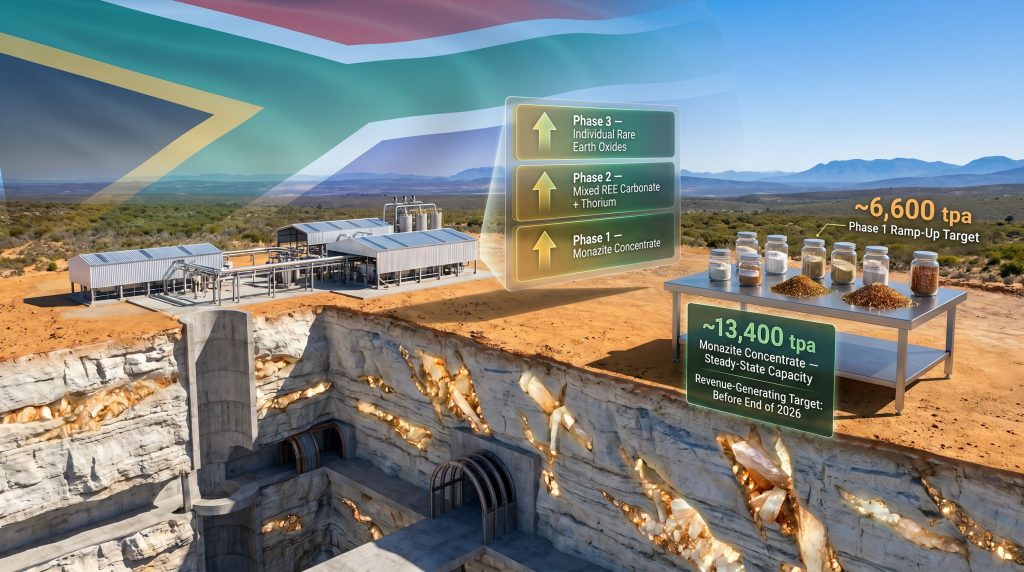
The Steenkampskraal Monazite Mine expansion is structured around a deliberate, sequenced development model that progressively moves the operation up the rare earth value chain. Rather than attempting to reach full separation capability in a single capital commitment, the project is designed to generate revenue at each stage while funding the infrastructure required for the next.
| Expansion Phase | Primary Output | Key Infrastructure | Development Status |
|---|---|---|---|
| Phase 1 | Monazite concentrate | Processing plant construction, mine mobilisation | Underway |
| Phase 2 | Mixed rare earth carbonate + thorium | Cracking plant design and metallurgical test work | Design phase |
| Phase 3 | Mixed and individual rare earth oxides | Separation plant development | Future stage |
This architecture is strategically sound. The rare earth industry is littered with projects that attempted the leap from in-ground resource to separated oxide production without first establishing operational credibility and cash flow. SMM's phased approach reduces that execution risk considerably.
The processing facility at the heart of Phase 1 is engineered to handle approximately 13,400 tonnes per year of monazite concentrate at steady-state output. Initial ramp-up operations are targeted at around 6,600 tonnes per year, representing roughly 49% of nameplate capacity at commencement. The company has publicly indicated a target of achieving revenue-generating status before the end of 2026, a timeline that positions the project as one of the more near-term rare earth development stories on the African continent.
Why Legacy Infrastructure Matters More Than Most Analysts Acknowledge
One factor that is frequently underweighted in assessments of mine restart projects is the value of pre-existing underground workings and surface facilities. In the context of rare earth development globally, greenfield projects routinely face five to ten year lead times from discovery to first production, driven by permitting complexity, infrastructure construction, and metallurgical test work.
Steenkampskraal's existing licensed infrastructure compresses that timeline materially. The underground workings are already in place. Surface facilities that would otherwise require multi-year construction programmes are already established. For a project seeking to generate first monazite concentrate revenue before the end of 2026, this infrastructure inheritance is not a minor advantage; it is arguably the most important commercial asset the project holds outside of the ore body itself.
"The combination of an existing licensed operation, established underground access, and a sequenced development model positions Steenkampskraal as one of the structurally lower-risk rare earth restart projects in the Southern African region."
The 60-Year Dormancy: What It Reveals About Rare Earth Valuation History
Steenkampskraal has a production history that pre-dates the modern rare earth industry. The deposit was originally mined for thorium between the 1950s and early 1960s, at a time when thorium was being investigated as a nuclear fuel source. When that demand evaporated and rare earth elements had not yet found their current industrial applications, the mine was placed on care and maintenance. It remained dormant for more than six decades.
That 60-year gap is instructive. It reflects the historical absence of an economic framework capable of valuing rare earth elements alongside thorium in a combined processing model. The deposit's mineralogy had not changed. What changed was the world's need for neodymium, praseodymium, cerium, lanthanum, and the suite of light rare earth elements (LREEs) that monazite carries in concentrated form.
Monazite is particularly enriched in light rare earth elements, with neodymium and praseodymium representing the most commercially significant outputs for permanent magnet manufacturing. These two elements are the primary inputs for NdFeB magnets, which underpin every electric vehicle motor and most wind turbine generators currently in production. Furthermore, the deposit that sat idle for six decades now sits at the intersection of every major clean energy technology supply chain, reinforcing the broader critical minerals demand story playing out globally.
Operational Leadership at a Critical Inflection Point
Building Institutional Knowledge for Multi-Phase Mine Development
The appointment of Sechaba Letaba as General Manager: Mining arrives at a moment when SMM is transitioning from a development-stage asset to an operational one. That transition is precisely when deep institutional knowledge of underground mining environments becomes most valuable, and where leadership gaps have historically caused the most significant project delays in the South African mining sector.
Letaba brings close to four decades of South African underground mining experience to the role, having begun his career as a learner official in the underground workings of Kimberley in 1988 following the completion of his schooling. His career progression through roles including Production Miner, Development Miner, Shift Boss, Mine Overseer, Mining Engineer, Superintendent, and Operations Manager reflects a bottom-up understanding of underground operations that is increasingly rare at executive level.
He holds a B-Tech Degree in Mining Engineering from the University of Johannesburg and has served in senior leadership roles at Phalaborwa Mining Company, where he held the position of New Business Development Manager, and at Foskor Mining, where he served as Senior Manager: Mining. He subsequently led Kudumane Manganese as CEO, giving him executive-level accountability for large-scale South African mining operations.
Key Competencies Aligned to SMM's Development Requirements
The competency profile required to navigate a phased rare earth mine expansion is distinct from the skill sets that dominate conventional bulk commodity operations. For SMM specifically, the most critical leadership attributes include:
- Underground operations management in technically demanding geological environments typical of the Western Cape
- Mine planning capability that can accommodate the transition from concentrate-only to full processing operations
- Project development experience that spans multiple commodity and processing configurations
- Business development expertise relevant to offtake negotiations and capital market engagement
- Executive-level stakeholder management across regulatory, community, and investor audiences
Letaba's career arc maps closely across each of these dimensions, providing SMM's management structure with a practical operational anchor as the project scales.
Monazite Processing: The Technical Complexity That Creates the Competitive Moat
Why the Cracking Stage Separates Serious Projects From Aspirational Ones
Within the rare earth processing chain, the transition from monazite concentrate to mixed rare earth carbonate — which SMM terms Phase 2 — requires a cracking plant capable of dissolving the monazite crystal structure using either a sulphuric acid or caustic soda process. This step is technically demanding and capital-intensive, which is precisely why most African rare earth projects have never progressed beyond concentrate production. These rare earth processing challenges are well documented across the industry.
The caustic soda (alkaline) cracking route is generally preferred for monazite due to its more effective thorium separation characteristics, though it carries higher reagent costs than acid-based alternatives. Managing the thorium stream produced during cracking requires regulatory licensing for radioactive material handling, adding a compliance layer that greenfield operations with no prior radioactive material experience find particularly challenging.
"Thorium's presence in monazite is not simply an inconvenience. It is a regulatory and technical filter that limits the number of credible operators globally. Projects that can demonstrate compliant thorium management capability are structurally advantaged in attracting Western industrial partners who require full supply chain transparency."
Comparing African Rare Earth Project Types
| Project Type | Key Mineral | Processing Complexity | Thorium Handling Required | LREE Enrichment |
|---|---|---|---|---|
| Monazite-based (e.g., SMM) | Monazite | High, multi-stage | Yes | Very High |
| Carbonatite-hosted (e.g., Lofdal, Songwe) | Bastnäsite / Synchysite | Moderate | Generally No | High |
| Ion adsorption clay | Clay-hosted REE | Lower, leaching dominant | No | Variable |
This comparative framework matters for investors and offtake partners assessing the long-term value capture potential of different project types. Monazite-based operations face higher upfront complexity but also produce a feedstock that is more amenable to full LREE separation, which is where the greatest margin resides in the rare earth value chain.
Risk Landscape: What Could Delay the Expansion Timeline
Technical, Regulatory, and Market Risks Specific to Monazite Development
No rare earth development project is without material risks, and the Steenkampskraal Monazite Mine expansion faces a set of challenges that are specific to its deposit type, jurisdiction, and development stage. Understanding these risks is essential for any analytical assessment of the project's probability of achieving its stated milestones.
- Thorium regulatory complexity: South Africa's nuclear licensing framework imposes specific requirements on the handling, storage, and disposal of thorium-bearing materials. Any delays in securing or maintaining these approvals can disrupt processing timelines independently of mining and plant construction progress.
- Rare earth oxide price volatility: The global rare earth market remains heavily influenced by Chinese production policy. Historical price cycles have seen neodymium oxide swing from below USD $40/kg to above USD $200/kg within single market cycles, creating significant revenue uncertainty for non-Chinese producers at the planning stage.
- Metallurgical transition risk: Phase 2 cracking technology and Phase 3 separation chemistry both involve processing configurations that have historically presented commissioning challenges for rare earth projects globally, often extending timelines by 18 to 36 months beyond initial engineering estimates.
- Capital sequencing dependency: Phase 2 and Phase 3 investment decisions are contingent on Phase 1 performance. If ramp-up is slower than projected, or if rare earth concentrate prices soften materially, the funding pathway for downstream phases becomes more constrained.
Three Scenarios for SMM's Development Trajectory
-
Accelerated scenario: Phase 1 achieves steady-state capacity at approximately 13,400 tonnes per year by mid-2027, enabling early cash flow generation and Phase 2 cracking plant commissioning by 2029. Full separation capability becomes operational by 2031, establishing SMM as a significant non-Chinese rare earth oxide supplier at the point when Western magnet supply chains most urgently need diversified feedstock.
-
Base case scenario: Phase 1 ramp-up encounters typical commissioning delays and reaches nameplate capacity through 2027 to 2028. Phase 2 and Phase 3 timelines shift by 12 to 18 months, but the project remains commercially viable given the structural demand outlook for NdPr oxides in electric vehicle and renewable energy applications.
-
Constrained scenario: Prolonged weakness in rare earth oxide pricing or broader capital market tightening defers the Phase 2 investment decision. SMM operates as a concentrate-only producer for an extended period, capturing value from the mining and beneficiation stage but forgoing the margin available at the cracking and separation stages.
The next major ASX story will hit our subscribers first
The Geopolitical Dimension: Africa's Rare Earth Potential in a Fracturing Supply Chain
Africa holds significant rare earth mineral endowment across multiple geological settings, yet the continent contributes a disproportionately small fraction of global rare earth oxide production. The structural barriers have historically included inadequate infrastructure, limited processing expertise, thorium regulatory frameworks, and a lack of patient capital willing to fund the multi-phase development model that rare earth projects require. Consequently, African mining finance dynamics are evolving rapidly as external pressures mount.
Those barriers have not disappeared, but the external pressure to overcome them has intensified dramatically. The United States, European Union, Japan, and South Korea have each identified rare earth supply chain diversification as a strategic industrial policy priority. Projects that can demonstrate not just mining capability, but processing and separation capability, are significantly more attractive to Western industrial partners than concentrate-only operations that still require Chinese downstream processing. The shifting rare earth geopolitics of the past several years have accelerated this dynamic considerably.
SMM's phased development model, with Phase 3 targeting individual rare earth oxide production, is aligned with exactly the specification that Western supply chain architects require. The project's location in South Africa, with its established regulatory framework, existing industrial infrastructure, and relative political stability compared to many African mining jurisdictions, adds further credibility to its long-term offtake and project finance prospects.
Key Milestones and Forward-Looking Indicators
The following table summarises the operational milestones SMM has achieved and the development targets it is working toward. These indicators provide a practical framework for tracking the project's progress against its stated development timeline.
| Milestone | Status or Target |
|---|---|
| On-site laboratory commissioning | Completed |
| First monazite concentrate production in 60+ years | Achieved |
| Monazite processing plant construction | Underway |
| Phase 1 ramp-up capacity | ~6,600 tpa monazite concentrate |
| Phase 1 steady-state nameplate capacity | ~13,400 tpa monazite concentrate |
| Revenue-generating operations | Targeted before end of 2026 |
| Phase 2 cracking plant | Design and metallurgical test work phase |
| Phase 3 rare earth oxide separation plant | Future development stage |
The commissioning of the on-site laboratory and the achievement of first monazite concentrate production after more than six decades of dormancy are not simply operational footnotes. In the rare earth development cycle, these milestones function as proof-of-concept signals that reduce technical risk perception for capital market participants and potential offtake partners. They demonstrate that the underlying deposit, processing approach, and operational team can deliver against stated targets, which is the foundational credibility requirement for accessing the project finance that Phase 2 and Phase 3 will ultimately require.
Frequently Asked Questions: Steenkampskraal Monazite Mine Expansion
What rare earth elements does Steenkampskraal produce?
The monazite ore at Steenkampskraal contains a concentration of light rare earth elements. The most commercially significant are neodymium and praseodymium, which together form the NdPr oxide used in permanent magnet production. The deposit also contains cerium and lanthanum, both of which have industrial applications in catalysts, glass polishing, and battery technologies, though at lower price premiums than NdPr.
When is Steenkampskraal expected to generate its first revenue?
The company has communicated a target of achieving revenue-generating operational status before the end of 2026, with Phase 1 focused on monazite concentrate production as the initial commercial output.
Where is Steenkampskraal located and why does that matter?
The mine is situated in South Africa's Western Cape province. While the region is not traditionally associated with large-scale mining, it benefits from established road and port infrastructure relative to more remote African mining jurisdictions, reducing logistics costs and operational risk during the early production phases.
What makes monazite concentrate different from a final rare earth product?
Monazite concentrate is the beneficiated ore product that serves as feedstock for downstream rare earth processing. Converting it to commercially usable rare earth oxides requires two further processing stages: a cracking step to dissolve the monazite mineral structure and separate the rare earth and thorium streams, followed by a solvent extraction separation process to isolate individual rare earth oxides. Each stage adds significant value but also requires substantial capital investment and technical expertise.
What is the long-term resource potential of the deposit?
Management has indicated that the deposit's geology holds expansion potential both at depth and along geological strike, which could extend the operational mine life beyond current resource estimates. Incremental resource delineation drilling has the potential to underpin Phase 2 and Phase 3 capital commitments with greater geological confidence, and to provide the extended mine life visibility that long-term offtake partners typically require before committing to supply agreements.
Disclaimer: This article contains forward-looking statements and scenario projections based on publicly available information and management disclosures. These projections involve assumptions about future market conditions, technical performance, and capital availability that may not eventuate. Readers should conduct their own due diligence and seek independent financial advice before making investment decisions related to any company or project discussed in this article.
Ready to Uncover the Next Major Mineral Discovery Before the Market Does?
Discovery Alert's proprietary Discovery IQ model delivers real-time alerts on significant ASX mineral discoveries — turning complex mineral data into actionable insights for both short-term traders and long-term investors. Explore historic discoveries and the returns they generated, then begin your 14-day free trial to position yourself ahead of the market.