
June 7, 2026
Storage Security Infrastructure: Understanding the Real Differences
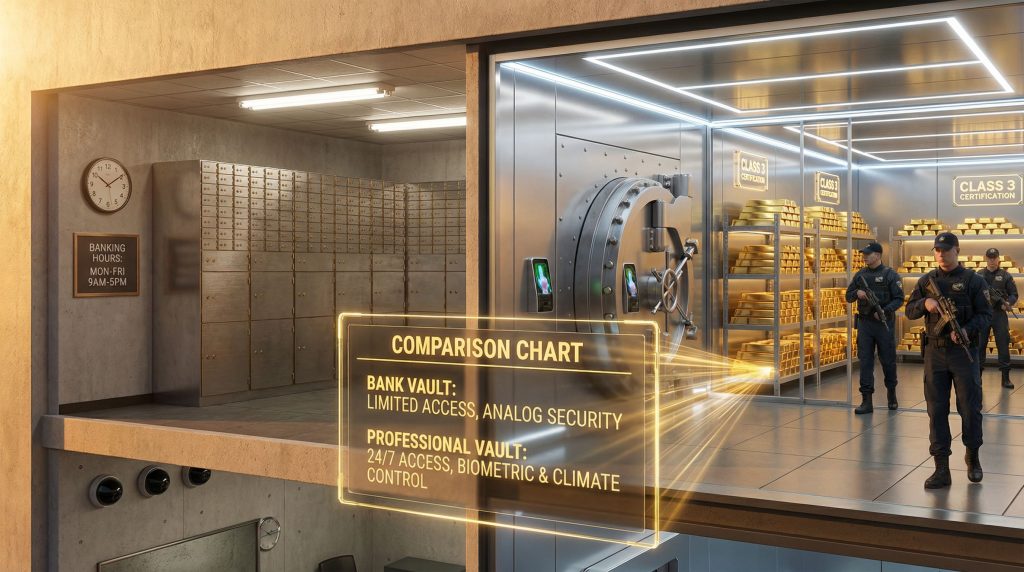
Modern precious metals storage represents a fundamental shift from traditional safety deposit approaches, built around specialized infrastructure designed specifically for bullion protection. When evaluating bank safety deposit box vs gold vault storage, the most significant distinction lies in the vault classification systems that govern commercial storage facilities.
Professional vault operators utilize Class 3 certification standards, representing the highest tier of commercial security infrastructure available in the storage industry. These facilities incorporate multiple layers of physical protection, including reinforced concrete construction, specialized steel barriers, and environmental control systems specifically calibrated for precious metals preservation.
Furthermore, the security architecture extends beyond basic physical barriers to encompass sophisticated access control mechanisms. Biometric authentication systems work in conjunction with traditional key management protocols, creating multiple verification checkpoints that must be satisfied before access is granted.
Environmental Protection Standards
Climate-controlled environments within professional vaults maintain precise temperature and humidity levels crucial for long-term precious metals preservation. These systems prevent oxidation, tarnishing, and other forms of degradation that can occur in uncontrolled storage environments.
However, banks typically design their vault systems for general document and valuables storage, without the specialized environmental controls required for optimal precious metals preservation. This fundamental difference in design philosophy creates meaningful gaps in protection quality over extended storage periods.
When big ASX news breaks, our subscribers know first
Insurance Coverage: The Hidden Risk Most Investors Overlook
The insurance landscape for precious metals storage reveals one of the most critical distinctions between bank safety deposit box vs gold vault storage options. Federal Deposit Insurance Corporation coverage explicitly excludes safety deposit box contents, leaving investors with significant protection gaps.
Consequently, FDIC insurance policies cover only cash deposits within qualified financial institutions, providing no coverage for physical assets stored in safety deposit boxes. This limitation means that gold, silver, platinum, or other precious metals remain entirely unprotected under federal insurance programs.
Bank Liability Limitations
Most financial institutions structure their safety deposit box agreements to minimise or eliminate liability for stored contents. Standard rental agreements typically include comprehensive disclaimer clauses that shift responsibility for loss, damage, or theft entirely to the box holder.
These liability limitations create scenarios where customers pay ongoing rental fees while assuming all financial risk associated with their stored assets. Even in cases of proven negligence, banks often successfully limit their exposure through carefully crafted contractual language, highlighting critical investment risk flags.
Professional Vault Insurance Structures
In contrast, specialised vault operators approach insurance coverage from an entirely different framework. Professional facilities typically include comprehensive insurance protection at full replacement value as a standard component of their storage services.
This insurance structure covers:
• Total asset replacement in cases of loss or theft
• Damage protection from facility incidents
• Environmental damage coverage including fire, flood, or natural disasters
• Transportation insurance during delivery and pickup operations
The insurance policies backing professional vault operations undergo regular evaluation by specialised underwriters who understand precious metals markets and pricing dynamics, particularly as a gold inflation hedge.
Professional Vault Operations: Specialized Infrastructure Design
Professional precious metals storage facilities operate under fundamentally different operational parameters compared to traditional banking vault systems. The infrastructure design reflects specialised requirements for bullion storage, handling, and security management, aligning with modern industry evolution trends.
Twenty-four-seven armed security presence represents a standard operational requirement across major vault facilities. These security teams receive specialised training in precious metals handling procedures and emergency response protocols specific to bullion storage environments.
Continuous Surveillance Systems
Modern vault facilities implement comprehensive surveillance networks that extend far beyond basic camera monitoring. Multi-spectrum imaging systems capture detailed records of all facility access and movement, creating comprehensive audit trails for every storage transaction.
The surveillance infrastructure includes:
• High-definition video recording with extended retention periods
• Motion detection systems throughout all access corridors
• Thermal imaging capabilities for after-hours monitoring
• Integrated alarm systems connected to off-site monitoring centres
Independent Verification Processes
Professional vault operators maintain strict independence from traditional financial institutions, creating operational separation that insulates stored assets from banking system disruptions. This independence proves particularly valuable during financial sector stress periods when bank operations may face restrictions or closures.
Third-party audit procedures provide ongoing verification of stored assets through independent accounting firms specialising in precious metals inventory management. These audits occur on both scheduled and unscheduled bases, ensuring continuous oversight of vault operations and asset verification.
Access Limitations: Banking Hour Restrictions and Crisis Scenarios
Traditional bank safety deposit box access operates within significant time and operational constraints that can prove problematic during periods when precious metals investors most need asset liquidity. Standard banking hours typically limit access to weekday business hours and exclude weekends and federal holidays.
Historical Access Restrictions During Crises
The 2008 financial crisis demonstrated how rapidly banking access can become restricted during systemic stress periods. Multiple bank failures occurred with minimal advance notice to customers, creating situations where safety deposit box access became unavailable for extended periods.
During the COVID-19 pandemic, widespread branch closures again highlighted the vulnerability of bank-dependent storage systems. Customers experienced weeks of restricted access to their stored assets, with no digital alternatives available for portfolio management or emergency liquidation.
Emergency Response Protocols
Bank closure procedures follow Federal Deposit Insurance Corporation protocols that prioritise deposit protection over safety deposit box access. When financial institutions fail, customer access to safety deposit boxes often becomes secondary to deposit insurance processing and regulatory oversight requirements.
Furthermore, the regulatory framework governing bank failures includes provisions for safety deposit box content recovery, but these processes typically involve significant delays and bureaucratic procedures that can extend for months or longer.
Digital Platform Integration
Professional vault storage addresses access limitations through twenty-four-seven digital platform capabilities that provide real-time portfolio management options regardless of physical facility hours or market conditions. These modern data-driven operations enable:
• Real-time holdings monitoring with current market valuations
• Instant transaction capabilities for buying, selling, or transferring metals
• Delivery coordination through secure logistics networks
• Portfolio rebalancing without physical facility visits
Counterparty Risk Analysis: Independence from Financial System Dependencies
The fundamental value proposition of physical precious metals ownership centres on independence from counterparty risk inherent in paper-based financial instruments. Gold and silver provide wealth preservation capabilities that don't depend on institutional promises or governmental fiscal policies.
Systemic Risk Exposure Through Banking Relationships
Storing precious metals within traditional banking systems inadvertently reintroduces the counterparty dependencies that physical ownership is designed to eliminate. Bank safety deposit box storage ties asset access to financial institution stability and regulatory compliance requirements.
This dependency becomes particularly relevant during periods of economic stress when banking systems face operational challenges. Historical precedents demonstrate how quickly financial institution access can become restricted during crisis periods.
Government Oversight and Regulatory Control
The regulatory framework governing banking operations creates potential pathways for government asset control that bypass traditional legal protections. Executive Order 6102, implemented in 1933, provides historical precedent for government gold confiscation executed through banking system coordination.
While such extreme measures remain unlikely under current political and economic conditions, the underlying regulatory structure that enabled past confiscation efforts continues to exist within modern banking oversight frameworks.
Asset Accessibility During Economic Disruption
Professional vault storage operates independently from traditional financial institutions, creating operational separation during systemic stress periods. This independence proves valuable when banking system disruptions limit customer access to traditional financial services.
Independent vault operators maintain their own security protocols, insurance structures, and operational procedures that function regardless of broader financial sector conditions. This separation provides continuity of access when traditional banking services face restrictions.
Storage Method Comparison: Security and Service Analysis
| Feature | Bank Safety Deposit Box | Professional Gold Vault |
|---|---|---|
| Insurance Coverage | Customer responsibility | Included at full replacement value |
| Access Hours | Banking hours only | Extended appointment-based access |
| Security Rating | General bank security | Class 3 vault certification |
| Crisis Accessibility | Limited during closures | Independent operation |
| Digital Management | None available | Real-time platform access |
| Specialisation | General storage | Precious metals focused |
| Environmental Controls | Basic vault conditions | Climate-controlled precision |
| Audit Verification | Customer responsibility | Independent third-party audits |
Cost Structure Analysis
Bank safety deposit box rental fees typically range from $20 to $200 annually, depending on box size and geographic location. However, these base costs don't include additional insurance requirements needed to protect stored precious metals adequately.
Homeowner's insurance policies generally provide limited coverage for off-premises valuables, often capping precious metals coverage at $1,500 or requiring specific riders with additional premium costs. These insurance gaps create hidden expenses that increase total storage costs significantly.
In contrast, professional vault storage pricing operates on transparent fee structures that include comprehensive insurance coverage at full replacement value. Allocated storage options typically cost 0.5% to 1.5% annually of stored asset value, while segregated storage commands premium pricing for individual identification and documentation.
The next major ASX story will hit our subscribers first
Allocated vs Segregated Storage: Understanding Ownership Structures
Professional vault storage offers two distinct ownership structures that address different investor preferences and documentation requirements. Understanding these differences helps optimise storage choices based on individual circumstances and objectives.
Allocated Storage Specifications
Allocated storage systems maintain precise one-to-one asset accounting while storing metals alongside others of the same type and purity. Each investor's holdings receive specific identification through digital record-keeping systems that track ownership down to individual coins or bars.
This approach provides:
• Verified ownership through detailed digital records
• Cost-effective storage due to operational efficiencies
• Full insurance protection at replacement value
• Audit verification through third-party accounting procedures
Segregated Storage Benefits
Segregated storage provides physical separation of individual investor holdings within dedicated storage spaces identified by name rather than account number. This approach offers enhanced documentation options for investors requiring specific verification for estate planning or regulatory compliance.
Segregated storage includes:
• Physical separation in individually identified storage containers
• Named identification rather than account-number-based tracking
• Storage certificates documenting specific holdings and location
• Enhanced estate planning documentation for inheritance purposes
Both storage structures maintain identical security protocols, insurance coverage, and access procedures. The choice between allocated and segregated storage primarily reflects documentation preferences and cost considerations rather than security differences.
Liquidity and Transaction Management
Modern vault storage addresses traditional precious metals liquidity challenges through integrated digital platform capabilities that enable real-time portfolio management without physical facility visits or banking hour restrictions.
Real-Time Portfolio Management
Professional storage platforms provide instantaneous access to current holdings valuations based on live precious metals pricing data. Investors can monitor portfolio performance, track market movements, and execute transactions regardless of vault facility hours or geographic location.
Platform capabilities typically include:
• Live pricing updates from major precious metals exchanges
• Portfolio performance tracking with historical data analysis
• Transaction history with detailed documentation
• Market alert systems for price movement notifications
Twenty-Four-Seven Trading Capabilities
Unlike bank safety deposit box storage, professional vault systems enable around-the-clock transaction capabilities that align with global precious metals trading schedules. This flexibility supports the broader gold market outlook by allowing investors to execute buy, sell, or transfer orders outside traditional banking hours.
This flexibility proves particularly valuable during market volatility periods when precious metals prices experience rapid movements that require immediate portfolio adjustments. Traditional banking-dependent storage systems cannot accommodate these time-sensitive requirements.
Is Bank Storage Really More Secure?
While many investors assume bank vaults provide superior security, the reality often differs significantly. Bank vault security standards vary considerably across institutions and geographic regions, with community banks often maintaining basic vault security appropriate for document storage but inadequate for high-value precious metals protection.
According to bank vault storage comparisons, professional vault operators implement standardised security protocols across all facilities, ensuring consistent protection levels regardless of storage location. These standards include specific requirements for:
• Physical barrier specifications with defined breach-resistance ratings
• Guard deployment standards including training and equipment requirements
• Surveillance system capabilities with retention and resolution standards
• Access control protocols with multi-factor authentication requirements
Insurance Gap Assessment
Comprehensive insurance analysis reveals significant protection gaps in traditional bank storage arrangements. Most investors underestimate their exposure to uninsured losses when storing precious metals in safety deposit boxes.
Key insurance considerations include:
• FDIC coverage limitations that exclude safety deposit box contents
• Homeowner's policy exclusions for high-value precious metals
• Bank liability disclaimers that shift loss responsibility to customers
• Coverage verification requirements for documenting stored asset values
Professional vault storage eliminates these insurance gaps through comprehensive coverage structures designed specifically for precious metals protection, as detailed in professional security comparisons.
Implementation Strategy for Storage Transition
Transitioning from bank safety deposit box vs gold vault storage requires careful planning to ensure asset security during the transfer process and proper documentation for tax and estate planning purposes.
Documentation and Verification Procedures
Detailed inventory documentation forms the foundation of successful storage transition. Professional vault operators provide comprehensive intake procedures that verify asset authenticity, purity, and condition before acceptance into storage.
The verification process typically includes:
• Physical inspection of all coins and bars
• Authenticity testing using specialised equipment
• Weight and purity verification against stated specifications
• Photographic documentation for insurance and record-keeping purposes
Estate Planning Coordination
Professional vault storage offers enhanced estate planning benefits through improved documentation and access procedures for beneficiaries. Segregated storage options provide particularly valuable benefits for estate planning purposes.
Beneficiary designation procedures within vault storage accounts enable streamlined asset transfer processes that bypass traditional probate requirements in many jurisdictions. This capability provides significant time and cost savings for estate settlement.
Decision Criteria for Storage Selection
Investment size and portfolio allocation represent primary factors in storage decision-making. Smaller precious metals positions may find bank safety deposit box storage adequate, while larger allocations benefit significantly from professional vault storage capabilities.
Risk Tolerance Assessment
Conservative investors typically prioritise maximum security and insurance protection over cost considerations, making professional vault storage the preferred choice despite higher annual fees.
Cost-sensitive investors may accept higher risk levels associated with bank storage in exchange for lower annual expenses, particularly for smaller precious metals positions that don't justify premium storage costs.
Liquidity Requirements
Investors requiring frequent access or trading capabilities benefit substantially from professional vault storage platforms that enable real-time portfolio management and transaction execution outside banking hours.
Buy-and-hold investors with minimal trading requirements may find traditional bank storage adequate for their needs, accepting access limitations in exchange for cost savings.
The choice between bank safety deposit box vs gold vault storage ultimately depends on individual risk tolerance, portfolio size, liquidity requirements, and cost sensitivity. Professional vault storage provides superior security, insurance protection, and operational capabilities, while bank storage offers lower costs for investors accepting higher risk levels and access limitations.
This analysis is provided for informational purposes only and does not constitute investment advice. Precious metals investments involve risk and may result in partial or total loss. Consult with qualified financial professionals before making investment decisions.
Looking to Invest in Precious Metals Discovery Opportunities?
Discovery Alert's proprietary Discovery IQ model delivers real-time alerts on significant ASX mineral discoveries, including precious metals finds that can generate substantial market returns. Explore Discovery Alert's dedicated discoveries page to understand how major mineral discoveries have historically created exceptional investment opportunities, then begin your 14-day free trial to position yourself ahead of the market.