July 23, 2026
When Infrastructure Meets Extreme Weather: The Physics of Port Terminal Vulnerability
Bulk commodity export terminals are engineered to handle enormous throughput volumes under demanding conditions, but their open-air design creates an inherent tension with one unavoidable force: extreme weather. Unlike enclosed industrial facilities, terminals built around large-scale stacker reclaimers, ship loaders, and conveyor systems are exposed to the full spectrum of atmospheric forces. When wind speeds climb into hurricane-force territory, even heavy-gauge steel structures weighing hundreds of tonnes can suffer catastrophic lateral loading that no standard engineering tolerance was designed to absorb repeatedly.
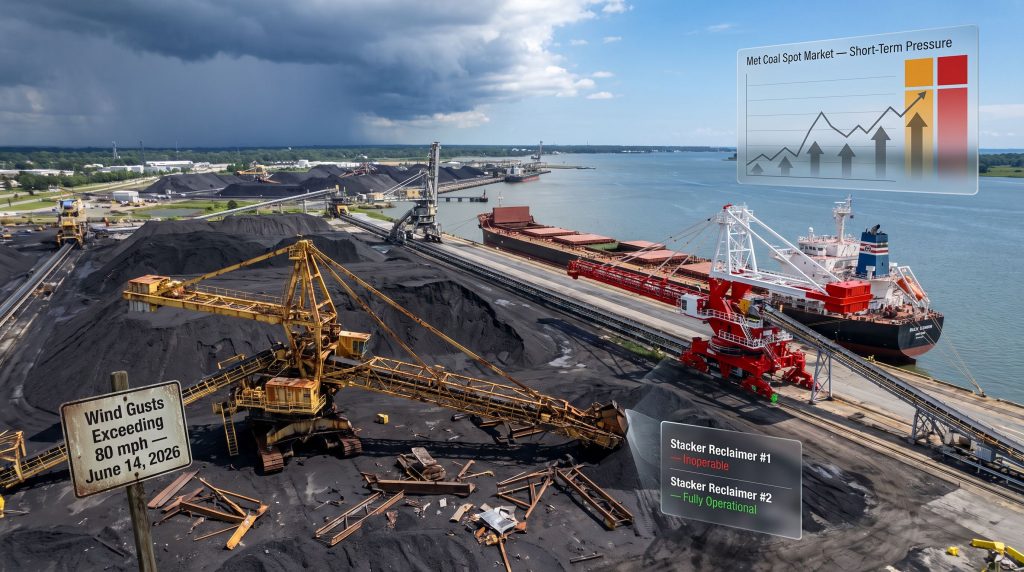
This physical reality came into sharp focus on the evening of June 14, 2026, when a severe storm swept through Newport News, Virginia, delivering sustained wind gusts exceeding 80 miles per hour to the Dominion Terminal Associates (DTA) coal export facility. The consequences — specifically the significant structural damage to one of two operational stacker reclaimers at the terminal — have triggered force majeure declarations across Alpha Metallurgical Resources' customer base and introduced meaningful near-term uncertainty into U.S. metallurgical coal export logistics. The storms damage reclaimer at DTA event is a stark reminder of how quickly extreme weather can reshape supply chains. Understanding why this event matters requires looking well beyond the immediate equipment failure.
When big ASX news breaks, our subscribers know first
DTA and the Metallurgical Coal Export Network: Why Newport News Matters
Dominion Terminal Associates, situated at the port of Newport News in Virginia, functions as one of the most strategically positioned coal export terminals on the U.S. East Coast. Its geographic location provides direct access to deep-water Atlantic shipping lanes, making it a preferred routing point for metallurgical coal destined for international steel mills in Europe, Asia, and South America.
Metallurgical coal, often called coking coal, is a fundamentally different product from thermal coal used in power generation. It serves as the primary carbon source in blast furnace steelmaking, where its coking properties — specifically its ability to bind and provide structural integrity within the furnace charge — make it irreplaceable in conventional steel production. The quality specifications demanded by steel mills are exacting: volatile matter content, ash levels, sulfur concentration, and coking strength are all tightly controlled, which limits the number of global supply sources capable of meeting them.
Alpha Metallurgical Resources stands as one of the largest dedicated metallurgical coal producers in the United States, with mining operations concentrated in the Central Appalachian coalfields of Virginia and West Virginia. The company's access to DTA represents a critical export pathway, and any disruption to terminal throughput capacity has direct implications for its ability to fulfil committed shipment volumes. Furthermore, those tracking the metallurgical coal price update will be watching this situation closely for downstream pricing effects.
How Stacker Reclaimers Work and Why Redundancy Is Non-Negotiable
To appreciate the operational significance of losing one stacker reclaimer, it helps to understand what these machines actually do within a bulk terminal environment.
A stacker reclaimer is a large, rail-mounted piece of equipment that performs two distinct but related functions:
- Stacking mode: As coal arrives from inland sources via rail or conveyor, the machine builds organised stockpiles across the terminal's storage yard, often creating elongated windrow formations that can reach heights of 15 metres or more.
- Reclaiming mode: When a vessel berths for loading, the machine reverses its function, using a rotating bucket wheel at the end of its boom arm to excavate coal from the stockpile and feed it back onto the conveyor system toward the ship loader.
The machine's boom, which can extend 50 metres or more, must swing laterally across the full width of the stockpile during both operations. This same lateral reach that makes the equipment so productive is precisely what exposes it to extreme wind loading. In high-wind conditions, the boom arm acts as a massive sail, transmitting enormous bending and torsional forces into the slewing ring and undercarriage.
At a two-machine terminal like DTA, both reclaimers typically operate in coordinated cycles to maintain continuous vessel loading schedules. When one machine is removed from service, the remaining unit must attempt to cover both stacking and reclaiming duties simultaneously, which is operationally constrained and can create dangerous stockpile imbalances when vessel arrival schedules do not adjust accordingly.
The June 14, 2026 Storm Event: Meteorological Context and Structural Impact
Wind gusts exceeding 80 mph place a storm event firmly at or above the threshold for hurricane-force classification. The Saffir-Simpson scale defines Category 1 hurricane conditions beginning at sustained winds of 74 mph, meaning the gusts recorded at DTA on June 14 were consistent with the destructive force associated with the lower boundary of tropical storm intensity.
According to reporting on the DTA storm incident, the event caused significant structural damage to critical bulk handling equipment at the facility. Wind engineering standards for bulk terminal machinery are typically designed to withstand operational wind speeds in the range of 20 to 30 mph and are placed in storm survival mode at speeds approaching 45 to 55 mph. Forces generated at 80-plus mph represent a multiple of those design thresholds, particularly for extended boom structures that act as aerodynamic surfaces.
Newport News sits on the Virginia Peninsula between the James River and Hampton Roads harbour, a geography that funnels coastal storm systems and can amplify wind speeds during fast-moving convective events. While the area has historically experienced significant weather, the intensity of this particular storm event appears to have exceeded the operational resilience of the affected equipment.
Equipment Status Following the Storm
| Equipment | Post-Storm Status | Additional Notes |
|---|---|---|
| Stacker Reclaimer #1 | Inoperable, significant damage | Full damage assessment ongoing |
| Stacker Reclaimer #2 | Fully operational | Underwent refurbishment earlier in 2026 |
The fact that Stacker Reclaimer #2, which had been refurbished earlier in 2026, survived the storm intact is operationally significant and may reflect upgraded structural reinforcement applied during the refurbishment process. While the exact scope of that refurbishment has not been publicly detailed, refurbishment programmes for large stacker reclaimers commonly include:
- Structural weld inspection and reinforcement
- Updated slewing ring components
- Improvements to storm tie-down and locking mechanisms
All of these upgrades can meaningfully improve resistance to extreme wind loading.
Commercial Consequences: Force Majeure and the Supply Chain Ripple Effect
Alpha Metallurgical Resources responded to the equipment damage by issuing force majeure notifications to affected customers. This is a legally significant step with substantial commercial implications across the metallurgical coal supply chain. Consequently, the full impact on commodity prices and miners with East Coast export exposure could be considerable in the near term.
Understanding Force Majeure in Commodity Supply Contracts
In commodity trading and mining supply agreements, a force majeure clause allows a supplier to suspend or reduce delivery obligations when an event beyond reasonable operational control renders performance impossible or commercially unreasonable. Severe weather damage to critical infrastructure typically qualifies, provided the supplier can demonstrate the event was unforeseeable and that all reasonable mitigation steps have been or are being taken.
The practical consequences for Alpha's customers vary by contract structure and sourcing flexibility:
- Integrated steel mills with long-term offtake agreements face the most immediate disruption, as they rely on scheduled shipment windows to manage coking coal inventory ahead of blast furnace production cycles.
- International commodity traders operating on shorter delivery windows may pivot to alternative supply sources more quickly but face spot market pricing exposure.
- Smaller regional buyers with limited supplier alternatives may experience the most acute impact given constrained sourcing optionality.
Disruption Timeline and Risk Escalation
| Timeframe | Risk Category | Potential Market Impact |
|---|---|---|
| 0 to 30 days | Vessel scheduling disruption | Localised spot price pressure on met coal |
| 1 to 3 months | Reduced export volume through DTA | Customer sourcing diversification |
| 3 to 6 months | Repair and restoration execution | Dependent on damage assessment findings |
| 6 months or beyond | Contract renegotiation risk | Structural shifts in supply relationships |
Note: The above represents an illustrative framework based on industry precedent. Actual timelines will depend on damage assessment outcomes and parts availability.
The Repair Decision: A Complex Engineering and Commercial Calculus
Once a comprehensive engineering assessment is completed, DTA and Alpha will face a decision framework with three broad pathways:
- Component-level repair: Viable when damage is isolated to specific secondary structures such as the boom head, conveyor system, or electrical enclosures. This is the fastest pathway, often executable within weeks to a few months depending on parts lead times.
- Partial structural replacement: Required when primary load-bearing members — the main boom, mast, or slewing ring assembly — are compromised. Lead times for fabricated steel structures of this scale typically range from several months to nearly a year.
- Full machine replacement: Reserved for catastrophic damage scenarios where the machine frame or undercarriage is beyond economical repair. Custom-manufactured stacker reclaimers for bulk terminals can carry lead times of 12 to 24 months, reflecting the specialised fabrication, engineering, and commissioning requirements involved.
The supply chain for heavy bulk handling equipment has faced documented capacity constraints in recent years, with specialised manufacturers in Europe, Australia, and China operating at elevated order backlogs. This means even a straightforward repair pathway could face unexpected delays if critical components require custom fabrication.
Operational Continuity Strategies During the Recovery Period
With Stacker Reclaimer #2 operational, DTA retains partial throughput capability. Managing this period effectively will likely require:
- Prioritising reclaim operations over stacking to maintain vessel loading continuity.
- Adjusting vessel berthing schedules to align with the reduced machine cycling capacity.
- Coordinating with alternative East Coast export terminals to absorb overflow volumes where feasible.
- Maintaining transparent communication with affected customers to preserve commercial relationships through the force majeure period.
Infrastructure Resilience and the Broader Lesson for Bulk Terminal Operators
The events at DTA are unlikely to be an isolated case study. Open-air bulk terminal infrastructure across the United States and globally faces growing exposure to high-intensity weather events. Industry engineering standards for wind load tolerance in stacker reclaimers and ship loaders have historically been benchmarked against regional wind speed probability distributions, but those distributions are shifting. In addition, broader mining infrastructure resilience is increasingly front of mind for operators and investors alike.
Terminals that operate ageing, unmodified equipment fleets carry disproportionate risk exposure compared to those with active refurbishment cycles. The DTA incident illustrates this contrast directly: one machine survived the event following a 2026 refurbishment programme while the other did not. Whether or not the refurbishment directly contributed to the survival of Stacker Reclaimer #2 remains unconfirmed, but the correlation underscores a broader industry principle.
Terminal operators and their insurance underwriters are increasingly factoring weather-related equipment risk into asset management and capital expenditure planning. For investors and analysts tracking companies with significant export infrastructure dependencies, the DTA event is a reminder that physical asset risk is a material factor in commodity supply chain exposure assessments — not merely a background operational consideration. This is particularly relevant given growing resource export challenges and the broader pressures of global commodity market tariffs affecting supply route economics worldwide.
The next major ASX story will hit our subscribers first
Frequently Asked Questions: Storms Damage Reclaimer at DTA
What exactly is a stacker reclaimer and why does losing one matter so much?
A stacker reclaimer is the primary machine responsible for building and retrieving coal stockpiles at a bulk export terminal. Without it, a terminal cannot efficiently cycle material from storage to vessel loading systems. At a two-machine facility like DTA, each unit carries roughly half the terminal's throughput capacity, making the loss of one machine a significant operational constraint rather than a minor inconvenience.
How long could repairs to the damaged machine realistically take?
Based on industry precedents for large bulk handling equipment, comprehensive damage assessments alone typically require two to six weeks. Repair execution timelines then depend on the damage severity: weeks to a few months for component-level fixes, several months to over a year for major structural replacement. The availability of specialised parts will be a key determining variable.
Does the DTA outage have any effect on global metallurgical coal pricing?
DTA handles a meaningful share of U.S. met coal exports. Any reduction in throughput capacity introduces supply-side friction that can support short-term spot price strength for high-quality coking coal grades, particularly if the outage coincides with strong demand from Asian or European steel mills. However, the broader market impact will depend on outage duration and the responsiveness of alternative supply routes. This should not be interpreted as investment advice.
Was the June 14 storm an unusual weather event for the Newport News region?
Wind gusts above 80 mph are classified as hurricane-force and represent the upper boundary of typical convective storm intensity for coastal Virginia locations. While the region does experience periodic severe weather, gusts of this magnitude at an active industrial facility represent a statistically uncommon but not unprecedented event.
Why did Alpha issue force majeure notices so quickly after the storm?
Prompt notification is both a legal requirement and a commercial best practice under most commodity supply contracts. Delayed force majeure declarations can expose suppliers to breach-of-contract claims and complicate subsequent renegotiations. Acting quickly preserves legal protections and gives affected customers maximum lead time to arrange alternative supply coverage.
Key Takeaways: What the DTA Storm Damage Reveals About Export Infrastructure Risk
- The June 14, 2026 storm event and the resulting storms damage reclaimer at DTA highlights the physical vulnerability of open-air bulk terminal equipment to high-intensity weather events.
- Alpha Metallurgical Resources' force majeure declarations represent a material commercial disruption to U.S. metallurgical coal export schedules through the Newport News corridor.
- Stacker Reclaimer #2 remaining operational after its 2026 refurbishment provides critical partial throughput continuity and prevents a complete terminal shutdown.
- The recovery timeline and full commercial impact will not be known until engineering assessments determine the scope and repairability of the damage to Stacker Reclaimer #1.
- For the broader industry, this incident reinforces the strategic and financial value of proactive equipment refurbishment, structural redundancy investment, and robust force majeure contractual frameworks across bulk commodity export infrastructure.
This article is intended for informational purposes only and does not constitute financial or investment advice. Timelines, market impact assessments, and repair scenario projections are based on industry precedent and are illustrative in nature. Readers should consult qualified professionals before making commercial or investment decisions based on the information presented here.
Want to Track the Market Impact of Major Supply Chain Disruptions Like the DTA Incident?
Events like the storm damage at Dominion Terminal Associates can swiftly reshape metallurgical coal supply dynamics and create time-sensitive opportunities for informed investors — Discovery Alert's proprietary Discovery IQ model delivers real-time alerts on significant ASX mineral discoveries, ensuring subscribers are positioned ahead of the broader market the moment material developments emerge. Explore historic discoveries and their market returns on Discovery Alert's dedicated discoveries page, and begin your 14-day free trial today to secure a market-leading edge.