August 24, 2026
What Makes the Strait of Hormuz the Ultimate Energy Security Test?
Energy security vulnerabilities rarely present themselves with such geographic precision as the Strait of Hormuz oil exports bottleneck. This narrow waterway represents the convergence of geological accidents, geopolitical tensions, and global economic dependency that creates a singular point of failure for world energy markets. Understanding how this chokepoint operates reveals the fragile architecture underlying modern energy infrastructure.
The mathematics of global energy dependency through this transit route expose structural weaknesses that extend far beyond simple supply disruption scenarios. When examining the flow of Strait of Hormuz oil exports, the concentration of risk becomes immediately apparent through both volumetric analysis and quality-specific constraints that bind Asian economies to Persian Gulf producers.
The Mathematics of Global Energy Dependency
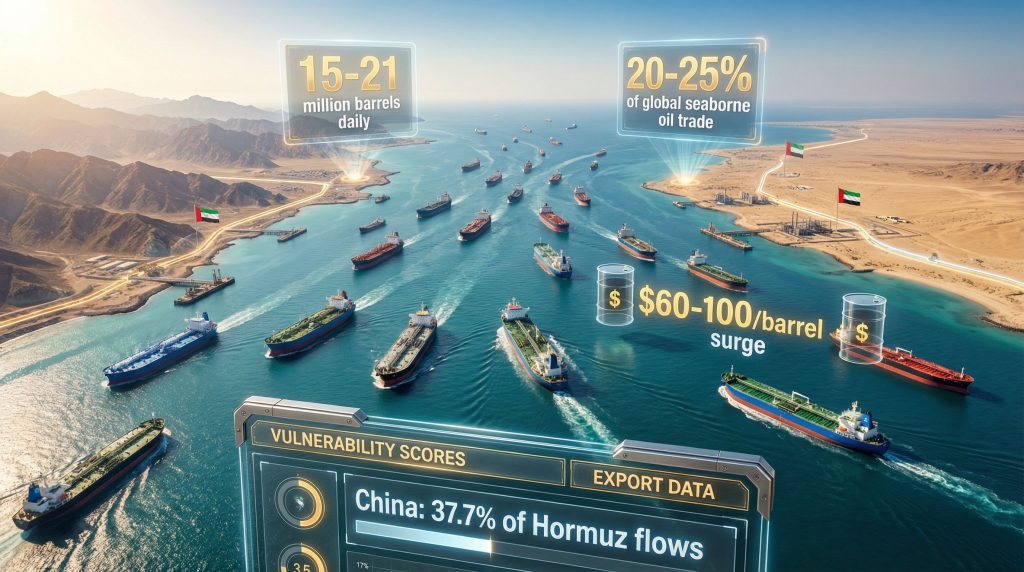
Current daily throughput through the strait fluctuates between 15-21 million barrels per day, representing approximately 20-25% of global seaborne oil trade under normal conditions. This baseline exposure creates immediate vulnerability for energy-importing nations, particularly those in Asia-Pacific regions where industrial capacity depends heavily on consistent crude oil flows.
The geographic constraint mechanism operates through a 21-mile width at the narrowest navigable point, creating natural bottleneck conditions that cannot be easily bypassed during crisis scenarios. Limited bypass infrastructure capacity versus actual throughput volumes establishes a fundamental mismatch between theoretical alternative routes and real-world emergency response capabilities.
LNG component flows add another layer of complexity, with approximately 20% of global liquefied natural gas transit depending on unimpeded passage through these waters. This dual exposure to both crude oil and natural gas supply disruption amplifies the potential economic impact of any sustained closure scenario.
Historical precedents demonstrate how quickly theoretical spare capacity becomes irrelevant when transportation infrastructure faces operational constraints. Furthermore, market responses to previous disruption attempts show that futures pricing mechanisms react faster than physical supply chain adaptations can occur.
When big ASX news breaks, our subscribers know first
Which Countries Face Maximum Exposure Risk from Hormuz Disruptions?
Vulnerability assessment requires analysis of both export-dependent producers and import-dependent consumers, each facing distinct but interconnected risks from Strait of Hormuz oil exports disruption. The asymmetric nature of these dependencies creates cascading effects that amplify initial supply shocks through secondary and tertiary economic channels.
Export-Dependent Persian Gulf Producers
| Country | Daily Exports Through Hormuz | Alternative Route Capacity | Vulnerability Classification |
|---|---|---|---|
| Saudi Arabia | 5.5 million bpd | 3.0 million bpd (East-West Pipeline) | Medium-High |
| Iraq | 3.2-3.4 million bpd | 0 million bpd | Critical |
| UAE | 2.6 million bpd | 1.0 million bpd (Fujairah Pipeline) | High |
| Iran | 2.1 million bpd | 0 million bpd | Critical |
| Kuwait | 2.0 million bpd | 0 million bpd | Critical |
Iraq's position represents the most acute single-country vulnerability within the Persian Gulf export system. Recent analysis shows Iraq's production baseline running near 4.0-4.3 million bpd total crude production, with exports typically averaging 3.2-3.4 million bpd from southern terminals at Basrah.
The concentration of this output in southern fields feeding exclusively to Basrah export terminals creates a single export infrastructure dependency that channels virtually all production through Hormuz. Current disruptions have already demonstrated this vulnerability in real-time, with approximately 1.5 million bpd shut-in and potential escalation to 3.0 million bpd if constraints persist.
Field-specific production data reveals the concentrated nature of this exposure:
- Rumaila field: 1.4-1.5 million bpd nameplate capacity
- West Qurna 1: ~600,000 bpd production, 650,000-670,000 bpd capacity
- West Qurna 2: ~460,000 bpd production, 750,000-800,000 bpd development target
- Zubair field: ~700,000 bpd design capacity
- Maysan complex: ~300,000-350,000 bpd contribution
Import-Dependent Asian Economies
Asian consumption patterns create quality-specific dependencies that compound volume-based exposure calculations. Oil trade flows through this critical waterway show that China and India together account for roughly two-thirds of Iraqi crude flows, making them particularly vulnerable to disruptions affecting medium-heavy sour grade availability.
China: 37.7% of total Hormuz flows (7.5 million bpd exposure)
India: 14.7% of total flows (2.9 million bpd critical dependency)
South Korea: 12.0% of flows (2.4 million bpd industrial impact)
Japan: 10.9% of flows (2.2 million bpd energy security risk)
For Iraqi crude specifically, China and India combined intake approximately 2.1-2.5 million bpd of medium-heavy sour grades. Asian refiners are largely configured for these heavier grades, creating operational constraints when substituting lighter crude types. This refinery configuration dependency means countries cannot easily substitute crude grades without experiencing efficiency losses, yield alterations, and margin compression.
The technical constraint operates through refinery design parameters optimized for specific crude quality ranges. In addition, substituting lighter grades alters diesel output yields and refining margins, creating economic pressure even when substitute crude supplies are theoretically available. Current market conditions already demonstrate this effect through tightening heavy crude differentials.
What Are the Primary Disruption Scenarios and Their Probability Matrices?
Scenario modelling reveals three primary disruption pathways, each with distinct probability assessments, timeline implications, and market impact characteristics. Understanding these scenarios provides framework for assessing both immediate response requirements and longer-term strategic adaptations.
Scenario 1: Partial Traffic Slowdown (High Probability)
This scenario involves insurance premium spikes and routing diversions that reduce throughput by 20-30% over 30-60 day periods. Current market evidence supports this probability assessment, with oil price movements already surging to $84 representing approximately $9 increase from baseline levels.
Insurance cost escalation has triggered shipping delays as insurers withdraw war risk protection coverage in the Gulf region. The mechanism operates through escalating insurance premiums that make certain shipping routes economically unviable, forcing traffic diversions to longer alternative routes.
Tanker rate volatility has pushed Middle East oil tanker rates to all-time highs, demonstrating how financial constraints can create physical supply bottlenecks even without direct military interference. Price impact projections suggest $10-15/barrel premium scenarios, with the most likely trigger being sustained regional tension escalation that maintains elevated risk perceptions without progressing to direct military conflict.
Scenario 2: Targeted Infrastructure Attacks (Medium Probability)
Infrastructure targeting scenarios involve selective attacks on loading terminals, pipeline connections, or port facilities that could reduce capacity by 40-60% for 60-120 day periods. Recent precedents include documented drone strikes affecting major refinery operations, providing modern validation for targeted infrastructure vulnerability assessments.
Recovery timelines depend heavily on damage scope and access for repair operations. Price impact modelling suggests $25-40/barrel spike potential, with sustained elevation until replacement capacity comes online through alternative routes or infrastructure repair completion.
The technical vulnerability stems from concentration of export infrastructure at limited number of terminal facilities. Most Persian Gulf producers rely on 2-3 major export terminals, creating potential single points of failure that could affect millions of barrels per day of export capacity.
Scenario 3: Complete Closure (Low Probability, High Impact)
Complete closure scenarios involve full military blockade or systematic mining of shipping lanes, resulting in 100% throughput halt for indeterminate periods. Economic analysis of such disruptions suggest $60-100/barrel price surge potential within 24-48 hours of sustained closure, with Goldman Sachs modelling suggesting Asian and European LNG prices could jump 130% under complete disruption conditions.
Strategic petroleum reserve activation would become immediate necessity, but coordinated global response capabilities face timing constraints. Emergency response mechanisms require 90 days for meaningful mobilisation, creating inevitable market disruption during the response gap period.
The economic cascade effect operates through immediate futures market pricing adjustments that exceed physical supply chain adaptation capabilities. However, market response speed fundamentally exceeds supply-side ramp-up timelines, forcing price spikes even when theoretical replacement capacity exists.
How Do Current Bypass Alternatives Stack Against Actual Need?
Alternative pipeline infrastructure analysis reveals critical capacity gaps that cannot bridge the supply deficit created by sustained Hormuz disruption. Combined alternative pipeline capacity totals approximately 6.5 million bpd versus 15-21 million bpd normal Hormuz throughput, creating a structural gap of 9-14.5 million bpd that cannot be addressed through existing bypass infrastructure.
Existing Pipeline Infrastructure Limitations
Saudi East-West Pipeline: 5 million bpd total capacity versus 5.5 million bpd current Hormuz export dependency creates minimal buffer capacity
UAE Fujairah Pipeline: 1.5 million bpd capacity versus 2.6 million bpd Hormuz dependency leaves 1.1 million bpd uncovered
Iraq-Turkey Pipeline: Currently non-operational due to ongoing regional disputes, contributing zero bypass capacity
Iran Alternative Routes: No meaningful bypass infrastructure exists for Iranian crude exports
The technical constraint operates through pipeline design parameters that cannot be rapidly expanded during emergency conditions. Most bypass pipelines operate near capacity under normal conditions, providing limited surge capability during crisis scenarios.
Emergency Rerouting Capacity Analysis
"Critical Infrastructure Gap: Combined alternative pipeline capacity totals ~6.5 million bpd versus 15-21 million bpd normal Hormuz throughput, creating a 9-14.5 million bpd structural deficit that cannot be bridged through existing infrastructure during sustained disruption scenarios."
Rerouting analysis must account for crude quality matching requirements, as alternative pipelines may not handle the same grade specifications as Hormuz-transited crude. Heavy sour crude from Iraqi fields cannot easily substitute for lighter grades available through alternative routes.
The timing constraint adds complexity, as emergency rerouting requires 30-60 days for contract negotiations, shipping arrangements, and logistics coordination. Consequently, markets react immediately while physical alternatives require extended implementation periods.
What Strategic Petroleum Reserve Capabilities Could Cushion Supply Shocks?
Global strategic reserve inventory provides temporary buffer capacity but faces sustainability constraints that limit medium-term response effectiveness. Current inventory levels and release capabilities offer meaningful short-term cushioning while revealing longer-term vulnerability to sustained disruption scenarios.
Global Strategic Reserve Inventory (Current Data)
| Country/Region | Reserve Size (Million Barrels) | Import Coverage (Days) | Release Capacity (Million bpd) |
|---|---|---|---|
| United States | 350-400 | 40-45 days | 4.4 |
| China | 500-600 | 90-100 days | 2.0-3.0 |
| Japan | 150 | 180 days | 1.0 |
| South Korea | 96 | 100 days | 0.8 |
| India | 39 | 18 days | 0.5 |
China's strategic reserve position provides significant buffer capacity with 500-600 million barrels supporting 90-100 days of import coverage. However, coordinated release mechanisms require multilateral coordination that may face political constraints during crisis scenarios.
Maximum coordinated release capability reaches 8-10 million bpd globally for 30-60 day periods, providing meaningful temporary supply replacement. Sustainability constraints limit this response to 90-180 day coverage periods, after which reserve replenishment becomes necessary.
Coordinated Release Scenarios
The United States maintains 350-400 million barrels with 4.4 million bpd release capacity, representing the largest single-country response capability. However, domestic political considerations may limit international coordination during extended crisis periods.
Refill timeline analysis suggests 12-24 months post-crisis for complete reserve restoration, depending on market conditions and crude availability. This extended refill requirement creates medium-term vulnerability if multiple disruption events occur in sequence.
Japan and South Korea maintain higher days-of-coverage ratios but lower absolute release volumes, providing buffer for domestic consumption but limited international market impact. For instance, India's 39 million barrel reserve provides only 18 days of coverage, making it particularly vulnerable to sustained disruption scenarios.
How Would Different Crude Quality Disruptions Affect Global Refining?
Crude quality disruption analysis reveals secondary vulnerability layers that compound simple volume-based supply assessments. Asian refinery configuration optimisation for medium-heavy crude processing creates quality-specific dependencies that cannot be easily substituted through alternative supply sources.
Medium-Heavy Crude Concentration Risk
Iraqi Basra exports consist predominantly of medium-heavy sour crude with API gravity in the 30-35 range, specifically configured for Asian refinery systems. Chinese and Indian refiners process approximately 2.1-2.5 million bpd of these grades, representing critical input for industrial diesel and petrochemical feedstock production.
Asian refinery design parameters optimise processing yields for heavier crude grades, creating operational inefficiency when substituting lighter sweet crude alternatives. Yield pattern alterations affect diesel output ratios, petrochemical feedstock availability, and overall refining margin economics.
Current market conditions demonstrate this constraint through tightening heavy crude differentials, indicating scarcity premiums developing for specific grade categories independent of overall crude availability.
Refinery Adaptation Timeframes
Immediate substitution capability: 30-40% efficiency loss when using mismatched crude grades for existing refinery configuration
Process optimisation timeline: 60-90 days required for refinery reconfiguration to accommodate alternative crude qualities
New supplier integration: 120-180 days for long-term contract establishment and logistics coordination with Atlantic Basin suppliers
The technical mechanism operates through fixed refinery infrastructure designed for specific crude quality ranges. Catalytic cracking units, distillation column parameters, and downstream processing equipment optimise for particular crude characteristics that cannot be rapidly modified.
Substitution economics create margin compression when refiners process non-optimal crude grades, translating supply chain constraints into reduced profitability and potential processing cutbacks. Furthermore, Asian refiners have already begun considering crude processing reductions as supply uncertainty affects operational planning.
The next major ASX story will hit our subscribers first
What Economic Cascade Effects Would Ripple Through Global Markets?
Economic cascade analysis reveals multi-stage impact propagation that extends far beyond initial energy sector disruption. First-order effects create immediate price adjustments while second and third-order impacts reshape industrial production, currency markets, and long-term investment patterns.
First-Order Economic Impacts (0-30 Days)
Transportation cost escalation represents the most immediate economic impact, with Middle East tanker rates reaching all-time highs during current disruption scenarios. Rate increases of 200-400% affect delivered crude costs independent of underlying commodity pricing, creating compound price pressure for import-dependent economies.
Regional price differential expansion creates arbitrage opportunities while disrupting established trading patterns. The Brent-Dubai spread has reached multi-year highs, reflecting supply chain disruption effects that alter traditional crude pricing relationships.
Currency volatility affects oil-exporting nations facing immediate revenue disruption as export capacity constraints limit foreign exchange earnings. Import-dependent nations face dual pressure from higher energy costs and potential currency depreciation as capital flows seek safer markets.
Second-Order Economic Impacts (30-180 Days)
Manufacturing cost inflation propagates through petrochemical and plastics industries as feedstock availability constraints force production adjustments. Asian industrial capacity faces particular pressure as crude quality mismatches affect downstream processing efficiency.
Supply chain reconfiguration accelerates as manufacturers seek alternative energy sources and production locations. This structural adjustment creates temporary inefficiency as established logistics networks require rebuilding around new supply sources.
Geopolitical realignment effects emerge as energy-dependent nations negotiate new security partnerships and supply agreements. Import diversification mandates create new bilateral relationships that may persist beyond immediate crisis resolution.
Long-Term Structural Changes (6+ Months)
Infrastructure investment surge patterns emerge as vulnerability exposure motivates major pipeline and LNG terminal construction projects. Committed investment flows of $50-100 billion target bypass route development and supply diversification infrastructure.
Energy transition acceleration occurs as sustained high oil prices create economic parity for renewable alternatives. Price spikes above the $100/barrel threshold level potentially accelerate adoption timelines by 3-5 years beyond baseline projections.
Trade route diversification creates permanent shifts toward Atlantic Basin suppliers, altering global crude flow patterns that may persist beyond crisis resolution. These structural changes affect shipping, financing, and long-term supply contract arrangements.
Which Alternative Supply Sources Could Partially Compensate?
Atlantic Basin production capacity analysis reveals limited surge potential that cannot fully compensate for sustained Hormuz disruption but may provide partial supply replacement over extended timeframes. Understanding these alternative sources helps calibrate realistic expectations for supply chain substitution capabilities.
Atlantic Basin Production Surge Potential
US Shale capacity: 2-3 million bpd additional production potential within 6-12 months, dependent on drilling activity acceleration and pipeline capacity availability
Brazil Pre-Salt expansion: 1-2 million bpd potential over 12-18 month timeline through existing field development acceleration
West African production: 0.5-1.0 million bpd combined potential from Nigeria and Angola, limited by infrastructure constraints
North Sea capacity: Minimal additional production potential due to mature field profiles and declining reserves
The US oil production decline situation complicates matters, as US shale production provides the largest alternative supply potential but requires 6-12 month development timelines that exceed immediate crisis response requirements. Drilling activity acceleration depends on oil price sustainability above break-even levels specific to individual shale plays.
Brazilian Pre-Salt capacity expansion faces technical constraints related to deepwater production complexity and infrastructure development requirements. Timeline estimates assume continued favourable regulatory environment and sustained high price incentives.
OPEC Spare Capacity Reality Check
"Critical Supply Gap Analysis: OPEC's theoretical 3-4 million bpd spare capacity concentrates primarily in Saudi Arabia (2 million bpd) and UAE (0.8-1.0 million bpd), but mobilisation requires 60-90 days and still depends on Hormuz transit for delivery to Asian markets."
The EIA redefinition of spare capacity terms establishes important distinctions between maximum sustainable capacity (achievable within one year under optimal conditions) and effective capacity (realistically available within 90 days without infrastructure damage). Emergency response planning must account for this 90-day mobilisation timeline constraint.
The OPEC production impact analysis shows spare capacity mobilisation faces the fundamental constraint that increased production must still transit through the same Hormuz chokepoint experiencing disruption. This creates a circular limitation where spare capacity cannot reach markets due to the same transportation constraints causing the initial supply shortage.
Quality matching requirements add complexity as OPEC spare capacity may not provide the same crude grade specifications as disrupted supplies. Saudi and UAE spare capacity tends toward lighter grades compared to Iraqi heavy sour crude that Asian refiners are configured to process.
How Are Major Energy Companies Preparing for Hormuz Disruption Scenarios?
Corporate risk mitigation strategies reveal industry-wide preparation for extended Hormuz disruption scenarios through inventory management, contract diversification, and alternative logistics investments. These preparations indicate private sector recognition of vulnerability and active contingency planning implementation.
Corporate Risk Mitigation Strategies
Asian refiners are implementing inventory buildup programmes targeting 60-90 day crude stockpiles, representing significant increases over normal 30-45 day operational inventories. This strategic stockpiling provides buffer capacity during supply disruption periods but requires substantial working capital commitments.
Contract diversification initiatives focus on establishing long-term agreements with Atlantic Basin producers, reducing dependency on Persian Gulf supplies. These arrangements typically involve premium pricing for supply security guarantees during crisis scenarios.
Insurance modifications include comprehensive war risk coverage adjustments and premium budgeting for elevated risk periods. Maritime insurance markets have already withdrawn coverage from certain Gulf routes, forcing shipping companies to self-insure or accept higher premiums.
Alternative logistics investments target floating storage capacity and longer-route shipping arrangements that can maintain supply flows through indirect routing. These investments create operational flexibility at higher cost structures.
Investment Flow Redirections
Pipeline infrastructure investment flows of $50-100 billion have been committed to bypass route development, indicating long-term private sector commitment to supply diversification. These projects typically require 3-5 year development timelines but provide permanent alternative capacity.
LNG infrastructure acceleration focuses on terminal construction in Asia-Pacific regions, reducing crude oil dependency through fuel substitution. Natural gas imports can partially offset crude oil constraints for power generation and industrial applications.
Renewable energy investment has accelerated as energy security concerns combine with economic incentives from sustained high fossil fuel prices. Strategic pivot toward energy independence projects reflects recognition that domestic energy sources provide ultimate supply security.
What Policy Responses Are Governments Developing?
Multilateral coordination mechanisms and national adaptation policies reveal governmental recognition of Strait of Hormuz oil exports vulnerability and active preparation for extended disruption scenarios. Policy responses balance immediate crisis management with longer-term strategic energy security enhancements.
Multilateral Coordination Mechanisms
International Energy Agency emergency response protocols provide framework for coordinated strategic reserve releases among member nations. Historical precedents demonstrate effective coordination during previous supply crises, though current scenario scale may exceed previous coordination experience.
Naval security cooperation frameworks involve international maritime protection arrangements designed to maintain shipping lane access during regional conflicts. However, these arrangements depend on military capabilities and political will that may face constraints during extended crisis periods.
China has initiated diplomatic engagement with Iran regarding strait access guarantees, reflecting recognition that energy security transcends traditional geopolitical alignments. These negotiations indicate willingness to pursue bilateral arrangements when multilateral frameworks prove insufficient.
National Energy Security Adaptations
Import diversification mandates require regulatory frameworks establishing minimum supply source variety for strategic energy imports. These policies force private sector investment in alternative supply chains even when economically inefficient compared to concentrated sourcing.
Strategic reserve expansion targets aim for 180-day coverage levels, substantially above current inventory capacity for most nations. Reserve expansion requires significant public investment and long-term commitment to energy security prioritisation.
Alternative energy acceleration policies provide regulatory support and financial incentives for reduced oil dependency. These programmes recognise that domestic renewable capacity provides ultimate protection against supply chain vulnerabilities.
Frequently Asked Questions About Strait of Hormuz Oil Export Vulnerabilities
How quickly could oil prices spike in a complete closure scenario?
Historical precedents and current market analysis suggest $60-100/barrel increases within 24-48 hours of confirmed complete closure. Futures markets price disruption scenarios immediately upon confirmation, creating price volatility that exceeds physical supply adjustment capabilities. Current market conditions have already demonstrated $9 price increases during partial disruption scenarios, indicating sensitivity levels that support higher projections under complete closure conditions.
Which countries would be forced to implement oil rationing first?
Import-dependent nations without substantial strategic reserves would face rationing within 30-60 days of sustained complete closure. India's 18-day import coverage makes it particularly vulnerable, followed by South Korea and smaller Asian economies with limited buffer capacity. Countries with higher strategic reserve levels could maintain normal consumption for 90-180 days but would eventually require rationing if alternative supplies cannot be secured.
Could renewable energy adoption accelerate as a result of Hormuz disruptions?
Sustained oil price spikes above $100/barrel create economic parity conditions for renewable alternatives, potentially accelerating adoption timelines by 3-5 years beyond baseline projections. Energy security concerns combined with economic incentives from high fossil fuel prices create dual motivation for renewable investment. However, renewable energy infrastructure requires years for meaningful deployment, limiting immediate crisis response contributions.
What role do China's oil stockpiles play in global market stability?
China's 500-600 million barrel strategic reserve provides significant buffer capacity with 90-100 days of import coverage, representing one of the world's largest emergency supply cushions. Coordinated release with other nations could provide 8-10 million bpd globally for 30-60 days, offering meaningful temporary supply replacement. However, reserve depletion creates medium-term vulnerability and requires 12-24 months for complete restoration.
The trade war oil impact and oil price crash factors demonstrate how multiple variables can compound Strait of Hormuz oil exports vulnerabilities, creating complex scenarios that require comprehensive strategic planning.
Investment Disclaimer: The analysis presented in this article is for educational and informational purposes only. Oil and energy markets involve substantial risks including complete loss of investment. Market conditions, geopolitical events, and supply chain disruptions can create extreme volatility. Past performance does not guarantee future results. Readers should conduct thorough independent research and consider consulting qualified financial advisors before making investment decisions. The scenarios presented are speculative and actual outcomes may differ significantly from projections.
Looking to Capitalise on Energy Market Volatility?
Discovery Alert's proprietary Discovery IQ model provides instant notifications when significant mineral discoveries, including critical energy transition metals, are announced on the ASX. With oil price volatility highlighting the urgent need for energy security and supply chain diversification, Discovery Alert's dedicated discoveries page showcases how major mineral finds have historically generated exceptional returns for early investors. Begin your 14-day free trial today and position yourself ahead of the market in this rapidly evolving energy landscape.